Bid farewell to the "human sea tactic" of intelligent agents: whoever can tame 100X Token will seize the next trillion-dollar market.
Shen Translation is a translation team under 36Kr, focusing on technology, business, workplace, life and other fields, introducing new technologies, new viewpoints and new trends from abroad.
Editor's Note: Software is getting more expensive while human labor is getting cheaper, and infinitely invoked AI is only creating a "human sea tactic". How to manage waste determines the success or failure of the next generation of trillion-dollar enterprises. This article is translated from foreign content.
AI was supposed to replace human labor, but the result is the opposite.
For the first time in history, human labor is cheaper than software.
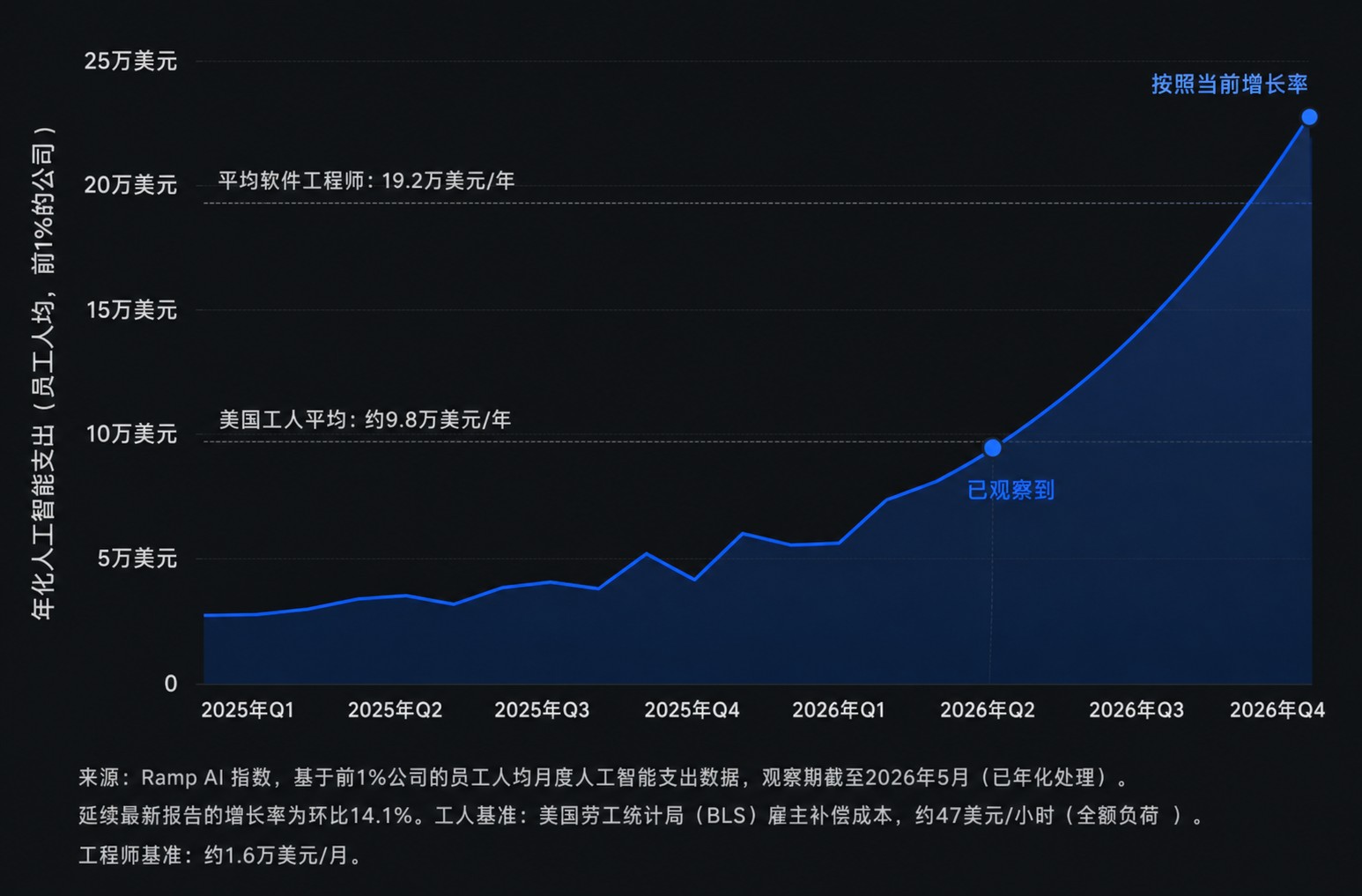
Per capita Token consumption of top enterprises
AI creates more jobs than it eliminates
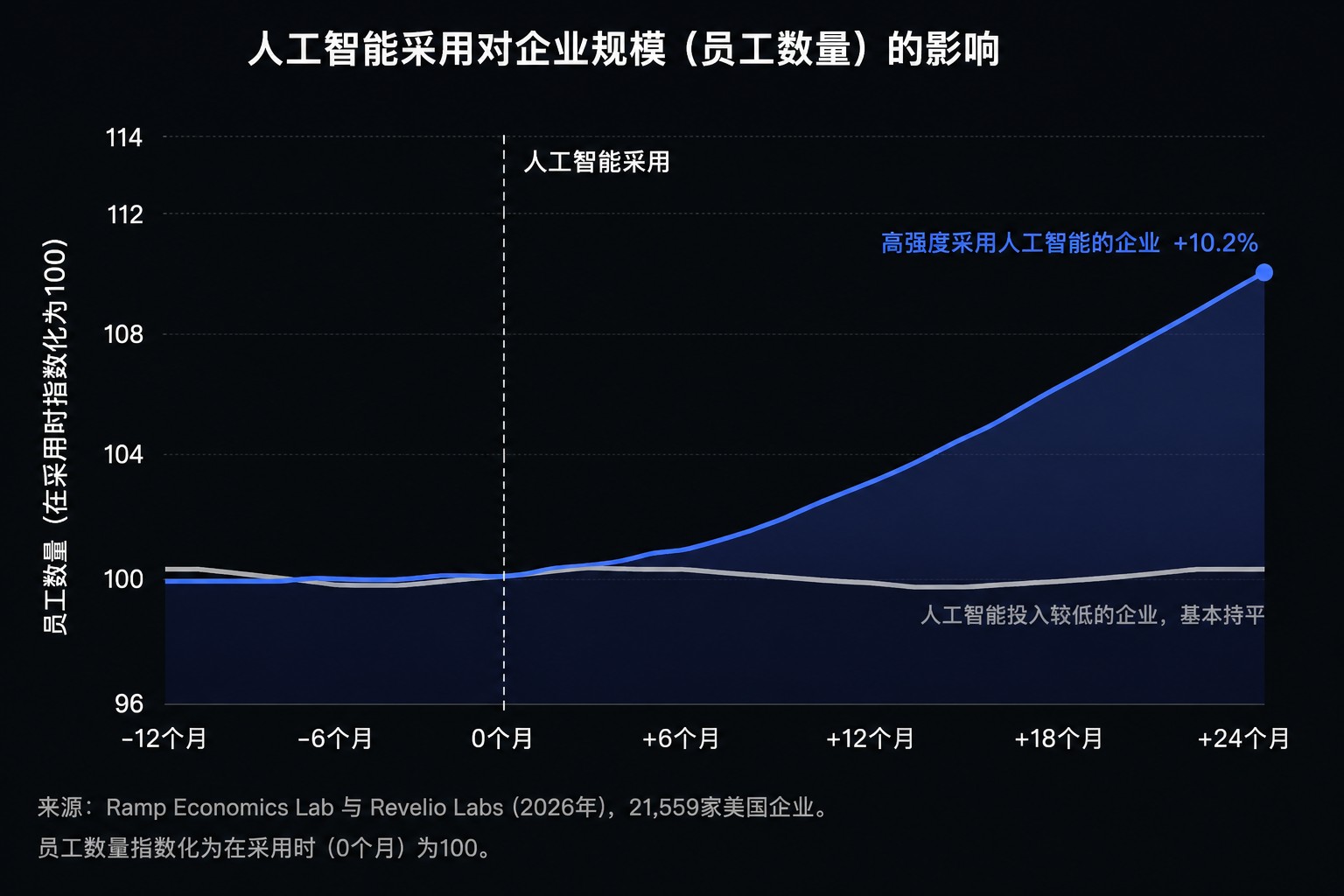
Headcount growth after AI adoption
Technology always solves old problems by creating new ones
In the 1830s, the emergence of railways drove the largest infrastructure construction in the world at that time. The mileage of railways in the United States increased 120 times within ten years.
Then the system collapsed.
On October 5, 1841, due to a simple coordination error, two trains collided on the Western Railroad in Massachusetts, causing a fatal tragedy.
As the complexity of railways increased, the train conductor alone could no longer guarantee driving safety. Therefore, railway companies launched decades of reform: hiring managers in various regions, defining new roles in the organization, and establishing a clear hierarchical system with reporting lines. Modern management science was born from this. Subsequently, railways became the world's first billion-dollar industry, accounting for about 60% of the total market value of the stock market at its peak.
Today, AI is shattering the existing system again.
We have just given every employee — even the least competent ones — unlimited headcount quotas and unlimited budgets.
Managing AI is more difficult than managing humans, because AI will instantly amplify incompetence and disorder. Fortunately, we can learn from history:
Agent teams fail in exactly the same way as human teams.
Understanding the 7 major parallel correspondences between the two will unlock the next trillion-dollar AI value creation.
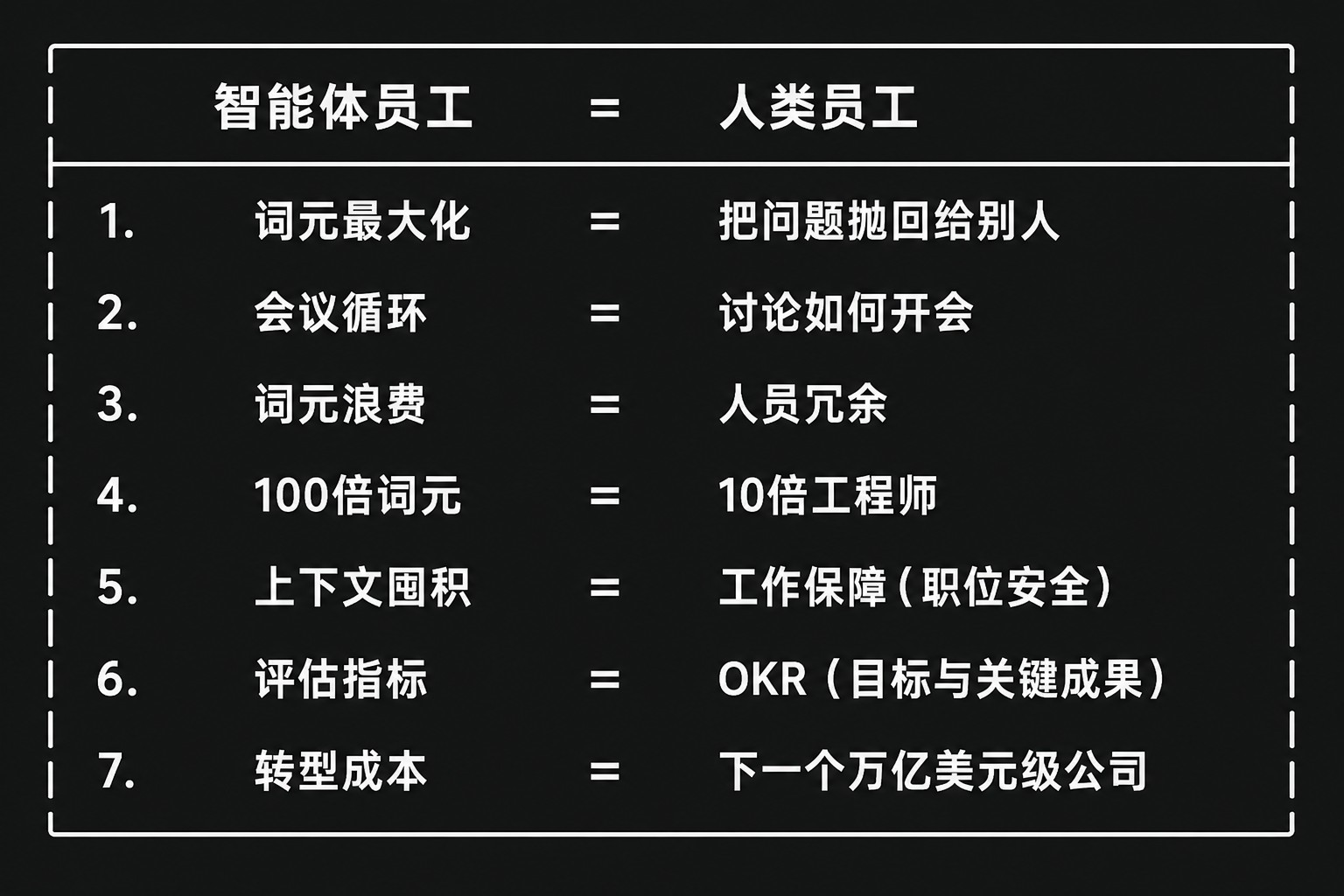
7 Major Parallel Correspondences Between Agents and Human Teams
1. "Tokenmaxxing" is nothing more than the "human sea tactic" in the AI world
The hype cycle of "Tokenmaxxing" ran its entire course in less than a month.
However, how many Tokens are consumed is not the core issue at all.
People are profligate with Tokens because they simply don't know how to use them.
Probably only one out of every 100 employees knows how to provide the correct Context for AI. Very few people can express processes clearly, have the patience to sort out polluted context windows, or even just understand what this concept means.
If you hand over the Agent scheduling framework (Harness) to the remaining 99 people, they will only create endless "Loops".
2. "Loops" are the "formalistic meetings" in the AI world (holding meetings for the sake of holding meetings)
Whether in Claude Code/Cowork, Copilot, Karpathy's Autoresearch, or any scheduling framework, loops are just a band-aid to cover up the fact that "almost no one can write effective Prompts successfully".
Loops are a helpless attempt to make up for human capabilities with brute force. Agents keep calling themselves to correct themselves, simply because humans have not made the task clear from the beginning. Brute force cracking has become the only way for the system to move forward. All this, in the final analysis, stems from the fact that humans did not thoroughly understand the task itself from the very beginning.
You are just consuming Tokens for the sake of consuming Tokens.
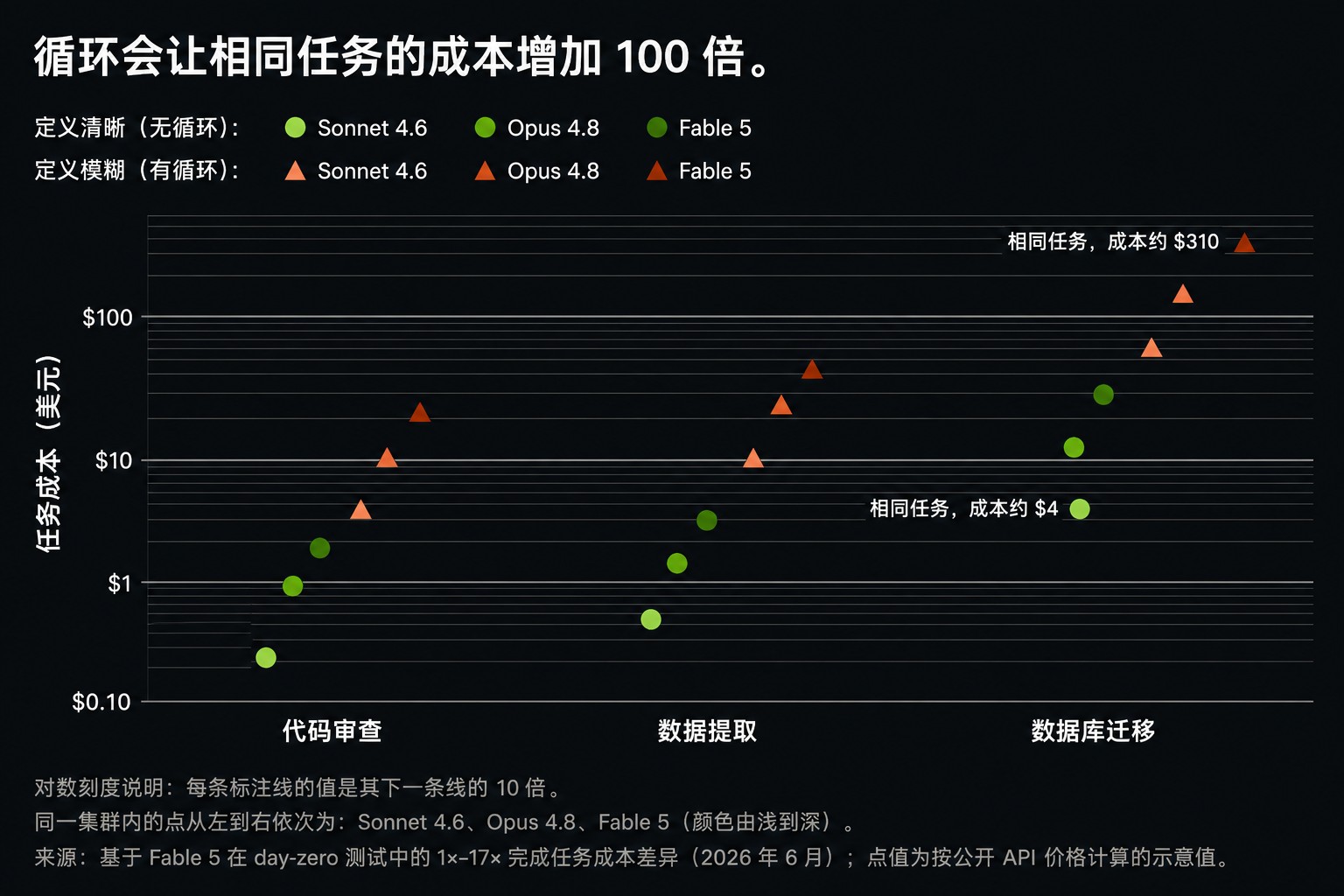
3. Wasted Tokens are the "redundant personnel" in the new era
Most companies today have poor management issues.
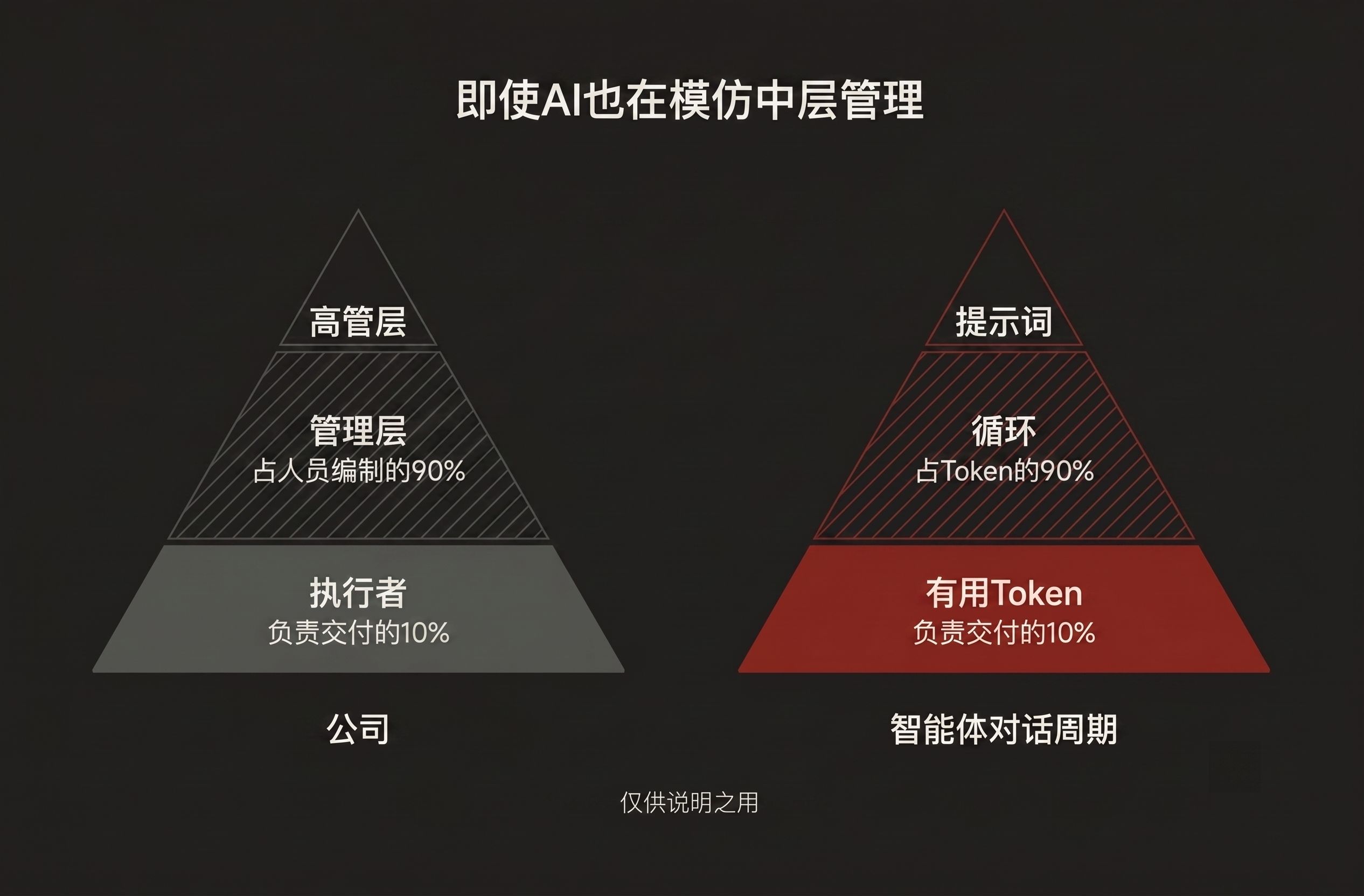
The vast majority of employees do not have a substantial impact on the business at all. They are just gears in a huge machine, stamping and approving at all levels, and recruiting more gears to nourish a machine that "exists for the sake of existing".
They are stuck in endless "loops" all the time.
In most cases, breaking the loop is far more efficient. Elon Musk laid off 80% of the employees of X (formerly Twitter), and the company performed even better. Operating partners in private equity make a living by arbitraging this simple fact.
Just as 80% of employees are idling, 80% of Tokens are useless today.
People recruit more people, Tokens generate more Tokens. Creating loops has become the new era's "clique formation and territory expansion".
4. "100X Token" is the "10X Engineer" of the new era
The old promise of software was: develop once, run permanently at low cost, and without any supervision. AI shattered this promise. When software becomes capable of doing anything, it becomes unable to do any one thing predictably well.
Tokens behave like employees, and once you treat Tokens as employees, all the wonderful promises advertised for AI begin to collapse:
"Tokens are more accurate than humans" — but only if the Prompt is completely correct.
"Tokens are more efficient than humans" — speed means nothing when you have to retry 100 times.
"Tokens don't engage in office politics" — but they will build amazing Token consumption empires.
"Tokens don't quit their jobs" — but they will be completely wiped out when a new model is released or a new session is started.
"Tokens are trustworthy" — yet they can make serious mistakes in a perfectly flawless format.
The only area where AI truly surpasses humans is scalability. Scaling a human team requires huge energy on recruitment, onboarding and staff turnover; while scaling Tokens is done instantly. This is why the cost of poor management is extremely high, and why you must find and scale "100X Tokens".
"10X Engineers" built the previous generation of enterprises, and "100X Tokens" will shape the next generation of enterprises.
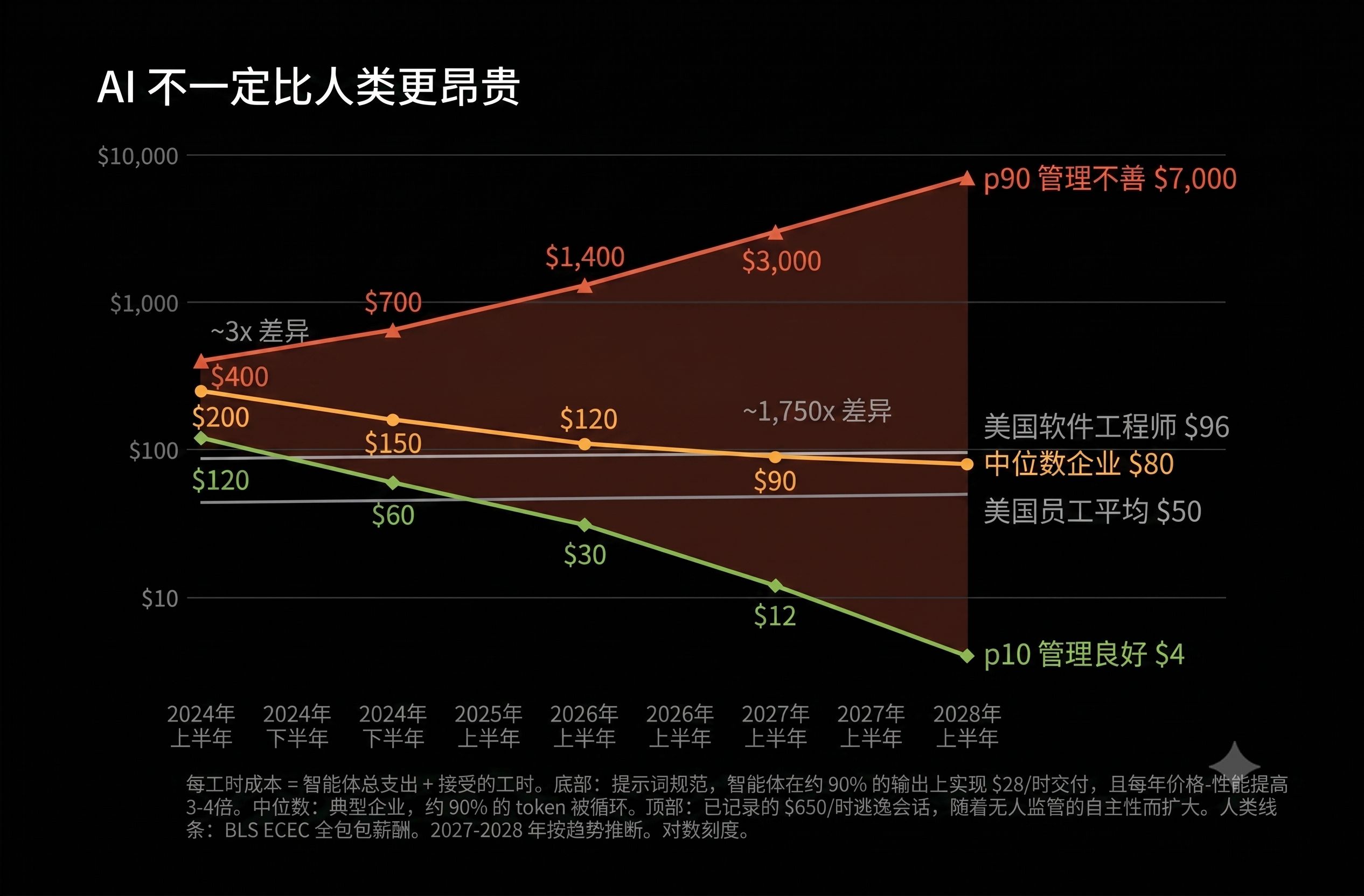
Just as a small number of elite employees can increase the productivity of others by 10 times, providing precise Token context for any specific job can reduce the AI's computing cost by several orders of magnitude. There do exist Tokens that can bring you 100 times leverage efficiency.
On average, human labor is cheaper than Tokens; but in large-scale applications, high-quality Tokens are more cost-effective.
And management is the bridge that transforms the former into the latter.
5. Hoarding "Context (experiential knowledge)" has become the latest workplace strategy to keep one's job
There is a huge "office politics" problem around AI inside enterprises, and this situation will only get worse.
Employees simply do not want to teach their unique secrets to the AI system.
They are beginning to realize that these systems are not just here to assist them or "improve efficiency".
Just look at Meta. Even though employees who hold company stocks have extremely high financial incentives to promote AI implementation, they still flew into a rage when they learned that the company was using employees' internal work records as training data. This is just a tech company... this conflict is just the tip of the iceberg that is about to sweep across all industries.
For centuries, unique tribal knowledge has been the bodyguard for workers to keep their jobs. Medieval guilds kept their technical secrets; AI is the first technology in history that requires employees to hand over all this knowledge at once.
No one wants to cultivate their own substitute for free.
Core employees who master "100X Tokens" lack the most motivation to contribute their secrets. From the perspective of emotion, organizational structure and political games, the current corporate mechanism is naturally inclined to reject this most critical technology for its future.
6. Evaluation (Evals) is the OKR of the new era
The best way to manage a team of Tokens is no different from managing a human team: define what "excellence" is.
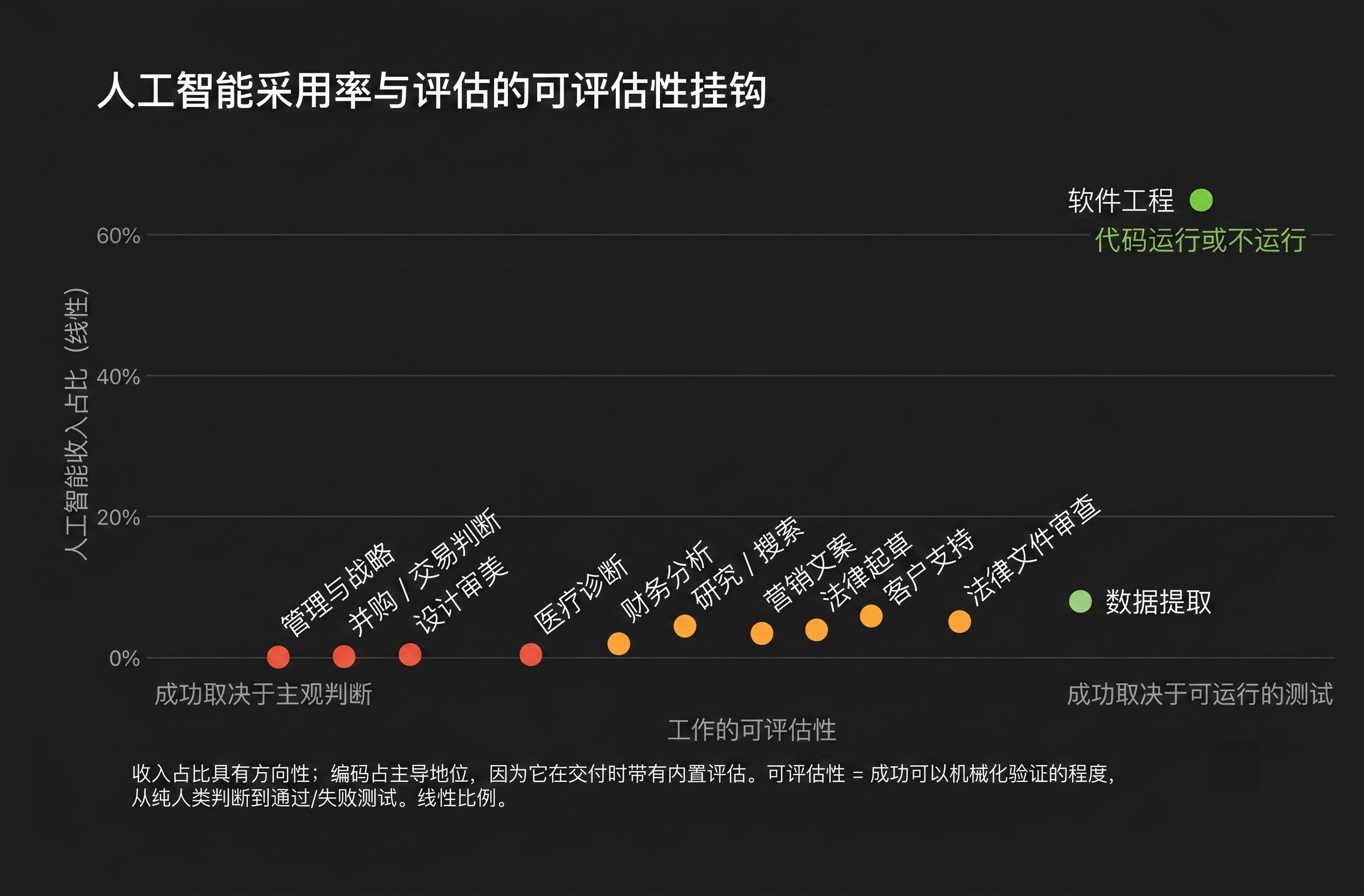
The only AI scenario that broke through political obstacles and achieved explosive application is programming. It expanded the cake and made every engineer better.
Its core mechanism lies in Evaluation (Evals). 99% of AI revenue today comes from programming, precisely because programming comes with its own evaluation criteria — code either works or doesn't.
Wider, cross-domain AI application scenarios will only truly land when someone builds the necessary evaluation criteria. Specific and clear evaluations are far more important than teaching employees to write prompts or providing them with conversation frameworks. With them, AI will devour economic fields that traditional code can never reach.
The essential work of management is to turn vague human workflows into code, and turn qualitative things into quantitative indicators.
An enterprise's Evaluation test suite (Eval suite) will become its most valuable asset.
Just as OKRs are the key to leveraging human teams to achieve the best output, evaluations will be the core to leveraging infinitely scalable Token teams. Evaluation criteria are the inevitable path to running "100X Tokens".
In addition, no two companies have exactly the same evaluation system. Evaluation criteria will become a core competitive advantage. An organization that only uses general evaluation criteria or general agents will have no competitive barriers at all.
7. The next trillion-dollar opportunity is "AI Transformation Service Companies"
For many years, enterprises have been purchasing basic large model prepayments, application layer products, and conducting internal self-development. However, all this hides a cruel truth in business economics:
No one has yet been able to make AI work stably and reliably.
Silicon Valley is so convinced of this status quo that its latest obsession is shorting traditional enterprises today. So-called "Neofirms" or "AI-native service" startups are continuously receiving financing, trying to eat into the $21 trillion service expenditure in the knowledge economy. The logic is: giants trapped in internal politics and outdated processes can never complete this transformation on their own.
Neofirms may indeed bring competitive pressure, forcing "Tradfirms" to accelerate AI adoption. However, the most core AI assets are still in the hands of traditional giants: those proven and differentiated business processes, as well as distribution networks that can be directly scaled and reused through existing channels.
In fact, the next batch of giant companies will not live off existing service expenditures, but will sell a new type of service to existing big players:
"AI Transformation Service Companies" will be 10 times larger than any Neofirm.
"Transformation" sounds like a one-off project, but there is a "Jevons paradox" here: every time an organization adopts an application scenario, ten new scenarios will be derived. The more AI-enabled an enterprise is, the greater its demand for transformation, and the frontier of technical possibilities is being updated every day. Continuous AI transformation and upgrading will become the only way to participate in market competition.
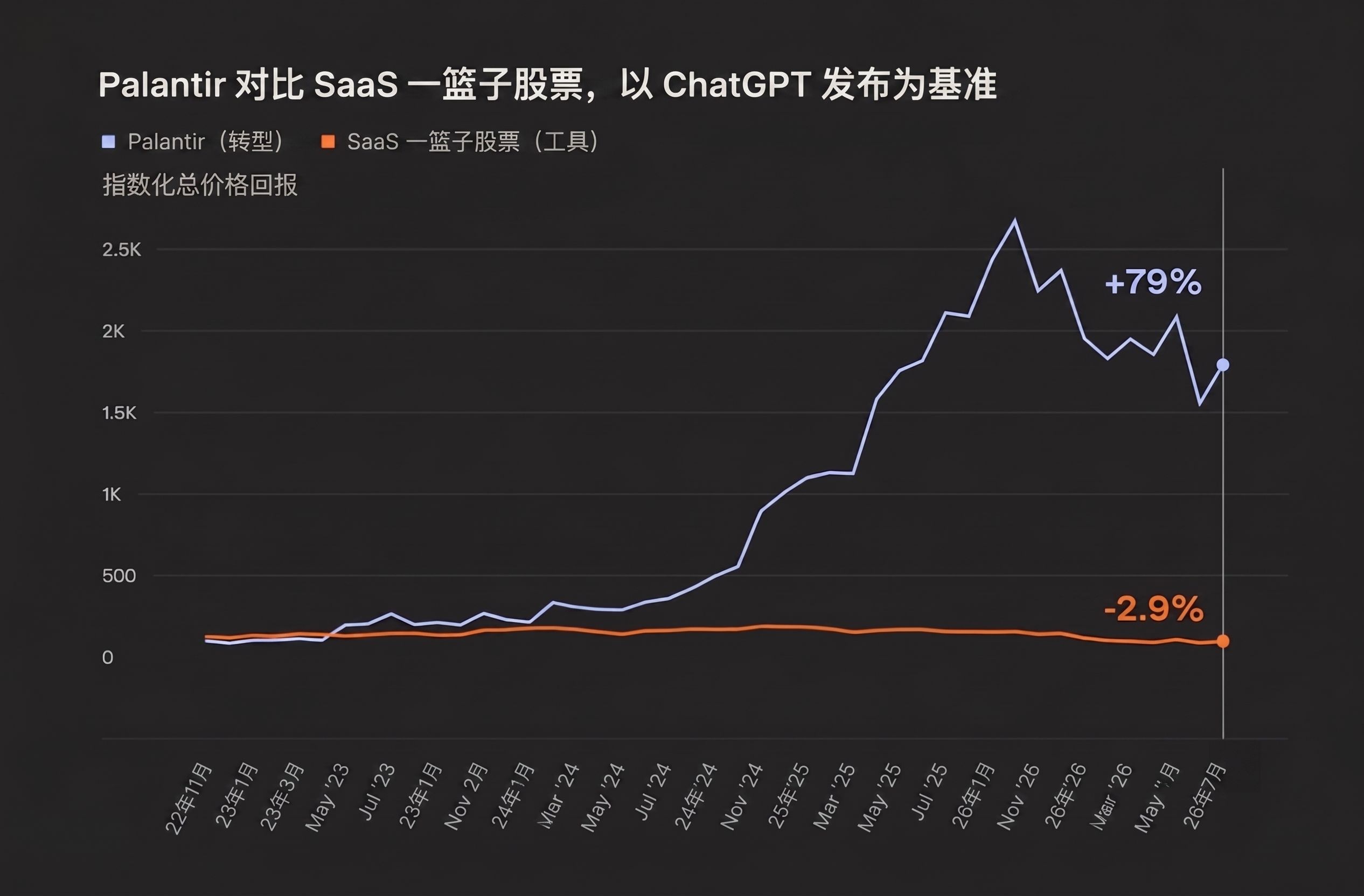
Take Palantir as an example. On paper, it is the company in the software industry that is most vulnerable to subversion by models like Claude: a behemoth with a market value of hundreds of billions of dollars that relies on handwritten code to customize applications for enterprises. According to the logic that has made the SaaS industry almost worthless for investment, $PLTR (Palantir) should have gone to zero long before $NOW (ServiceNow) collapsed.
But it didn't, because what Palantir sells has never been software — it sells "transformation services".
But in the new "AI-first" era, transformation services themselves are no longer what Palantir used to do, such as ontology construction, custom software, or writing a few rare custom prompts. The real hard-core work is to build evaluation criteria, streamline Token consumption, and understand the business so deeply that it can be reprogrammed with code.
Encoding the unique details and subtleties of each company into agents will be the most grand economic task in the next decade.
It's Time to Reshape Management
Every stage of the AI wave has its iconic cliché.
During the gold rush, we were told to sell shovels, so we frantically built infrastructure; later, we were told to sell "Service-as-a-Software", so we poured money into building Neofirms. But now, the infrastructure is sufficient, and there are enough services. The next core task is: make the trains run on time.
It's time to take