The most bustling week for China's robotics industry saw capital outpace orders.
In the early hours of July 23 Beijing time, Elon Musk raised the most practical challenge for the humanoid robotics industry during Tesla's Q2 earnings call: many online demonstrations rely on pre-programmed scripts or background teleoperation. To this day, there is still no humanoid robot that can independently complete various daily tasks using only a single verbal command or visual instruction.
In the same week, China's robotics industry saw a wave of concentrated developments. From July 23 to 24, Agibot Innovation announced its plan to list in Hong Kong. Wang Xingxing, founder of Unitree Robotics, and the manned mech GD01 made the cover of Time magazine. XPeng Iron launched small-batch trial production in Guangzhou, and the ExRobotics T800 also rolled off the production line in Zhengzhou.
Capital, public attention, and manufacturing momentum are all heating up simultaneously, yet the problem raised by Musk persists. The global robotics industry is going through a special phase: industrialization is advancing rapidly, while autonomous intelligence still needs to catch up.
01. Agibot's Hong Kong IPO: Valuation Disputes Come to the Forefront
On July 24, Agibot Innovation officially confirmed its launch of a Hong Kong IPO, and on the same day, the company changed its short name from "Agibot Robotics" to "Agibot Innovation", with CITIC Securities acting as the sponsoring broker.
What draws more attention now is at what valuation this IPO will proceed. Earlier, an investor told *Caijing* that the target range is HK$40 billion to HK$50 billion, and the company once internally aimed to reach HK$80 billion. Almost simultaneously, other market sources put forward a valuation of about US$20 billion, which translates to two to three times higher than the previous figure when converted to Hong Kong dollars.
The prospectus has not been submitted yet, so it is impossible to tell for now which figure is closer to the final plan. The valuation divergence itself shows that the market is not only focused on Agibot's growth rate but also re-evaluating the pricing model for a robotics platform company. By removing the word "robotics" after the name change, Agibot also made it clear that it does not want the market to view it solely through the lens of a robotics firm.
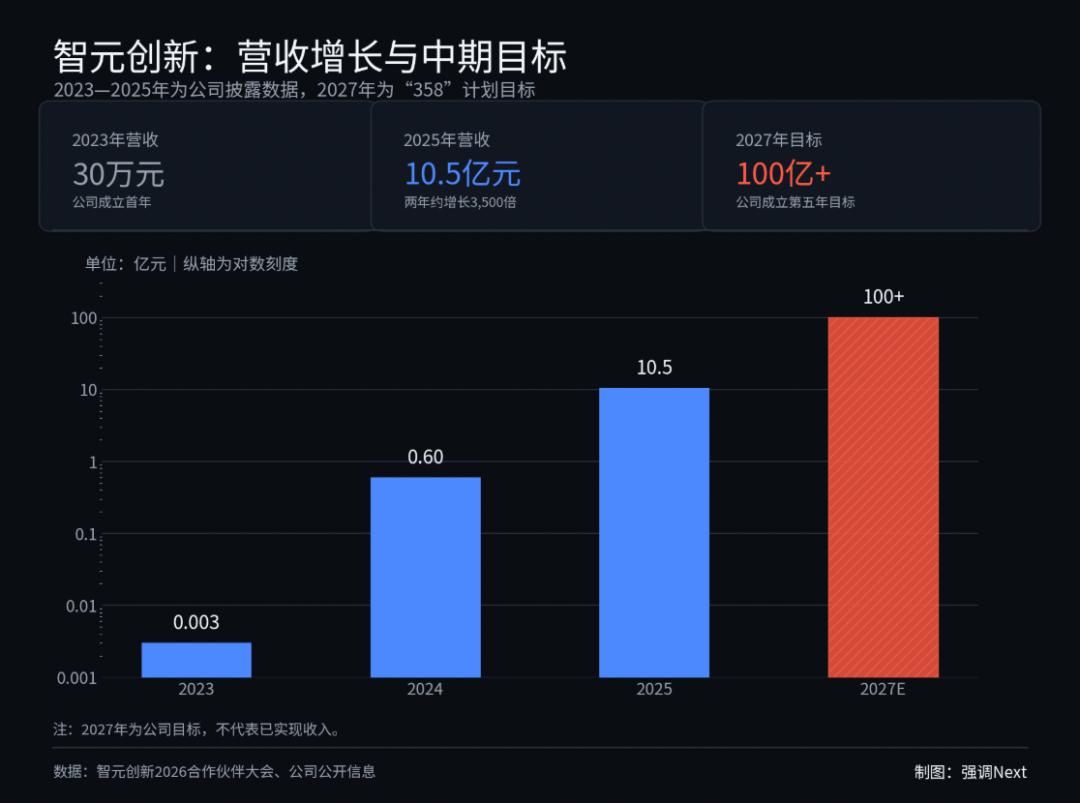
The verifiable data lies in its growth curve. Deng Taihua, founder and CEO of Agibot, calculated the figures at a partner conference: the company generated revenue of 300,000 yuan in its first year, over 60 million yuan in the second year, and exceeded 1 billion yuan for the first time last year (2025). Under the "358" plan, its 2027 target is to reach 10 billion yuan in revenue.
The shipment pace is also accelerating. When Agibot was founded in 2023, it only had 6 prototype units. In March 2026, its mass production volume exceeded 10,000 units, and by June, the 15,000th general-purpose embodied robot rolled off the production line, adding another 5,000 units in less than 3 months. However, the "15,000 units" figure uses a broad definition, covering various forms such as wheeled robots and semi-humanoid robots.
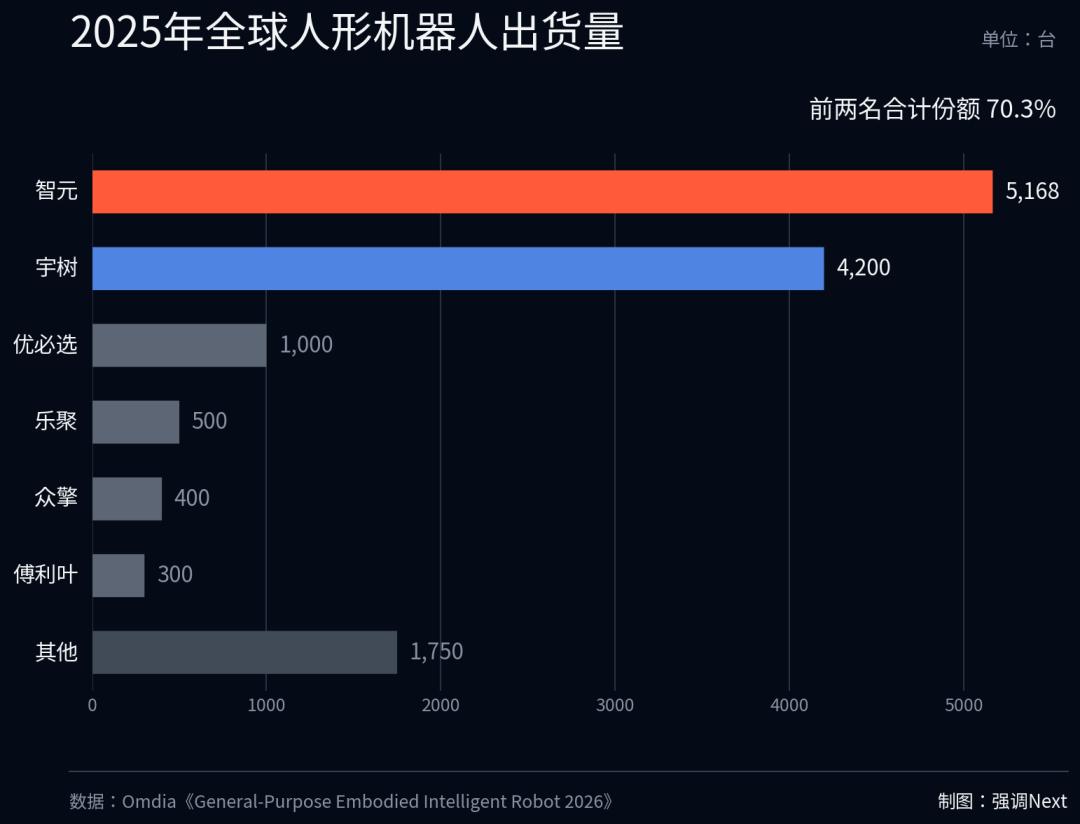
If we only look at the "general-purpose humanoid robots" counted by Omdia, shipments exceeded 5,100 units in 2025, accounting for about 39% of the global market share and ranking first worldwide.
Agibot's capital layout is also advancing rapidly. In July 2025, the company acquired over 63.62% of the shares in Sino Composite through a shareholding platform, completed the share reform in November, and is now pushing forward the Hong Kong stock IPO.
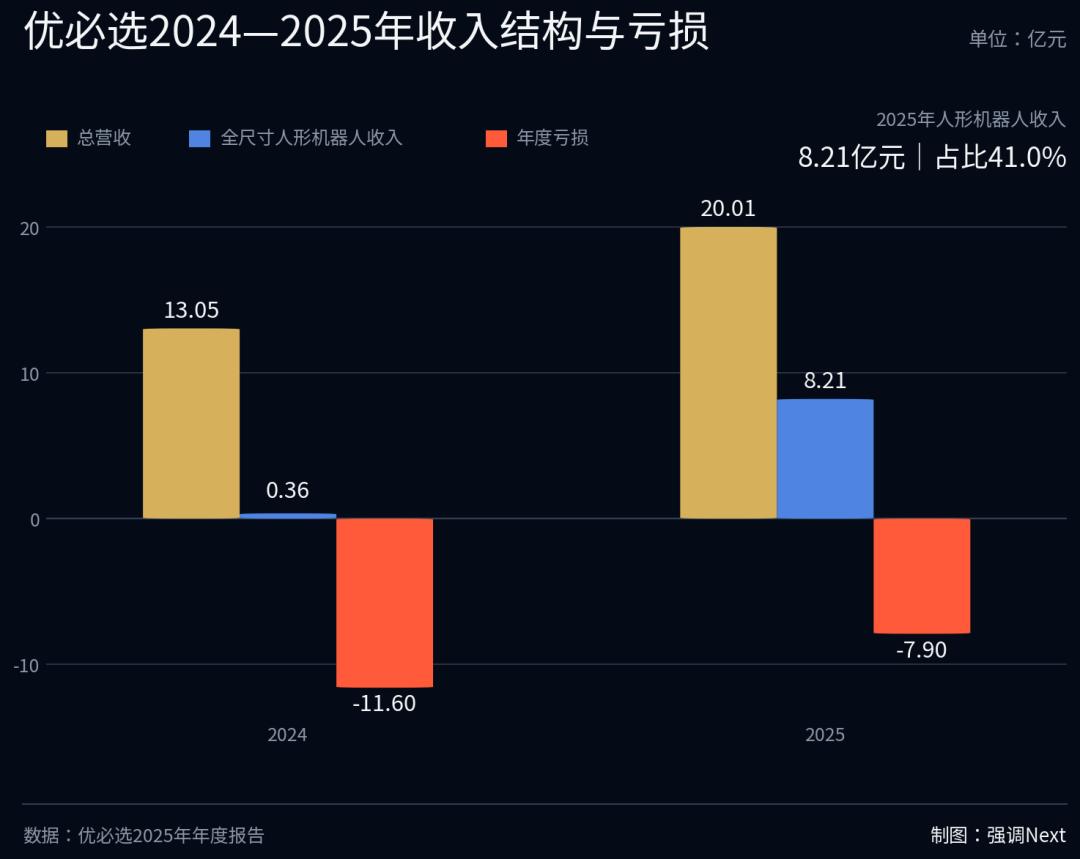
Using UBTECH as a reference, its market capitalization is about HK$39.6 billion (as of July 24), with 2025 revenue of 2.001 billion yuan, corresponding to a price-to-sales ratio of about 17 times. If Agibot is valued at HK$40 billion to HK$50 billion, its price-to-sales ratio would be around 33 to 41 times. If the valuation is US$20 billion, this multiple would rise significantly.
Whether this high valuation is justifiable depends on whether the public market is willing to pay a premium for Agibot's supply chain integration capabilities, industrial investments, and platform strengths. This can only be judged after the prospectus discloses more financial details.
02. Wang Xingxing on the Cover: Autonomous Capabilities Remain Unproven
On July 23, Wang Xingxing and his company's manned mech GD01 appeared on the cover of Time magazine, with the headline "The Robot Age Has Arrived". The last time a Chinese entrepreneur appeared on the cover of this magazine was 8 years ago, when Robin Li was featured.
In fact, Unitree and Wang Xingxing have been included in Time's annual rankings three times in 2025: they were selected to the Time 100 AI list, the Time 100 Most Influential Companies list, and the Unitree R1 was named one of Time's Best Inventions of the year.
The Time report also mentioned two details. First, there are currently over 140 companies in China developing humanoid robots. Second, industry insiders generally believe that what Unitree truly aims to replicate is the successful model that BYD implemented in electric vehicles and DJI in drones: turn hardware into a platform, rather than just manufacturing a single robot.
The GD01 itself is the world's first mass-produced manned mech, unveiled on May 12. It weighs about half a ton, with a starting price of 3.9 million yuan. Users need to sit inside the body to control it for movement. Its core positioning is closer to a manned equipment and hardware platform, and autonomous decision-making is not the main selling point of the current product.
The World Artificial Intelligence Conference held from July 17 to 20 also showed a similar contrast. This year, the number of exhibitors in the embodied intelligence zone increased from over 80 last year to more than 200, with 208 terminals and over 300 real robots displayed on site. There are more products and a more lively atmosphere, yet developers remain cautious about large-scale implementation. The robot dog dance, combat, and mech demonstrations are still far from being able to stably complete production tasks.
Musk's judgment has thus drawn widespread attention: robots can already perform complex actions, but they still cannot understand open environments the way humans do. Previously, Figure AI claimed that three robots sorted over 40,000 packages autonomously for 33 consecutive hours, which was also questioned for involving remote control operations.
On the first trading day after Tesla's earnings call, its stock price experienced the largest single-day drop in a year, as Wall Street is waiting for Optimus and Robotaxi to prove their business progress. Musk also admitted that expanding Optimus' production scale is more difficult than expected.
However, the industry is not standing still. Focusing on data scale and specific application scenarios, companies are setting clearer targets.
Yao Maoqing, a partner at Agibot, estimates that physical AI will need about 100 million hours of real-world data to reach its "GPT moment", and obvious "emergent capabilities" may appear by the end of 2027. Unitree has released the UnifoLM-OminiA-0.3 model, attempting to enable the G1 to independently complete tasks such as fetching medicine, folding clothes, and washing dishes in elderly care scenarios.
This means that autonomous capabilities have not yet been fully solved, but verification is gradually moving from stage demonstrations to real specific scenarios.
03. XPeng and ExRobotics: First Deploy in Controlled Scenarios
On July 24, XPeng Iron launched small-batch trial production at its Guangzhou factory, with the mass production line entering the final joint debugging phase. The ExRobotics T800 also completed its first batch of rollout in Zhengzhou. Both companies have chosen to start verifying their products from their own familiar scenarios.
At XPeng, He Xiaopeng issued an internal letter on June 10, announcing that he would personally take on the role of CEO of the robotics business, and compared the current stage to the eve of the XPeng G3 mass delivery 8 years ago.
According to the plan, Iron's monthly production capacity target will exceed 1,000 units by the end of this year, with a planned annual shipment of about 5,500 units. XPeng has signed an agreement with Tianhe District, Guangzhou, to build an 110,000-square-meter mass production base. Baosteel has also officially announced that it will become an ecological partner, and Iron will be deployed in Baosteel for inspection tasks in the future.
However, in the first quarter of 2027, Iron's first job will still be to return to XPeng's own stores, taking on the roles of shopping guide and product explainer. As planned, the product will start going overseas in the second half of 2027, and will not be available to ordinary consumers until 2028.
This arrangement has its practical considerations. The store environment is relatively fixed, the task boundaries are clear, and it is easy to control trial-and-error costs. XPeng can first use its own scenarios to train products and accumulate data, before gradually moving into the production environments of external customers.
The same logic can also be applied to analyzing Tesla. The Q2 2026 earnings report shows that the production line at the Fremont factory originally used to make Model S and Model X has been transformed into a dedicated Optimus production line, with a planned annual capacity of 1 million units. Musk confirmed on July 1 that the production line is ready. The second production line at the Texas factory is expected to be put into operation in the summer of 2027, with a long-term designed annual capacity of 10 million units.
Automakers can indeed transfer their capabilities in batteries, motors, supply chain management, and large-scale manufacturing to the robotics business, but the reuse of the manufacturing system does not mean that the autonomous capabilities of robots will mature simultaneously. These two capability curves still need to be advanced separately.
ExRobotics is taking a different path. Its Zhengzhou base is close to Zhengzhou East Railway Station, an area once known as "Apple City" due to Foxconn's iPhone assembly plant. Now, Henan Investment Group, together with Zhengzhou Industrial Investment, Zhengzhou High-Tech Industrial Investment, and Luoyang Industrial Control Group, has made a strategic investment in ExRobotics, placing the global production, R&D, and manufacturing center here. Embodied intelligence has also been included in Henan's "15th Five-Year Plan".
ExRobotics' Honghualing base in Shenzhen has already been put into use, capable of rolling out one robot every 15 minutes. The first phase of the Zhengzhou base has a planned annual output of 5,000 units, and the second phase plans to expand to 10,000 units per year. ExRobotics has set its target for 2027 to 2028 as an annual output of 30,000 to 50,000 units.
The T800 is 1.73 meters tall, with a starting price of 180,000 yuan. It is also the designated model for the Global Humanoid Robot Free Combat League, and ExRobotics itself hosted the first global tournament of this event.
One company chose retail stores, the other chose combat arenas and transportation scenarios. Different paths, but similar ideas: first enter scenarios with clear task boundaries and complete feedback chains to verify product capabilities, then gradually expand the scope of application.
04. 13,000 Orders: The Key Lies in Conversion Rate
When judging the commercialization progress of robots, a more direct indicator than valuation is order quality.
On June 30, UBTECH launched the UBTECH U1 series, priced from 119,800 yuan to 990,000 yuan, focusing on emotional companionship. Founder Zhou Jian announced that omnichannel orders have exceeded 13,361 units, and the company will strive to complete delivery within the year.
However, most of these orders are currently pre-orders with a 3,000-yuan refundable deposit, so the final conversion rate remains to be seen. The product's 2 to 4 hours of battery life, walking smoothness, and interaction effects have also sparked market discussions.
UBTECH's financial pressure has not been relieved. From 2020 to 2025, the company recorded losses for six consecutive years, with a cumulative loss of over 5.6 billion yuan. Its net operating cash flow in 2025 was negative 784 million yuan.
After Unitree's IPO progress was announced, UBTECH's stock price once experienced a noticeable pullback. The market is worried that Unitree's listing will weaken the scarcity of UBTECH as "the only humanoid robotics stock on the Hong Kong stock market".
A similar concept diffusion has also emerged in the A-share market. Companies including Changshu Bearing, Riying Electronics, and Zhongzhong Technology subsequently issued announcements stating that their revenue related to embodied intelligence business accounts for less than 1%, and some companies have not even generated any revenue from it.
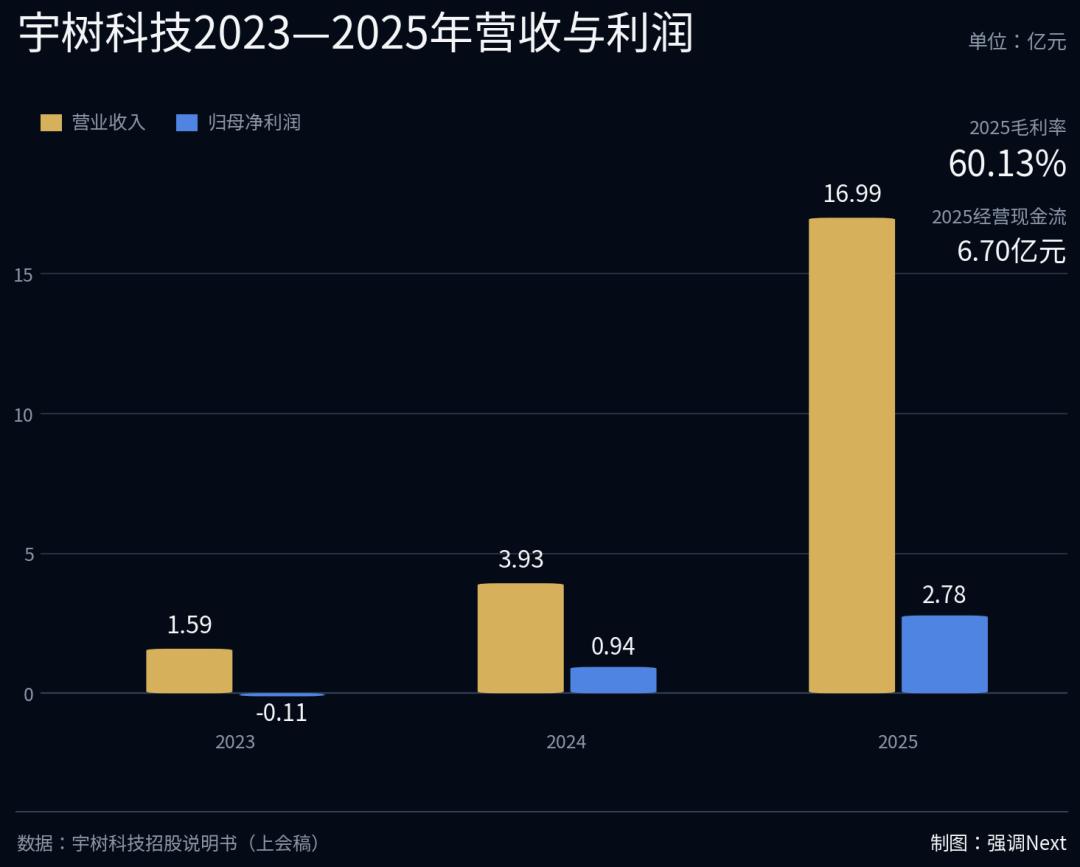
These facts show that robotics enthusiasm is spreading to the capital market, but what ultimately determines valuation is order conversion rate, gross margin, cash flow, and repeat purchases. As a leading player in the industry, Unitree has become a reference benchmark for the entire sector.
05. From Large One-Time Orders to Sustained Repeat Purchases
Genuine market demand is also emerging.
In April this year, the State Grid Corporation of China internally issued the "2026 Embodied Intelligence Development Plan", planning to procure about 8,500 embodied intelligent devices within the year, with a total investment of about 68 billion yuan, covering power inspection, live-line operations, emergency rescue, and warehousing logistics. Suppliers include Deep Robotics, Unitree, Agibot, UBTECH, and Fourier Intelligence.
This is one of the largest publicly reported embodied intelligence procurement plans. However, tasks like power inspection still belong to scenarios with fixed environments and clear boundaries, and the orders also carry the attributes of central SOE demonstration procurement and industrial policy support. The over 20 billion yuan of procurement agreements reached during the World Artificial Intelligence Conference are also mostly letters of intent, and their actual performance will depend on formal contracts, delivery, and payment collection in the follow-up.
Data disclosed by the Ministry of Industry and Information Technology shows that in the first half of this year, China's share of the global four-legged robot sales market is close to 70%. More than 400 humanoid robot complete products have been launched, accounting for over half of the global total. The annual output of complete robots is expected to exceed 100,000 units for the first time.
