5-yuan dumpling stalls and 4-yuan noodle restaurants, a group of low-cost catering businesses have gone viral. Can they actually make money?
Low-price dining options are becoming increasingly common, yet only a handful of them are actually profitable.
15 dumplings for 5 yuan, a bowl of noodles for 4 yuan — restaurants with such incredibly low prices have even popped up in first-tier cities.
Earlier this year, a restaurant in Guangzhou suddenly went viral. Its name was straightforward: "5-Yuan Dumplings & 4-Yuan Noodles Shop". What it sold and the prices were crystal clear, seemingly rolling food prices back to the 1990s.
The owner of this shop recently opened a new location, "8-Yuan Pork Knuckle Rice", which also serves free daily soup. Many netizens joked that his business model is "getting more and more outrageous". Meanwhile, numerous similar low-priced restaurants have sprung up across the country, such as 6-yuan chicken leg rice and 5-yuan oil-sprayed noodles.
With prices this low, can these businesses really make money?
The 5-Yuan Dumpling Craze: A Wave of Low-Price Restaurants Engages in Cutthroat Competition
"5-Yuan Dumplings & 4-Yuan Noodles Shop" is tucked in a narrow alley in the Dongpu urban village of Guangzhou. The shop is small, with only six tables in total, and a limited number of SKUs. The menu covers just three categories: dumplings, noodles, and braised dishes. Among them, 15 dumplings cost 5 yuan, and fresh raw dumplings are available for takeout at 10 yuan for 40 pieces; there are 7 noodle SKUs, with the cheapest green vegetable noodles at only 4 yuan, and the most expensive "Gao Qiqiang Pork Knuckle Noodles" priced at just 9 yuan; braised dishes include marinated eggs, dried tofu, and braised chicken legs, ranging from 1.5 yuan to 6 yuan.
The stark contrast between a first-tier city setting and single-digit pricing turned this tiny shop into an internet sensation overnight, attracting countless consumers who came to check it out. At the peak of its popularity, the dumplings were sold out as early as 7 p.m.
Now, several months have passed since "5-Yuan Dumplings & 4-Yuan Noodles Shop" rose to fame, and the store has seen some new changes.
At 3:30 p.m. on a weekday, Red-Car Network navigated through the winding alleys of the urban village to reach the shop. At that moment, four or five customers were dining, and only one aunt was busy in the kitchen. "Foot traffic has slowed down a bit now. Our daily revenue is around 1,500 yuan, and at the peak, we could make over 3,000 yuan a day," admitted shop owner Zhang Kun. He is well aware that viral traffic comes and goes quickly, eventually settling back to a normal level.
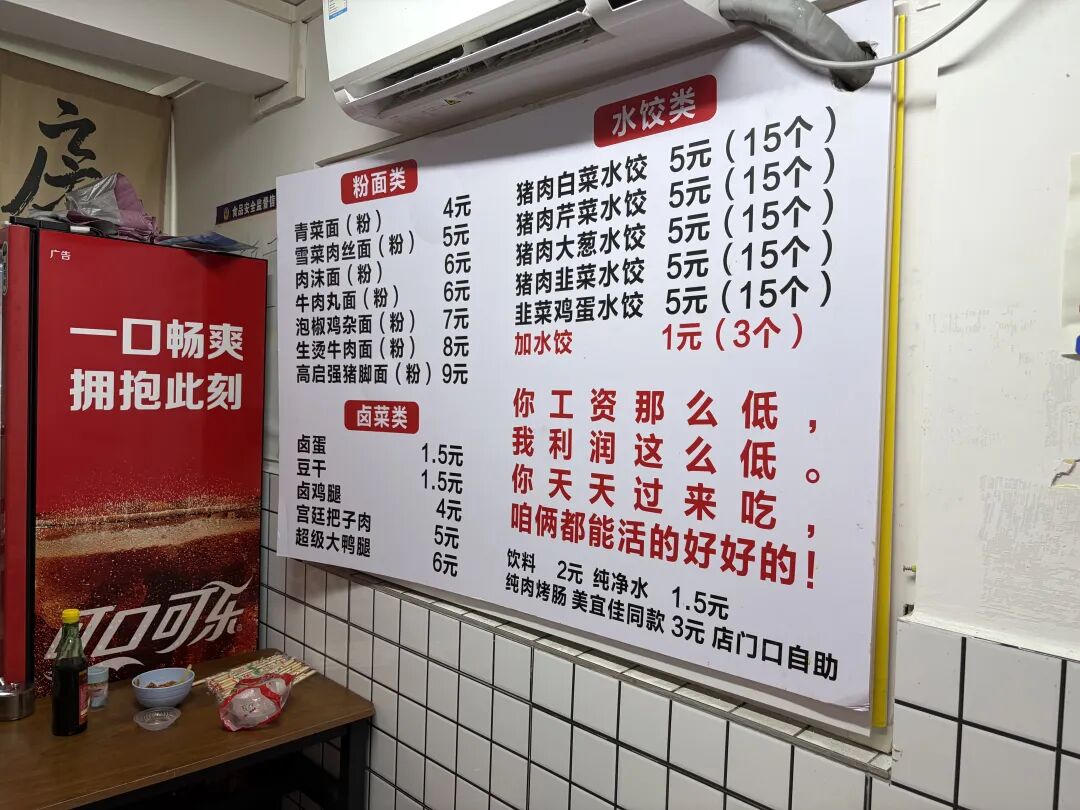
△ The menu of "5-Yuan Dumplings & 4-Yuan Noodles Shop"; Image source: Photo by Red-Car Network
According to Zhang Kun, the small shop is operating relatively stably at present, but he is not content to rest on his laurels. He has opened a new "8-Yuan Pork Knuckle Rice" shop 1 kilometer away from the old one, near a main road. In his view, dumplings take a long time to serve and are less popular in the local market than braised food and roasted meat dishes. Pork knuckle rice, on the other hand, can be served quickly and has a solid consumer base in Guangdong, making it his second choice.
Compared to "5-Yuan Dumplings & 4-Yuan Noodles Shop", the "8-Yuan Pork Knuckle Rice" store is slightly more "upscale". It has eight four-person tables inside, with simple decorations including LED light strips and wall stickers. In terms of dishes, in addition to the signature pork knuckle rice, it adds common Guangdong fast food items like roasted duck, barbecued pork, and poached chicken, plus three soup options, all priced at single-digit amounts.
However, the new store has only been open for half a month, and its operational model and dish structure are still being adjusted. Zhang Kun remains highly confident and plans to expand further once the model is fully refined.
Meanwhile, Red-Car Network has observed that under the influence of "5-Yuan Dumplings & 4-Yuan Noodles Shop", a wave of "X-Yuan X-Dish" low-priced restaurants has begun to spread across the country.
Right across from the Guangzhou shop, the owner of a roasted meat store converted his space into a special-price fast food restaurant, with items like salt-baked chicken rice, hand-shredded chicken rice, and salt-baked drumstick rice priced between 6 yuan and 8 yuan. In the Tangdong urban village of Tianhe District, Guangzhou, a "6-Yuan Chicken Leg Rice" shop has appeared, where 6 yuan gets you a chicken leg, fried egg, seasonal vegetables, and rice. The owner mentioned in some food exploration videos that he can sell at least 4 large pots of braised chicken legs a day.
In Xi'an, Shaanxi Province, a noodle shop followed suit and opened a "6-Yuan Oil-Sprayed Noodles" restaurant. According to reports from Shaanxi City Express, this shop was directly inspired by the Guangzhou "5-Yuan Dumplings & 4-Yuan Noodles Shop", and after it went viral online, two or three nearby stores also converted to sell "5-Yuan Oil-Sprayed Noodles".
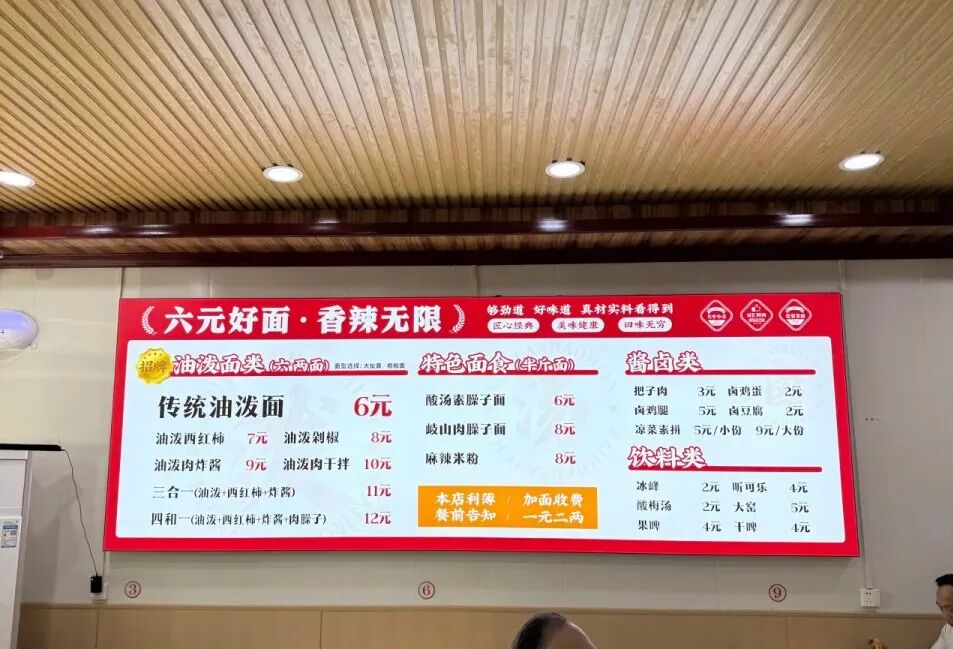
△ The menu of "6-Yuan Oil-Sprayed Noodles"; Image source: Xiaohongshu screenshot
In Zhenjiang, Jiangsu Province, a consumer named Xiao Lan told Red-Car Network that a "5-Yuan Dumplings & 4-Yuan Noodles" shop opened locally in April this year, shortly after the original Guangzhou store went viral, with products almost completely replicated. "This shop does decent business, but it has never been fully packed." From Xiao Lan's observation, the store is run solely by the owner. The taste is just ordinary home-style, but it's well worth the price.
In addition, Red-Car Network's searches on Dianping show that similar low-priced dining establishments have appeared in cities including Shenzhen, Guilin, Wuhan, Huizhou, and Hangzhou, many marked as "newly opened". The trend of low-price dining is spreading rapidly.
How on Earth Do They Make Money at Such Ultra-Low Prices?
Like many entrepreneurs, Zhang Kun had no prior experience in the catering industry and was a complete novice. But his logic for entering the market was clear: "I set my own criteria: high gross margin, high frequency of consumption, essential need, and low spending. After filtering through these, only the catering industry fits best." Since he had no chef experience and needed to ensure consistent food quality, he finally settled on dumplings and noodles as his core categories.
Zhang Kun told Red-Car Network that the initial investment for "5-Yuan Dumplings & 4-Yuan Noodles" was not large. He deliberately chose a store with basic renovations already in place, which saved costs on hard decorations like walls and floors. He only needed to add tables and chairs, do simple decorations, and purchase kitchen equipment such as stoves, freezers, and tableware. All in all, the total store setup cost was only about 10,000 yuan.
But once the store opened, profitability became the ultimate goal. According to Red-Car Big Data, as of the first quarter of 2026, the average per-person consumption in the catering industry was 32.9 yuan, while the customer unit price of these low-priced restaurants is only single-digit, less than one-fifth of that level. With prices this low, to make money, costs must also be kept extremely low.
The three major cost burdens in catering are ingredients, rent, and labor. The profit margin of "5-Yuan Dumplings & 4-Yuan Noodles Shop" is squeezed out bit by bit from these three aspects.
In terms of ingredients, Zhang Kun said, all the dumplings in the shop are purchased through KuaiLv, a supply chain channel under Meituan. Leveraging the price advantage of large-scale procurement from the platform, the cost of frozen dumplings is kept very low. Even with the "5 yuan for 15 dumplings" pricing, the store is still profitable, with a gross margin of 66%. The chicken legs and duck legs in the shop mostly use cost-effective frozen ingredients as well.
For the pork knuckles and pork belly in "8-Yuan Pork Knuckle Rice", fresh ingredients are used — a choice made after careful consideration. On one hand, the purchase price of fresh pork knuckles in the market is actually cheaper than frozen ones; on the other hand, there are limitations in the supply side. "For example, pork belly should ideally be three parts fat to seven parts lean, but the quality provided by the platform cannot meet this standard, so we go to the market to buy fresh ingredients every day. We would rather earn a little less, but ensure the quality."
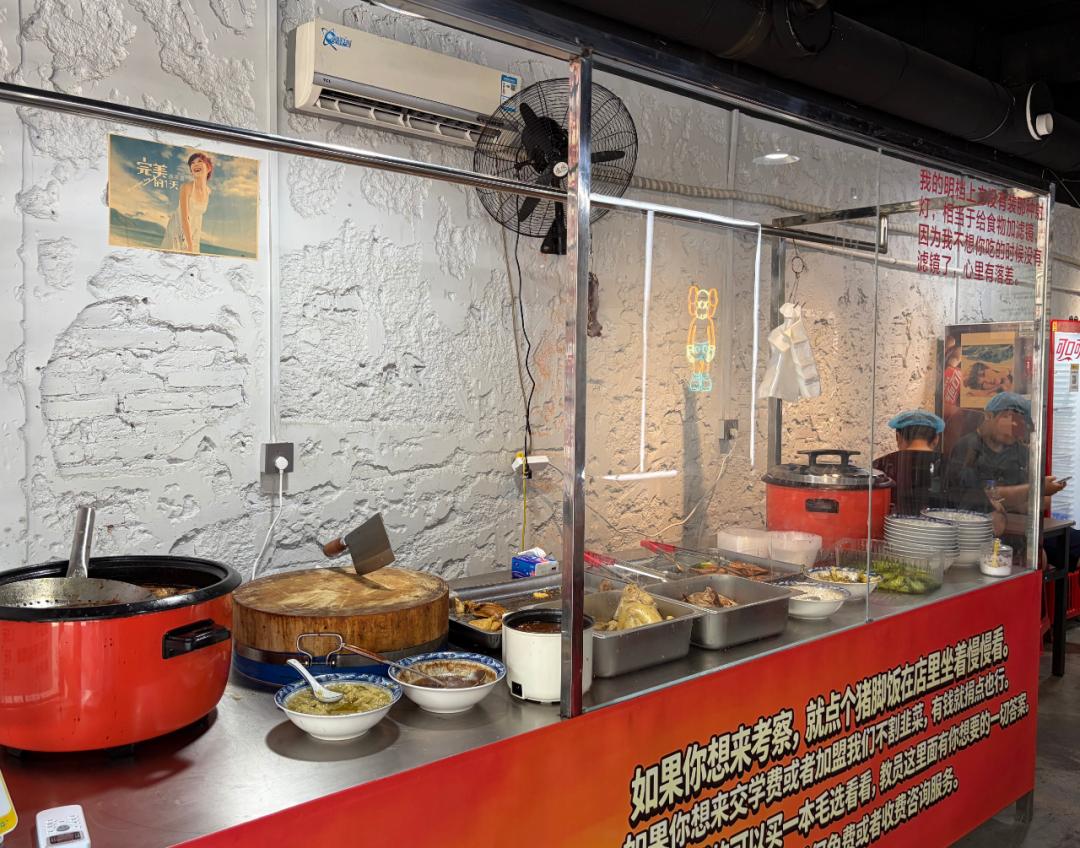
△ Image source: Photo by Red-Car Network
Next is rent, a fixed unavoidable expense. Many restaurant owners have joked that "every day when you open your eyes, you are working for the landlord".
In contrast, the rent pressure for "5-Yuan Dumplings & 4-Yuan Noodles Shop" is much smaller. The shop is located in an alley of the urban village, with a monthly rent of only 2,000 yuan, roughly 70 yuan per day. Calculated at a net profit of 2 yuan per serving, the shop only needs to sell over 30 servings of dumplings a day to cover the rent.
The owner of the Xi'an "6-Yuan Oil-Sprayed Noodles" shop also mentioned in a live stream that his store is in a relatively remote location, outside the West Third Ring Road, with low rent. The monthly rent for a 100-square-meter space is about 4,000 yuan, while the daily revenue can reach around 6,000 yuan. Rent accounts for a low proportion of revenue, leaving considerable profit space for low-price operations.
Finally, there is labor cost. In the early days of opening, Zhang Kun saved as much as possible. "At the beginning, I was the only one in the shop. Later, my mother came to help, so there was almost no extra labor cost."
As customer flow gradually increased, he began to hire additional staff. Currently, his mother works full-time in the shop, and he also employs a full-time aunt and a part-time hourly worker who only comes during peak hours. The former gets 4,000 yuan per month, and the latter is paid 20 yuan per hour, keeping labor costs at a very low level.
But after all, even with layers of cost control, the nature of this business remains small profits but quick turnover. Zhang Kun has stated publicly on multiple occasions that even though the store currently has high sales volume and low costs, the selling prices are not high, and the business relies heavily on customer flow. Low-price catering is never a highly profitable business — every dollar earned is hard-earned.
Right Time, Right Place, Right People: A Game of Survivorship Bias
When Red-Car Network asked Zhang Kun if he considered himself a case of survivorship bias, he nodded without hesitation. On social platforms, there have been successive reports from entrepreneurs who tried to copy "5-Yuan Dumplings & 4-Yuan Noodles Shop" only to see their stores close down.
Zhang Kun shared a case from Shenzhen: a shop named "6-Yuan Dumplings & 5-Yuan Noodles". Its owner was originally an office worker who jumped on the bandwagon when he saw the trend. After opening the shop, he couldn't bear the hard work of the catering business, taking eight or nine days off every month. Although the shop didn't lose money, it always hovered around the break-even point and was finally transferred after just two months.
This is just a microcosm of many imitators. Many people rush into the business just seeing the hype, with no knowledge of site selection, operations, or market conditions, assuming that opening a store will guarantee easy profits.
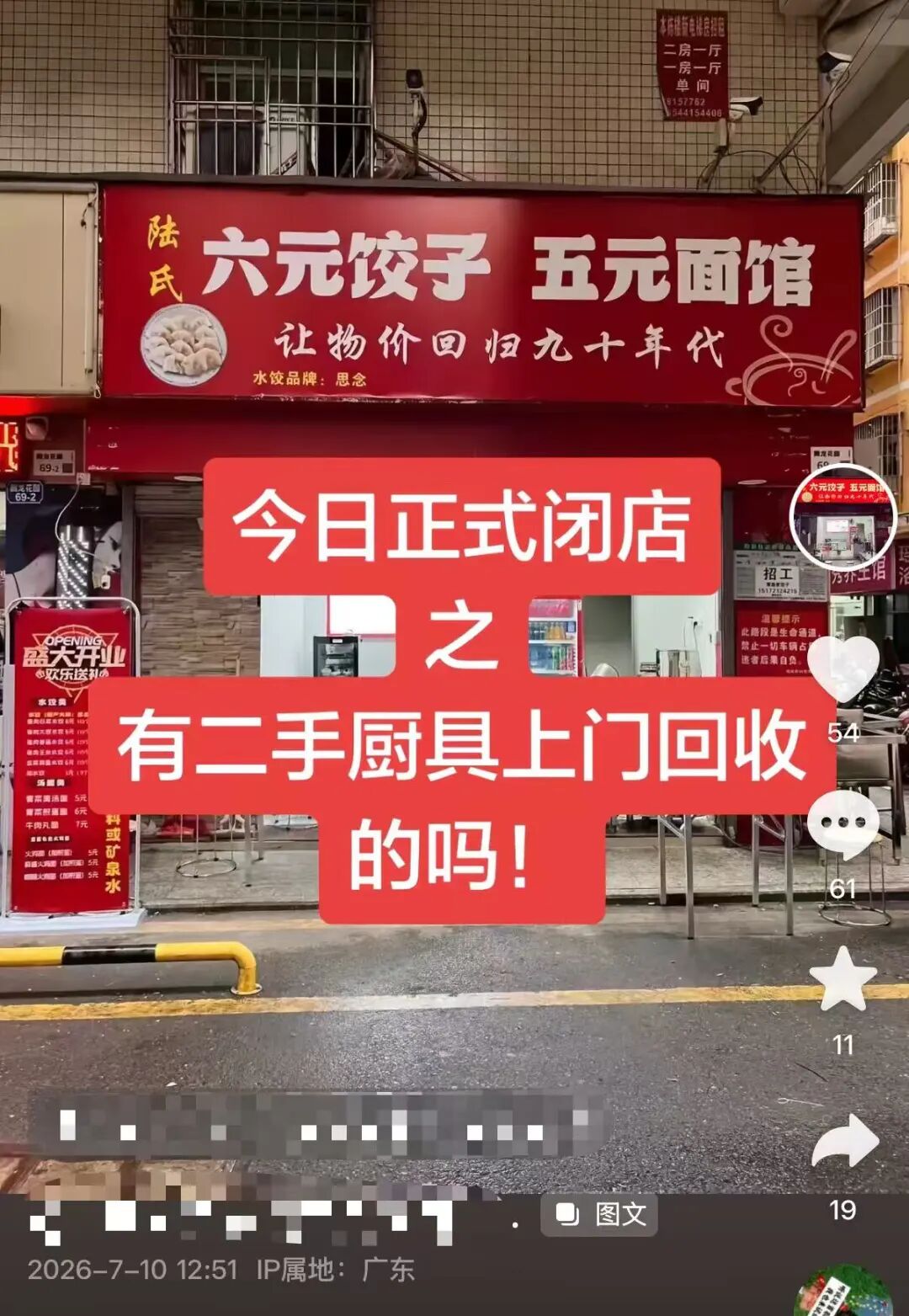
△ Image source: Douyin screenshot
Apart from cost control, low-price dining relies mainly on small profits but quick turnover to make money. This means without sufficient sales volume, such stores usually cannot survive for long. The reason why this original Guangzhou shop thrives is the high customer flow brought by its massive popularity.
But traffic is unpredictable. When the hype comes, you can't stop it; when it fades away, you can't retain it. The success of "5-Yuan Dumplings & 4-Yuan Noodles Shop" is due to the price contrast, the perfect timing, the owner's Douyin operations, and a bit of luck — none of these factors are dispensable. Change the city, change the neighborhood, or change the timing, and the outcome could be completely different.
In the long run, the hype will eventually fade. Just like the Mor's Chicken Pot that went viral a few months ago, which had a peak daily foot traffic of 8,000 people, now it sells less than 20 pots a day. Those customers who came for the novelty will almost never make repeat purchases. Without returning customers, a business decline becomes inevitable.
In Zhang Kun's view, the unique demographic structure of Guangzhou's urban villages provides an excellent environment for "5-Yuan Dumplings & 4-Yuan Noodles Shop". The rent is low, and self-built residences are densely distributed, gathering a large number of migrant workers and young people who have just graduated. For them, low prices are the biggest attraction, an advantage that is difficult to replicate in other cities.
"The catering business is all about serving people within a 300 to 500-meter radius. Beyond that distance, people only come out of curiosity, and their consumption frequency is very low," Zhang Kun said. The main customer base of the shop now consists of delivery riders, couriers, and nearby urban village residents, with a repeat purchase rate of 50%.
It's clear that even though business has slowed down a bit now, since the shop is rooted in the urban village, it already has a group of price-sensitive regular customers to rely on, making it far less fragile than those copycat stores that only live on fleeting internet traffic.
In fact, this is not the first time low-price dining has sparked a market boom. In early 2024, projects like 2-yuan bread and 7-yuan hot rice noodles emerged. Low investment and high popularity attracted many catering novices to rush in, while many quick-franchise brands took the opportunity to cash in. According to Phoenix Weekly, from 2023 to 2025, 2-yuan bread stores expanded at a rate of over 4,300 stores per year.
But after opening, these entrepreneurs realized that this business has extremely high requirements for site selection and relies on high customer flow to operate, eventually leading to a wave of store closures