Kai-Fu Lee laid his cards on the table to Bloomberg: We will achieve profitability next year, and see you at the Hong Kong Stock Exchange in 2027.
During this year's WAIC conference, Bloomberg conducted a video exclusive interview with Kai-Fu Lee. The session was packed with insights, and the core takeaway was singular: 01.AI is preparing to go public, aiming to become "China's first truly profitable AI company."
In other words, while the entire AI industry is still collectively debating when large language models will finally turn a profit, this company is already ready to hand in its exam paper ahead of schedule. Moreover, the final, most high-stakes question on its exam sheet is not model commercialization, but how to make AI profitable through offerings ranging from C-suite AI for enterprise leaders to sovereign AI for overseas markets.
Kai-Fu Lee's answer lays out that the company's order value has tripled or quadrupled, while expenditures have dropped sharply. Targeting Palantir as its benchmark, 01.AI is on track to achieve profitability next year, with a planned listing on the Hong Kong Stock Exchange in 2027.
At the same time, its overseas business has already covered regions including Central Asia, the Middle East, and the Southern Hemisphere, and has accessed deep, complex demands for sovereign AI in markets such as Kazakhstan.
The speed at which 01.AI is submitting its results has left many struggling to follow its logic.
Just over a year ago, the industry narrative still labeled the company as "the first of the 'six little AI tigers' to voluntarily exit the foundational model race." Today, it has transformed into China's first AI company sprinting for an IPO with clear profitability expectations. Kai-Fu Lee now refers to the current 01.AI as a "leopard" — lighter, faster, and focused on generating real, tangible revenue.
What exactly happened during this period? How much of the "Chinese Palantir" narrative actually holds up?
01. Voluntarily moving away from cash burn, meeting Palantir on a more profitable battlefield
When 01.AI was first founded in 2023, its story was framed as that of China's OpenAI. It launched the Yi series of foundational models with international SOTA-level capabilities, secured investments from backers including Alibaba Cloud, and at one point reached a valuation exceeding $1 billion. In the landscape of Chinese AI startups at that time, 01.AI was firmly in the first tier.
However, two subsequent variables completely rewrote the economic calculus of the domestic self-developed foundational model track.
The first was DeepSeek: it not only open-sourced its weighted foundational models, but also thoroughly drove down the training costs of cutting-edge models through inference optimization. As Bloomberg noted, since the start of last year, only a handful of companies with "bottomless balance sheets" have been able to afford the cost of training large models from scratch.
The second was a collective shift among investors. The capital market began pressing all model companies with the same question: when will the cash-burning training and research work finally translate into revenue?
Kai-Fu Lee recognized earlier than many peers that these two issues would become long-term structural challenges. Instead of stubbornly persisting on the original path, he chose to proactively switch tracks.
He cut the most cash-intensive pre-training model training operations, and shifted the entire company's focus from foundational models to the enterprise AI track. Moving away from the most capital-heavy technical route does not mean exiting the deep waters of technology; translating the accumulated full-stack large model technology stack into productized delivery capabilities is another challenge with high barriers to entry.
Kai-Fu Lee's judgment is that as the capabilities of open-source models improve, the focus of AI competition will shift from single-dimensional model metrics to system delivery capabilities. The model defines the starting line, but in enterprise scenarios, what determines outcomes is whether AI can integrate into an enterprise's data, workflows, permissions, and decision-making chains.
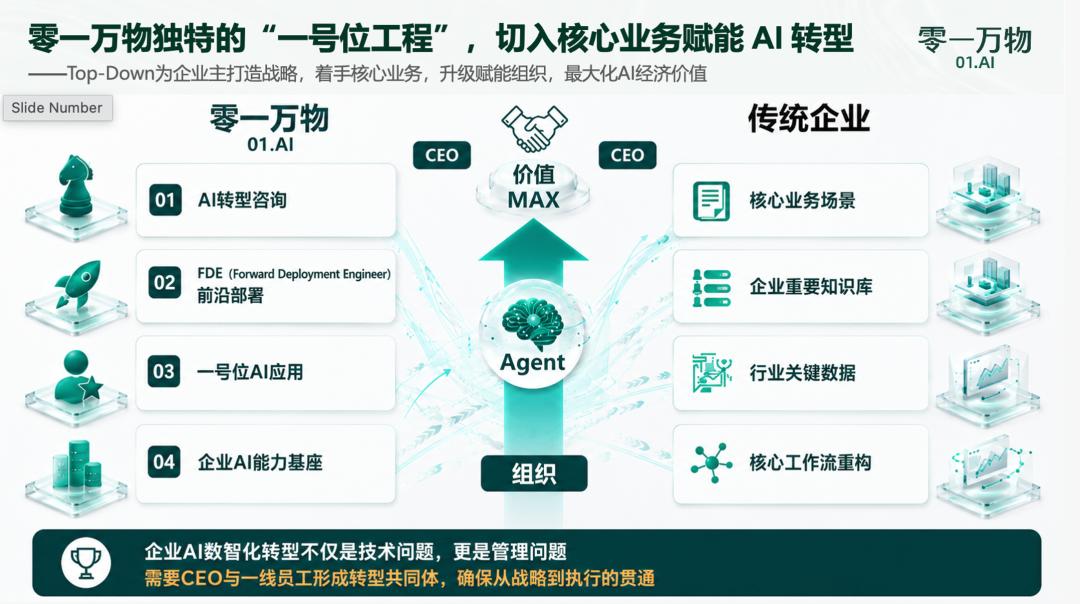
01.AI's choice was to directly penetrate the core business scenarios of enterprise clients. It performs fine-tuning and scenario customization based on domestic open-source models, and invests heavily in business understanding — for example, deploying FDE teams to client sites to complete business mapping, data integration, ontology modeling, and permission governance. Combined with its self-developed enterprise AI platform and agent capabilities, it transforms an enterprise's organizations, workflows, data, and decision-making scenarios into business systems that AI can understand, reason through, and execute. This ultimately forms enterprise AI solutions that support private deployment and continuous iteration.
No longer allocating resources to train cutting-edge foundational models has given 01.AI a more advantageous niche: it can build on the foundation of open-source models to conduct model optimization, agent orchestration, and private deployment targeted at real enterprise scenarios.
This same set of capabilities allows 01.AI not only to serve enterprise AI transformation, but also to address sovereign AI demands in some national and regional markets: local languages, local data, local deployment, and local industrial scenarios are all supported by the same underlying engineering capabilities.

Kai-Fu Lee's exact words were: "The ecosystem has taken shape, and we are very glad we made this choice. Over the past year, the company's expenditures have dropped sharply, so we can move toward profitability quite quickly."
As the company switched tracks, the path to profitability naturally emerged.
01.AI currently has a team of around 240 people — not bloated by industry standards — including FDE teams that embed themselves in clients' real business operations to co-build AI decision-making systems with top enterprise leaders. While solving specific operational, growth, and investment challenges, they codify business workflows, data relationships, permission systems, and decision logic into enterprise ontologies, scenario templates, and agent capabilities, which can then be reused through 01.AI's Wan Ce platform.
Like Palantir, 01.AI positions itself to deliver enterprise-grade solutions to the global market — the difference lies in its starting point.
The Chinese market, whether in terms of scenario complexity or enterprise intelligent infrastructure, offers far more room for AI to create value. Kai-Fu Lee used a vivid description in his Bloomberg interview: this is a two-horse race, and the other horse simply cannot enter our track to compete.
02. What kind of business are C-suite AI and sovereign AI?
After switching tracks, 01.AI's product logic shifted from building a more powerful standalone model to helping top leaders of organizations embed AI deeply into their business operations.
The so-called "C-suite Engineering" targets the most critical decision-making blind spots in enterprise AI transformation.
Enterprise AI transformation should not be pursued for its own sake. To align new productivity with an enterprise's long-term strategy, the transformation cannot be advanced solely by the CIO or IT department in a siloed manner. It requires top decision-makers such as the CEO and chairman to define goals, mobilize resources, and take responsibility for outcomes.
01.AI's "C-suite AI" business is the productized implementation of this strategy: Boss AI serves top enterprise operations leaders, Sales Champion AI serves leaders in charge of sales growth, and Investment Officer AI serves leaders overseeing investment and capital decision-making.
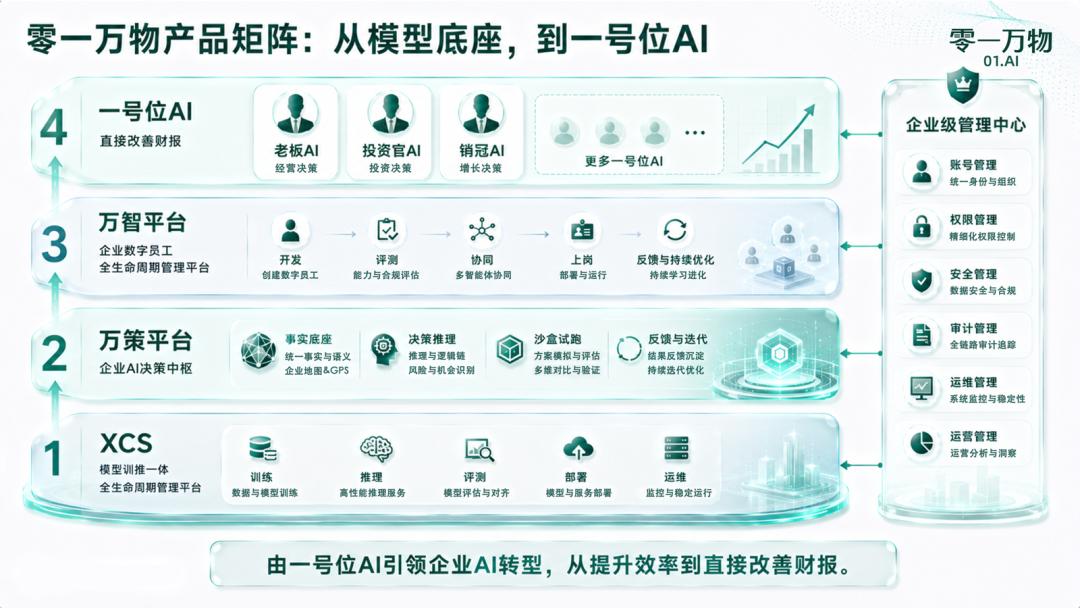
The three products target different roles, but share the same goal: to integrate AI into the core chains that directly impact revenue, costs, efficiency, and capital quality, rather than remaining at the superficial level of improving efficiency for a small number of departments in trivial business scenarios.
Extending further upward and outward, these intelligent organizational capabilities can also support national and regional-level digital transformation, which corresponds to the definition of "sovereign AI." This is easy to understand: enterprises need AI integrated into their operational systems, while countries and regional markets require locally controllable, sustainably evolvable AI infrastructure.
In this interview, Kai-Fu Lee described a typical scenario: many CEOs want to pursue AI transformation but do not know where to start. They ask their CIO and IT teams, and get answers such as deploying intelligent customer service, adopting AI for legal work, and implementing AI in finance. In the end, they end up with a collection of impressive functional demos, but no substantive improvements in productivity, and no tangible benefits to the financial metrics that CEOs care about most.
The more mature model capabilities become, the more such scenarios will emerge. He then put forward a clear judgment: currently, only two companies in the world have products that can drive enterprise AI transformation from the top down, while delivering tangible financial results within two to three months.
One is 01.AI, and the other is Palantir.
What kind of company is Palantir exactly? In Silicon Valley, OpenAI and Anthropic have grabbed the vast majority of the limelight, but if you look at the US enterprise software sector, the company that has delivered the most staggering returns in recent years is not any model vendor — it is Palantir.
The capital market views Palantir as a company characterized by long contract cycles, high average deal values, and stable repurchase rates. Its niche is also very unique: it does not operate at the foundational model layer, firmly positioning itself in the application layer; it does not build general-purpose tools, focusing instead on "decision operating systems." Its primary clients are not consumer office workers or developers, but the US Department of Defense, the CIA, large banks, and multinational manufacturing enterprises.
These organizations have no shortage of capital, cutting-edge technology, or high-performing models — what they lack is exactly the capability to "let management see the full picture" of their operations.
To ensure that decision-grade AI delivers commercial returns while being deployed, Palantir uses its AIP practical training camps to replace traditional B2B sales processes. It can run usable AI applications based on clients' real data within a few days, drastically shortening the sales cycle.
How strong is Palantir's financial performance in North America? In the first quarter of 2026, its revenue increased by 85% year-over-year, its adjusted operating margin reached 60%, and its free cash flow margin hit 57%. Generally, the "Rule of 40" is used to measure the quality of software companies: a company is considered excellent when the sum of its revenue growth rate and margin exceeds 40% — and Palantir's figure stands at 145%. This is why the capital market assigns it a highly optimistic valuation, with its dynamic price-to-earnings ratio consistently ranging between 120 and 150.
Kai-Fu Lee chose Palantir as his benchmark not only because he is bullish on the enterprise AI track, but also for a key reason: Palantir's highlights lie in its anticipation and validation of the commercial logic of AI, while avoiding the "heavy delivery" label that plagues the traditional enterprise service market.
Palantir was the first to prove two things. First, the true value of enterprise AI lies beyond the model layer. Compared to the technical cutting-edge nature of the model itself, enterprise AI places far more importance on whether it can integrate into real business systems and improve key operational outcomes.
Second, enterprise AI requires long-term accompaniment for clients and deep immersion in their on-site operations. A "finish the project and leave" delivery model is meaningless.
In the future, the landscape of enterprise AI may look like this: GPT and Claude provide underlying intelligence, while Palantir and 01.AI deliver the infrastructure that enables this intelligence to be deployed safely in complex enterprise environments.
It can be said that what 01.AI aims to achieve and what Palantir is pursuing ultimately lead to the same destination — but in its distinct market, 01.AI has developed a more competitive Chinese-style engineering approach.
Once you understand Palantir's commercial logic, you can quickly grasp the product form of C-suite AI and sovereign AI, and why 01.AI dares to set a profitability timeline for next year.
From a business structure perspective, connecting the fragmented, chaotic, and isolated data pools within large organizations, allowing management to perform real-time queries and visualize data instantly, and then overlaying agents on top of the data foundation to assist CEOs in decision-making, is inherently high-value and high-return.
Kai-Fu Lee himself is also a user, and he uses the product every day. He said: "Our business has grown so well precisely because C-suite AI has taught us how to sell our products to clients effectively."
According to the data Kai-Fu Lee disclosed to Bloomberg, the contracted order value of 01.AI's "C-suite Engineering" has increased three to four times compared to last year, with demand far exceeding the company's current capacity. Approximately half of its business comes from markets outside China, covering regions including Central Asia, the Middle East, and Southeast Asia.
Taking Kazakhstan as an example: local clients show little interest in generic large models. What they want is a localized, private, sustainably iterable sovereign AI system. The basic requirements are that the model understands local language and culture, and that all data remains onshore. The deeper demand is for the system to serve local industrial scenarios spanning education, energy, transportation, communications, and government services, with a delivery team that can support the entire process from strategic design to organizational implementation.
These demands align perfectly with the capabilities 01.AI has developed over the past year. Kai-Fu Lee frankly stated that the current challenge is to find more qualified consultants and engineers who are proficient in English and Arabic, capable of traveling to clients' countries to work with local teams on AI deployment.
In other words, the current bottleneck no longer lies on the demand side, but on the delivery side.
High-value scenarios defined by product forms, real business implementation driven by co-creation with clients, and platform accumulation supporting large-scale reuse — the combination of these three factors gives 01.AI the confidence to announce its profitability target for next year and 2027 IPO plan.
However, the fact that 01.AI shares a similar positioning with Palantir does not mean it will simply retrace the path of this American AI company.
He made a crucial remark: "The flexibility, work ethic, and willingness of the Chinese team to fly anywhere to help clients succeed will become the unique strength that makes us stand out in the enterprise AI transformation sector."
Palantir grew out of the US government, defense, intelligence systems, and large enterprises. 01.AI, by contrast, faces global demands that are more closely tied to "sovereignty": a large number of countries, regional markets, and large organizations hope to integrate AI into their industrial systems without giving up data sovereignty.
If Palantir has proven that AI can integrate into large-scale decision-making systems, then 01.AI is verifying whether Chinese AI can export its enterprise-grade AI engineering, delivery, and localization capabilities to the rest of the world through the emerging "sovereign AI" business.
03. Where will the first profitability exam paper lead?
Historically, there have been almost no successful cases of Chinese enterprise software companies expanding overseas.
From an industry perspective, 01.AI's narrative of switching tracks has gone beyond the scope of domestic AI commercialization, touching on a proposition that no one has ever successfully navigated: can a Chinese company secure a solid position in the global enterprise service market?
Back in the domestic AI circle, peers are also submitting their own answers. But Kai-Fu Lee's exam paper has already outlined pre-written order growth and profitability expectations.
The differences currently lie in track directions and paper plans, but in the next one or two years, these companies will inevitably be compared and scrutinized by the Hong Kong stock market. What valuation will the Hong Kong Stock Exchange ultimately assign to the "Chinese version of Palantir"? In this wave of Chinese AI companies expanding their businesses overseas and pursuing public listings, 01.AI's valuation may very well determine the future direction of AI in the B2B market.
Looking further ahead, the first-mover advantage of positioning in enterprise decision-grade AI undoubtedly grants 01.AI a very favorable window of opportunity.
However, how long this window will remain open is still unclear, and it may depend on two variables: how long the market mismatch between model capabilities and commercialization can persist, and whether the delivery team can keep up with global order demand.
After the IPO, capital will at least solve part of the globalization delivery problem, but the ability to co-create with clients cannot be built through financing