Hard Krypton Exclusive | First to achieve profitable operations, Zhigu Tianchu secures nearly RMB 100 million financing led by China Merchants Venture Capital
Recently, Zhigu Tianchu, an enterprise specializing in intelligent cooking robots, officially announced the completion of a new round of strategic financing of nearly 100 million yuan. This round of financing is led by China Merchants Venture Capital, followed by Transition Capital, and old shareholders including Cloud Capital, Qifu Capital made over-subscribed additional investments.
In the current capital market environment, the over-subscription from old shareholders is often the most direct recognition of a company's commercial implementation capability and technical barriers. Centering on "cooking robot hardware + AI digital cuisine large model", Zhigu Tianchu is transforming the highly experience-dependent links in Chinese food cooking into product capabilities that can be standardly developed and delivered on a large scale. After the financing is completed, the company will continue to promote the research and development of Physics AI, and accelerate the global implementation of Chinese and Pan-Asian catering.
AI Digital Cuisine Large Model: Empowering Products and Delivery, Taking the Lead in Achieving Profitable Operation
The commercial intelligent cooking track has entered a deep development stage. For customers, the purpose of purchasing cooking robots is never the machine itself, but stable and delicious food output. However, traditional cooking machines based on program control can only execute fixed instructions; while the definition of taste by different brands and regions, as well as the differences in ingredient selection and meal budget, lead to completely different corresponding "cuisine programs". To eliminate these differences, the usual path in the industry is to continuously invest a large amount of manpower in cuisine R&D and service, and develop solutions for customers one by one — making up for the lack of intelligence with manpower, which keeps the delivery and operation costs at a high level. This is also one of the key reasons why this track has long been difficult to achieve profitability.
Zhigu Tianchu's solution is a standardized and scalable replicable product: one end is the cooking robot hardware, and the other end is the "AI Digital Cuisine Large Model" that runs on both the cloud and the machine side. The hardware is responsible for stable execution, while the digital cuisine large model shifts cuisine development from relying on human experience to model-driven — customers can flexibly complete the development and iteration of dishes at the model layer according to local taste preferences, characteristics of the ingredient supply chain, meal budget and even the difference in single serving size. The combination of the two forms a complete product of "hardware + AI digital cuisine large model", rather than an automated device that passively executes preset programs.
Behind this is a seemingly contradictory but actually critical design. There is no unified standard for deliciousness, and diversity and personality are the soul of Chinese cuisine; what Zhigu Tianchu provides is not a set of fixed recipes, but a "standardized cuisine development capability" — with the support of this standardized capability, customers can instead produce more distinctive dishes. The recipes are standardized, the tastes are diversified, and it is the model rather than manpower that connects the two.
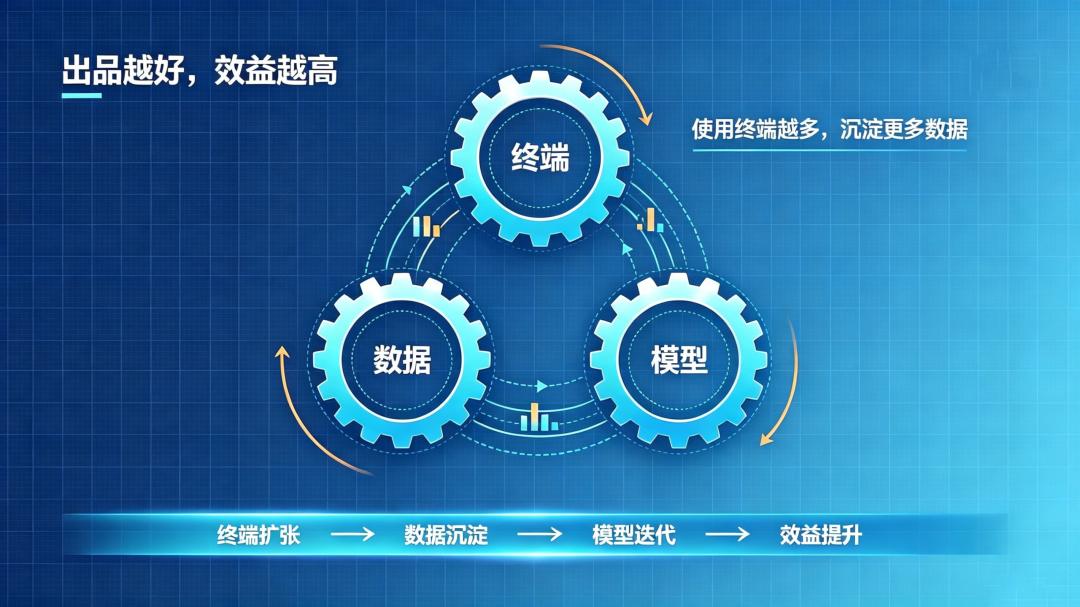
More importantly, this model-driven product naturally brings a "data flywheel" effect to customers: every time the robot runs, its real cooking and operation data will continue to flow back, and millions of real structured cooking data accumulated every day will train the cloud model; after the model is iterated, it will be distributed to all intelligent terminals in batches, making the output of each robot more stable and the cuisine development more efficient.
The better the output, the higher the benefit, the more terminals are used, and the more data is accumulated — the terminals, data and models drive each other, making the flywheel spin faster and faster. Driven by this flywheel, the quality of dishes can be traced throughout the whole process and stably reproduced in different terminals and regions; the company's growth no longer depends on the linear accumulation of manpower, but accelerates with the expansion of data scale — this is exactly the deepest moat of Zhigu Tianchu.
"The flipping skills, heat control intuition and seasoning insights of the older generation of chefs, those unique skills hidden in veteran chefs, and the local flavors on the verge of being lost, are being precipitated into traceable and inheritable digital assets with data collection and model training." said Dr. Geng Kaiping, founder of Zhigu Tianchu.
In his view, cooking robots with intelligent hardware as the carrier and supported by the AI Digital Cuisine Large Model are building a "digital ark" for the thousands of years of Chinese culinary techniques.
This business model centered on standardized products and data platforms is being verified by performance. In this track where most players exchange scale for losses, the ability to make profits is the real touchstone to prove that the business model is feasible — and Zhigu Tianchu is one of the few cooking robot enterprises with revenue exceeding 100 million yuan and realizing profitability in the industry. Among them, the repurchase rate of old customers is strong, new customers are diverse and continue to expand, the company as a whole develops healthily and rapidly, and it is expected that the revenue in 2026 will maintain a 300% growth rate compared with 2025. It is understood that the company's products have penetrated into multiple business forms such as intelligent manufacturing, health care for the elderly, campus canteens, fast food chains, fresh food retail, cultural tourism and hotels; recently, it has been deployed in the logistics canteen of the world's largest new energy OEM, and has been put into use in batches in school canteens in Beijing. Its customers include leading enterprises and institutions in various fields.
When "Heat Control Intuition" Meets Top Engineers
If the AI Digital Cuisine Large Model solves the problem of "what dishes to cook", to make the same dish stably reproduced on different terminals, another hurdle in the physical world has to be crossed: there are differences in ingredient batches, fluctuations in ambient temperature, and the deployment of the same cuisine model to different terminals may not output the same taste. Traditional cooking machines stay in the "numerical control execution" stage, which can only mechanically repeat according to the preset time and temperature, and are difficult to cope with such complexity. The "Physics AI" that Zhigu Tianchu has been continuously developing is born for this purpose.
The essence of "Physics AI" is to enable machines to no longer mechanically copy recipes, but to understand the real physical process and make real-time adjustments. Its long-term goal is to transform the heat judgment and operation habits formed by excellent chefs relying on experience into measurable, analyzable, verifiable and continuously iterable engineering parameters and algorithm models, forming a complete closed-loop control — so that the output of the cuisine model can be accurately transformed into the stable result of each cooking process.
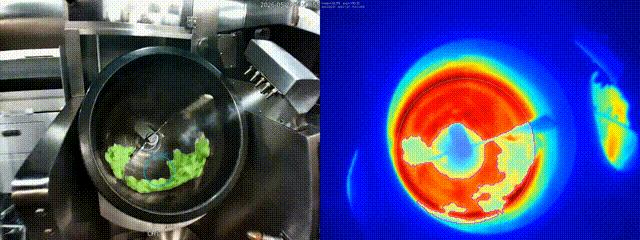
The multi-modal AI perception system developed by Zhigu Tianchu
At the end of 2025, the new CTO Vincent officially joined Zhigu Tianchu and promoted the establishment of an independent AI cooking R&D team. Vincent received his bachelor's and master's degrees from Tsinghua University, and his doctorate was jointly trained by the National University of Singapore and the Massachusetts Institute of Technology (MIT). After that, he served as a senior engineer at Apple. For many years, he has accumulated profound practical experience in the fields of robotics, sensors, algorithms, and software and hardware system development, and has deeply participated in the R&D and mass production of consumer-grade intelligent hardware.
At present, the team is carrying out R&D and small-scale verification around cooking data collection, multi-modal perception and cooking parameter optimization — through temperature, weight, vision and robot operation data, identify the initial state of ingredients and key differences in the cooking process, and precipitate the relationship between these differences and parameters such as firepower, time, rotating speed and feeding rhythm into a continuously trainable model.
"I hope our intelligent cooking robots can become the 'intelligent partners' of catering practitioners, making cooking change from an experience-dependent 'physical work' to an enjoyable activity that can be precisely controlled and freely created." Vincent said.
From "Going Global" to "Integrating into Local Markets", the Overseas "Second Growth Engine"
The overseas market is opening up new growth space for Zhigu Tianchu.
Since the end of 2025, the average daily number of overseas customer visits has increased by about three times, and the order signing conversion rate of visiting customers has exceeded 50%. Its overseas business growth rate ranks among the top in the industry, and its products have been deployed in Europe, North America, Australia, Southeast Asia, Japan, South Korea and other regions.
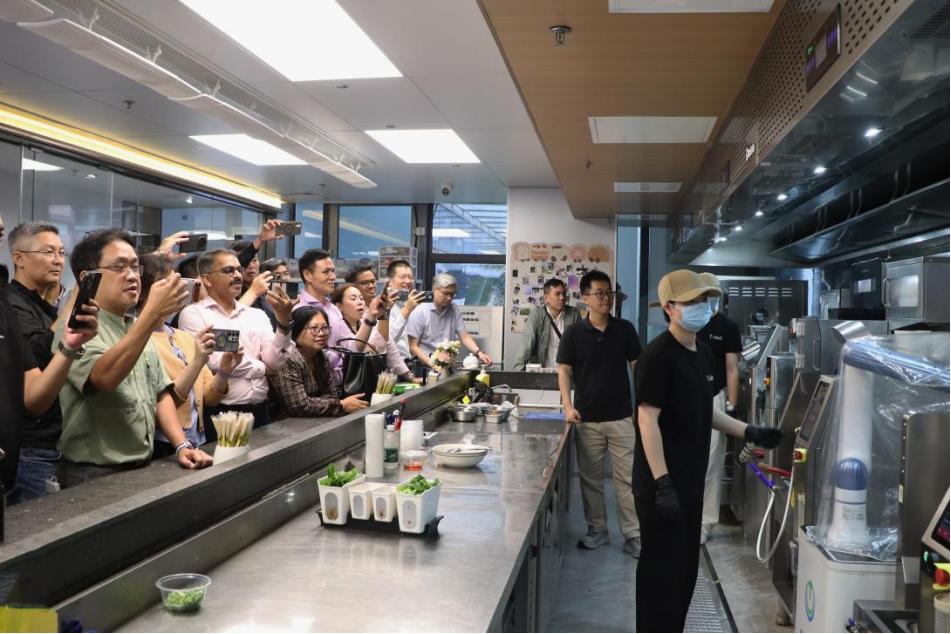
Overseas customers are very interested in Zhigu Tianchu's intelligent cooking robots
Behind the high growth is the in-depth insight and judgment of the overseas catering market. "In the global catering market, the consumer demand for Pan-Asian cuisines represented by Chinese food, Japanese food and Southeast Asian flavors continues to rise, and the market scale is expanding steadily." said the head of Zhigu Tianchu's overseas business.
In March this year, Marco, the owner of an Italian restaurant, brought a Zhigu Tianchu intelligent cooking robot into his kitchen. Unexpectedly, this robot allowed his restaurant to add more than a dozen new Chinese dishes overnight — from Kung Pao Chicken to Stir-fried Rice Noodles with Beef, with stable output and authentic wok hei. Customers have more new choices to try, the repeat customer rate has increased, and the monthly revenue has risen by nearly 30%. Marco smiled and said: "It breaks my mystery of Chinese food, injects new vitality into the restaurant, and brings new growth to the store's revenue."
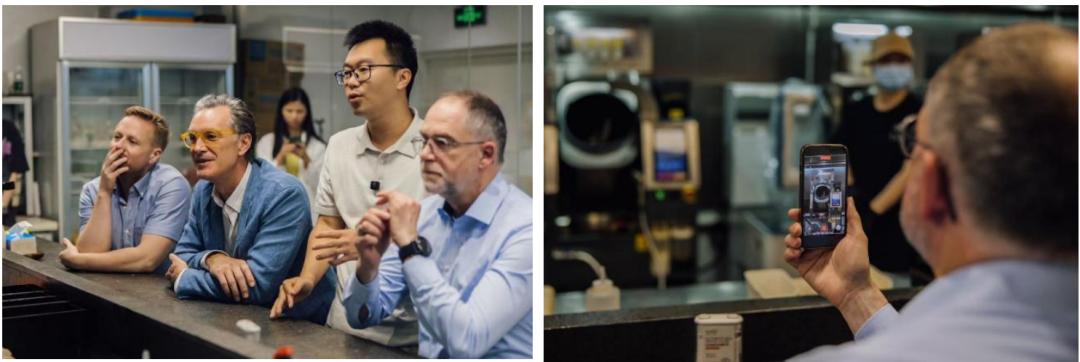
Overseas scenarios are not exactly the same as domestic scenarios. The real going-global mode does not mean copying the Chinese solution. In the process of co-creation with overseas customers, Brain, the owner of a Chinese restaurant in the United States, who has long been troubled by the shortage of kitchen staff and unstable output during peak hours, exclaimed "Amazing!" after using the T-Chef (Zhigu Tianchu) cooking robot; Mr. Ono, the operator of a Japanese izakaya, said after using it that it perfectly reproduces and integrates the local teriyaki flavor; Muhammad, a Turkish customer, admitted that the evenness of the fried noodles produced by the machine is better than that made manually, and sincerely sighed: "This is exactly what we wanted!"
"Cooking robot is one of the few fields in intelligent robots that can truly land in business scenarios and form a closed loop of user value. We are very confident in its large-scale popularization." said the investor from China Merchants Venture Capital. "After in-depth research on the main players in the industry, we found that the Zhigu Tianchu team used the least funds in the industry to produce the best products and achieved the most efficient path of commercialization."
From Zhigu Tianchu to Qianyi Intelligence: A Strategic Upgrade for the Future
It is reported that in order to better match the globalization strategy and the technical core of "cooking big data + Physics AI", Zhigu Tianchu will soon complete a comprehensive brand upgrade and officially change its name to "Qianyi Intelligence" — "Qian" represents thousands of intelligent terminals all over the world, and "Yi" represents the intelligent game driven by data and models. Behind the brand upgrade is a simpler vision: Technology makes cooking borderless and makes delicious food accessible to all.