Under the new national standard for electric bicycles, Ninebot needs a new playbook.
In the summer of 2026, under the scorching sun, China Central Television (CCTV) exposed the gray industrial chain of electric vehicles, sending a chill through the entire industry.
According to CCTV News on July 19, some dealers in the Taizhou electric vehicle market first collected users' identity information to register license plates in advance, then produced non-compliant vehicles and assigned the pre-registered plates to them, selling them under the guise of "0-kilometer used cars". The actual top speed of these vehicles far exceeded the 25km/h red line set by national standards.
Right after the report was released, the Beijing Municipal Administration for Market Regulation responded swiftly and launched special regulatory interviews, imposing mandatory "two implementations, five strict prohibitions" requirements on mainstream electric vehicle brands including Ninebot, Yadea, Aima, and Niu. In the past, original equipment manufacturers (OEMs) attributed industry chaos to individual dealer misconduct. Now, regulatory oversight is forcing enterprises to strengthen channel management, and the entire industry is entering a period of full-scale compliance rectification.
Market analysis indicates that this round of industry compliance storm will have a non-negligible impact on Ninebot, which takes intelligent technology as its core selling point and has high public discussion on store refitting. As the gray-area dividends of the industry fade, striking a balance between technological innovation, compliance control, and market scale has become its core challenge.
Notably, the company reached a major development milestone half a year before the industry storm hit. On January 23, 2026, Ninebot officially announced that its cumulative domestic shipments of electric vehicles had exceeded 10 million units. Before the glory of this achievement faded, undercurrents began to surge. The growing pains of this young industry giant are now pushed to the forefront.
After stepping out of the shadow of Xiaomi, where will Ninebot head next?
The rise of Ninebot is a history of precise differentiated breakthroughs.
In 2014, Ninebot secured over $80 million in Series A funding from investors including Xiaomi, HSG, and Shunwei Capital, formally becoming a member of the Xiaomi ecological chain. Leveraging Xiaomi's distribution channels and supply chain resources, the company quickly expanded its product market reach.
According to its prospectus, the connected-party sales amount between the company and Xiaomi from 2017 to 2019 reached 10.19 billion yuan, 24.34 billion yuan, and 24.00 billion yuan respectively, accounting for 73.76%, 57.31%, and 52.33% of total operating revenue in corresponding periods. The proportion of connected-party transactions exceeded 50% in all three years, clearly demonstrating its high level of reliance on Xiaomi.
However, fortune often hides misfortune. The "cost-performance" curse of the Xiaomi ecological chain followed closely. During the same period, the gross profit margin of Ninebot's products sold through Xiaomi's channels was 22.46%, 20.79%, and 15.11% respectively, declining year by year. The shadow of the "price butcher" loomed increasingly large.
With limited autonomy over its profitability, Ninebot did not lack the will to break away from reliance on Xiaomi, but it did not have sufficient leverage at that time. While its balance scooter and kick scooter businesses had already ranked first globally, these product categories had limited market ceilings. Coupled with the continuous rise in supply chain costs, the negative backlash from its reliance on Xiaomi kept intensifying.
A turning point emerged when the company opened up a brand new business track. At the end of 2019, facing the solid competitive barriers of traditional giants such as Yadea and Aima, Ninebot launched its first intelligent electric vehicle product, targeting the mid-to-high-end intelligent market with price points above 4000 yuan. In August 2022, the company disclosed that its shipments of two-wheeled electric vehicles had exceeded 1 million units, officially entering the "1 million unit club" after only 3 years of operation.
According to Wandian Research, Ninebot's successful breakthrough in high-end products benefited from keyless unlocking, APP vehicle control, and sensor-activated unlocking. These features, which are now commonplace, precisely met the demand of young consumer groups born in the 1980s, 1990s, and even 2000s for "tech-savvy trendy playthings". With marketing campaigns featuring popular celebrities such as Jackson Yee, the company successfully built an "intelligent technology" competitive moat and secured considerable market premium.
Ninebot Chairman Gao Lufeng once stated ambitiously: "The electric vehicle industry is still stuck in the feature phone era. We will redefine it with intelligence." This new growth curve quickly became the mainstay of the company, granting it the real leverage to shake off its reliance on Xiaomi.
According to financial reports, in 2023, the proportion of sales revenue from Xiaomi had dropped to 4.3%, while sales through its own brand and channels accounted for as high as 95.7%. By 2024, the company no longer listed "revenue from Xiaomi customized product distribution" as a separate item in its financial statements. In other words, without the explosive growth of its two-wheeled vehicle business, Ninebot's journey to independence would have been much slower and far more difficult.
However, business independence and capital withdrawal are two sides of the same coin. As Ninebot completed this impressive transformation, institutional investors including Xiaomi kept reducing their holdings in the company.
According to Wind data, between November 2021 and June 2022, entities under HSG (Sequoia) and Xiaomi's PeopleBetter had already reduced their holdings to cash out 2.38 billion yuan. In December 2024, after Xiaomi reduced its holdings through centralized bidding and block trading, its shareholding ratio fell below 5%, removing it from the list of major shareholders of the company.
As of June 18, 2026, the latest shareholder data disclosed by Ninebot, sourced from Wind, shows that the shareholding ratio of Xiaomi's fund People Better Limited has dropped to only 3.27%.
The departure of shareholders is not only a footnote to Ninebot's growing independent strength, but also a stark signal: the era of external capital transfusion is over, and the company must now survive on its own operational profitability. More critically, as time goes by, this second growth curve that once carried the banner of independence is now facing multiple challenges.
After breaking through, the intelligent pioneer encounters a "stalling" crisis
In the business world, there is no permanent competitive moat. For Ninebot, the story of operational independence is only the first half of its journey. As the industry landscape quietly changes, the company suddenly finds that the intelligent technology moat it built on its own is being quickly filled in by competitors.
The first to be impacted is its intelligent brand label. Since 2025, with the explosion of the artificial intelligence industry, the trend of physical AI has also swept the electric bicycle sector. Industry competition has shifted to consumer-driven dynamics, making intelligent technology the core competitive track.
At present, traditional giants such as Yadea and Aima, leveraging their large-scale procurement and production systems, can quickly and cost-effectively popularize features including keyless start, APP interconnection, and remote positioning across their entire product line. Yadea has introduced a TCS traction control system in its high-end models, and integrated it with large AI models, attempting to surpass competitors in intelligent experience.
Under the trend of widespread intelligent popularization, Yadea and Aima have extended basic intelligent features to their mainstream product lines priced between 2000 and 3000 yuan. The intelligent transformation of electric mobility is not a competition between brands, but a battle for inclusive access.
For the vast majority of consumers whose top priorities for vehicle purchase are compliance and practicality, the "sufficiently functional and affordable" products from traditional brands are undoubtedly more appealing. As basic intelligence becomes a standard feature, Ninebot's core selling point of intelligent products is being eroded. Its competitive moat has evolved from a technical barrier to a first-mover advantage, which appears extremely fragile in the face of price wars.
While competitive pressure strikes from the outside, policy impacts disrupt operational rhythm from within. In 2026, the new national standard for electric bicycles was fully implemented, setting strict red lines for speed limit, total vehicle weight, and motor power. Amid the massive industry reshuffle, brands are no longer facing a single contest between compliance costs and product strength, but a comprehensive competition across the entire value chain covering R&D, supply chain, distribution channels, and after-sales services.
The consequences of this dual squeeze have been directly reflected in the company's financial statements. According to financial reports, in the fourth quarter of 2025, Ninebot's revenue plummeted 56.55% quarter-on-quarter to 2.888 billion yuan, with a net profit of -29.0315 million yuan, marking its first quarterly loss since 2021.
Regarding the quarterly loss in Q4, Ninebot explained that its compliant Fz series vehicles were not officially launched until December 22. The product gap caused by the transition to the new national standard exposed the company's vulnerability in policy adaptability. While traditional brands smoothly navigated the transition with full product reserves, Ninebot's operational rhythm was disrupted by the new regulatory standard.
Entering the first quarter of 2026, Ninebot's pressure did not ease. During this period, the company achieved revenue of 5.870 billion yuan, with year-on-year growth slowing to 14.82%; net profit reached 203 million yuan. Although it improved quarter-on-quarter compared to Q4, it dropped 55.42% year-on-year. In addition, the company's net operating cash flow stood at -477 million yuan, plummeting 130% year-on-year.
When intelligence is no longer a differentiated selling point, distribution channels and services become the final decisive battlefield. In April 2026, Ninebot disclosed during an investor communication session that it plans to add 3000 new stores and renovate 1000 existing stores throughout the year, attempting to accelerate its catch-up in terminal coverage. However, behind this ambition lies a non-negligible gap in offline operational scale compared to leading industry players:
Yadea officially disclosed that as of May 2026, it operates over 40,000 terminal stores globally, achieving a layout of "3 stores per county, 1 store per town" in China, with a township outlet coverage rate exceeding 95%. Aima has over 30,000 exclusive stores nationwide, mainly covering county-level cities and above, with store density in third- and fourth-tier cities second only to Yadea.
In comparison, by mid-2026, Ninebot has approximately 10,000 to 13,000 stores (including planned new additions), mainly concentrated in core business districts of first-, second-, and strong third-tier cities, with very limited coverage in counties and townships. Its stores are positioned as integrated "experience + service" centers, targeting young consumers who are willing to try new products.
For Ninebot, even if it meets its annual target of adding 3000 new stores as scheduled, its total store scale will still be less than one-third of Yadea's and half of Aima's. The gap in store scale between Ninebot and leading brands remains significant. In China's electric vehicle industry, which is centered on offline distribution channels, the gap in channel density directly translates to differences in user reach capabilities and after-sales support systems.
The *2026 White Paper on China's Two-Wheeled Electric Vehicle Industry Development*, released on June 13, shows that the total social inventory of two-wheeled electric vehicles in China has exceeded 450 million units, and the market has officially transitioned from incremental expansion to stock replacement. AVC (Ove Cloud) data further confirms this trend: in the first half of 2026, domestic two-wheeled electric vehicle market sales decreased by 12.6% year-on-year.
In such a market environment, Ninebot still relies heavily on direct-operated experience stores and core business district layouts in first- and second-tier cities. Against the general trend of intelligent popularization, functional convergence, and consumer preference shifting back to "sufficient functionality, convenience, and peace of mind", the gap in channel density and after-sales service accessibility cannot be easily filled by an expansion plan spanning merely one or two years.
With its competitive moat eroding and channels under pressure, Ninebot faces an even more critical challenge from its products. When intelligence is no longer a scarce selling point, and the new compliance national standard eliminates the previous refitting dividends, what remains as the foundation supporting the brand's high-end premium?
From industry hotspot to crossroads, "product-centric philosophy" collides with quality controversies
For an enterprise that believes in the "product-centric philosophy", nothing can shake its foundation more than losing control over product quality.
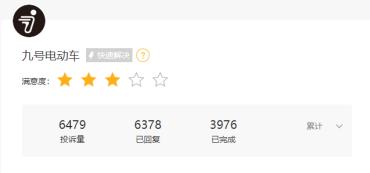
Cracks in consumers' trust in Ninebot's products have spread through numerous user complaints. On the Black Cat Complaint Platform, the number of complaints related to Ninebot electric vehicles continues to accumulate.
As of July 25, the Black Cat Complaint Platform has received a total of 6479 complaints, of which 517 new complaints were added in the latest 30 days. Only 416 complaints received responses, and merely 28 were marked as resolved.
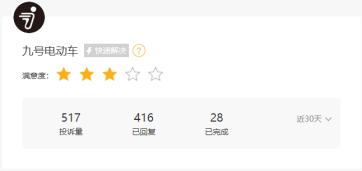
It is worth noting that the figure of 517 new complaints in 30 days itself indicates that Ninebot is experiencing a concentrated surge in complaint volume, with users releasing negative emotions at a significantly accelerated pace. For a two-wheeled electric vehicle consumer brand, what truly determines user retention is whether each store chooses to "feign ignorance" or "properly address" the complaints.
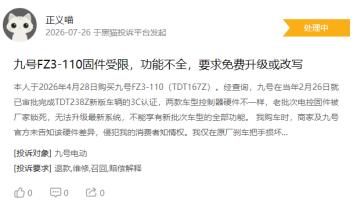
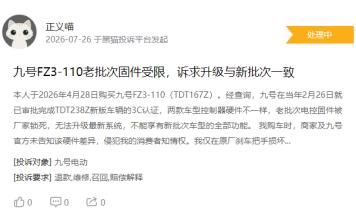
An important reason for the short-term surge in consumer complaints against Ninebot is that its products are embroiled in the "AB vehicle controversy". According to Guancha.cn, over 200 owners of the Ninebot FZ3 110 on the Black Cat platform have launched collective rights protection actions. According to insiders, the FZ3 110 vehicles complained by consumers are actually produced by three different factories, corresponding to three independent CCC (China Compulsory Certification) certificates.
Objectively speaking, under China's current production regulations, having multiple manufacturing bases for the same vehicle model corresponding to multiple certification certificates is a common practice in the manufacturing industry and does not inherently constitute a violation. However, the problem is that products from the three factories deliver two completely different user experiences.
Some batches of products have locked controller firmware that cannot be remotely updated. Other batches suffer from obvious body resonance at high driving speeds and delayed throttle response. This clearly exposes Ninebot's shortcomings in supply chain integration and production consistency control, resulting from its relatively limited accumulation in core manufacturing processes.
The stability of an enterprise's foundation can often be most accurately reflected by the actions of its actual controllers and major shareholders. According to Wind database statistics, since the lifting of the ban on its initial public offering shares, Ninebot's actual controllers Gao Lufeng and Wang Ye, along with their concert parties, have repeatedly reduced their holdings, cashing out over 1 billion yuan in total. Coupled with the continuous withdrawal of institutional shareholders, Ninebot's actual controllers and major institutional shareholders have cashed out more than 7 billion yuan in total since the company went public.
Stock price is a barometer of capital market