Can an old god in the AI era make money just by rebranding itself?
As the old master Tang once said, "Business is about making money, and there's no shame in that." Thus, Kai-Fu Lee's story has found a new breakthrough: "01.AI aims to become the first profitable AI company."
A New Narrative Script Has Been Written
Kai-Fu Lee has been telling this very same story for an entire year now.
From his exclusive interview with China Entrepreneur Magazine in August 2025 to his recent one-on-one dialogue with Huxiu, Kai-Fu Lee's public narrative has remained almost entirely consistent:
The era of building base models as a standalone startup direction is over. 01.AI wants to become China's Palantir, going all-in on the B2B sector. For agents to integrate into core enterprise operations, the transformation must be driven by the top leader of traditional companies. The essence of AI transformation is organizational restructuring, where enterprises must build moats using closed-loop data. And finally, Kai-Fu Lee himself is 01.AI's top salesperson.
When this core narrative takes shape, it signals he is ready to present this new story to capital markets and potential major clients.
The first step of this new story is to discard the old reference points. For example, Kai-Fu Lee no longer wants people to refer to 01.AI as one of the "Six Young Tigers" — to some extent, he must have found that label embarrassing.
Becoming a narrative benchmark for an industry means you have defined its standard answers and reference frameworks. Titles like "Top 10 Tech Innovators," "Three New Powerhouses," "AI Dragons," and "Six Large Model Tigers" represent cycles of new labels for new batches of companies. These are both coronations and seals of fate — from that moment on, these companies cannot escape the destiny of being endlessly compared to one another.
Being compared isn't the scary part; the awkwardness comes from falling behind, especially if you're the one who always trails the pack.
Among the other four "tigers," Zhipu AI and MiniMax have already gone public. Even with fluctuating stock prices, they've successfully brought their stories to the secondary market, facing more transparent yet brutal valuation standards. Moonshot AI is extremely hot in the primary market, with investors lining up from Zhichun Road all the way to France, and its current valuation is around 330 billion RMB. Although StepFun's performance has been underwhelming, it still maintains a seat at the table with its model capabilities and multimodal products.
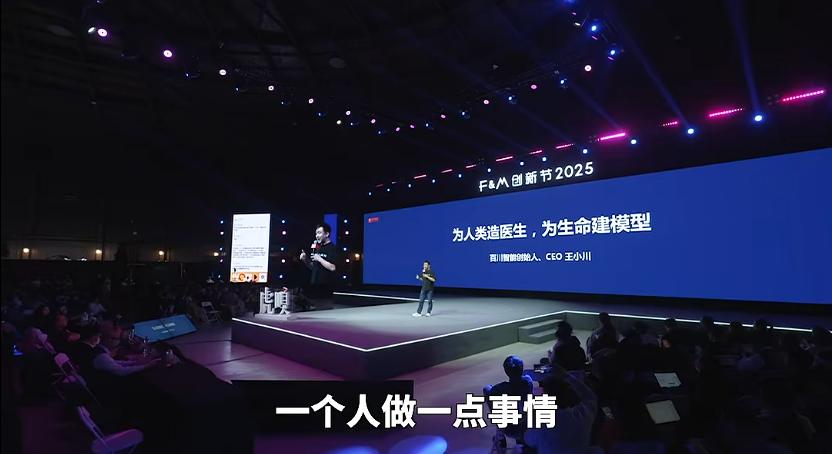
Kai-Fu Lee's 01.AI and Wang Xiaochuan's Baichuan Intelligence have become the only two awkward outliers.
After DeepSeek swept the large model industry, Wang Xiaochuan switched tables entirely. He stopped focusing on general large models and bet his story on AI healthcare. In the capital market, this is a more focused and vertical narrative, and healthcare has long been Wang Xiaochuan's desired field. He publicly acknowledged plans to develop medical applications back in 2024, and this pivot has kept his story alive. (No one should have to pay for Wang Xiaochuan's personal dream.)
But Kai-Fu Lee's situation is genuinely awkward.
From the very beginning, Kai-Fu Lee had positioned 01.AI's full-stack capabilities — "Model + AI Infra + Applications" — as its competitive moat. However, early last year, before applications were fully developed, 01.AI transferred most of its model training and AI Infra teams to Alibaba. The city walls had crumbled overnight.
It's like a steamed bun shop announcing it will no longer make its own fillings — at that point, calling it one of the "Six Young Tigers of the Bun Industry" would just be rude.
The story seemed to have reached a dead end. According to Kai-Fu Lee's own account, one-third of the company's workstations were empty during that period. Of the remaining employees, some were distracted, others were job hunting, and morale dropped so low that Kai-Fu Lee even said: "I don't ask everyone to do anything extraordinary. Of course, everyone must look out for themselves. But can you do me one small favor? Next time we pass each other in the hallway, please look at me and give me a smile."
In that moment, Kai-Fu Lee — the startup mentor, AI evangelist, tech investor, founder of Microsoft Research Asia, and former head of Google China — resembled an elderly person in a short video begging strangers for well-wishes.
But shutting down directly would be far too undignified, whether for investors or for his long-cultivated reputation. That's the worst possible outcome. What to do?
The solution lies in history.
Kai-Fu Lee has always had a distinct ability: when an old story is about to run out of steam, he timely finds a bigger new story for himself and his company. This is exactly what happened with Sinovation Ventures.
Looking at the development trajectory of Sinovation Ventures, we can see how its identity has transformed:
In its early days, Sinovation Ventures entered the market with strong incubator characteristics, emphasizing services for entrepreneurs — from office space, hiring support, and legal assistance, to mentor resources, financing support, and Kai-Fu Lee's personal influence. It tried to pull startups through the chaotic early stages and onto the right track. But this incubator model quickly hit a ceiling: services were too heavy, reach was too limited, and it couldn't support larger funds or higher return expectations.
Thus, Kai-Fu Lee redefined Sinovation Ventures' identity: a tech-savvy VC that truly understands AI.
In 2016, Sinovation Ventures established the AI Engineering Institute, with Kai-Fu Lee himself as dean. The goal was to integrate AI technology, talent cultivation, startup incubation, and commercialization. By collaborating with other investment teams, they participated in project evaluation, due diligence, and post-investment AI system construction.
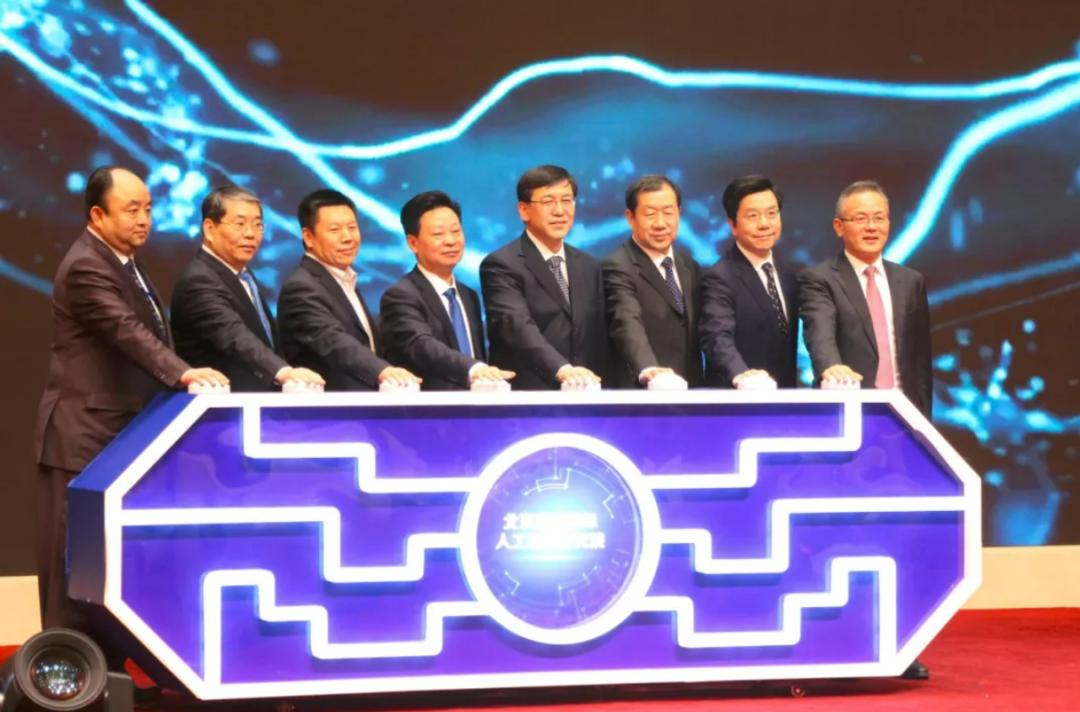
This gave Sinovation Ventures a new selling point: it understood technology better than ordinary funds and was better positioned to place bets in the AI wave.
The benefits of this transformation quickly became apparent: when founded in 2009, Sinovation Ventures only raised $15 million. By 2016, it closed its third USD fund at $300 million and second RMB fund at 2.5 billion RMB, with AUM exceeding 8 billion RMB. By 2019, AUM further rose to around 15 billion RMB.
This process clearly shows that Kai-Fu Lee has long been at the center of the AI narrative. As a world-class AI expert himself, he naturally couldn't bear to see 01.AI end so quickly.
So, when the "Six Young Tigers" narrative lost steam, Kai-Fu Lee quickly gave 01.AI a new identity: the "Leopard."
The specific animal metaphor doesn't matter. What matters is the prefix — it signals that 01.AI is no longer competing on model performance, but shifting to a profitability-focused narrative.
In this way, 01.AI's story can no longer be called a failure. Instead, Kai-Fu Lee is portrayed as having seen early on that the base model war was unsustainable, proactively pivoting from the "China's OpenAI" narrative to the "China's Palantir" narrative.
Of course, the premise of this new story is that 01.AI's greatest asset remains intact.
The "Kai-Fu Lee Universe"
While other enterprise AI companies are scrambling for desktop office space, CRM, ERP, data platforms, or collaboration entry points like DingTalk and Feishu — trying their best to embed themselves into enterprise decision-making and execution chains — Kai-Fu Lee decided to personally stand at 01.AI's front door as the greeter.
As we all know, whether in B2B or B2C businesses, the hardest part is getting through the door. While other companies are struggling through customer visits and bidding processes, 01.AI has taken a shortcut: Kai-Fu Lee personally knocks on the doors of major corporations.
After all, who would turn down Kai-Fu Lee's business card?
This is essentially Kai-Fu Lee's MVP moment — the reputation and connections he accumulated in the tech industry over his entire career are now being fully bet on this final play.

Image caption: Still from the movie The Big Short
Today's 01.AI looks like an AI company built entirely around the IP of "Kai-Fu Lee": the top salesperson is Kai-Fu Lee himself, its multi-agent system is named "Kai-Fu AI," and its B2B strategy is summarized as a "top-leader project centered on Dr. Kai-Fu Lee." The transformation narrative no longer emphasizes how powerful the Yi model (01.AI's base model) is, but rather how Kai-Fu Lee leads the team to help CEOs formulate AI strategies.
A person can open doors, but they can also become a bottleneck. The flaws of this business model are already well-demonstrated in the adjacent MCN industry. Even in the B2B context, a consulting firm built around a star partner often finds that clients buy the individual's credibility. Clients follow the person, making it difficult for the organization to build long-term institutional capabilities.
But Kai-Fu Lee doesn't have the time to wait patiently for a sustainable business model to naturally mature. At this stage of the base model battle, 01.AI has no advantages in computing power, capital, cloud ecosystem, or developer access. The most monetizable asset he has left is himself.
After adopting the "Leopard" identity, 01.AI's strategic direction can be summarized in several key terms: Palantir, Top Leader Project, AI Transformation, and Sovereign AI. These terms, while seemingly parallel, actually form a complete chain from narrative direction, cooperation model, delivery outcome, to market expansion.
Palantir's performance in recent years has been nothing short of meteoric, earning widespread acclaim.
Popular rumors about the company suggest that its precise geolocation capabilities helped US forces target and eliminate Hamedani, and that it played a critical role in the 2011 operation to track down Osama bin Laden. It was also reportedly involved in the 2022 operation targeting Venezuelan President Maduro, with its mysterious presence behind the scenes.
Beyond these anecdotes, Palantir was founded in the aftermath of 9/11, initially serving governments, militaries, security agencies, and intelligence organizations. Later, it expanded aggressively into the civilian commercial market, entering manufacturing, energy, finance, healthcare, and other business scenarios as a software platform company providing data integration, complex decision support, and business execution systems.
A representative case is Airbus — in 2015, to increase A350 production capacity, Airbus needed to coordinate a complex manufacturing system spanning four countries, multiple factories, hundreds of teams, and 5 million components. Palantir integrated data scattered across production planning, shift management, parts delivery, and quality defect systems onto a single platform, enabling all participants to collaborate and make decisions based on unified data. This ultimately increased A350 delivery speed by 33%.
These capabilities reached their highlight moment in 2025.
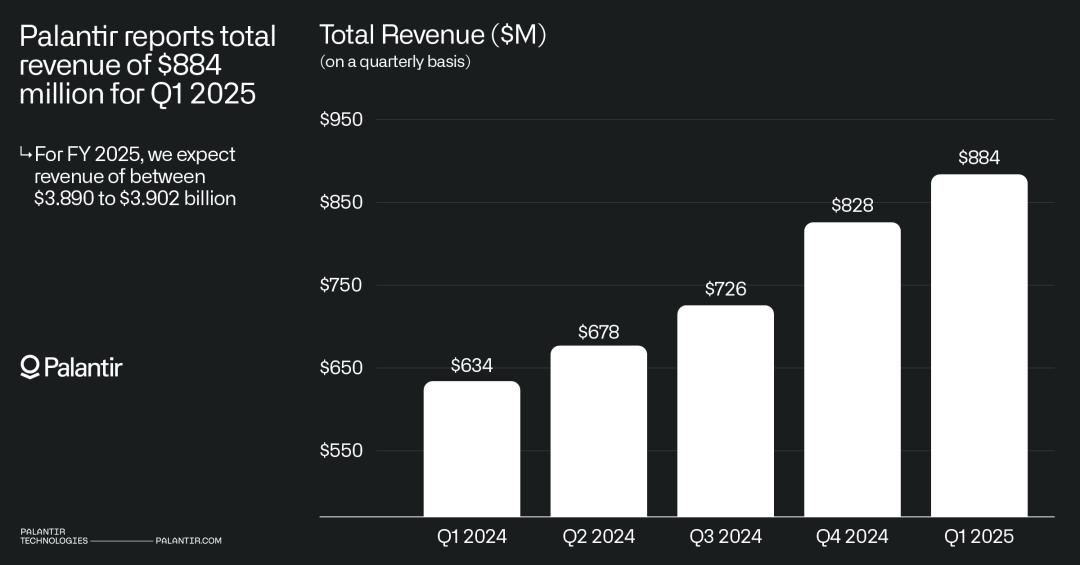
Image caption: Palantir's revenue has risen for five consecutive quarters
This year, the AI narrative began to shift from "how smart models are" to "how AI can integrate into real work." Palantir's data and business infrastructure, built over 20+ years, finally got access to sufficiently capable large models. For the first time, AI could truly enter enterprise workflows to participate in decision-making and drive execution. This led to a massive revaluation of Palantir, with its market cap approaching $500 billion at one point, making it the most prominent example of enterprise AI implementation.
This is almost a tailor-made new reference point for Kai-Fu Lee.
01.AI can no longer tell the "China's OpenAI" story, but its model capabilities, engineering experience, and enterprise deployment tools accumulated over the past year haven't become obsolete. They can be repackaged into a new Palantir-style narrative, repositioned by Kai-Fu Lee as the foundation for enterprise AI transformation: no matter how smart the model is, it must connect to the client's systems, workflows, and data to generate actual business results.
For 01.AI, this translates to an opportunity to use its full technical stack — from model fine-tuning to application development — to help enterprises implement AI. The Wiz platform later released by 01.AI essentially helps enterprises deploy models, get them running, connect to business systems, and turn them into usable agents for specific job roles.
But that's not enough.
After meeting with more than 100 CEOs, Kai-Fu Lee discovered that these top leaders weren't primarily concerned with installing a few more agents. What they cared about was whether AI would impact revenue, profits, growth rates, and risk. A deeper hidden fear was: if competitors completed AI transformation first, would they fall far behind in the next round of competition?
AI has thus evolved from a technical department tool into a core business issue on the CEO's desk.
This further deepens Kai-Fu Lee's "Top Leader Project": not only does he, as 01.AI's top leader, need to lead the charge, but the client's top leader must also personally get involved. Because AI transformation doesn't just change tools — it reshuffles power, organizational structures, and people.
In May this year, at a roundtable co-hosted by Tencent Research Institute and the University of Hong Kong, Wang Ruoyu, co-founder of Workstream, expressed similar views: AI transformation bottlenecks often lie with the top leader of the organization. If the top leader doesn't personally drive it, partial transformation risks being swallowed up by inefficient departments, and those who truly know how to use AI could end up as "sacrifices."
Kai-Fu Lee saw this and seized the opportunity to sell anxiety, creating a sense of urgency in his narrative that top leaders who "don't board the AI train now will get left behind." In his own words, "Top leaders around the world have only two choices: either lead AI transformation to outcompete rivals, or let your competitors do it and get outcompeted. There are no other options."
Now 01.AI is starting to talk like Palantir.
In Palantir's delivery methodology, the most important concepts are FDE and Ontology. FDE stands for Forward Deployed Engineer. These engineers immerse themselves in the client's daily operations, run through their business workflows, and translate those unspoken, daily processes and judgments into rules that software can execute.
<