Tesla: Toughing it out in vehicle manufacturing, with its widely hyped grand AI promises never being delivered.
Tesla released its Q2 2026 earnings report after US market hours on the early morning of July 22 Beijing time, and the overall financial results fell short of expectations. The details are as follows:
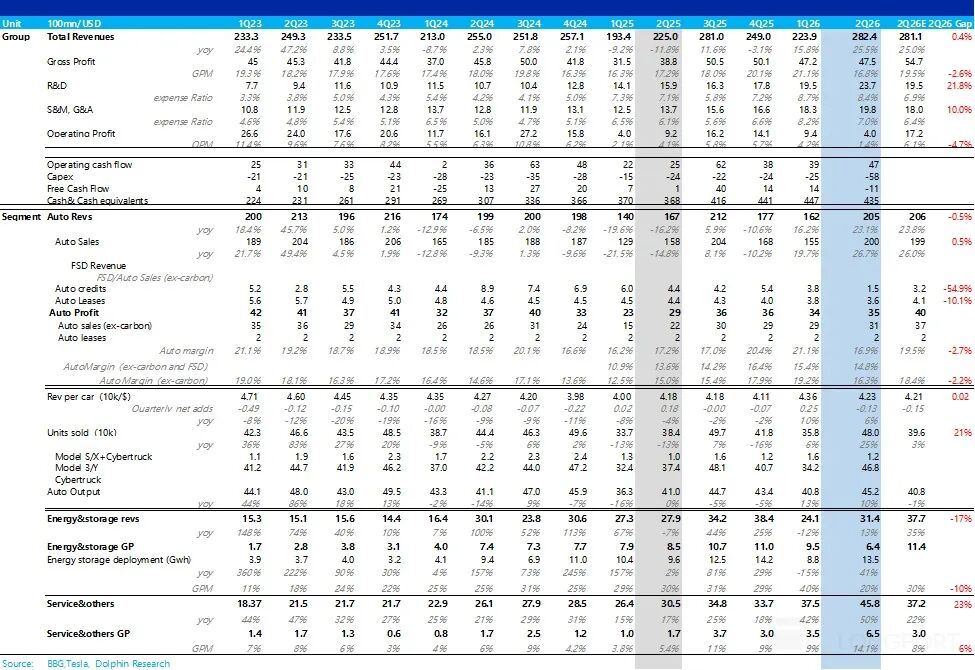
① Solid top-line performance: Tesla's total revenue in Q2 reached $28.2 billion, up 25.5% year-over-year, largely in line with the consensus estimate of $28.1 billion. However, as the figure included a $500 million positive foreign exchange impact, stripping out this one-off factor, the adjusted revenue stood at $27.7 billion, slightly below expectations.
For core operations, core automotive revenue came in at $20 billion, broadly meeting forecasts, though average selling prices (ASPs) for vehicles continued to decline quarter-over-quarter. Energy generation and storage revenue hit $3.14 billion, significantly below the expected $3.77 billion, driven by falling storage ASPs — a sign that competition in the energy storage segment has materially intensified.
② Automotive revenue narrowly met expectations: Core automotive sales revenue (excluding regulatory credits and leasing income) reached $20 billion this quarter, roughly in line with market consensus. The 27% year-over-year increase was primarily driven by higher vehicle delivery volumes.
However, vehicle ASPs continued their sequential decline, hitting $42,000 this quarter, down $1,300 quarter-over-quarter. This was mainly due to a product mix shift toward lower-priced models (Model S/X production halts), persistent promotional offers offsetting modest targeted price hikes (particularly as rising interest rates increased subsidized loan costs), and negative regional mix effects (declining US revenue share, rising share from Europe and other markets).
③ Automotive gross margin sharply missed expectations: On a true underlying automotive gross margin basis (excluding regulatory credits and leasing), the segment posted only 16.3% this quarter. Even with vehicle volumes handily beating forecasts, automotive gross margin fell 2.9 percentage points quarter-over-quarter, and also came in below the 18.4% consensus estimate.
Last quarter, Tesla benefited from $250 million in one-off warranty and tariff concessions that added roughly 2 percentage points to gross margin, a tailwind that disappeared this quarter. Meanwhile, rising commodity prices and higher subsidized loan costs from climbing interest rates further pressured this quarter's automotive gross margin.
④ Heavy R&D and capital expenditure investment continues to fund Tesla's ambitious AI roadmap: Tesla's R&D spending reached $2.37 billion this quarter, remaining at a high level and rising sequentially. The investment was primarily directed at FSD training iterations, AI5 chip design, and new product lines including Cybercab and Optimus, with management indicating R&D spending will continue to increase going forward.
Capital expenditures this quarter rose $3.3 billion quarter-over-quarter to $5.8 billion, directly pushing free cash flow back into negative territory at -$1.1 billion, representing a $2.5 billion sequential decline.
⑤ Operating profit sharply missed expectations with margins still contracting: Due to the substantial gross margin shortfall, rising R&D costs from AI investments, and higher SBC expenses (largely tied to CEO performance awards) driving up SG&A costs, operating profit reached only $400 million, well below the $1.72 billion market consensus. Operating margin stood at just 1.4%, down a further 2.8 percentage points quarter-over-quarter.
Dolphin Analyst Viewpoint
Overall, after this quarter's delivery volumes far exceeded expectations and the market raised its earnings forecasts accordingly, Tesla delivered a results report where profitability fell well short of heightened expectations.
Core automotive ASPs continued their modest sequential decline, and even with scale effects reducing per-unit depreciation costs and high-margin FSD subscription income boosting results, the true underlying automotive gross margin still dropped nearly 3 percentage points quarter-over-quarter to 16.3% this quarter.
Beyond the absence of last quarter's one-off benefits (roughly $250 million in warranty and tariff concessions contributing ~2 percentage points to margin), falling vehicle ASPs and rising raw material costs (lithium, steel, aluminum, copper, DRAM) combined to drag down gross margins.
Tesla's second growth engine, the energy storage business, also underperformed. Energy storage gross margin plummeted 20 percentage points quarter-over-quarter to just 20%, as the 1Q26 one-off tariff benefit (~$250 million) did not repeat, alongside falling storage ASPs.
Management forecasts that energy storage gross margin will trend downwards amid intensifying competition and tariff impacts, likely stabilizing long-term in the mid-20% range — far below the prior 30%+ steady-state level, confirming that competition in energy storage is materially intensifying even for Tesla, whose core market remains the US.
As such, even with delivery volumes far exceeding expectations this quarter, overall profitability underperformed, and core operating profit continued its sequential decline. With persistently rising Capex investments, Tesla's free cash flow has turned negative (down $2.5 billion quarter-over-quarter to -$1.1 billion).
Yet Tesla is maintaining its full-year 2026 Capex guidance of over $25 billion (primarily for expanding the Robotaxi fleet, scaling Optimus production capacity, constructing semiconductor factories, expanding solar manufacturing capacity, and building out AI compute infrastructure), implying roughly $16.7 billion in Capex will be deployed in H2 2026 (following ~$8.3 billion in H1).
With both Tesla's core automotive and energy storage businesses facing margin pressure, covering its growing Capex investments with operating cash flow will become a major challenge.
Looking at Tesla's share price, the automotive business accounts for less than 1/3 of its total market value, and the market's focus has gradually shifted from the automotive segment to AI operations, with vehicles and energy storage increasingly acting as "cash cows".
With roughly 2/3 of Tesla's market value still highly dependent on the execution of its AI roadmap, quarterly earnings reports represent critical milestones to verify whether its grand AI ambitions are materializing as planned, and track progress on future AI growth initiatives:
① Optimus: No key milestone confirmations provided
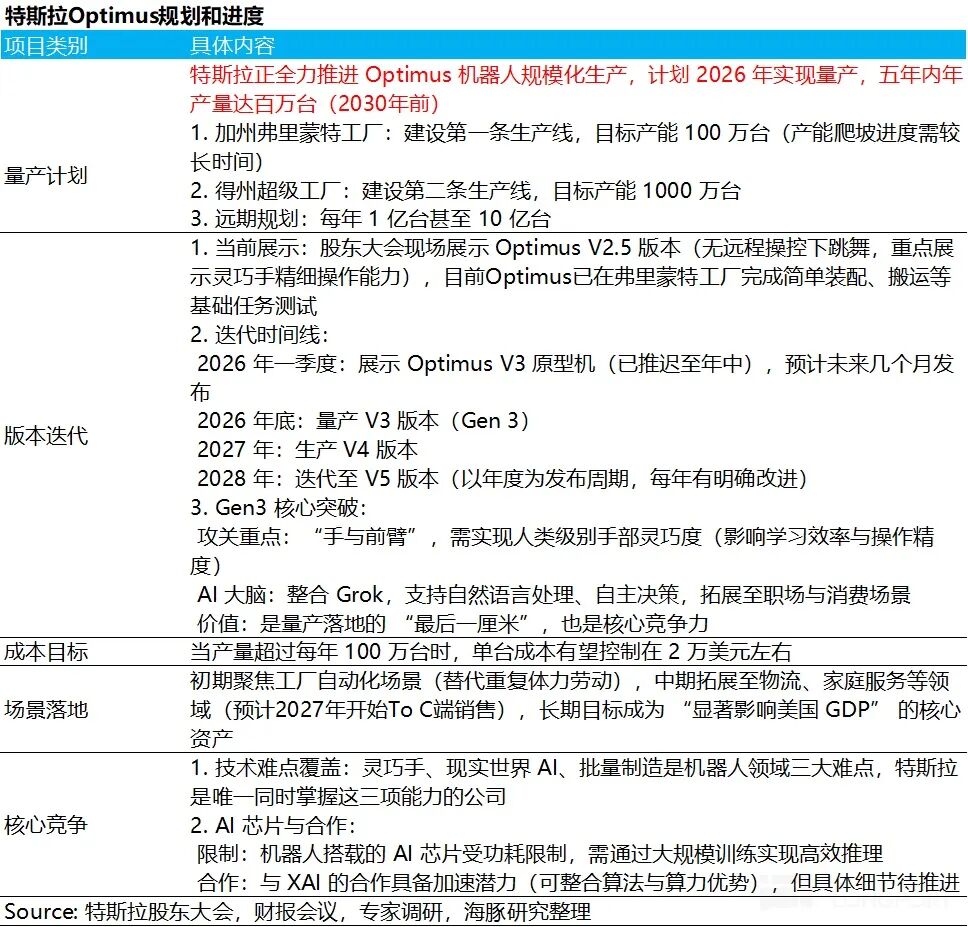
As Optimus development moves from the conceptual phase to production preparation, tangible progress (such as design finalization, production launch, and securing external orders) is critical to supporting its long-term 2030 mass deployment vision of millions of units and corresponding valuation.
During last quarter's earnings call, Tesla provided explicit guidance:
Optimus V3 reveal timeline: V3 design is nearly complete, with a demonstration planned for mid-2026.
Mass production timeline: The Fremont factory is preparing to launch production, with management targeting startup in late July or August. A second Optimus facility is under construction at Giga Texas, scheduled to come online in summer 2027.
Production ramp progress: Elon Musk noted that this is an entirely new product with over 10,000 unique components and a brand new supply chain, so initial production rates will be very gradual, with meaningful capacity levels not expected until 2027.
However, per industry reports cited by Morgan Stanley, Tesla has already issued capacity guidance to suppliers targeting 1,000 units per week (before September) and 2,000-2,500 units per week (by year-end), leading the market to build renewed expectations for Optimus production acceleration.
Use case deployment: Optimus has begun performing simple tasks within Tesla factories, with management anticipating it will be operational at external companies sometime next year.
No reconfirmation of any of these key milestones appeared on this quarter's earnings call. Instead, Tesla outlined an even more ambitious target: an annual production capacity of 10 million units for Optimus V4 — an order-of-magnitude increase from the 1 million unit target for earlier Optimus generations.
② Robotaxi: The long-awaited large-scale commercialization "inflection point" also went unvalidated
Tesla's core competitive advantage in autonomous driving lies in its ability to pursue faster large-scale deployment than peers, leveraging low-cost ~$30,000 vehicles and eliminating the need for pre-mapped high-definition road data.
As a result, Robotaxi is viewed by the market as one of the most critical upside drivers for Tesla's stock (with faster monetization and stronger near-term feasibility than the Optimus business). Investors remain most focused on which cities and regions Robotaxi will expand into, the share of total miles driven under "unsupervised autonomous operation", and Cybercab production progress.
From an investor perspective, current Robotaxi deployment progress remains "slower" than hoped:
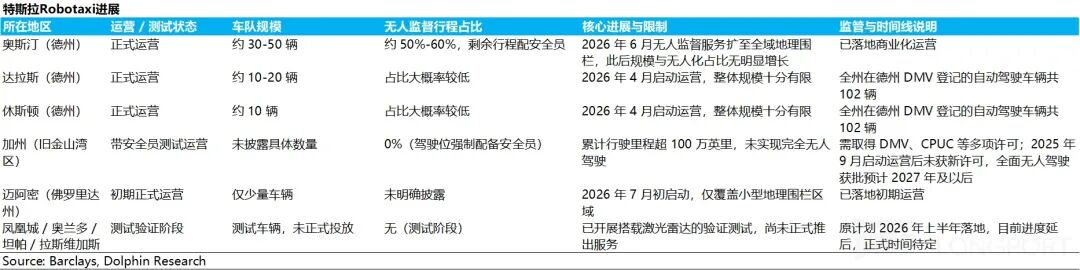
Tesla only operates a small fleet of roughly 30-50 vehicles in Austin, with only 50-60% of those trips running without human supervision.
By comparison, Tesla lags far behind Waymo in Robotaxi commercial scale — Waymo now operates ~3,800 vehicles across over 30 cities, leaving Tesla still in the very early stages of commercial rollout.
While Robotaxi progress has been gradual, market expectations remain extremely high, as the segment is seen as make-or-break for Tesla's valuation. Investors are eagerly awaiting a proven "inflection point" demonstrating large-scale commercial viability.
During last quarter's call, Tesla laid out its Robotaxi operational outlook: targeting unsupervised operation across more than ten states by year-end. However, citing rigorous safety validation requirements and the fact that the current test fleet still runs on the V14.3 software version, management argued that large-scale Robotaxi deployment would not be prudent before the V15 architecture (which significantly raises safety performance thresholds) is released.
As a result, Robotaxi and unsupervised FSD will not deliver material financial contributions in 2026, with the inflection point for explosive revenue growth anchored in 2027.
On this quarter's call, Tesla only noted that the difficulty and lead time for launching in new cities is steadily decreasing, with the future goal shifting from "city-by-city" expansion to "state-wide coverage", and stating that 99% reliability levels and dedicated Cybercab driving data accumulation are prerequisites for mass rollout. This implicitly suggests that large-scale Robotaxi expansion will likely face further delays.
For Cybercab (the $30,000 purpose-built two-seater with no steering wheel), pilot production kicked off in April 2026 but output remains limited, with mass production not yet initiated. Tesla provided no specific timeline guidance for full-scale Cybercab manufacturing.
③ FSD: No confirmation of a "full unsupervised driving launch timeline"
The market's core expectation for FSD centers on when Tesla will push "unsupervised" FSD capabilities to consumer vehicles (allowing drivers to disengage and even sleep behind the wheel).
FSD progress not only enables Robotaxi expansion, but also directly boosts the attractiveness of Tesla's passenger vehicles (part of Q2 US delivery upside may stem from customers purchasing cars specifically to access FSD), and converts directly into high-margin subscription revenue (FSD gross margins are ~90%), lifting overall profitability.
Elon Musk stated on the 1Q26 earnings call that for safety reasons, the company is exercising extreme caution before rolling out unsupervised FSD to consumers, with the earliest possible timeline being Q4 2026.
This quarter's call similarly provided no reconfirmed timeline for delivering fully unsupervised autonomous driving to end users.
On the regulatory front, however, this represented the most meaningful FSD progress in Q2 2026:
Europe: Supervised FSD has received regulatory approval in multiple European countries including the Netherlands, Belgium, Denmark, Estonia, and Lithuania. Dutch regulators have already begun the process of seeking European Commission approval for EU-wide deployment, paving the way for broader clearance across the bloc.
China: FSD is currently undergoing the domestic regulatory approval process, with management stating on the April earnings call that they hope to secure clearance in Q3 2026.
While FSD technical and regulatory progress is accelerating, the timeline for releasing the highly anticipated "unsupervised" FSD to private consumers — a key driver of vehicle sales and Robotaxi adoption, as well as a core catalyst for market sentiment — again received no concrete confirmation this quarter.
Against the backdrop of Tesla's underwhelming earnings results, and its automotive and energy storage segments failing to generate safe, stable operating cash flow amid ongoing margin contraction, the company's capital expenditures remain at elevated levels (over $25 billion in 2026) and are projected to keep growing for the next 2-3 years. Tesla's AI ambitions must rapidly achieve a self-sustaining commercial closed loop to generate positive cash flow, or the company will face very real financing pressure over the next 1-2 years.
Furthermore, progress across the full AI portfolio (Optimus, FSD, and Robotaxi) received no critical milestone validations on this quarter's call, which will amplify market concerns about the uncertainty surrounding AI monetization.
As a result, the Dolphin Analyst expects Tesla's stock price to remain under pressure following these earnings — particularly as AI now dominates its valuation — unless unexpected positive AI developments or new strategic narratives (such as a Tesla + SpaceX combination that tells a full-stack AI infra, model, and application story) emerge to justify its lofty valuation.
Detailed Analysis
1. Tesla: Revenue Meets Expectations, but Gross Margin Faces Severe Pressure
Tesla's Q2 total revenue reached $28.2 billion, up 25.5% year-over-year, largely in line with the consensus estimate of $28.1 billion. However, as the figure included a $500 million positive foreign exchange impact, stripping out this one-off factor, the adjusted revenue stood at $27.7 billion, slightly below expectations.
On the gross margin front, overall Q2 gross margin was 16.8%, down a sharp 4.3 percentage points from the prior quarter and below the 19.5% consensus estimate, indicating persistent severe margin pressure. Breaking down performance by business line:
① Automotive business: Revenue meets expectations, but margins remain under pressure
Total automotive revenue hit $20.5 billion this quarter, up 23% year-over-year and broadly in line with the $20.6 billion consensus. This figure includes:
Pure profit from regulatory credits of $150 million, down $230 million quarter-over-quarter, a decline that was largely anticipated by the market following prior adjustments to emissions regulations.
Core automotive sales revenue (excluding regulatory credits and leasing income) reached $20 billion, roughly matching market consensus. The 27% year-over-year growth was driven by higher vehicle delivery volumes, though vehicle ASPs continued their sequential decline to $42,000 this quarter, representing a $1,300 quarter-over-quarter drop.
Reported automotive gross margin came in at 16.9% this quarter, below the 19.5% market consensus, primarily due to reduced recognition of high-margin regulatory credit revenue.
However, on a true underlying automotive gross margin basis (excluding regulatory credits and leasing), the segment posted only 16.3% this quarter. Even with vehicle volumes handily beating forecasts, automotive gross margin fell 2.9 percentage points quarter-over-quarter, and also came in below the 18.4% consensus estimate.
Last quarter, Tesla benefited from $250 million in one-off warranty and tariff concessions that added roughly 2 percentage points to gross margin, a tailwind that disappeared this quarter. Meanwhile, rising commodity prices and higher subsidized loan costs from climbing interest rates further pressured this quarter's automotive gross