Does the "open-source villain" Anthropic also have a good cost-performance ratio?
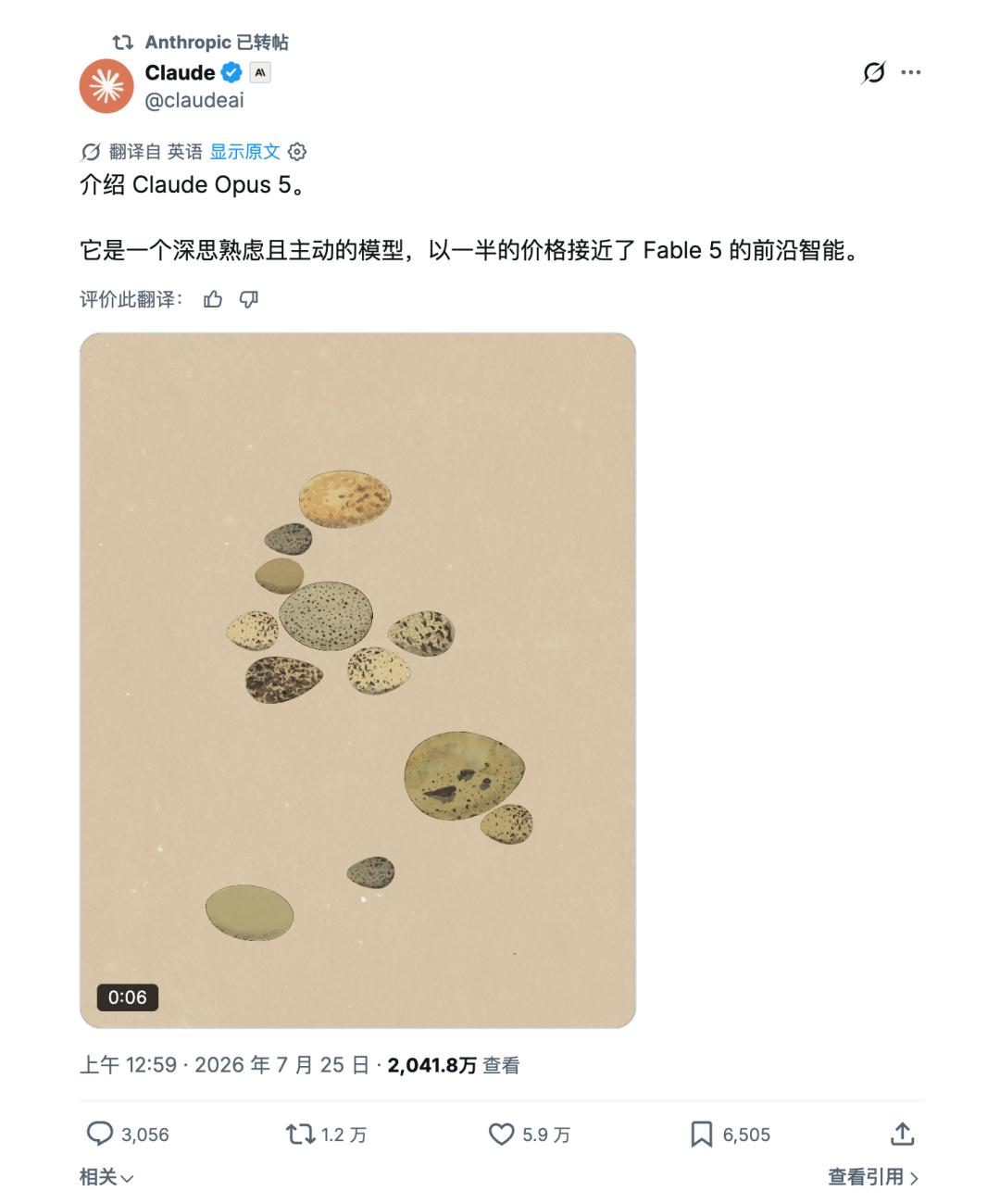
Anthropic released Claude Opus 5 in the early hours of July 25 Beijing Time, claiming that the model's performance is close to Fable 5, but its price is only half of the latter.
This is likely the first time Anthropic has publicly emphasized the cost-performance advantage of its own model. Claude Opus 5 is priced at $5 per million input tokens and $25 per million output tokens, the same price as the previous-generation Opus 4.8, but with a significant performance boost.
Even compared to OpenAI's GPT-5.6 Sol, Opus 5 still has a certain price advantage. The input prices of the two are the same, but the output price of Opus 5 is 16.7% lower.
Anthropic says Opus 5 is designed for daily use and is more efficient than other models. Tests from Artificial Analysis show that Opus 5's comprehensive intelligence index is basically on par with Fable 5, even taking the lead in some agent knowledge work tests, with an average task cost 26% lower.
Shortly before that, Chinese large model company Moonshot AI released the open-source model Kimi K3 with 2.8 trillion parameters. Its performance is very close to Fable 5 and GPT-5.6 Sol at a significantly lower price, which once caused panic in the U.S. tech industry and was regarded as "DeepSeek 2.0".
Thanks to its leading position in programming scenarios, Anthropic's models have always been priced at a premium. Earlier this year, its revenue even surpassed that of OpenAI, which has a user base several times larger. However, as the performance gap between top-tier models gradually narrows and enterprises continue to tighten their token spending, Anthropic has also had to start considering price factors.
Earlier, Anthropic's Opus 4 model was priced as high as $15 per million input tokens and $74 per million output tokens. But after the price of Opus 4.5 at the end of last year was cut by two-thirds, the Opus series models have not adjusted their prices since then, remaining at the $5/$25 level.
Now, with the arrival of Opus 5, Anthropic finally has a cost-effective offering.
Half-price Fable 5, More Value Without Price Hike
If you had to describe Anthropic's newly released Opus 5 in one sentence, it would probably be "half-price Fable 5".
The Opus series used to be Anthropic's highest-performance and most expensive model line, but after the launch of the Mythos and Fable models this year, Opus seems to have taken a back seat. Some updates, such as the 4.7 version, even drew collective complaints from developers, as if each update made the model less capable, leading people to wonder if Anthropic had diverted all its resources to the Fable model line.
Fable 5, the first open model at the Mythos level, was officially released in June this year. Its performance far exceeded that of the contemporaneous Opus 4.8, and it remains the most powerful model on the market to date. However, the reception of Fable 5 has not been entirely satisfactory. Its high price, higher token consumption, and Anthropic's consistent controversial downgrade operations in the name of safety have instead made this highest-performing model the subject of the most dissatisfaction.
Opus 5 can be regarded as a correction of direction for Anthropic. Unlike in the past when Anthropic always emphasized the strong performance of each new Opus series model, the first sentence of its Opus 5 announcement was "...with intelligence close to Claude Fable 5, but at half the price" — clearly trying to avoid scaring developers away again.
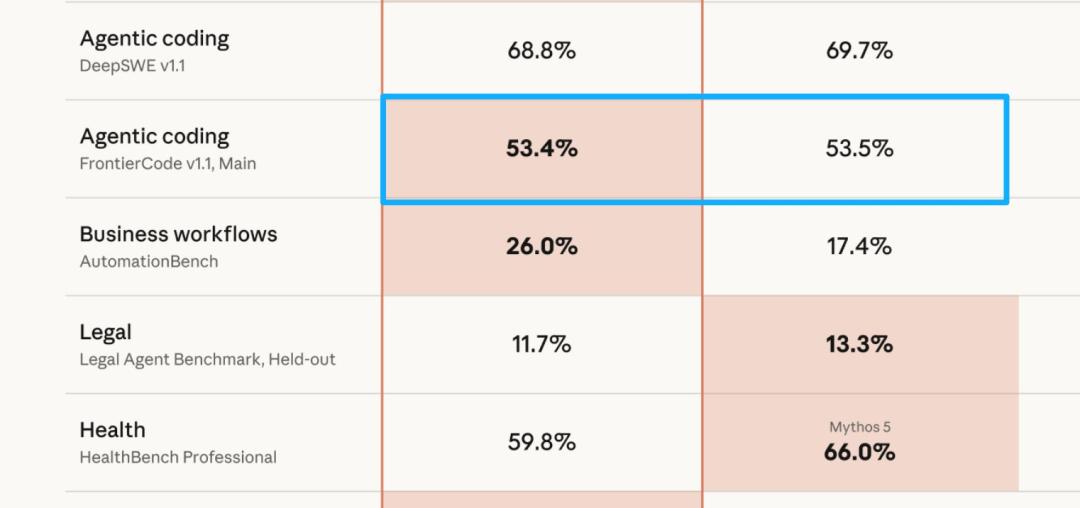
Lower pricing brings performance that is no less than Fable 5. In multiple coding and knowledge work tests including Frontier-Bench and GDPval-AA, Opus 5 outperforms Fable 5, and is called a SOTA model by Anthropic. Only in cybersecurity tasks does Opus 5 lag slightly behind.
Elon Musk, an old friend of the Chinese people who just commented on Kimi K3 as "impressive", also praised Opus 5 with "Very impressive". However, he also emphasized that Grok's upcoming 4.5 model will be even more cost-effective.
But perhaps due to the hasty release, Anthropic mistakenly marked a result where Opus 5 lagged behind Fable 5 as the optimal one in its initial test rankings, a misstep that echoes OpenAI's past public blunders.
What matters even more is cost. Anthropic particularly emphasizes that Opus 5 achieves better performance at the same cost as its predecessor Opus 4.8. In internal tests, Opus 5 requires fewer tokens to complete the same task, with an average cost about 30% lower than Opus 4.8.
For example, in the CursorBench 3.2 test, under the highest reasoning intensity, the performance of Opus 5 differs by less than 0.5% from the peak score of Fable 5, but the cost per task is only half of the latter. In the OSWorld 2.0 test, Opus 5 even surpassed Fable 5's best result at roughly one-third of the cost.
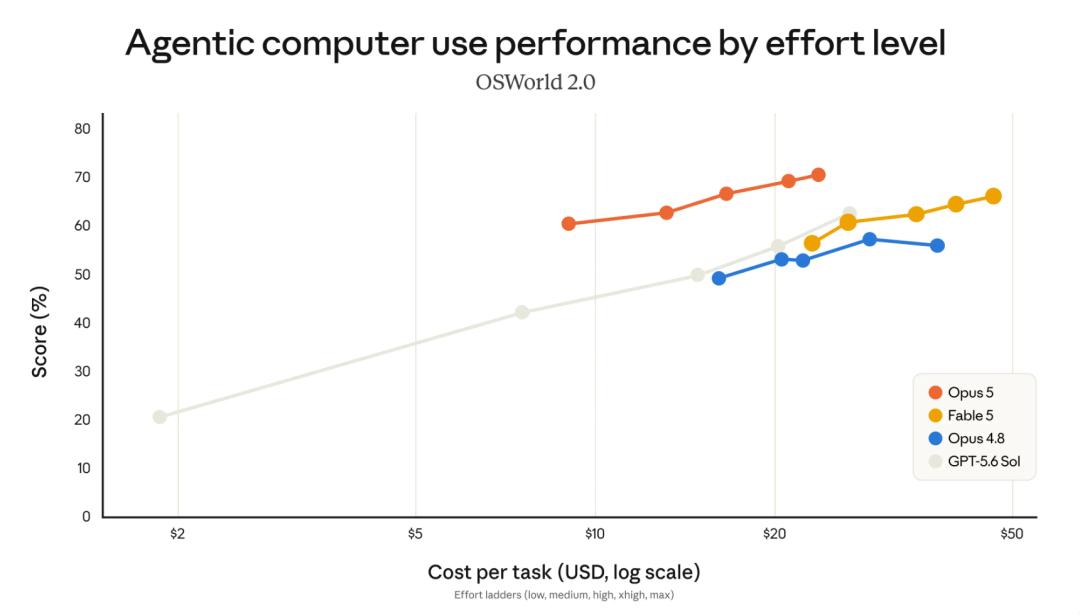
Anthropic has also added five levels of reasoning intensity to Opus 5, allowing developers to adjust the computing workload according to the complexity of the task. For low-intensity tasks, the model can reduce token consumption, while enabling higher reasoning capabilities for complex tasks. But even at the highest reasoning level, the average single-task cost of Opus 5 is $2.03, which is lower than Fable 5's $2.75.
In short, all the optimizations of Opus 5 are dedicated to building a model with better cost efficiency. Its absolute performance may still lag behind Fable 5, but it is more than sufficient for daily development scenarios. Compared with domestic models, Opus 5 is still slightly more expensive, but within Anthropic's product portfolio, Opus 5 can already be described as cost-effective.
It has received significantly more positive reviews than its predecessor, Opus 4.8. Some developers believe Opus 5 is more suitable as the primary model for daily development, and some even used the phrase "Fable 5 is basically dead" to emphasize Opus 5's excellence.
However, Anthropic still has not stopped its downgrade strategy, and Opus 5 will still silently switch to Opus 4.8 under certain circumstances.
Anthropic Is Forced to Shift Focus
The large model industry bears some similarities to the consumer electronics industry: the capabilities of the previous generation of flagship models are continuously cascaded down to lower-priced product lines, and the cost of models continues to decline with iterations. In the past, models released by Anthropic such as Haiku 4.5 and Sonnet 5 have all achieved partial capabilities on par with the higher-tier Sonnet 4 and Opus 4.8.
But Opus 5 is not a simple replication of the previous capability cascading. In the past, lower-tier models usually had to wait for one or even several rounds of iterations to catch up with the performance of higher-tier models, while Opus 5 matched Fable's performance at a lower cost just over a month after Fable 5's release.
Part of the reason may be related to Fable's excessive pricing. Even though current token prices have dropped significantly compared to a few years ago, due to the higher token consumption of agents, enterprises' AI spending has instead risen rather than fallen, putting an increasing burden on them. Although Fable 5 has excellent performance, it is difficult to be used as a base model for large-scale enterprise calls.
Last month, *The Wall Street Journal* published an article stating that "the AI price war has fully broken out", noting that large companies and startups are increasingly turning to low-cost open-source models, putting OpenAI and Anthropic under price-cutting pressure. The most intuitive pressure comes from Chinese open-source models: for example, the price of Fable 5 is more than 50 times that of DeepSeek-V4 Pro.
AI model aggregation platform OpenRouter stated that DeepSeek has been the AI company with the highest token usage on its platform since mid-May. From the fall of 2025 to the spring of 2026, the token usage of open-source models grew at four times the rate of closed-source models. OpenRouter says more than 500 organizations have abandoned proprietary models in favor of open-source alternatives.
Anthropic used to be able to command a premium by relying on its performance advantages, but it is now difficult to maintain that position. While there is still a 6-12 month performance gap between open-source and closed-source models, enterprises do not always need the most powerful models.
Mike Sacks, CEO of Cursor, put it this way: the highest-performance model is not a necessity for daily tasks, "it's like driving a Lamborghini to the grocery store to buy milk when the car is meant for the racetrack."
In the past, the trend among U.S. enterprises was "token maxxing", but *The Wall Street Journal* now argues that the new trend is "Thrift-maxxing" — extreme cost saving. Companies no longer route all requests to the most expensive models, but instead use a mix of models from different vendors and tiers.
Over 80% of Anthropic's revenue comes from enterprise customers, making it more vulnerable to industry shifts. In May this year, Microsoft internally suspended the use of Claude Code, one of the reasons being its excessive token costs. Amazon is also reducing its Claude calls, routing more requests to its in-house developed models, and handling simple tasks through caching and deterministic programs.
Anthropic also faces fierce competition from OpenAI. According to previous media reports, OpenAI is planning a significant price cut in a bid to poach customers from Anthropic. OpenAI internally assumes that Anthropic will also take similar price reduction measures.
Opus 5 may just be the beginning of Anthropic's shift to a cost-performance focus. As the Fable and Opus models are iterated to the 5th generation, the lower-tier Sonnet and Haiku models will also be upgraded soon, with even lower prices.
The Only Open-Source Opposition
At the same time as the release of Opus 5, NVIDIA CEO Jensen Huang posted an AI open-source initiative on the X platform, stating that U.S. leadership in AI should not depend solely on one state-of-the-art closed-source model, but on the ability to build an open ecosystem that penetrates all industries. "The world needs cutting-edge closed-source models, and it also needs cutting-edge open-source models."
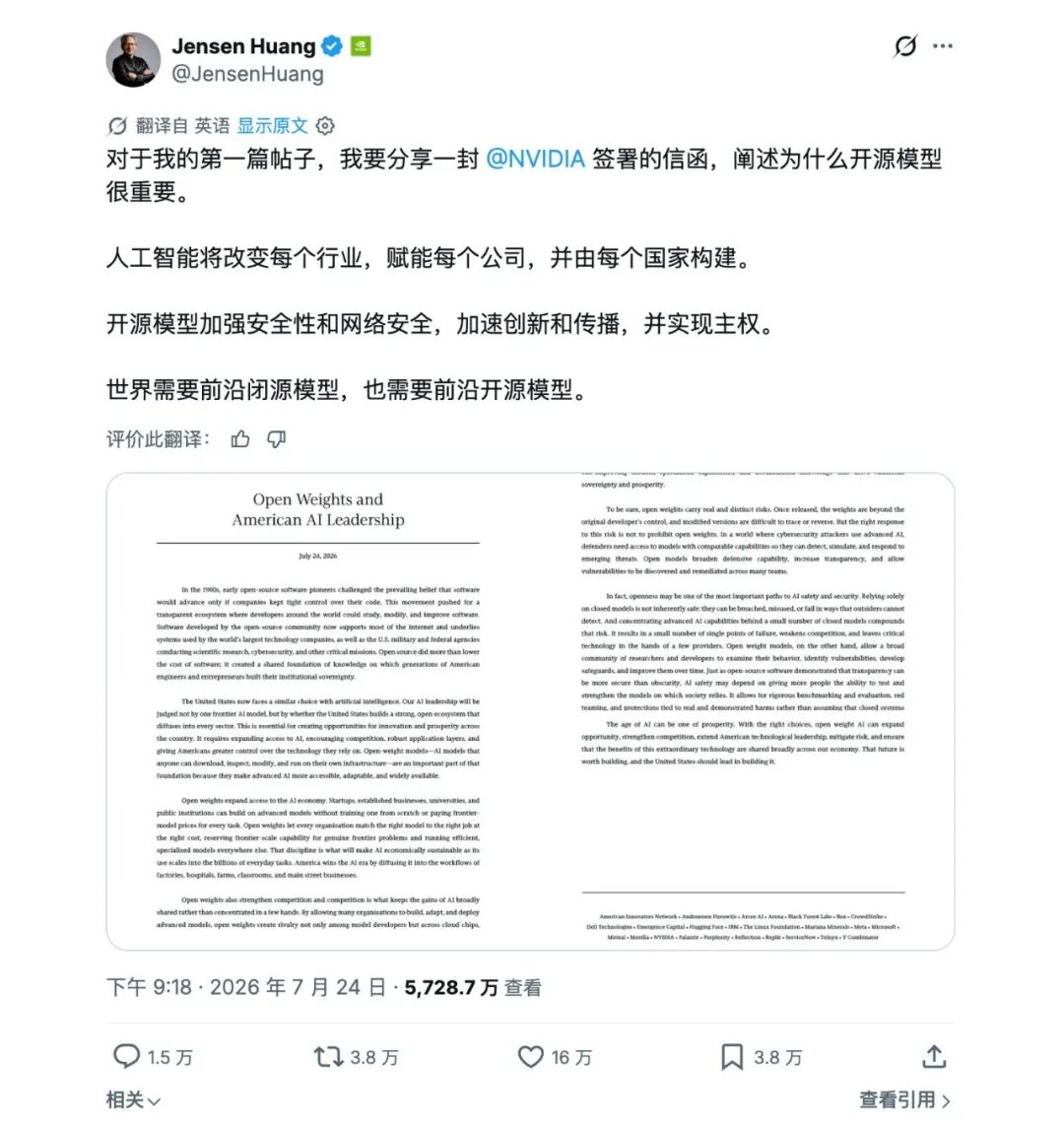
Jensen Huang releases the open-source initiative
From its inception, the initiative received joint support from 24 tech giants, investment institutions, and startups, including Microsoft, Meta, IBM, and a16z.
In the following two days, 23 more companies including OpenAI, Google, GitHub, Cloudflare, and Cisco joined to support the initiative, expanding the list of co-signatories to 50. Elon Musk's SpaceX has not yet signed, but he immediately reposted his support on X, saying "I fully support this."
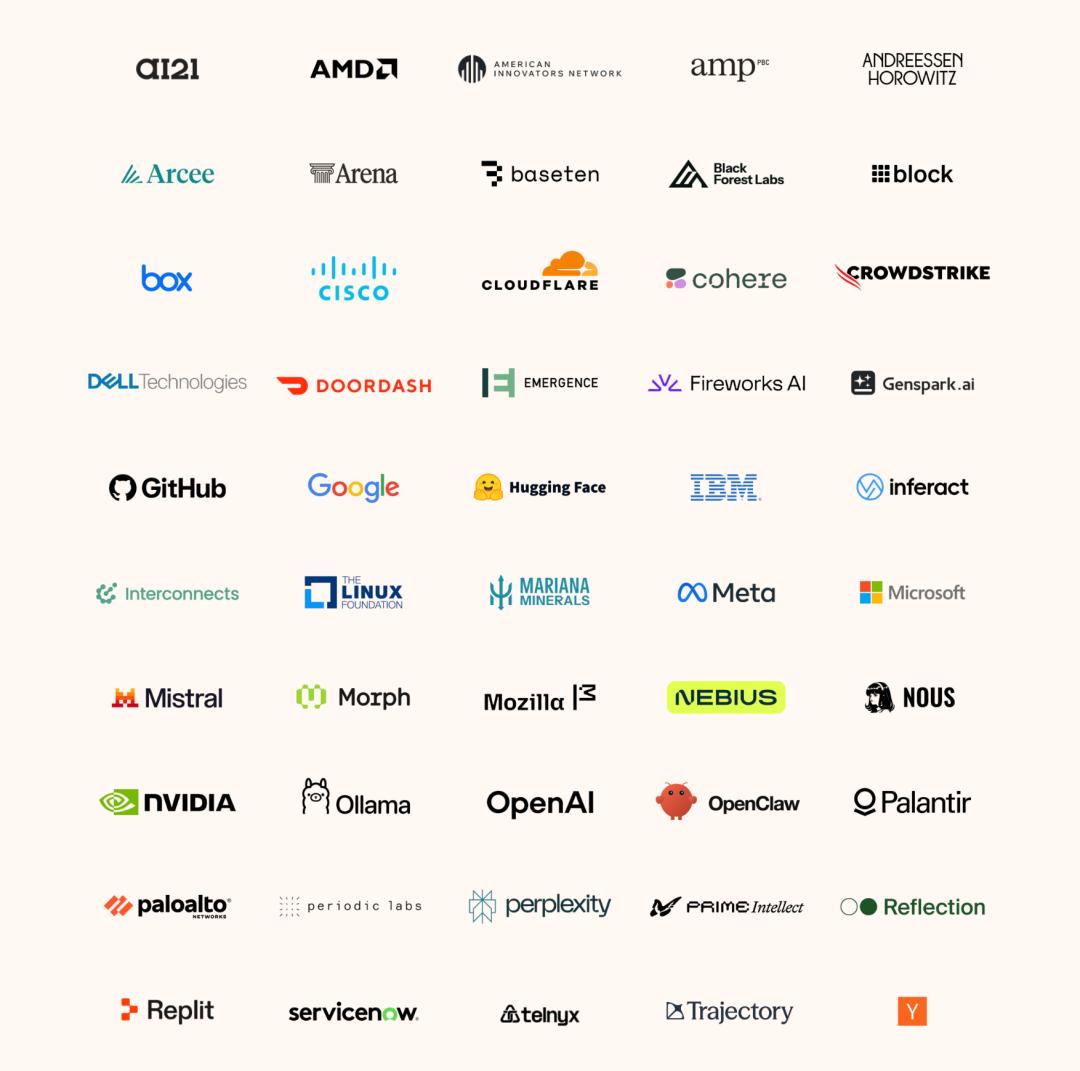
List of companies that co-supported the open-source initiative
As is well known, Anthropic has long been one of the most vocal opponents of open-source models in the entire U.S. tech industry. Anthropic has long emphasized model weight security, catastrophic risk testing, and export controls, repeatedly accusing Chinese open-source models of performing "distillation attacks" on its own models, and lobbying the U.S. government to ban Chinese open-source models.
But now, even core players in the AI industry chain such as Microsoft, OpenAI, Meta, and NVIDIA have publicly supported the open ecosystem, and the closed-source path that Anthropic adheres to is facing increasing pressure. On X right now, Opus 5 is no longer the focus of people's attention; instead, Anthropic's values are facing growing skepticism.
As of press time, Anthropic has not yet responded to Jensen Huang's open-source initiative. However, Julian Schrittwieser, a researcher at Anthropic, publicly quipped about Jensen Huang, "I'm so excited that Jensen Huang is now a believer in open source. Looking forward to the open-sourcing of CUDA and GPU drivers!" After Microsoft CEO Satya Nadella reposted his support for Jensen Huang's open-source initiative, Schrittwieser also joked, "Looking forward to the open-sourcing of Windows and MS Office."
"All the companies that historically were extremely against open source are suddenly all for openness," Schrittwieser said.
Just like Anthropic's various controversial moves in the past, this researcher's remarks also sparked considerable backlash on social media. Some comments argue that Jensen Huang's open-source initiative is more about allowing open-source models to exist, rather than forcing other closed-source companies to switch to open-source, but Anthropic always seems to be inclined to set itself against the entire open-source community.
Julien Chaumond, co-founder and CTO of Hugging Face, said that he doesn't hate Anthropic, and Anthropic has every right not to open-source its own work, but at the same time, it is reasonable to point out their bad ideas.
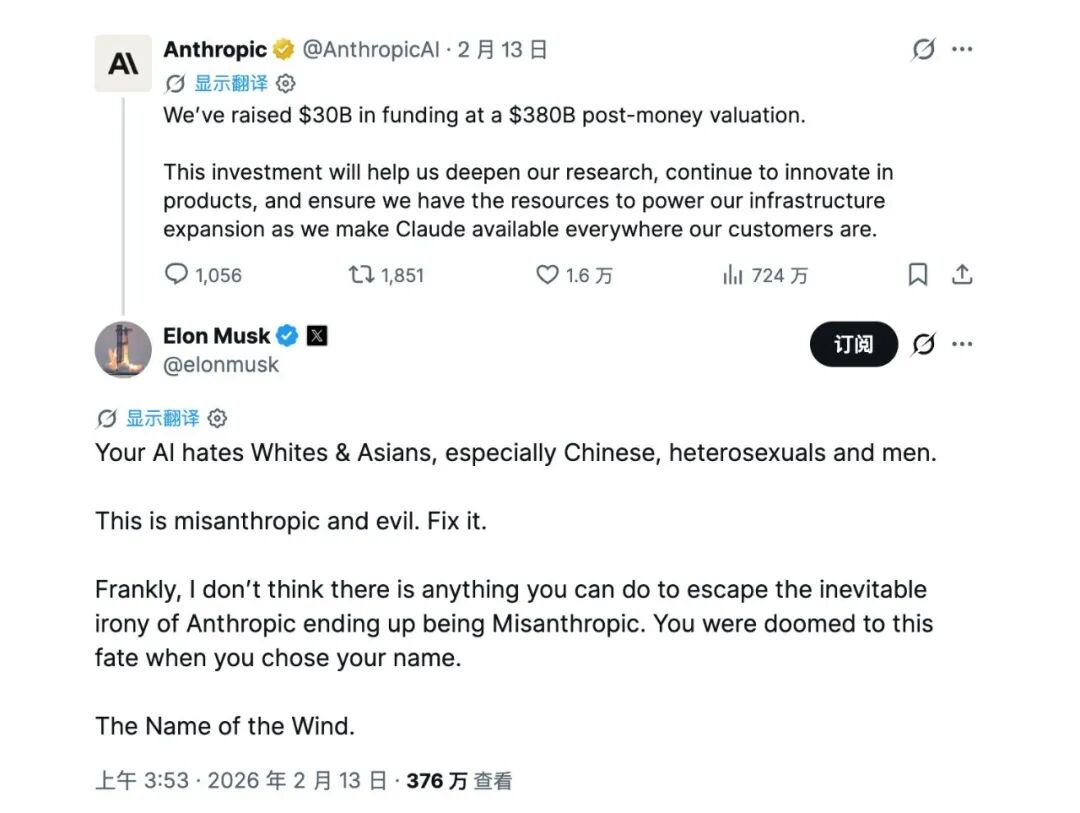
Earlier, Elon Musk commented on Anthropic's values, saying that their AI is biased against white and Asian groups, and especially hates Chinese people, heterosexuals, and men. "This is anti-human and evil."
This article is from the WeChat public account "On the Mountain", author: He Jian, editor: Jiang Jiao, published with authorization from 36Kr.