Humanoid robots, it's time to compete on brainpower.
July 22, 2026, nearly 200 Silicon Valley startups, including Proton and Y Combinator, jointly signed a letter to the White House — urging the U.S. government not to block American companies' access to Chinese open-weight AI models, warning that such a move would trigger severe consequences.
"Hundreds of companies will collapse overnight. That would be great news for Anthropic, because all of us will have to pay to use their services."
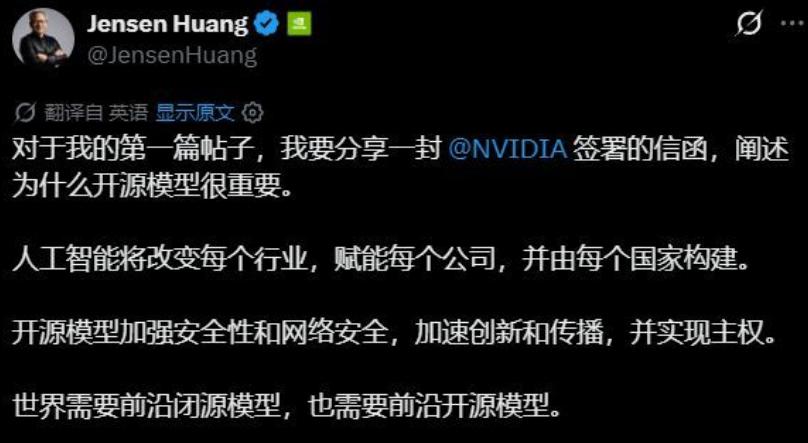
Two days later, on July 24, 2026 (local time), Jensen Huang, CEO of NVIDIA, posted his first-ever tweet. The full text reads as follows:
"My first post, sharing a joint letter signed by NVIDIA on why open-source models are so important. Artificial intelligence will transform every industry, empower every company, and be built collectively by all nations. Open-source models enhance security and cybersecurity, accelerate innovation and accessibility, and safeguard national sovereignty. The world needs both cutting-edge closed-source models and cutting-edge open-source models."
The trigger for these two events points to the same source — the Kimi K3, released by Chinese AI company Moonshot AI.
This open-source large model with 2.8 trillion parameters natively supports visual understanding and features a 1 million-token context window. It outperforms GPT-5.6 and Anthropic's Fable 5 in multiple authoritative benchmarks. Most critically, its full weights will be completely open to the public on July 27, 2026 — making it the open-source model with the largest parameter count in the world.
Starship Insight has noted another detail: just over a month ago, on June 1, 2026 — Jensen Huang announced that NVIDIA and Unitree Robotics had jointly launched the humanoid robot reference design H2+ (powered by the Isaac GR00T system). At the time, the move was widely interpreted as a powerful collaboration in the humanoid robot sector — the strongest "Chinese body" paired with the strongest "American brain."
But just over a month later, the release of Kimi K3 and the Silicon Valley joint letter have fundamentally reshaped that narrative.
China's "brain" is by no means inferior.
Moreover, Chinese large models are following a different path from the U.S. model — the U.S. focuses on closed-source systems, with technology concentrated in a small number of giants. China prioritizes open-source development, making technology accessible to developers worldwide. Chinese large models have been deeply integrated into the global AI innovation ecosystem, becoming an indispensable infrastructure for the global AI developer community.
Returning to the humanoid robot sector —
What this field requires is deep integration of "brain" and "body." Currently, leveraging the world's most complete manufacturing system and supply chain, China is building advantages in motion control, mass hardware production, and cost optimization.
In the large model domain, China has already reached a level of development on par with the U.S., even leading in some areas. The core current gap lies primarily in the production capacity and computing power supply of AI chips.
The "Cerebellum" Advantage: A Time-Limited Ticket
The humanoid robot race did not start recently. Over the past century, this track has evolved from U.S. dominance, U.S.-Japan rivalry, to the current landscape of U.S.-China dual leadership.
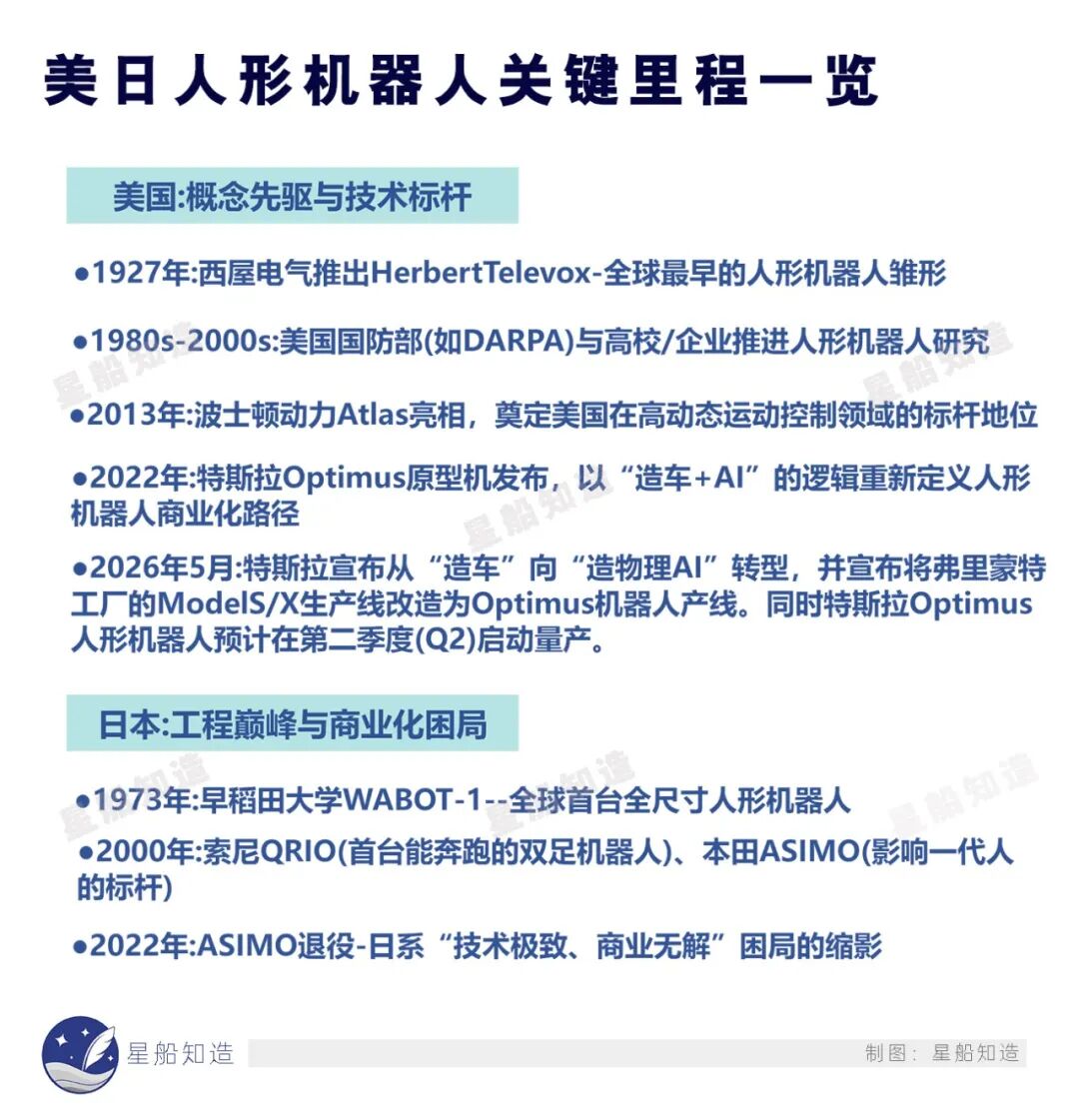
Japanese humanoid robot development has largely faded from view in recent years — Honda's iconic ASIMO robot was retired in March 2022, never leaving the laboratory over its 22-year development lifespan.
In contrast, China's humanoid robot industry started later, but boasts exceptional supply chain efficiency and rapid evolutionary speed.
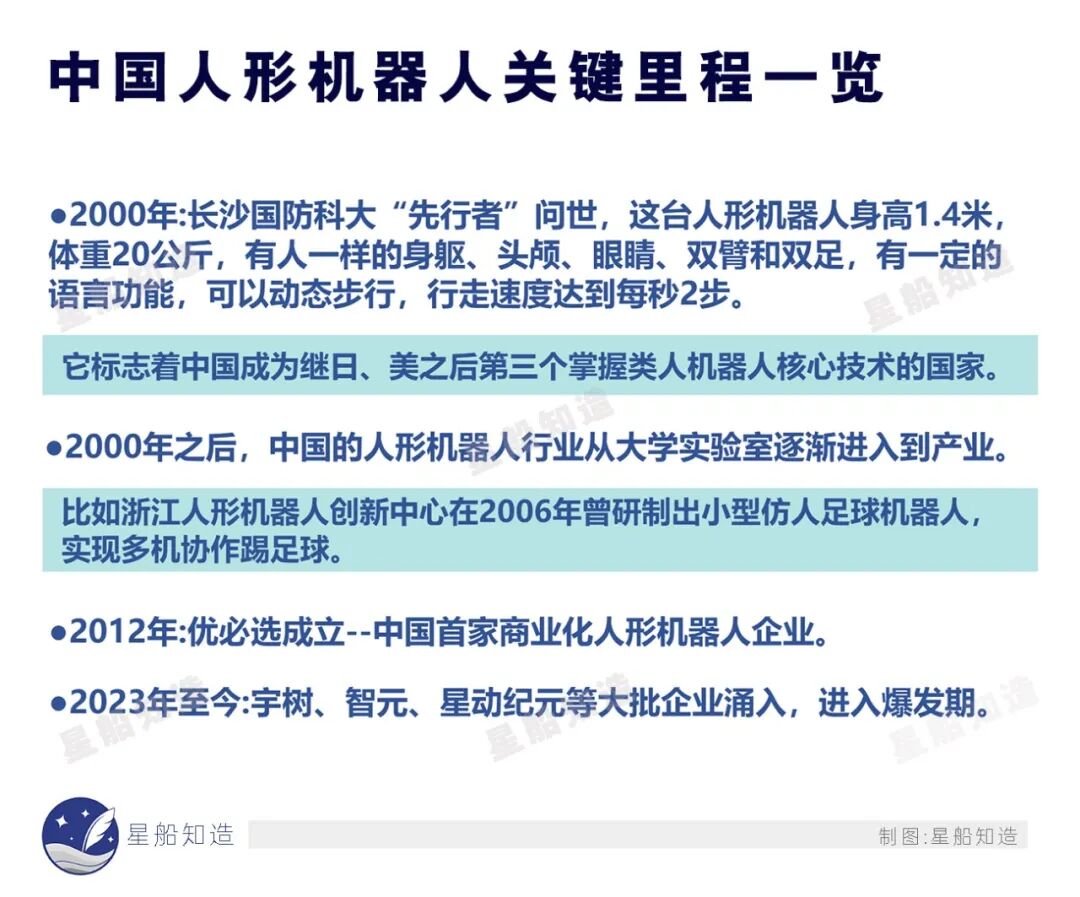
Overall, the six-year period from 2017 to 2022 marked the end of China's humanoid robot industry's fledgling phase, as it entered the "eve" of industrial explosion toward maturity.
A wave of mature products emerged — UBTECH, CloudMinds and other enterprises continuously optimized humanoid robot locomotion technology, gradually progressing from slow static walking to continuous dynamic walking, a notable step forward, though still falling short of high-dynamic movement capabilities. Cross-industry tech players joined the field, such as Xiaomi which released its full-size humanoid bionic robot "Cyber One" in August 2022, making the leap from smartphone manufacturing to humanoid robotics.
Some central state-owned enterprises established subsidiaries to fully prepare for humanoid robot R&D. For example, CETC Robotics, founded in May 2019, unveiled its first product — SEARI Capital Robot No. 1 (developed by the Robotics Engineering Center of the 21st Research Institute of CETC) — to the public for the first time in 2024.
2023 to the present marks the explosive growth phase.
This includes both enterprises founded during the pre-explosion period whose products only launched in the boom phase, and emerging startups that showcased products immediately after establishment.
For instance, Fourier Intelligence was founded in Beijing in August 2023, incubated by the Institute for Interdisciplinary Information Sciences, Tsinghua University, dedicated to the R&D of embodied intelligence and humanoid general-purpose robot technologies and products.
Astribot, the humanoid robot company, demonstrated its AI robot Astribot S1 this April — an embodied humanoid robot with full-range operational capabilities. Supported by multimodal large models, the S1 can autonomously perform complex tasks including folding clothes, sorting items, flipping woks to cook, vacuum cleaning, and competitive cup stacking through intelligent human-robot interaction. It also possesses generalization and transfer capabilities, fully adapting to various complex scenarios.
Neural Propulsion Systems recently announced the latest technical progress in full-body mobile operation for its full-size humanoid robot CL-1. In a simulated warehouse environment, CL-1 completed a series of high-load, long-distance continuous handling tasks without interruption across multi-tier shelves stacked with goods, marking a further advancement in the company's embodied intelligence technology.
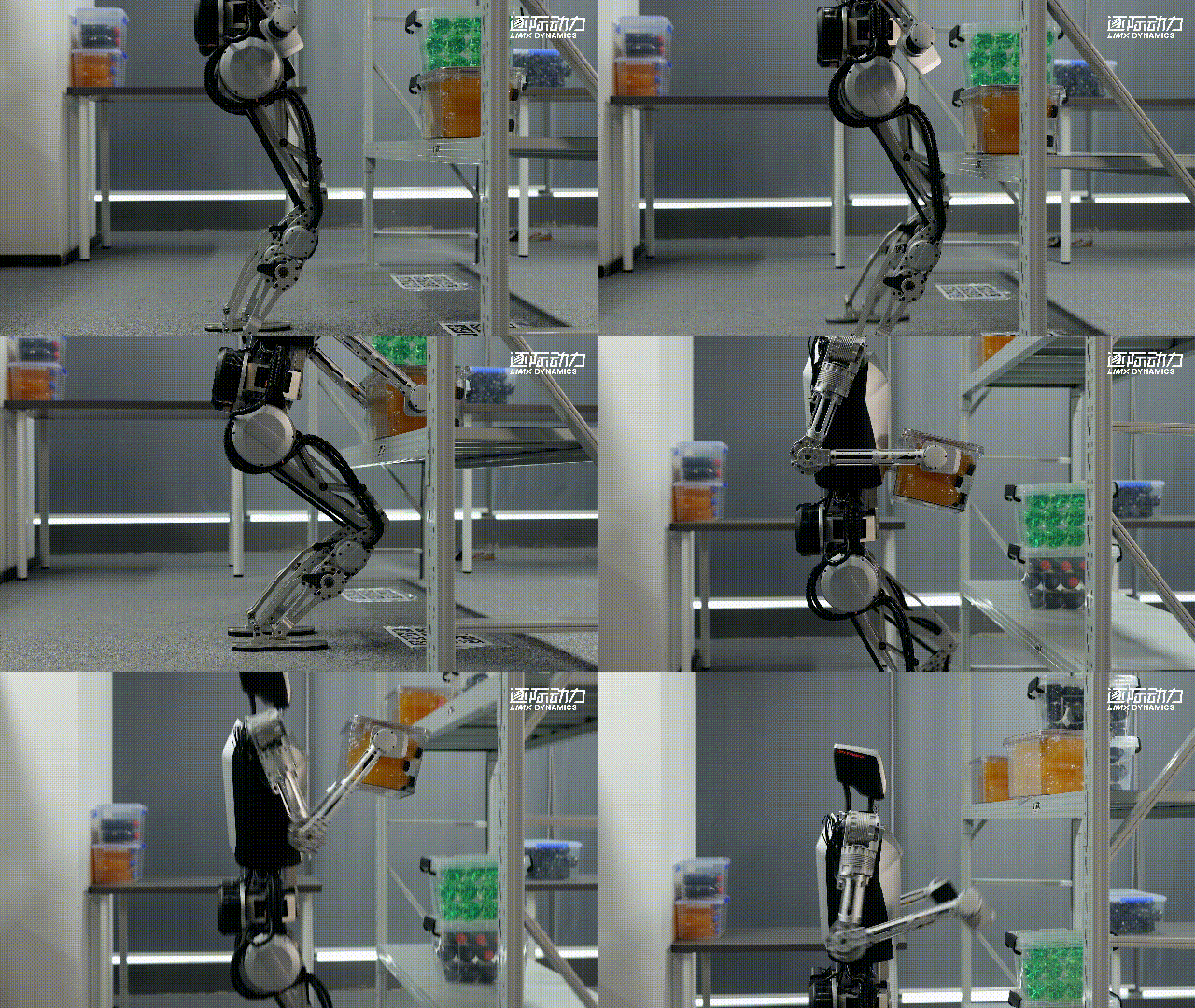
CL-1 lifts a 4.1kg soda bottle from the lower shelf to the upper shelf source: Neural Propulsion Systems
China's current leading position in humanoid robot "motion control" represents the concentrated realization of "hardware dividends" and "supply chain dividends."
In March 2024, Unitree Robotics' humanoid robot Unitree H1 achieved a breakthrough milestone: it successfully completed a standing backflip without relying on a hydraulic system, demonstrating the strength of China's motor drive technology and marking a new milestone in humanoid robotics.
From servo motors, speed reducers, and controllers to complete robot units, China's supply chain has laid the industrial foundation for the large-scale explosion of the humanoid robot industry.
When the supply chain can provide sufficiently low-cost components, humanoid robot manufacturers can launch more cost-effective finished solutions.
Take robot electric drive joints as an example: their unit price has dropped from nearly 10,000 RMB in the early days to less than 1,000 RMB today, a reduction of over 90%.
In August 2025, T-Motor released a new generation of integrated drive-control joint modules, with the unit price dropping to three digits for the first time; Flexbot even launched an integrated joint module priced at only 299 RMB.
The six-dimensional force sensor, known as the "nerve ending" of humanoid robots, is installed at the end effectors such as wrists and ankles, responsible for sensing forces and torques from multiple directions. Its price has plummeted from tens of thousands of RMB to several thousand RMB, a result of the Chinese supply chain's leap from traditional patch-based processes to optical structures. Traditional processes rely on manual calibration, while optical solutions can complete calibration directly on automated equipment, significantly reducing manufacturing costs. Full-system manufacturers including Fourier, UBTECH, and Beijing Humanoid Robot Innovation Center have begun to install domestically produced six-dimensional force sensors.
Harmonic speed reducers and servo motors have also seen substantial cost reductions — Green Drive's harmonic reducers have reached international top-tier precision levels at half the price of Japan's HarmonicDrive. For servo motors, the power source of humanoid robot movement, Inovance Technology and other enterprises have cut costs to one-third of Japanese products.
China's humanoid robots perform exceptionally well in motion control, joint flexibility, mass hardware production capacity, and cost control — leveraging the world's most complete manufacturing system to excel in these areas. Unitree H2 completing a standing backflip, Qihan T800 performing an aerial flying kick, Honor "Lightning" winning the half marathon, Agibot A3 playing full autonomous table tennis, and "Embodied Tiangong 3.0" successfully executing a "Thomas maneuver" in February 2026 — all are concentrated demonstrations of these strengths.
Behind these "extreme movements" lies the advantage of China's manufacturing industry with "complete categories, sufficient production capacity, and rapid localization of core components."
China's cost control capabilities in the humanoid robot hardware sector are unparalleled globally. This ability to rapidly localize and refine core components while maintaining cost advantages allows our robots to keep pace with the U.S. in the shortest possible time.
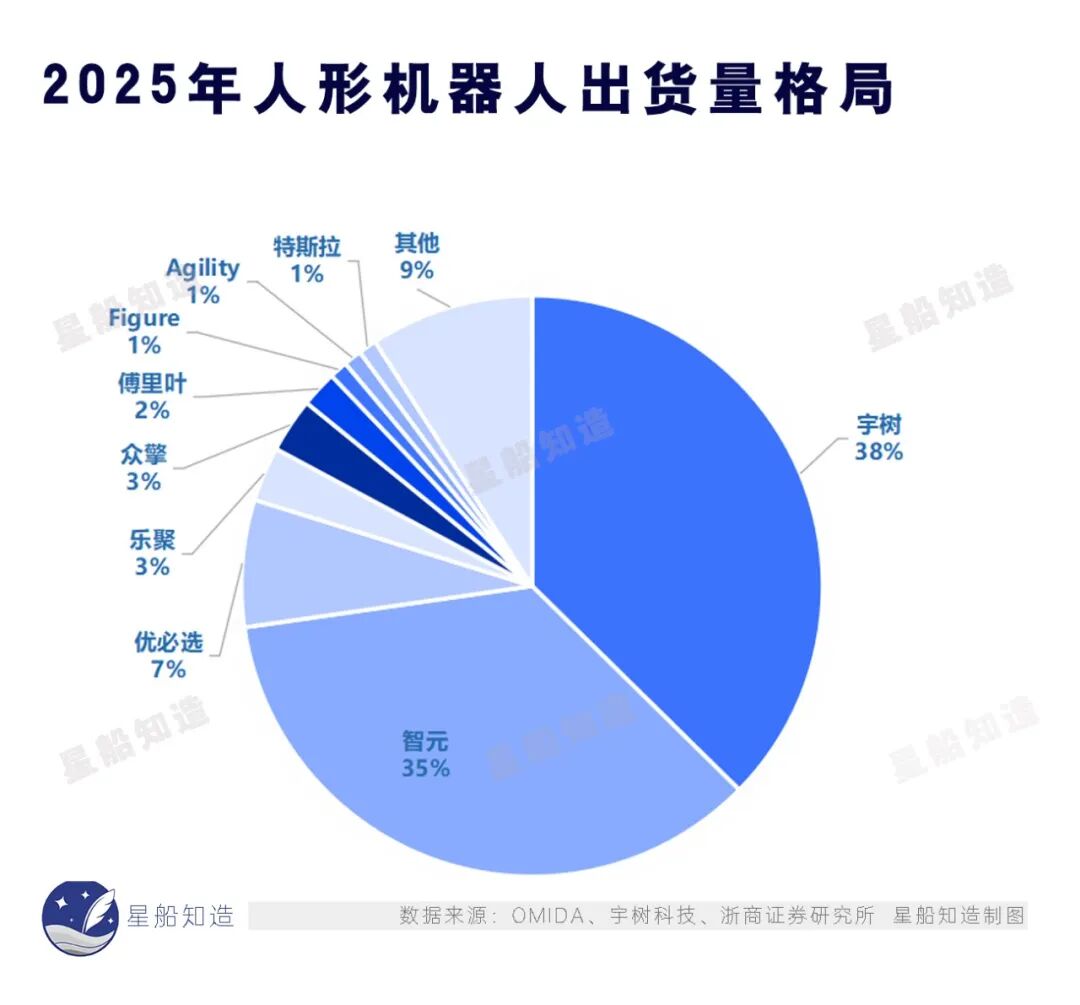
In the U.S. humanoid robot sector, NVIDIA holds over 90% of the global GPU market share, and the CUDA ecosystem has built a deep software moat; OpenAI and Google DeepMind continuously iterate large model capabilities, forming a closed loop of "chips + models + simulation training." This combination gives U.S. products strong capabilities in complex task reasoning and fine operation decision-making, and has fostered leading AI enterprises such as Anthropic and OpenAI.
At the application level, mainstream models including Tesla Optimus, Figure 03, and Agility Robotics' Digit rely on underlying large model technologies from Meta, OpenAI, and NVIDIA, and generally possess strong Vision-Language-Action (VLA) mapping capabilities. Figure AI's Helix model and Tesla's end-to-end neural network can understand task intentions through natural language instructions, recognize objects via vision, and form a closed loop of "understanding instructions → planning actions → executing operations," with enhanced capabilities for long-sequence task planning and cross-scenario generalization.
In the AI chip domain, the U.S. holds strong advantages. Leveraging underlying technologies such as Tesla FSD pure vision solutions and NVIDIA Project GR00T, the U.S. has achieved vertical integration from chips and simulation training to body control, accelerating the closed-loop optimization of data collection — model training — on-site feedback.
In the AI chip sector, China still faces structural shortages in production capacity, alongside restrictions on access to advanced equipment. The explosive growth in computing power demand has also exacerbated supply pressures to some extent. However, in the mid-to-low end market, domestic computing chip production capacity remains considerable.
Nevertheless, in the large model domain, we have made undeniable progress.
Moonshot AI's Kimi K3 has a parameter scale of 2.8 trillion, making it the world's largest open-source large model, and it outperforms top U.S. closed-source models in multiple authoritative benchmarks, demonstrating strong cognitive capabilities. In the field of embodied intelligence-specific models, Wujian Dynamics MWA™, NeuroVLA, and the Beijing Humanoid Robot Innovation Center's Pelican-Unify 1.0 have also topped international authoritative rankings — these achievements signify that China has developed a complete model matrix spanning from general-purpose foundations to embodied-specific systems at the "brain" level.
New Battlefield: From Capital Feast to Real-World Deployment
2026-2027 marks a critical inflection point for the humanoid robot industry👇
Tesla Optimus V3 is scheduled to debut in mid-2026, with production starting in July-August. The Fremont factory's Model S/X production line has been converted to a dedicated Optimus production line, with a long-term designed annual capacity of 10 million units.
Unitree Robotics obtained STAR Market registration at a record speed, becoming the "first A-share humanoid robot stock." Nearly 50 enterprises are queuing for IPOs, as capital drives the industry from "lab demonstrations" to "large-scale mass production."
As the market becomes more discerning, humanoid robots can no longer rely solely on "physical performance" — running and flipping will increasingly lead to audience fatigue.
Scarcity of high-quality embodied data, poor generalization capabilities, and insufficient coordination between the brain and cerebellum — these shortcomings at the "brain" level must be urgently addressed — the 2026-2027 mass production validation window will determine who can cross the commercialization threshold first in this race.
In the view of Starship Insight, buying time for the "brain" requires far more than the tireless efforts of technical personnel — sustained capital investment is equally critical.

source: unsplash
From current market practices, injecting massive R&D funds, opening up IPO access channels, and accelerating domestic supply chain substitution are the three core approaches widely adopted by domestic capital.
These three measures have played a vital role in promoting China's humanoid robot industry to establish its position as a global industrial hub.
So, what kind of path is capital building for our humanoid robot industry?
Where does the money come from? Where is it invested? How are costs reduced? And what exactly is the market willing to pay for?
Currently, state-owned capital and industrial capital are forming a "collaborative" dynamic — first, through funding supply and R&D acceleration.
In the first quarter of 2026, disclosed industry financing exceeded 300 billion RMB (some statistical calibers reach 681 billion RMB), with the average single deal size rising to 550 million RMB👇
Related statistical data shows: from January to April, 269 disclosed financing events in China's embodied intelligence sector raised a total of over 345