Over 30 days, Eli Lilly's USD 950 million investment plus Sanofi's strategic investment: This Biotech has drawn a map on the cell surface
Recently, the global pharmaceutical M&A and partnership market was ignited by two landmark deals from Eli Lilly in a single day. The pharma giant simultaneously expanded its footprint across three core therapeutic areas: oncology immunology, autoimmunity, and chronic inflammation. On one hand, it acquired Ventyx Biosciences outright for $1.2 billion to bolster its NLRP3 inhibitor portfolio, while the other $950 million global strategic partnership was directed at InduPro Therapeutics (referred to as InduPro below), a four-year-old startup with fewer than 50 employees.
This is no ordinary collaboration between a Biotech and an MNC. Eli Lilly not only secured the partnership through high-value transaction consideration and equity investment, but also opened up its global clinical development and commercialization resources in exchange for access to InduPro's AI/ML-powered MInt Membrane Interactomics Platform. The two parties will jointly develop next-generation oncology therapies including novel bispecific antibodies, multispecific antibodies, bispecific ADCs, and TCEs, targeting up to three oncology targets.
Interestingly, just one month before Lilly's investment, Sanofi had completed a strategic investment in InduPro and secured exclusive negotiation rights for its bispecific PD-1 agonist program, targeting the autoimmunity and inflammatory disease space.
In just 30 days, two of the world's top-tier pharmaceutical companies have consecutively placed bets on the same startup, with the total transaction value and strategic weight far exceeding that of a typical platform collaboration. What kind of technological secret does this Biotech, which only closed an $85 million Series A financing in 2024, hold that makes two major MNCs willing to invest heavily and lock in its core assets in advance?
Spatial Regulation Technology Breaks Through the Boundaries of Traditional Immunology R&D
The core academic theoretical foundation of InduPro is a groundbreaking study published in *Nature* in 2020 by the team of its scientific founder, Chris Garcia, a recipient of the Pasarow Award. This study was the first to confirm that through artificially designed bispecific antibodies, CD45 (a key phosphatase for immune regulation) and PD-1 (a core immune checkpoint molecule) can be forcibly brought into close proximity in cis on the cell membrane. Using the intracellular phosphatase domain of CD45 to directly dephosphorylate the intracellular segment of PD-1, it regulates Tonic Signaling at the source (also known as constitutive background signaling).
The tonic signaling here refers to the weak basal signal that cells maintain to ensure survival and homeostasis even in the absence of external ligand stimulation. However, in tumors and autoimmune diseases, this signal is abnormally and continuously amplified, driving disease progression. Traditional PD-1/L1 antibodies can only block the binding of ligands and receptors outside the cell, failing to reach this already activated intracellular signaling pathway — which is one of the important reasons why the efficacy of such immune checkpoint inhibitors is limited in some patients. This discovery breaks away from the traditional antibody R&D mindset of "single-target blocking" and verifies the feasibility of rewriting cellular signals by regulating the spatial proximity of proteins.
Based on this theory, Dr. Chris Garcia joined hands with members of Merck's core former R&D team — including Dr. Rob Oslund and Dr. Niyi Fadeyi, inventors of the photocatalytic proximity labeling technology, as well as Dr. Scott Lesley, former Vice President of Biologics Discovery at Merck, to co-found InduPro. They established the underlying logic for R&D: the core value of a drug lies not only in simply binding a single target protein, but more importantly in achieving targeted remodeling of biological functions by precisely regulating the spatial distance between proteins.
On this basis, leveraging the MicroMapping photocatalytic proximity labeling technology published by the founding team in *Science* in 2020, InduPro has developed its core technological asset — the MInt Membrane Interactomics Platform.
Driven by AI/ML at its core, MInt integrates proprietary blue-light-activated high-resolution membrane protein mapping technology and deep learning algorithms, which can restore the real spatial distribution of cell surface proteins at the nanoscale: by labeling target proteins with photoactive molecule-conjugated antibodies, proteins within the nanoscale proximity can be chemically "fingerprinted" after blue light irradiation, followed by mass spectrometry identification to complete the precise mapping of the spatial neighborhood relationships of proteins. This enables accurate identification of naturally coexisting protein proximity pairs in diseased cells, solving the industry pain point of blind trial and error in target selection in traditional bispecific antibody R&D.
This platform can precisely distinguish and apply two core proximity effects: first, identifying inherent proximal protein pairs on diseased cells to discover novel therapeutic co-target combinations; second, forcibly bringing target proteins closer through molecular design to create induced proximity for remodeling cellular signaling pathways, elevating target discovery from "empirical guessing" to "data-driven precise positioning".
To translate the platform's capabilities into clinical therapeutic advantages, InduPro further proposed a precise targeting strategy based on TAPA (Tumor-Associated Proximal Antigens). TAPAs are surface antigens in the tumor microenvironment that are spatially colocalized and functionally associated with tumor-associated antigens (TAAs), and their combination forms a unique "spatial signature" of tumor cells.
Drug molecules such as bispecific ADCs and T-cell engagers (TCEs) designed based on this signature, through a low-affinity synergistic design, must simultaneously bind two targets that are extremely close in spatial distance to achieve stable binding and pharmacological effects. Even if normal tissues express a single one of these targets, they cannot trigger effective binding and action of the drug, fundamentally solving the core pain points of traditional therapies such as high off-target toxicity and poor tumor selectivity, and significantly improving the safety and therapeutic window of the molecules.
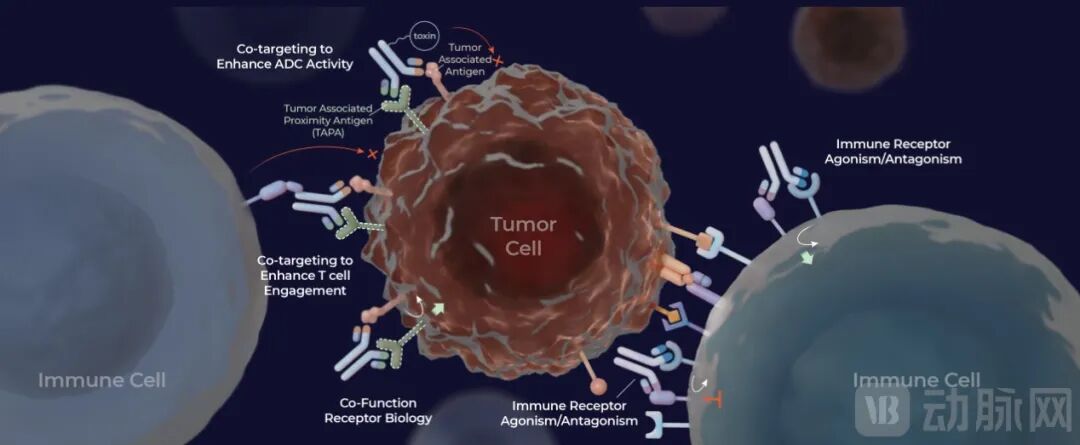
Schematic diagram of the full-scale mechanism of InduPro's technical logic (Image sourced from InduPro's official website)
Proximity Regulation: The Same Key Can Turn Both Ways
Leveraging the MInt Membrane Interactomics Platform and TAPA targeting strategy, InduPro has built a differentiated pipeline matrix around two high unmet need therapeutic areas: oncology and autoimmunity.
Currently, all three core pipelines are in the preclinical stage. They share the same proximity regulation logic but point to different therapeutic directions: either to enhance the selectivity of tumor recognition, or to amplify immune activation, or in reverse to suppress overactivated immune responses.
The fastest-progressing IDP-001 is a first-in-class EGFR (Epidermal Growth Factor Receptor) targeting bispecific ADC developed based on the TAPA inherent proximity strategy. It simultaneously targets EGFR and the platform's exclusively discovered proximal antigen TAPA-E1, and stable binding and drug internalization can only be achieved when the two targets are spatially colocalized on the tumor cell surface.
This dual-confirmation mechanism solves the pain points of strong off-target toxicity and narrow therapeutic window in traditional EGFR therapies. While greatly improving targeting selectivity and avoiding normal tissue toxicity, it enhances internalization efficiency and killing activity, and is expected to overcome drug resistance caused by EGFR mutations.
If IDP-001 uses proximity to solve the problem of "where to hit", IDP-002 uses it to solve the problem of "whether the effect is sufficiently thorough". This PD-1 bispecific antibody based on induced proximity technology adopts a cis design, binding PD-1 and an exclusive synergistic target, which can simultaneously achieve extracellular ligand binding blockade and intracellular PD-1 inhibitory tonic signaling shutdown, bidirectionally enhancing the anti-tumor activity of T cells.
Moreover, IDP-002 can achieve a receptor occupancy rate far exceeding that of traditional PD-1 antibodies without relying on the VEGF target that most mainstream bispecific antibodies depend on. While enhancing the activation of effector T cells, it limits the proliferation of Treg cells, which not only broadens the boundaries of indications but also improves medication safety.
IDP-003 reverses the same logic. It utilizes the natural proximity between PD-1 and T cell antigen 2 to design a bispecific antibody, which precisely recruits PD-1 to the immune synapse, and can directly enhance its intrinsic inhibitory signaling without the need for PD-L1 ligand binding, thereby suppressing overactivated T cells in autoimmune diseases.
It directly addresses the shortcomings of traditional FcR-mediated PD-1 agonists, which are prone to cytokine storms, carry high safety risks, and whose efficacy is highly dependent on PD-L1 expression, achieving dual breakthroughs in efficacy and safety.
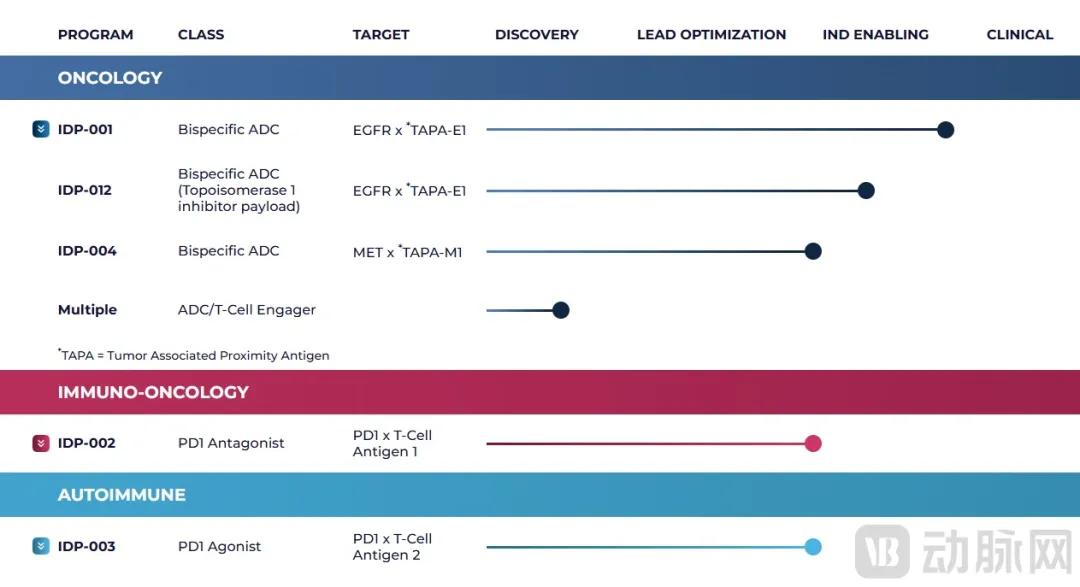
InduPro's current pipeline (Image sourced from InduPro's official website)
A Rise, and Also a Starting Point
The rapid rise of InduPro is underpinned by profound changes in the competitive logic of the global biomedical industry. Over the past decade, the explosive growth of the monoclonal antibody, bispecific antibody, and ADC sectors has led the industry into homogeneous competition characterized by "crowded targets and incremental innovation churn", and the traditional R&D mindset of single-target blocking has hit the dual ceilings of efficacy and safety.
What InduPro represents is a fundamental logic shift from "finding targets" to "defining spatial coordinates" — no longer limited to the functional blockade of individual proteins, but reconstructing cellular signal transduction by regulating the spatial proximity of cell surface proteins, attempting to fundamentally solve the pain points of traditional drugs.
Of course, for this startup that has only been established for four years and whose pipelines are all in the preclinical stage, there are still many uncontrollable challenges ahead. The biomedical industry is never short of promising preclinical ideas. The clinical efficacy and safety evidence after IND submission is the true touchstone of technological value; and the novel therapeutic path based on spatial proximity biology still needs to undergo long-term verification in human clinical trials.
This article is from the WeChat Official Account "vcbeat" (ID: vcbeat), authored by MiaoXin Yu, and published by 36Kr with authorization.