5.179 billion yuan, Trip.com was handed the heaviest fine.
The 5.179 billion yuan anti-monopoly fine imposed on Trip.com has sent a shockwave across the entire platform economy.
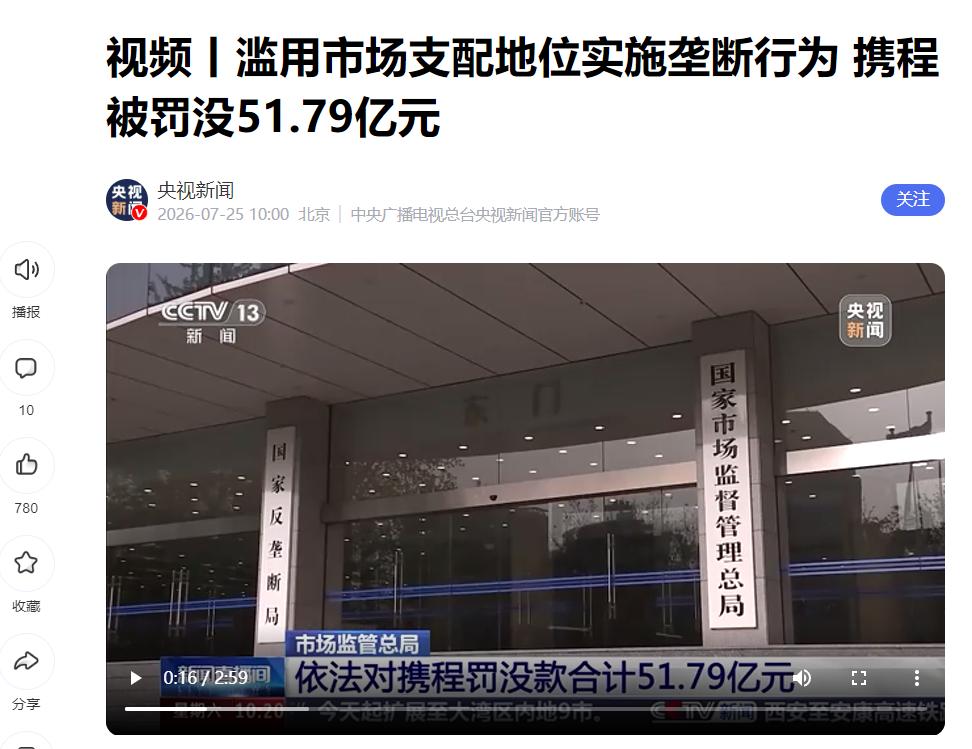
According to reports from China Central Television, in July 2026, the State Administration for Market Regulation issued an administrative penalty decision against Trip.com for abusing its dominant market position, ordering the company to cease its illegal practices, fully refund the order deposits, confiscate 1.658 billion yuan of illegal gains, and impose a fine of 3.521 billion yuan, with the fine ratio reaching 7.5%.
In previous cases, Alibaba was fined at a 4% rate for its "choose one from two" practice, while Meituan faced a 3% fine for similar violations. Trip.com's penalty directly hit 7.5%, leaving it just a step away from the 10% upper limit stipulated in the Anti-Monopoly Law, marking an unprecedentedly severe enforcement effort.

Behind this fine lies Trip.com's monopolistic conduct, which is far more covert and ruthless than the "choose one from two" practices of Alibaba and Meituan in the past.
A single platform siphons off profits from the entire industry
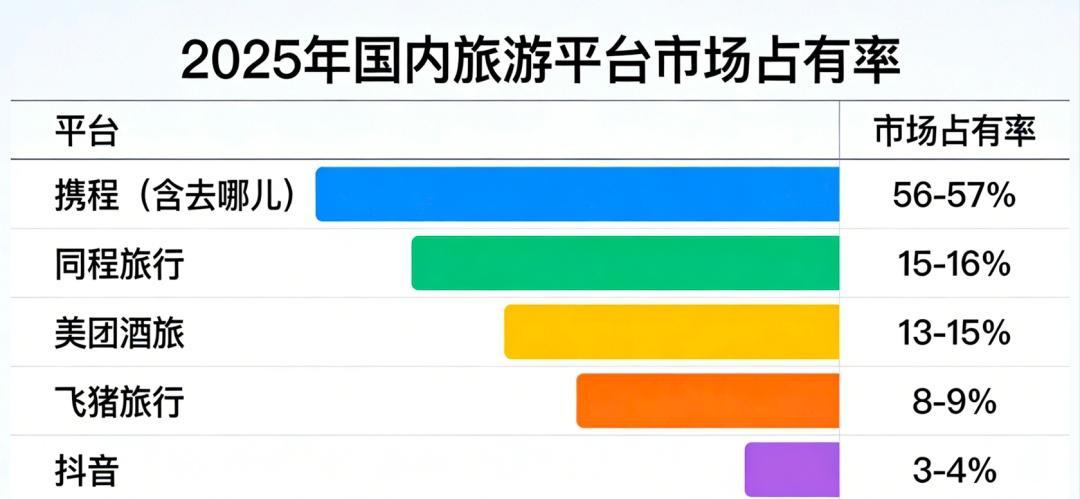
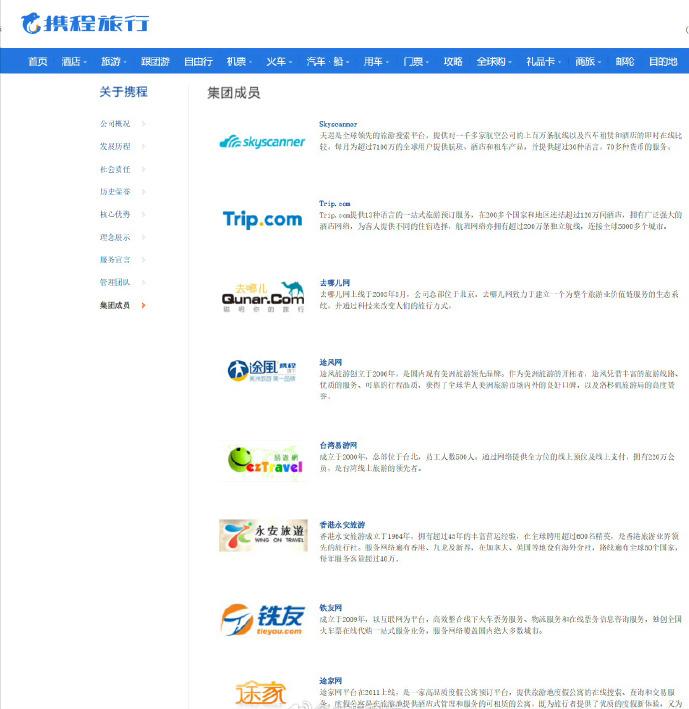
As determined by the State Administration for Market Regulation, Trip.com has long maintained a stable market share of over 50% in China's online hotel booking market. When including platforms it controls such as Qunar, the entire Trip.com ecosystem accounts for nearly 70% of the market, making it the undisputed industry leader. Most people who book hotels, even when browsing across different platforms, are essentially operating within the Trip.com ecosystem without realizing it.
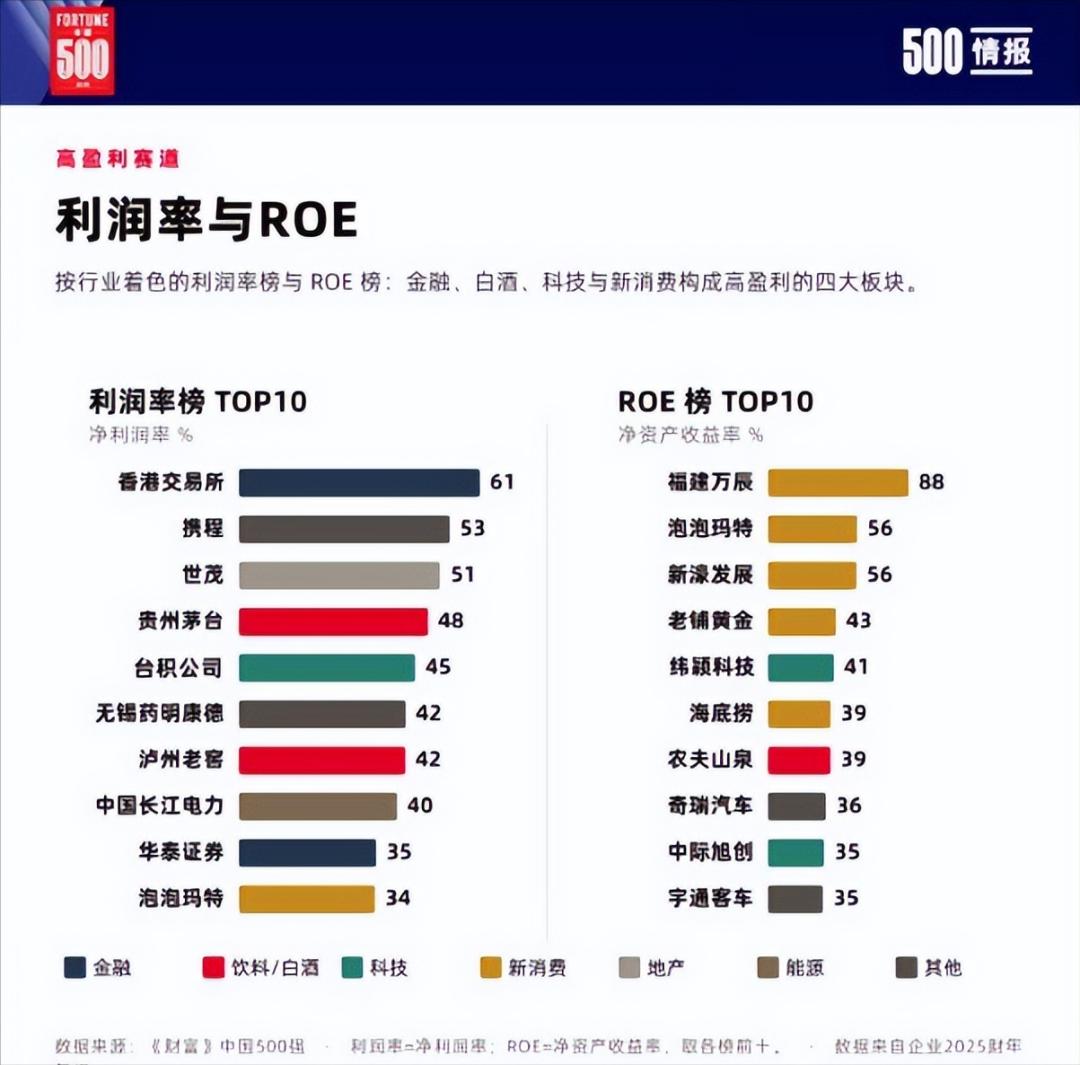
Trip.com's full-year net profit reached 17.2 billion yuan in 2024, and surged to over 33 billion yuan in 2025.
In stark contrast, in the first three quarters of 2025, the combined net profit of all listed companies across the A-share tourism industry chain — spanning scenic spots, hotels, and travel agencies — was only about 19 billion yuan, less than 60% of Trip.com's standalone profit.
From 2018 to 2023, employment in the accommodation and catering sectors increased by 3.05 million people, with around 1 million of those positions in the accommodation sub-sector. Employment in commercial services also grew by 2.02 million, a figure highly correlated with the hotel and accommodation industry.
Among the employment growth in recent years, the top three sectors are retail and wholesale, commercial services, and hotel accommodation.
The service industry acts as an employment reservoir, and the current growth engine of the service industry is cultural and tourism.
Cultural and tourism visitor volumes and revenues both maintained double-digit growth rates in 2024 and 2025. Yet amid this vibrant, booming landscape, a predatory force has emerged to siphon off benefits through exploitative practices.
Trip.com did not adopt the blatant "choose one from two" tactics used by Meituan and Alibaba. Instead, it implemented a three-tier system of "Special Label, Gold Label, and No Label" hotels.
Special Label hotels receive the maximum traffic priority and best exposure positions, resulting in significantly higher order volumes than regular hotels. The tradeoff is that these hotels can only partner with Trip.com and are prohibited from listing their properties on other platforms.
Gold Label hotels receive secondary traffic support, with the requirement of committing to the "lowest price across all platforms" — Trip.com's price must be 20 yuan cheaper or 5% lower than prices on any competing platform.
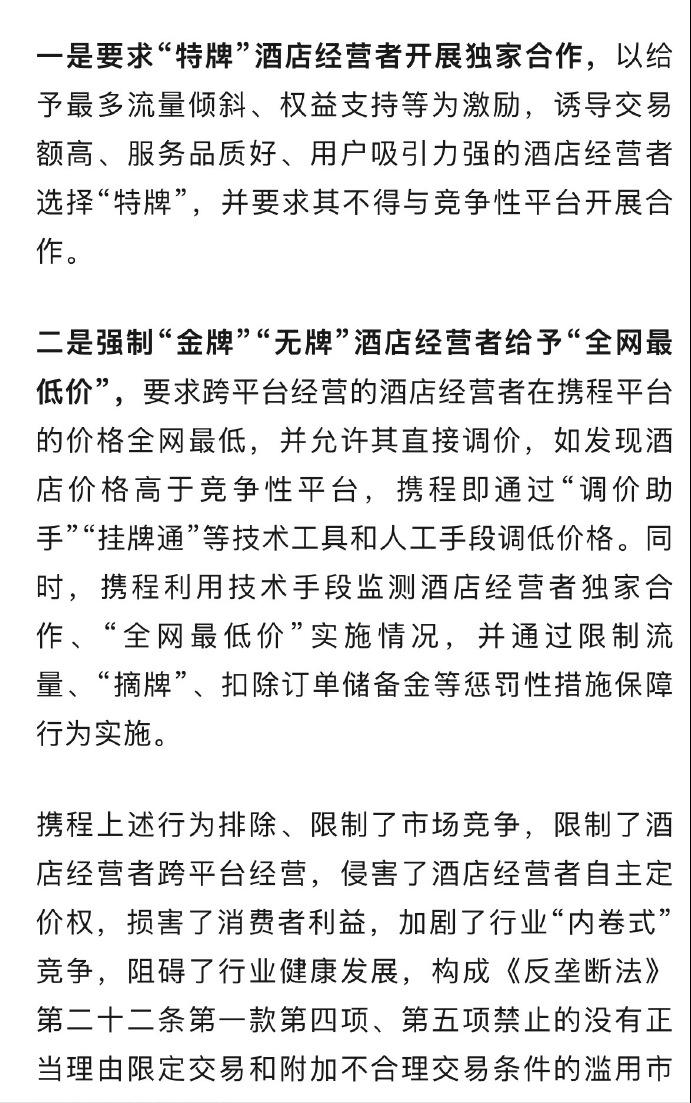
As for No Label hotels, they are effectively "invisible" on the platform — users may scroll through dozens of pages without finding them, making their order volumes predictably negligible.
There is no explicit coercion; all merchants "voluntarily" choose their tier. But the fundamental question remains: do they actually have a choice?
Without signing the Special Label agreement, hotels get no traffic. Once they sign it, they are completely tied to Trip.com, leaving the platform free to raise commissions and dictate terms unilaterally.
The "choose one from two" practices of Alibaba and Meituan in the past were at least explicit, with terms clearly written in contracts. But all of Trip.com's exclusive and pricing requirements were never documented in writing — they were only communicated verbally by account managers.
Furthermore, Trip.com established a rigorous monitoring system. Once it detected a merchant operating on competing platforms, it immediately imposed punitive measures including traffic restrictions, demotion in search rankings, and label revocation, causing a "cliff-like drop" in the merchant's traffic. Merchants seeking redress had no written evidence to support their claims, leaving them with no choice but to accept the losses silently.
More ruthless than "choose one from two": the invisible soft noose
If the tiered system represents a covert exploitative measure, then the "Price Adjustment Assistant" function amounts to outright plunder.
The so-called "Price Adjustment Assistant" can forcibly lower pricing without the merchant's consent. Trip.com adjusts prices under the pretext that the merchant has agreed to the lowest platform-wide price, then directly deducts funds from the merchant's account on the grounds that the adjusted price is too low to meet Trip.com's required commission percentage. It first forces a price cut, then arbitrarily deducts extra fees, shifting all associated costs entirely onto the merchant.
Many hotel operators reported that even when they set a 480-yuan nightly rate for peak holiday periods, Trip.com's "Price Adjustment Assistant" would change the price to 130 yuan without their authorization. Even more absurdly, merchants could not manually disable this function — the platform would repeatedly reactivate it, sometimes as many as nine times.
This is equivalent to running a restaurant where you have no say over your own menu prices, and you are forced to absorb all losses from unauthorized price changes. Disagree? Your traffic will be directly restricted and your label revoked, leaving you with zero bookings.
Who ultimately suffers from the "lowest price across all platforms" policy?
At this point, many people will surely ask: If platforms force hotels to offer the lowest prices across all platforms, isn't that good for consumers, who get cheaper hotel rates?
In the short term, you may seem to get a bargain price, but in the long run, all consumers end up as losers.
First and foremost, the "lowest price across all platforms" is never subsidized by the platform itself — all associated costs are fully borne by the merchants.
The platform contributes zero subsidies, and simply manipulates its rules to compel hotels to cut their own prices. With no profits left, hotels can only cut costs on essential services: reducing room cleaning frequency, replacing toiletries with the cheapest available options, downsizing service staff, and even skimping on utilities and linen quality.
You think you've saved a few dozen yuan, but in reality, you end up staying in a room with diminished service quality. Moreover, the "lowest price across all platforms" essentially locks out all market competition.
This is the most misleading aspect of the platform's practices. While it claims to be saving consumers money, it is actually protecting its own commission revenues.
What truly benefits consumers is never a single platform promising permanently low prices, but genuine choice — where other platforms, hotel official websites, and front desks all have the opportunity to offer lower prices.
By using its rules to lock in prices across all channels, Trip.com creates the illusion of the lowest possible price, while effectively eliminating all potential for better bargains elsewhere.
The 7.5% heavy penalty is fully justified
After Alibaba and Meituan were successively fined for "choose one from two" practices in 2021, Trip.com abandoned its explicit "choose one from two" tactics and replaced them with more covert tiered systems and algorithm-driven price controls — essentially the same exploitative model under a new guise, continuing to extract profits from merchants.
Unlike the single-type monopolistic violations of the past, Trip.com engaged in "compound misconduct": implementing de facto exclusive dealing through the Special Label system, locking in pricing power via the "lowest price across all platforms" requirement, and using technical tools to unauthorizedly modify prices — tactics that are far more covert and sustained.
This exploitative model operated for a full six years from 2020 to 2026, generating over 1.6 billion yuan in illegal gains. This marks the first time in a platform economy anti-monopoly case that such a large sum of illegal proceeds has been fully confiscated.
The significance of this penalty extends far beyond the fine itself.
It is important to recognize that in recent years, local governments have invested heavily in developing cultural tourism attractions and supporting infrastructure, while hotel owners have poured capital into renovations and hiring staff. The entire industry has undertaken heavy risks and asset-heavy operations, with the goal of driving local real economic growth, enabling local homestays, restaurants, and retail businesses to generate profits, ultimately raising household incomes and revitalizing the entire industrial chain.
But what was the outcome? The benefits never fully reached local businesses, nor did they translate into substantial gains for ordinary consumers. Local cultural tourism groups across the country suffered massive losses, and the tourism sector in stock markets plummeted sharply.
In 2025, China's hotel industry did not shrink in overall scale (the total number of guest rooms continued to grow), but operational efficiency declined significantly: national RevPAR (Revenue Per Available Room) dropped by approximately 5% year-on-year, with some regions seeing a 7.9% revenue decline and a sharp contraction in profits.
Why? Because tourists rely entirely on online platforms to book hotels, purchase tickets, and find travel guides. Monopolistic platforms like Trip.com leverage their control over traffic and pricing power to extract proportional commissions and service fees, effectively collecting a form of "digital land rent" online that siphons off all the profits.
Local governments bear the heaviest costs and take the greatest risks, yet after all their investments aimed at boosting the local economy and increasing household incomes, the majority of the profits end up in Trip.com's pockets.
Previously, enforcement targeted explicit unfair contractual terms. Now, covert monopolistic practices hidden within algorithms and platform rules, as well as the exploitation of merchants, will also be uncovered and penalized.
Industry insiders point out that practices that heavily manipulate traffic distribution through platform rules, using access to traffic as leverage to force merchants into unfavorable transaction terms, have been explicitly classified as illegal conduct and will be subject to legal regulation in the future.
The era of exploiting merchants and consumers through traffic hegemony, information asymmetry, and technical manipulation is gradually coming to an end.
It is foreseeable that Trip.com's Special Label and Gold Label systems will inevitably face rectification, and overreaching functions like the "Price Adjustment Assistant" will be regulated. Hotels' independent operational rights and pricing power will gradually be returned to the merchants themselves.
If monopolistic platforms are allowed to set exploitative rules leveraging their dominant position, the entire industry will work hard for a full year only to see all profits siphoned off by traffic platforms. Local governments will never recoup their infrastructure investments, merchants will earn no profits, consumers will receive poor service and no access to lower prices, and the entire industry will eventually hit a dead end.
This penalty serves as a clear warning: If platforms fail to focus on innovation to provide better services and technologies for the public and reduce operational costs for merchants, but instead rely on their monopolistic position to extract profits without boundaries, they will inevitably face severe consequences.
This article originates from the WeChat public account "Hot Comment Microscope" (ID: redianweiping), authored by WANG Xinyi, and republished by 36Kr with official authorization.