The AI capabilities around the world have dropped by 10,000 times, and only I am still an ordinary person.
When you wake up, the world's AI capabilities have degraded by 10,000 times,
and you are the only one who remains an average person.
People are astonished that you know how to call APIs,
and even have a "lobster" LLM deployed locally,
making you the most skilled AI user on the planet.
This is a classic short-drama trope whose plot everyone can easily predict. But along the current path of AI development in the United States, this scenario could very well become a reality in the future: global AI capabilities will drop by 100 times, ordinary people will no longer have access to cutting-edge models, and only a handful of entities will be able to afford them.
If this scenario were turned into a production, Jensen Huang's name should be in the screenwriter credits. On July 24, the NVIDIA CEO, who had never posted on X before, published his first post: an open letter co-signed by 35 companies, whose entire message revolves around one single plea: don't let this dystopia come true.
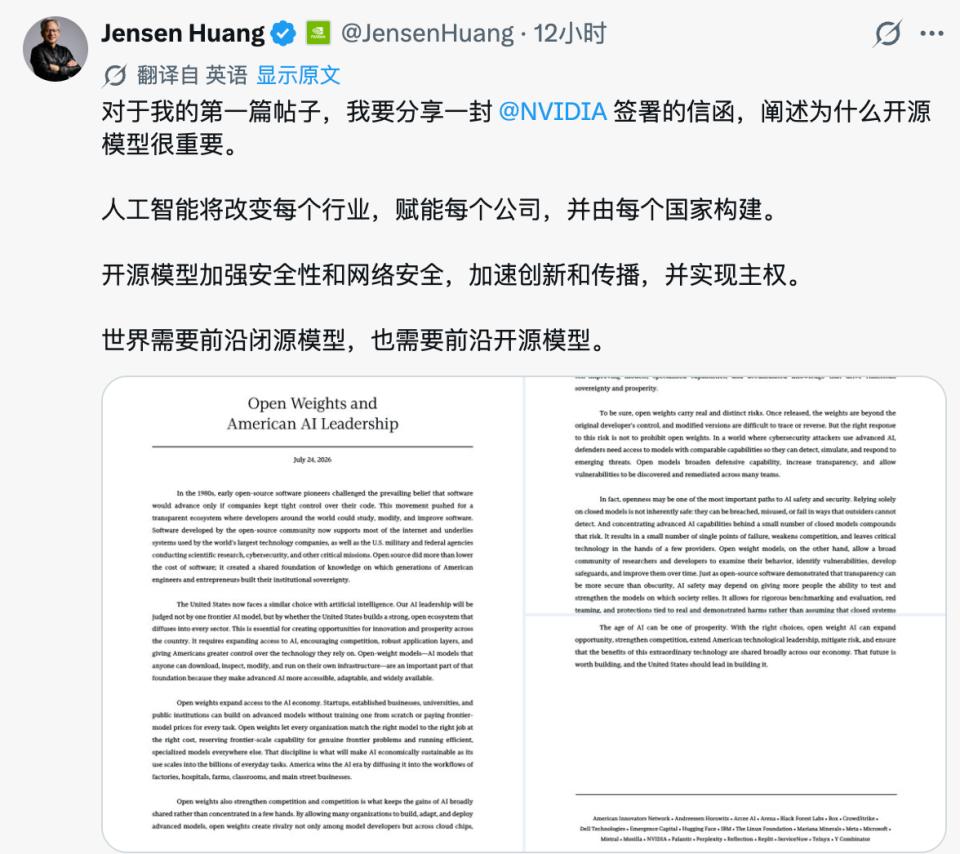
What conditions would make this dystopia real? The world does not need AI to degrade at all — it only requires open weights for advanced models to disappear, and cutting-edge capabilities to be re-centralized within a small number of APIs.
Tech Killer 2049
In the open-source era, every industry can deploy local models at low cost: a small law firm can boot up its computers and run a 2.8-trillion-parameter model to review contracts at a monthly cost of just dozens of dollars; a county-level hospital can deploy an imaging model on its on-premises servers to keep all data within its walls; a small cross-border e-commerce team can fine-tune a self-owned translation tool from open-source models, without being at the mercy of any single company. Tokens are so cheap that they are not worth calculating individually — just like no one itemizes every bit of electricity they consume.
If open weights are taken away, this world will transform instantly. Only a handful of cutting-edge models will remain, all locked behind API barriers. Law firms will see their contract review costs surge dozens of times, forcing them to do cost accounting before using any AI. Hospitals that want to leverage AI will either have to pay exorbitant fees for interfaces without any guarantee of data security, or fall back on traditional manual workflows relying solely on doctors' naked eyes to read medical scans. The medical environment will deteriorate sharply, and hospital operating costs will keep spiraling upward.
Next will come structural changes: all profits will flow to a single point. Dominant large model companies will collect all the rent, leaving no secondary players in the industry. No one else will be able to build models, only wrap them up for resale, with profit margins dictated entirely by upstream pricing sheets.
The cost of scientific progress will be even higher. Cutting-edge capabilities will be locked inside a few black boxes that external researchers cannot disassemble, modify, or validate — they can only run "surveys" on these black boxes. Academic papers will degrade from "We discovered" to "We obtained trial access." The speed of progress in an entire field will thereafter be determined by the release schedules of a handful of corporations.
Of course, this is a relatively rough analytical framework. MaaS vendors can of course sell interfaces to new industry formats, but with layers of markup, the cost for every individual to use AI will still rise drastically.
Model strength is just a ticket to entry. The number of industries that can actually use AI is what determines whether AI can drive healthcare, manufacturing, and scientific research forward. A world with nothing but closed-source models means handing this question over to the pricing sheets of a few top model companies. All other industries will lose their initiative, and the so-called "AI empowerment" will cease to exist entirely.
The only way the closed-source model path makes sense is if LLMs truly reach AGI. In that case, all the AI we are discussing right now is the singular end point of all technology, and no other industry needs to accelerate its evolution — they can all just stand still and wait.
This assumption requires no imagination: the world before the end of 2022 was more or less like this.
Who Holds the AI Discourse Power
On the morning of July 21, US Treasury Secretary Bessent told Fox Business that the government is investigating whether Chinese AI models have stolen US intellectual property and is considering sanctions. His stated reason is that certain "watermarks" from US models have appeared in Chinese models — a claim for which no technical evidence has been made public to date.
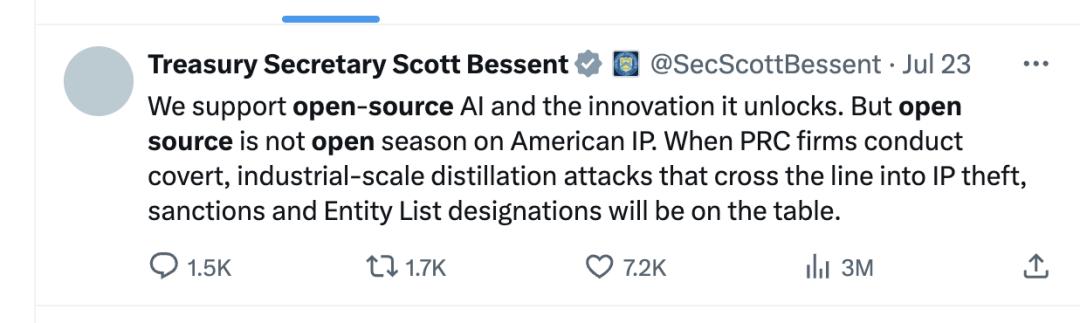
Bessent's statement on X (July 23): "open source is not open season on American IP"
That same afternoon, Jensen Huang sat down for an Axios exclusive in Fort Worth, Texas. He said: "These Chinese models are very good. Good open-source models should be used." Distillation and learning from other models are the foundation of intelligence formation. Regulation should target specific illegal acts, not blanket bans on models. He even called out Anthropic by name, saying its cybersecurity model Mythos should be open to everyone.
On July 24, the man who had never posted on X published his first post: a co-signed open letter titled *Open Weights and American AI Leadership*. The signature list posted on Microsoft's official website includes 35 organizations: NVIDIA, Microsoft, Meta, IBM, Dell, Palantir, Hugging Face, a16z, Y Combinator, Mozilla, Mistral, Perplexity, Replit — with Nadella retweeting the post shortly after. Neither Anthropic nor Google appears on the list. Initial domestic media reports said OpenAI was also absent, but OpenAI's name is on the Microsoft official list, which is the authoritative source.
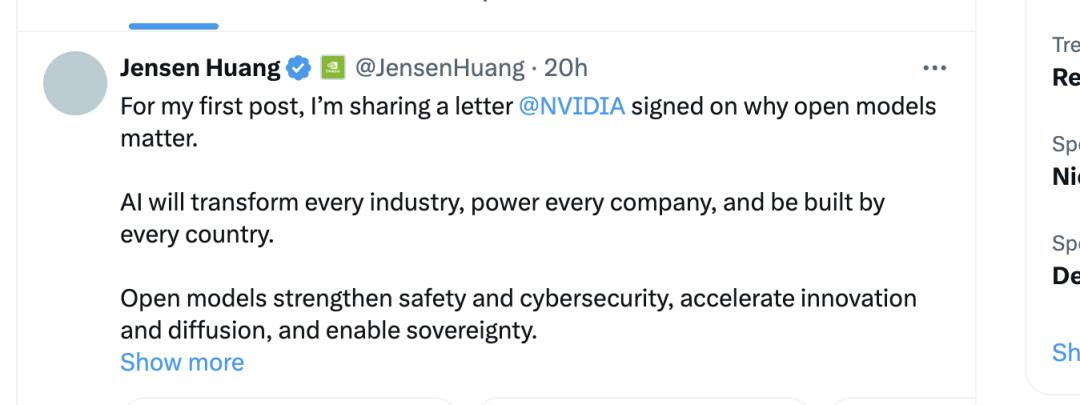
Jensen Huang's first X post (July 24): sharing the open letter signed by NVIDIA
The letter spells out all the risks upfront: concentrating advanced AI behind a small number of closed-source models will create single points of failure, weaken competition, and cede control of critical technology to a tiny handful of suppliers. Huang put it even more plainly in the interview: if the whole world can only use one model, the whole world has only one attack target. The "security" banner, long held by the closed-source camp, has now been snatched by NVIDIA.
Why is NVIDIA stepping into this fray? The reason is obvious. In the week after the Kimi K3 launch on July 16, the Philadelphia Semiconductor Index fell by 12.5%, and NVIDIA briefly lost its title as the world's most valuable company. Huang's judgment is that the market misread the situation: cheaper, more accessible AI will get more people using AI, and more usage will only drive up demand for chips and data centers. He noted the market misinterpreted the DeepSeek release once before, and this is the second time. Open source is part of NVIDIA's ceiling, and its market support is protecting its own business — there is no need to pretend otherwise.
Dig deeper into the numbers, and you find what is really making him restless. NVIDIA's growth story is built on AI spreading to factories, hospitals, schools, and farms. If this diffusion can only advance according to the sales schedules of a few closed-source companies, computing demand will shrink from "everyone needs it" to "a few buyers order it," and the entire industry chain will hit a ceiling.
He also offered a judgment in the interview: banning open source in the name of national security will make the United States more vulnerable, because demand will not disappear — it will just migrate, along with all the innovation, somewhere else.
The fear of that dystopian world was voiced out loud by nearly 200 US startups and investment institutions. Right after K3 launched, they quickly formed a "little tech coalition" to call on the government: if cheap open-source models are banned, startups will have to go back to paying exorbitant API fees to OpenAI and Anthropic, and countless cash-strapped companies will die immediately. What these 200 companies are protesting is exactly the "only wrapping the model" fate described in the first section. As of July 25, the ban has not landed, but the fear is very real.
AGI May Not Come Very Soon
In the same week, Beijing was not part of this argument — it was doing something else entirely.
On July 23, four Chinese government departments including the Beijing Municipal Development and Reform Commission issued the *Several Measures to Accelerate the Agent-Led Development*, introducing a set of new terms: Token-as-a-Service, Agent-as-a-Service, and Outcome-as-a-Service. The policy encourages shifting token billing from volume-based pricing to deliverable-outcome-based pricing, supports the construction of "token factories," and distributes token vouchers. Earlier, on July 3, the Beijing Data Group had already launched the first state-owned "Jingsuan Token Factory." The supporting narrative notes that industry performance metrics are shifting from peak computing power to "tokens per watt."
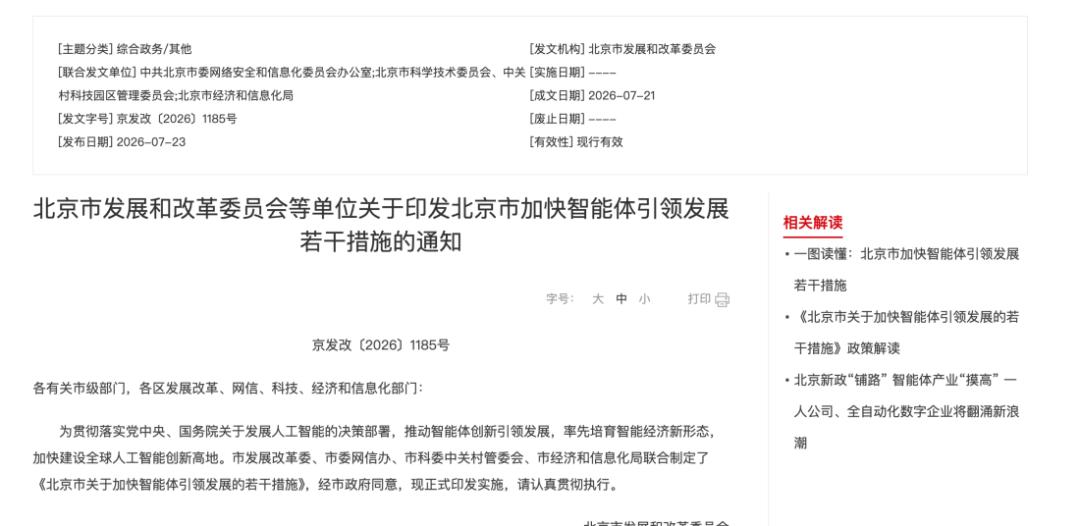
The full text of *Several Measures of Beijing Municipality on Accelerating the Agent-Led Development* (Jing Fa Gai [2026] No. 1185, issued July 23)
This set of policies is straightforward: Beijing is working to establish public measurement and service standards for tokens, deploying AI as ubiquitously as utilities like water, electricity, and gas. Utilities have two core attributes: they are affordable, and they are always available. China's daily token call volume was still at the 100-billion level in early 2024, but by May 2026 it had exceeded 170 trillion — a thousand-fold increase in two years. This number at least proves that large-scale AI adoption is already happening, and the policy is building the pipelines after the fact.
Now look at the fork in the road between the two sides. Washington is debating whether to restrict Chinese open-weight models, citing security and intellectual property concerns; Beijing is discussing how to price tokens and distribute vouchers, driven by supply-side priorities. One side views foreign open-weight models as risks; the other side is writing open-source ecosystems, token factories, and service vouchers into its industrial policies.
The Kimi K3 weight release countdown page is already up on Hugging Face. Moonshot AI has promised to deliver the full 2.8-trillion-parameter weights for free download by July 27, allowing anyone to disassemble and modify them.
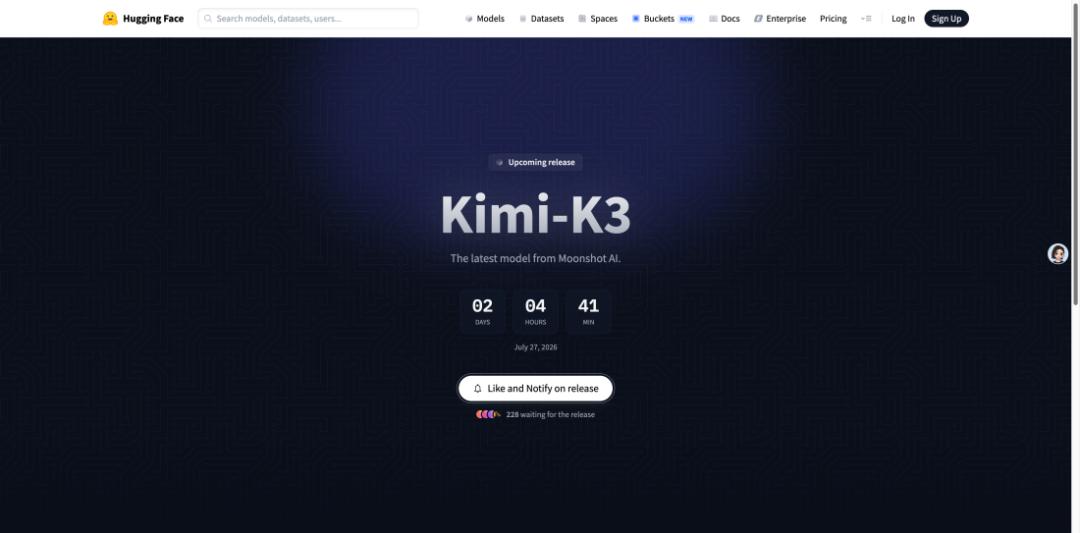
The Kimi K3 weight release countdown page on Hugging Face (as of July 25: 2 days and 4 hours remaining, 228 subscribers to release alerts)
The closed-source camp's most powerful accusation is: open-source models stand on the shoulders of closed-source pathfinders — without OpenAI and Anthropic burning money to blaze the trail, open source would have nothing to copy. This claim is partially true: the pathfinding money was indeed spent by closed-source players. But the other half of the story is being rewritten. K3 did not just stack up a larger Transformer; it pioneered its own path in KDA, Attention Residuals, and MoE sparsification, proving that the open-source camp is now blazing its own trails. The line in Huang's letter that "the world needs cutting-edge closed-source models, and it also needs cutting-edge open-source models" is ultimately about this division of labor.
This competition is far from over. But what is clear is that on this side of the Pacific, we believe every industry still needs to be reinvented by AI, and AGI will not necessarily arrive anytime soon. On the other side of the Pacific, however, if the valuations of the two closed-source forerunners OpenAI and Anthropic collapse, a real financial tsunami could very well be triggered.