OnePlus and realme go their separate ways, which one does OPPO favor more?
Recently, OPPO has rolled out a major strategic adjustment.
According to the newly clarified global product strategy for its sub-brands, going forward, realme will focus on overseas markets and suspend product updates in the Chinese market, while OnePlus will prioritize development in the Chinese market and halt the launch of new products in the European and North American markets.
In terms of product positioning, both brands will concentrate on the gaming and high-performance segments in the future.
The announcement immediately sparked widespread discussion and speculation across and beyond the industry, with reactions ranging from regret and skepticism to unwavering support...
Regardless of differing opinions, from a business market perspective, this represents the optimal solution OPPO could have devised.
After all, realme's performance in the domestic market has been mediocre, leaving limited room for growth, while it still holds considerable potential in overseas markets. Meanwhile, OnePlus has established distinct brand advantages within the Chinese market. This strategic shift of one advancing and the other retreating has become an inevitable choice for OPPO to achieve balanced development...
While the logic behind the decision is understandable, viewing the situation from realme's perspective paints a very different picture.
The core issue is that realme and OnePlus have extremely similar brand and product positioning, so theoretically, OPPO could have relied on either brand to fulfill its strategic goals.
Even though there is a certain gap in their current domestic market shares, it is important to note that realme only officially reintegrated into the OPPO ecosystem in January this year. If OPPO had been willing to grant realme more time for integrated operations, there would have been a realistic possibility for it to catch up with OnePlus's performance in the future...
However, the reality is that OnePlus encountered setbacks in overseas markets earlier and rejoined the OPPO system sooner. As a result, OPPO chose to keep the more established, underperforming brand close to home, showering it with additional resources and preferential treatment.
Meanwhile, the more promising younger brand is being sent out to navigate the challenging global market, with the expectation that it will generate revenue to support the entire group.
Complicating matters further, according to data from institutions such as Counterpoint, in key overseas markets where realme holds advantages, including India, OPPO has long allowed OnePlus and realme to compete directly against each other alongside its own branded products.
Now, OPPO has unified the product positioning of realme and OnePlus, yet only required OnePlus to pause its expansion in the European and North American markets...
Objectively speaking, how could this coordinated set of measures not leave realme feeling unfairly treated?
On an emotional level, could this arrangement create subtle tensions between the two sub-brands and their respective veteran leaders — Li Bingzhong and Liu Zuohu?
Did realme simply fail to outcompete OnePlus?
Admittedly, from a holistic planning perspective, OPPO's current strategic adjustment for its two sub-brands is indeed the optimal macro-level solution. However, the problem remains: A strategy that is optimal at the macro level does not always translate to a mutually satisfactory outcome when implemented on the individual competitive battlefields.
Take realme as an example. In terms of overseas market performance, realme currently demonstrates far greater growth potential than OnePlus.
Although both brands originated from overseas expansion, realme, founded in 2018, achieved the milestone of 100 million smartphone sales globally in just 37 months — making it the fastest smartphone brand in history to reach that threshold.
It surpassed 200 million units in 2023, and on its 7th anniversary in August 2025, realme announced that its total global cumulative sales had exceeded 300 million units.
This scale of achievement is undeniably impressive...
Furthermore, taking the Indian market as an example — where both brands have previously delivered strong results — Counterpoint data shows that in 2025, realme's brand shipment share reached 10%. While this represents a 1% decline from 2024, OPPO's own brand share in the same period was only 13%, meaning the overall gap between the two was relatively small.
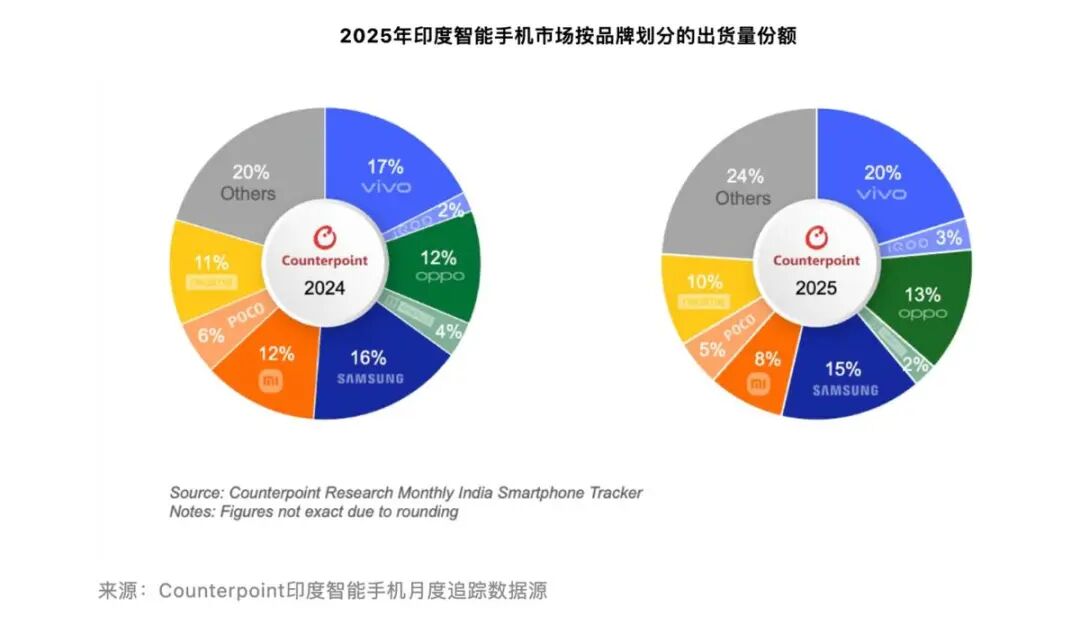
In comparison, OnePlus only holds a 2% share, representing a sharp decline from the 4% it recorded in 2024.
From this vantage point, refocusing realme on overseas markets might appear to be a perfect decision that allows it to return to its comfort zone?
In reality, the situation is not that straightforward.
Timing is a critical factor on one hand.
What is the current market context? Prices of core components such as global memory chips and semiconductors are skyrocketing. Coupled with realme's long-standing "dare to transcend specifications" cost-effective product strategy, the brand now faces far more acute and burdensome cost-profit pressures than most competitors.
In response, industry players ranging from Apple to domestic brands including OPPO, vivo, Xiaomi, and Honor have all announced price increases to offset rising component costs. But will consumers accept these higher prices?
IDC data shows that global smartphone shipments in the second quarter of 2026 fell by 6.7% year-on-year. Counterpoint reported an even steeper decline of 11%, marking the lowest second-quarter shipment level since 2013.
As a result, amid this industry-wide structural contraction, Apple and Samsung remain firmly positioned thanks to their premium brand product advantages. The real casualties are brands like OPPO, realme, and Xiaomi, which are struggling to maintain their footing in the mid-to-low-end market segments...
This also explains why OPPO, in this round of brand adjustments, has unified the systems of its two major sub-brands?
The fundamental reason is that external market pressures have become so intense, and the room for trial and error in overseas markets is continuously shrinking, that OPPO now needs to "reduce costs and improve efficiency", encouraging its sub-brands to unite as a cohesive force and support each other through challenging times...
On the other hand, in the long run, even if realme survives this wave of severe cost pressure, it cannot avoid a persistent core challenge:
With identical positioning, competing in the same segments, and targeting overlapping user groups, how can it prevent internal friction from "fighting in the same family" against OnePlus?
This is not an unfounded concern, as there is already clear precedent of OPPO, OnePlus, and realme competing against each other in the Indian market...
Looking further ahead, once the competitive landscape in emerging markets like India and Southeast Asia stabilizes, will OPPO in the future push realme to enter the overseas strongholds that OnePlus and Liu Zuohu have painstakingly cultivated over many years — the North American and European markets?
At that point, the "internal and external relationships" between the two sub-brands will inevitably face a more thorough reshuffle: Will they support each other from complementary positions, or will they continue to cannibalize each other's markets? Or will OnePlus be required to completely abandon its overseas ambitions to fully enable realme's success?
This is a choice that OPPO will eventually have to make.
Following this line of reasoning, we can also observe the other side of the impact this adjustment has on OnePlus:
In a certain sense, the greater the market pressure realme faces, the more complicated the feelings may not be for realme founder Li Bingzhong, but rather for the seemingly more relaxed team at OnePlus led by Liu Zuohu.
The reason is simple: OnePlus also rose to prominence through overseas markets, and once had a glorious period of international success. In 2019, it secured the fourth-largest market share in the global premium smartphone segment, and even became the top-selling premium smartphone brand in India.
Therefore, if OnePlus could maintain its momentum, having OnePlus lead overseas expansion right now would actually be a better strategic choice for OPPO, as it would be better positioned to withstand the pressures of the memory chip price surge and continue moving forward.
Unfortunately, OnePlus's market influence gradually declined over time, leading to its return to OPPO in 2021 and the launch of its full-scale localization process focused on the Chinese market...
As a result, OPPO's current adjustment essentially represents the final verdict on the overseas market story that OnePlus had previously promoted.
Regarding OnePlus's performance in the domestic market, it appears to be relatively strong at first glance — Li Jie, President of OnePlus China, shared last November that the brand's market share had for the first time exceeded 3.3%. However, a closer look reveals that this achievement would be almost impossible without substantial support from OPPO.
A clear manifestation of this support is that OPPO's official flagship store on Tmall has now added dedicated sections for both OnePlus and realme, with the core goal of maximizing product sales growth.
This creates a striking contrast: one sub-brand, despite underwhelming performance in the domestic market, has delivered numerous pleasant surprises for OPPO through its overseas operations; the other has failed to independently achieve notable results in the domestic market, has not brought new growth overseas, and even tends to create internal friction that undermines its peer sub-brand...
Judging from the current strategic adjustment, if OnePlus continues along its traditional path, it will be difficult to find new breakthrough opportunities in the domestic market, while realme holds the potential to unlock far greater growth possibilities overseas.
This means that while realme and OnePlus appear to have diverged in their destinies, the reality is that Li Bingzhong has not lost, and Liu Zuohu has not won...
The AI smartphone era has arrived, and OPPO is adopting a strategic balance of offense and defense?
As previously mentioned, OPPO's current restructuring of its sub-brands is largely intended to reduce internal strategic friction in the domestic market, as well as to mitigate the development risks brought by the chip price surge and the downturn in the smartphone market.
To be frank, however, these measures are mostly palliative rather than curative. To achieve genuine breakthroughs, the key lies in identifying a reliable path to sustainable growth.
Currently, the entire smartphone industry faces two major strategic directions:
The first path is to achieve premiumization of the brand, following the examples set by Samsung, Apple, and Huawei, which leverage their strong brand equity and premium pricing flexibility to achieve counterintuitive share growth even in a stagnant market.
However, this is not a path that OPPO and vivo can successfully navigate in a short period of time, making it somewhat like "drinking poison to quench thirst" — a solution that cannot address immediate challenges.
The second path is to launch more valuable and innovative products, analogous to the transformative impact that intelligent new energy vehicles have had on traditional fuel cars, or the way Insta360 pioneered the panoramic action camera segment, to reignite consumers' desire to upgrade their smartphones...
Within the smartphone industry, the most promising frontier for product innovation today is artificial intelligence, specifically AI smartphones.
From the launch of the first-generation Doubao smartphone last year, to the recent release of the second-generation Doubao smartphone, the AI agent smartphone developed by StepFun, and the debut of Honor's ROBOT Phone, all developments clearly indicate that the era of AI smartphones has officially begun.
Coincidentally, before this, the Cyberspace Administration of China published the filing information for seven products that provide on-device generative AI services on smartphones, covering major brands including Apple, Huawei, OPPO, vivo, Xiaomi, Samsung, and Nubia.
On one side, new players in the AI era are seizing the initiative with innovative product offerings. On the other side, traditional smartphone manufacturers have completed the required regulatory filings. When viewed together, it is easy to recognize the underlying trend:
The release of these filings essentially represents a market signal that the established smartphone industry players are adopting a strategy of simultaneous offense and defense.
The offensive aspect is easy to understand: As the narrative around AI smartphones becomes increasingly clear, the first mover will likely gain the upper hand. Therefore, even without a new AI product ready for launch, established brands like Huawei, Xiaomi, OPPO, and vivo must proactively engage in this marketing positioning battle.
For OPPO in particular, securing a ticket to the AI era is an opportunity it cannot afford to miss.
After all, it is regrettable that during the previous wave of domestic chip development, OPPO failed to see its efforts through to completion, and as a result, the brand was unable to build new underlying technological moats, even wasting precious time in a state of strategic indecision;
Regarding this current AI wave, OPPO actually "started too early" — Tianyancha App data shows that two years ago, OPPO's CEO Chen Mingyong officially fired the first shot for AI smartphones through an internal letter, announcing not only the establishment of an AI center, but also that OPPO would comprehensively popularize AI smartphones across its entire product lineup that same year...
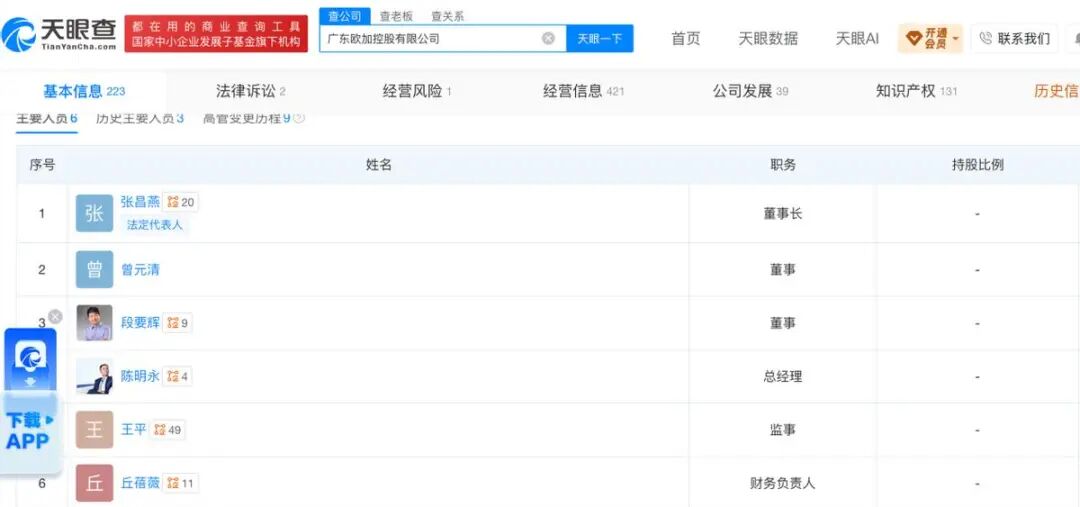
This forward-looking market vision deserves recognition, but "starting too early" also means that the brand had to blaze a trail alone and bear all the costs of trial and error.
As everyone has witnessed, it was not until the launch of the Doubao smartphone last year that AI smartphones finally became a tangible, market-ready product category...
Looking at the current situation, we sincerely hope that OPPO will not repeat this kind of missed opportunity for a third time.
The defensive aspect of the strategy is also self-evident. Although none of the three AI smartphone brands have aggressively expanded shipment volumes in their business operations, and with the exception of Honor, most are not traditional mainstream smartphone manufacturers, on the strategic chessboard, great developments often originate from small, almost imperceptible beginnings.
Looking back at countless disruptive moments across industries, the greatest threats have never come from direct competition within the same segment, but from "enemies that are not even on the same map":
For example, the product that defeated instant noodles was not another instant noodle brand, but food delivery platforms;
The product that displaced traditional cameras was not a better roll of film, but smartphones;
And ten years ago, who could have imagined that two smartphone companies would one day capture the full attention of the entire automotive industry?
This kind of cross-sector dimensionality reduction renders many traditional competitive dynamics in original market segments completely irrelevant.
When the Doubao smartphone became a viral hit last year, who was still fixated on evaluating its camera system, display, or processor? Consumers only cared about the new AI-powered experiences and scenarios it delivered.
Therefore, the release of this filing information can be interpreted as a move to prevent the Doubao smartphone from monopolizing the spotlight, and also as a pre-emptive blockade against potential fourth, fifth, and sixth cross-sector AI smartphone players that could emerge in the future, essentially putting up a warning sign that reads "This space is crowded, please find another path..."
If they fail to act now, today's Doubao smartphone may not disrupt the existing market structure, but what about the Qwen smartphone tomorrow, or the Yuanbao and Wenxin smartphones the day after?
No brand is willing to take that gamble.
Fortunately, the game in the AI smartphone era has only just begun. Short-term wins and losses are of little significance. The ultimate victory, driven by long-term commitment, will belong only to those who can patiently endure periods of obscurity and rise to meet the challenges of the times.
Just as you cannot discover new continents using outdated maps, OPPO and its peers are currently using concrete actions to chart their own new routes and directions.
And all future divergences will eventually converge at a higher level of development...