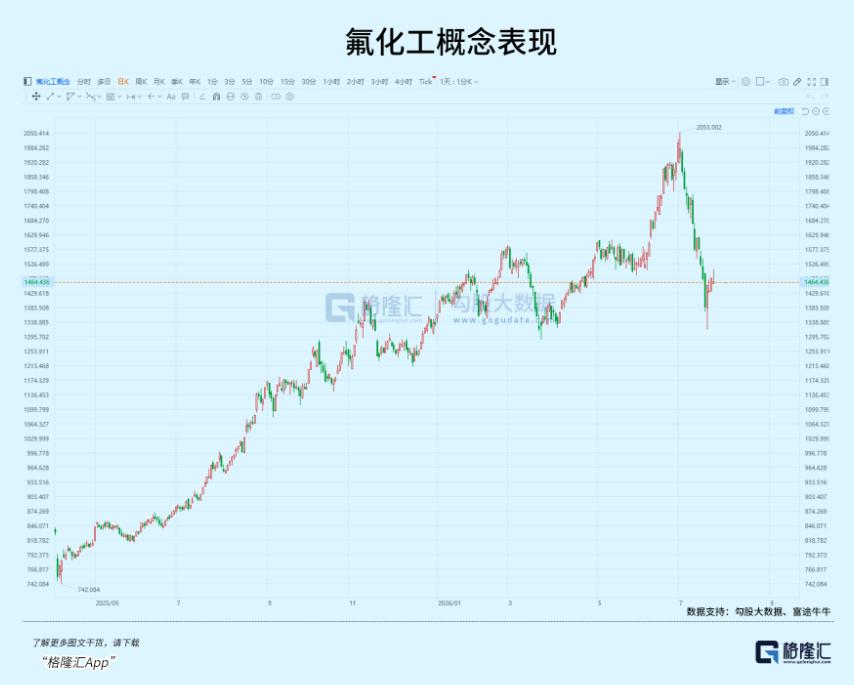
After a sharp rally followed by a brutal slump, did the sector's boom last for merely one month?
The fluorine chemical industry is now at the intersection of the traditional peak seasonal cycle and the AI computing power revolution.
Over the past two years, the refrigerant sector has completed a full cycle from price recovery to profit realization under the quota system framework, and the industry's overall profit baseline has shifted upward.
At almost the same time, AI computing infrastructure has begun driving incremental demand for fluorine-containing electronic materials — chip etching, thin-film deposition, and chip heat dissipation, previously overlooked segments, are becoming rigid consumption points across the semiconductor supply chain.
Against this backdrop of supply-demand mismatch, downstream categories including refrigerants, fluoropolymers, and lithium battery electrolyte additives (such as VC) have seen price hikes to varying degrees. However, the fluorine chemical sector failed to sustain its June rally, with core concept stocks recently pulling back 30%-40% on average, nearly erasing all gains made since the start of the year.
Has the decades-old cyclical framework for this industry truly been rewritten?
01
AI Computing Power Reshaping the Landscape
The explosive growth of AI computing infrastructure is driving rigid demand for fluorine-containing materials across three key dimensions.
As chip manufacturing processes advance, requirements for precision, layer stacking, and heat dissipation become increasingly stringent. Etching and cleaning for advanced nodes, thin-film deposition in 3D NAND, and thermal management for high-density server racks — every technical approach pushed to its physical limit relies on fluorine-containing materials.
Electronic-grade hydrofluoric acid is used for chip etching and cleaning. On silicon-based chips, only fluorine-based chemistry can selectively etch silicon dioxide without damaging the silicon substrate — a property dictated by fluorine's electronegativity, with no viable alternative available.
Electronic-grade hydrofluoric acid is classified by purity levels. Grade G4 requires metal impurity control at the ppb (parts per billion) level, while Grade G5 tightens this further to the sub-ppb range, an order of magnitude stricter than G4. Chips manufactured at 3nm or smaller nodes can only use G5-grade material.
Globally, only 8 companies have the capacity to produce G5-grade products, primarily led by Japanese firms (Stella Chemifa, Morita Chemical), with remaining producers located in mainland China, South Korea, and Taiwan, China.
The core contradiction lies in the widening gap between accelerating demand and rigid supply constraints.
G5 production capacity is highly concentrated in Japanese companies, with a CR5 ratio reaching 98%. The full cycle from constructing a G5 production line to passing customer certification spans 18-24 months. Iteration of AI chip processes continues to accelerate demand growth, while capacity decisions on the supply side were made long ago and cannot be adjusted in the short term.
Reports indicate TSMC, Samsung, and SK Hynix have simultaneously begun stockpiling supplies, with some suppliers raising prices by 20-30%. South Korean media outlet The Elec reported in May that South Korean semiconductor firms import 90% of their anhydrous hydrofluoric acid from China, revealing that East Asia's supply chain dependence on China is far deeper than market perceptions suggest.
Tungsten hexafluoride (WF₆) is used in tungsten deposition processes for 3D NAND and chip interconnects. As 3D NAND evolves beyond 200 layers, every layer requires WF₆ as a tungsten precursor — no other material currently meets the industrial requirements for both deposition rate and thin-film purity.
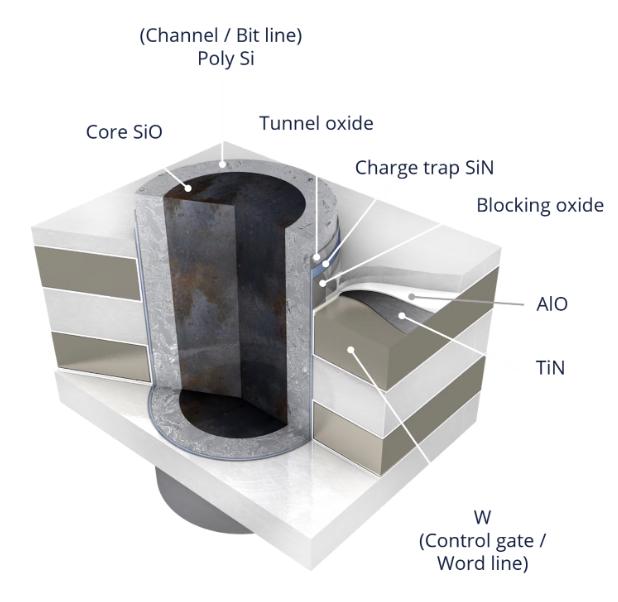
(Image source: Applied Materials)
According to TECHCET statistics, global WF₆ demand grew from 4,500 tons in 2020 to nearly 9,000 tons in 2025, representing a 14% compound annual growth rate. Per-wafer consumption for 3D NAND has surged 37 times compared to traditional chips, while AI chips consume over three times more WF₆ than regular chips.
However, on the other hand, demand is expanding while supply is contracting:
In early 2026, China's Ministry of Commerce implemented tungsten export controls. Shortly afterward, Japan's Kanto Denka Kogyo and Central Glass announced on July 1st that they would permanently cease WF₆ production, withdrawing a combined 2,000 tons of annual capacity from the market.
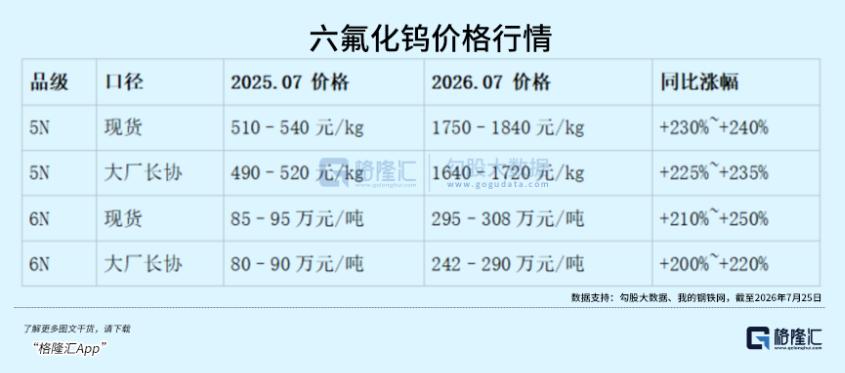
As of July 25th, spot prices for 5N-grade tungsten hexafluoride stand at 1,750-1,840 yuan/kg, skyrocketing 2.3 times year-over-year; 6N-grade WF₆ is priced at 2.95-3.08 million yuan/ton, marking a 2.1-2.5 times year-over-year increase.
Fluorinated fluids are used for immersion liquid cooling in AI data centers. Once single-rack power density exceeds 30kW, air cooling hits a physical ceiling. Fluorinated fluids, with their non-conductive properties, chemical inertness, and high specific heat capacity, are currently the only viable immersion cooling medium that can operate safely on energized equipment.
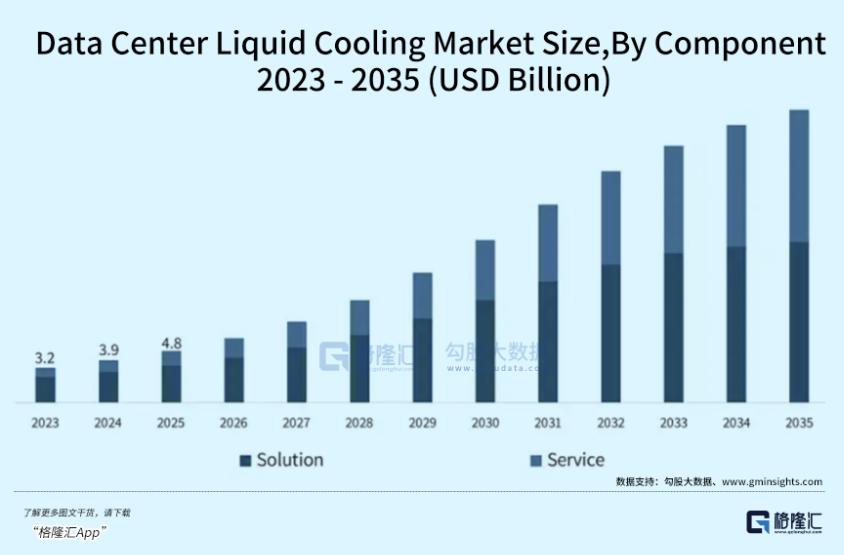
According to the latest report from Global Market Insights Inc., the global data center liquid cooling market was valued at $4.8 billion in 2025, and is projected to grow from $6 billion in 2026 to $27.1 billion by 2035, representing an 18.2% compound annual growth rate for 2026-2035.
The biggest variable on the supply side is 3M's market exit. Approximately 80% of global fluorinated fluid capacity is concentrated in two companies, 3M and Solvay. 3M will fully cease production of PFAS products by the end of 2025, directly creating a supply vacuum of tens of thousands of tons.
The severity of the supply-demand imbalance is already reflected in prices. 3M stopped accepting new orders for Novec in March 2025, after which the market only traded existing inventory — Novec 7000 series products are now quoted at $45-90 per liter in the secondary market, while alternatives Galden and Asahiklin have risen to $60-110 per liter. For reference, non-fluorinated hydrocarbon coolants of equivalent grade only cost $3-18 per liter. The scarcity premium for fluorine-containing materials exceeds an order of magnitude.
Translating to the A-share market, there are corresponding listed companies for each of these three segments.
Special Gas Group is the domestic leader with the largest WF₆ production capacity (2,000 tons/year, with plans to expand to 4,000 tons/year). Benefiting from the price surge, its stock price once rose more than 10 times in two years, and its current valuation remains at a high level.
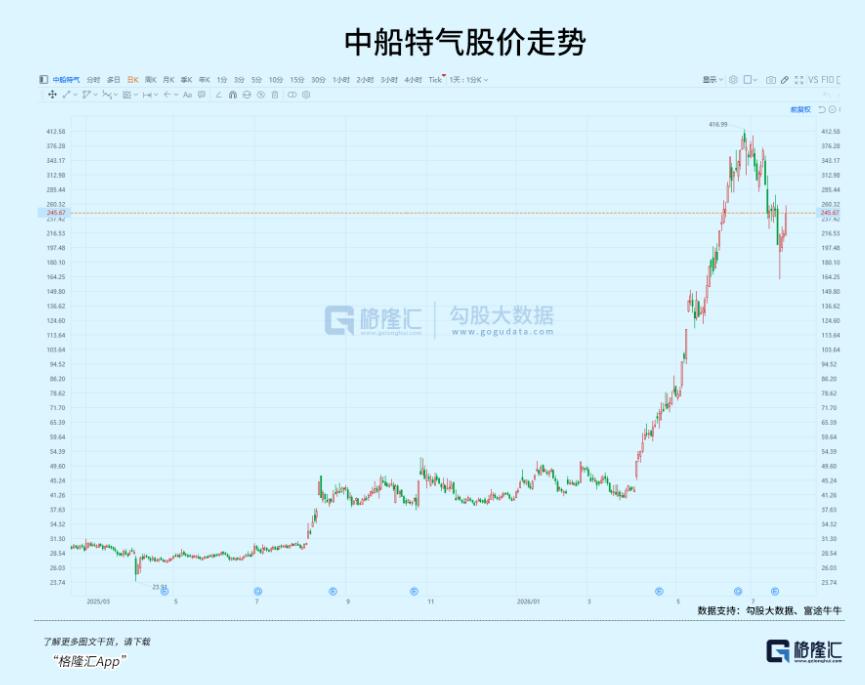
Do-Fluoride New Materials holds the most strategic position in electronic-grade hydrofluoric acid — it has passed certifications from TSMC and Samsung and is already supplying them in volume. The company's total long-term planned production capacity will exceed 70,000 tons, with phased production verification to be completed by the end of 2026.
New Zebang has a clear first-mover advantage in fluorinated fluids — it ranks first in domestic market share for semiconductor coolants. Leveraging its two bases, Hystech and Hydref, it has broken overseas monopolies on core fluorinated fluid formulas, becoming the only domestic enterprise that covers both mainstream perfluoropolyether (PFPE) and hydrofluoroether (HFE) systems.
Juhua Group has a presence across all three segments — its fluorinated fluids are already supplied to NVIDIA and Alibaba Cloud, and it also holds key positions in PFA, tungsten hexafluoride, and other fields.
Fluorine-containing materials are evolving from a marginal segment of the chemical cycle to an unavoidable bottleneck in the semiconductor supply chain, which in turn opens up new valuation potential for industry chain companies.
However, it is the refrigerant sector that truly underpins the profit base of the current fluorine chemical cycle.
02
The Refrigerant Cycle
Refrigerants lie at the core of the traditional fluorine chemical cycle.
In the last cycle, severe overcapacity in 2019-2020 pushed R32 prices below 10,000 yuan/ton, leading to widespread industry losses. In 2021, post-pandemic demand recovery paired with supply-side consolidation lifted R32 prices to around 20,000 yuan/ton. By 2022, as profitability improved, companies expanded production en masse, flooding the market with new capacity and driving prices back down. In 2023, the industry fell into another downturn.
In 2024, the HFCs quota system under the Kigali Amendment was fully implemented, establishing a permanent supply constraint under an international convention framework. Refrigerant supply shifted from free competition to quota locking, meaning companies can no longer seize market share through capacity expansion — the floodgates for capacity growth have been closed.
Production quota data issued by the Ministry of Ecology and Environment shows that the total 2026 production quota for third-generation refrigerants is 797,800 tons, representing a mere 0.75% year-over-year increase — nearly zero growth.
The effects of the quota system are directly visible in price trends. Before 2024, R32 prices fluctuated long-term in the 10,000-20,000 yuan/ton range — falling below cost during overcapacity periods, recovering briefly after consolidation, only to be driven back down by another round of expansion.
In 2024, with the quota system fully implemented, this cycle was completely broken. R32 started at around 15,000 yuan/ton and rose to 64,000 yuan/ton within a year, marking an increase of over 300%. R134a and R125 prices moved upward in tandem, lifting the overall refrigerant price baseline from below the break-even line to a high-profit range.
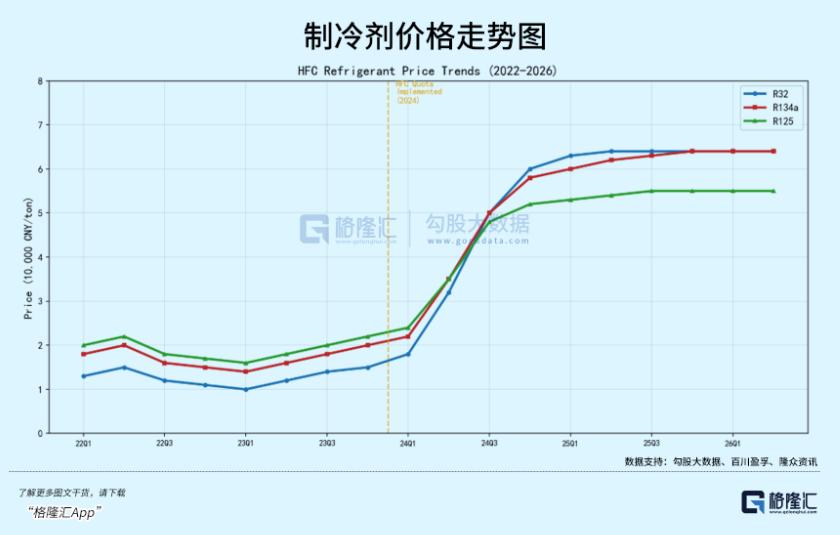
As of July 3rd, 2026, R32 is quoted at 64,000 yuan/ton, R134a at 64,000 yuan/ton, and R125 at 55,000 yuan/ton. Prices have entered a high and stable phase, shifting from explosive growth to gradual increases.
Entering May 2026, two additional catalysts emerged on the demand side. The UK and US successively postponed their HFCs reduction timelines, unexpectedly extending China's refrigerant export window. The UK's largest wholesaler Beijer Ref UK immediately announced a 60% price hike for R410a. The domestic-foreign price gap further supports China's domestic price baseline.
The export segment is also experiencing decoupling between volume and price. According to General Administration of Customs data, China's HFCs monomer refrigerant exports reached approximately 42,000 tons in January-April 2026, down 26.8% year-over-year. However, overall average export prices have risen — R32's average export price is 57,100 yuan/ton, up 39% year-over-year; R134a's average price is 51,100 yuan/ton, up 21% year-over-year.
The decline in export volume is mainly due to geopolitical logistics disruptions. Shipping delays in the Red Sea and Strait of Hormuz have pushed up freight costs. After the UK and US postponed their reduction policies, northern hemisphere summer restocking demand is being released, and export volumes are expected to recover in the second half of the year.
This institutionalized framework affects not just the price baseline, but the entire competitive landscape.
Juhua Group alone accounts for 37.6% of the national third-generation refrigerant quota, and the top six enterprises combined hold 90% of the total. By product category, each segment is essentially tightly controlled by three to four companies.
In the 2026 quota scheme, as the upper limit for cross-product allocation within the year expands from 10% to 30%, industry giants with complete product lines can flexibly reallocate quotas across categories, directing more resources toward products with the highest profit margins. Quotas are allocated based on historical production volumes, and this seemingly neutral rule effectively consolidates the existing competitive landscape.
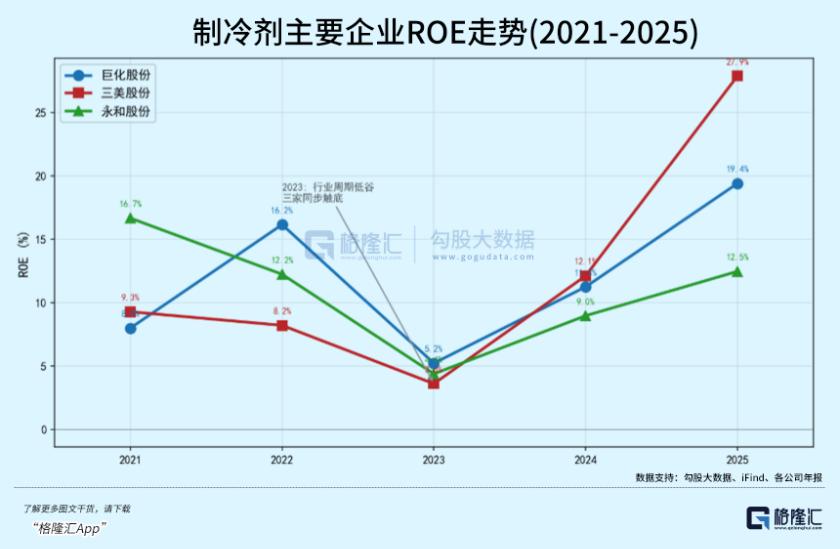
Looking at 2025 annual reports, the business characteristics of these industry leaders show clear differentiation: Juhua Group recorded 26.991 billion yuan in revenue in 2025, with refrigerants contributing about 40% (around 10.8 billion yuan) and the remainder coming from fluoropolymers, petrochemical materials, and basic chemicals. Sanmei posted 5.85 billion yuan in revenue, with refrigerants accounting for about 80% (around 4.7 billion yuan). Yonghe achieved 5.206 billion yuan in revenue, driven by both refrigerants and fluorinated polymers, with its FEP (fluorinated ethylene propylene copolymer) capacity ranking first domestically and second globally.
Sanmei's revenue is less than a quarter of Juhua's, but its extremely high refrigerant exposure and well-aligned quota-product structure led its 2025 ROE to reach 27.9%, surpassing Juhua's 19.4%. Sanmei's consolidated gross margin is approximately 50.60% and net margin 34.95%, with its higher profitability rooted in superior cost structure and product mix — all of Sanmei's refrigerant products are in high-price ranges with strong cost control, while Juhua's larger scale means its non-refrigerant segments drag down overall profit margins