Wang Hong, take your time to think.
The Fields Medal weighs approximately 169 grams. Its obverse side bears the portrait of Archimedes, the ancient Greek mathematician, while its reverse side is engraved with a Latin inscription, the general gist of which is:
Mathematicians from all over the world have gathered to award you this medal in recognition of your outstanding contributions.
As the most prestigious and influential award in the field of mathematics, the Fields Medal is often hailed as the "Nobel Prize of Mathematics". It prioritizes originality, breakthroughs, and long-term academic value. The medal is awarded every four years, with recipients required to be under the age of 40 by January 1 of the award year, and a maximum of four laureates are selected each time.
On the evening of July 23, Beijing time, at the Pennsylvania Convention Center in Philadelphia, USA, Chinese mathematicians Hong Wang and Yu Deng received the medal at the award ceremony. This marks the first time a Chinese national mathematician has won this award, and 35-year-old Hong Wang is the third female laureate in the nearly 90-year history of the Fields Medal.
The core achievement that led her to the podium is a 127-page paper she co-authored with Professor Joshua Zahl of the University of British Columbia, published in February 2025: A Rigorous Proof of the 3-D Kakeya Conjecture. Emmanuel Ullmo, Director of the Institut des Hautes Études Scientifiques (IHES), commented that this is a result significant enough to reshape the landscape of the entire research field.
After winning the award, Hong Wang said in an exclusive interview with Xinhua News Agency that this medal is of extraordinary significance to her and her collaborators. She also mentioned that when she was in high school, she read in a mathematics magazine that Terence Tao had won the Fields Medal (Terence Tao received the Fields Medal in 2006, becoming the second Chinese mathematician to receive this honor after Shing-Tung Yau), and she was very excited at the time. Twenty years later, she stood on the very same podium.
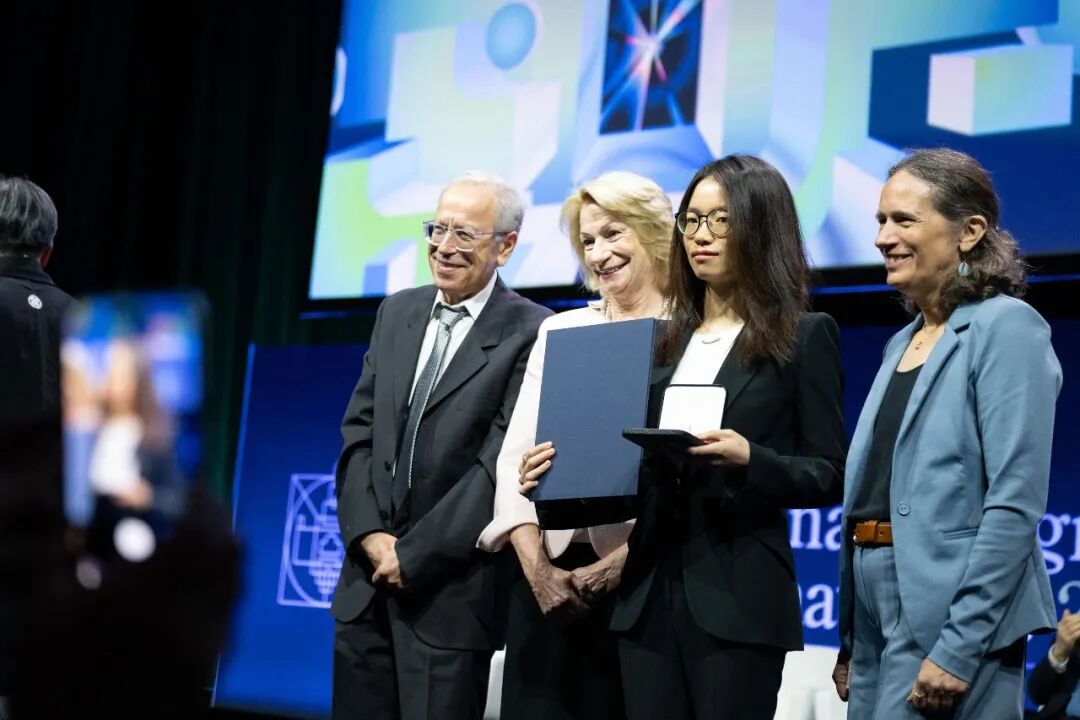
"Today I am just as excited," she said.
After the excitement, Hong Wang's life seems to have not changed much. Most of the time, she still ponders over those perplexing problems. When she gets stuck, she goes to exercise, and after a good rest, she thinks through them slowly.
"Just Think About It"
In 1991, Hong Wang was born in Pingle County, Guilin City, Guangxi Zhuang Autonomous Region. Both of her parents were local middle school teachers.
Her early education was characterized by an "atypical" laid-back approach. In an interview with Quanta Magazine, she described her childhood this way: her parents never put excessive academic pressure on her. After school, Hong Wang would read Greek mythology, Harry Potter, and *The Lord of the Rings*, play table tennis and badminton, and in the evening, the whole family would take walks amid the iconic karst landscapes of Guilin.
This path is completely different from that of Yu Deng, her Peking University alumnus and fellow Fields Medalist — Deng has an illustrious competition background, while Hong Wang was never selected for the national Olympiad mathematics training team or winter camp.
Hong Wang's interest in mathematics originated when she was five or six years old, when she got an elementary school mathematics textbook ahead of schedule. There was a problem in a section of the textbook called "Just Think About It": Given 7 trees, what is the maximum number of straight lines that can be formed such that each line contains exactly 3 trees? She was extremely delighted after figuring out the answer.
From then on, she fell in love with that feeling of "just thinking about it".
In 2007, 16-year-old Hong Wang took the National College Entrance Examination and was admitted to Peking University with a score of 653. However, the Department of Mathematics of Peking University only recruited one student in Guangxi that year, so Hong Wang was eventually admitted to the School of Earth and Space Sciences.
From the first day of enrollment, she started preparing to transfer to another department. In an exclusive interview with *China Science Daily*, Hong Wang recalled: "I was absolutely certain that I wanted to do mathematics." Because she had an "ambitious" idea — that doing mathematics could leave something meaningful behind, and "maybe one day I could prove a theorem".
Transferring departments is known as the "second college entrance examination". According to the regulations, to apply for a transfer, a student must rank at the top in both their current major and the transfer exam. Hong Wang had to study courses for two majors simultaneously. Due to credit restrictions, among the three core mathematics courses of Geometry, Advanced Algebra, and Mathematical Analysis, she could only choose the first two, so she had to teach herself Mathematical Analysis. That year, she spent most of her time in the library and classrooms. In her sophomore year, she successfully transferred to the Department of Mathematics.
However, after truly immersing herself in mathematics, she found that university mathematics was completely different from what she had learned in secondary school. "How to study mathematics systematically was a critical problem for me, and I spent a long time figuring it out," Hong Wang once said.
After graduating with a bachelor's degree in 2011, Hong Wang went to France to pursue a master's degree at École Polytechnique and Université Paris-Sud 11 (now Paris-Saclay University).
Seeking Certainty Amid Uncertainty
In France, Hong Wang made an unexpected decision: to put mathematics aside and study architecture instead.
At École Polytechnique, she took an architecture course, and after the semester ended, she interned at an architecture firm for a month. For about half a year, she barely touched mathematics at all.
Why did she return to mathematics? Hong Wang said in a 2023 exclusive interview with the School of Mathematical Sciences of Peking University, "I'm not entirely sure what made me come back. Maybe I realized that for me, mathematics didn't seem as difficult to learn as architecture. At that time, I had received a considerable amount of mathematical training, but there were so many outstanding students at Peking University that I forgot that. With architecture, I had no clear idea how to learn it, but with mathematics, I at least knew where to start."
During her internship at the architecture firm, she found that architectural creation required persuading others and seeking funding, which limited creative freedom; whereas mathematical research allowed her to build a world all on her own. More importantly, she discovered that architecture lacked a clear objective, while in mathematics, she could "build" ideas on her own.
She once recalled that learning English was frustrating because there were as many exceptions as rules, but mathematical theorems seemed rock-solid.
In 2013, during her master's studies, Hong Wang visited the Massachusetts Institute of Technology (MIT) for several months and joined the research team of Larry Guth. Guth is a leading global scholar in geometric measure theory and harmonic analysis, and his patience left a deep impression on Hong Wang — when Hong Wang got stuck while discussing with her supervisor and couldn't derive the results at the blackboard (a situation colloquially known in mathematical circles as "getting stuck on the blackboard"), Guth would always wait patiently with a smile, never interrupting or negating her, and encouraging her to "pour out" all the ideas in her mind, even if they were messy and vague.
"When I was studying mathematics, my views were not always aligned with those of the people around me. He always listened, and tried hard to understand my thought process. That helped me build confidence," Hong Wang said, "Through those conversations, I learned how to sort out the ideas in my head and how to delve deeper into them."
In 2014, Hong Wang obtained her engineer's degree from École Polytechnique and her master's degree in mathematics from Université Paris-Sud 11. She then entered MIT to pursue her doctorate under the supervision of Guth. After earning her PhD in 2019, she conducted postdoctoral research at the Institute for Advanced Study in Princeton. In 2021, she became an assistant professor at the University of California, Los Angeles. In 2023, she joined the Courant Institute of Mathematical Sciences at New York University as an associate professor, and was promoted to full professor in 2025. In September of the same year, she was appointed as a tenured professor at the Institut des Hautes Études Scientifiques (IHES), becoming the first female tenured professor in the institute's history.
The Kakeya Conjecture
The Kakeya conjecture originated from a problem proposed by Japanese mathematician Sōichi Kakeya in 1917:
What is the smallest possible "space" that an infinitely thin needle can sweep through while rotating to point in every possible direction?
Mathematicians later discovered that on a plane, it is possible to construct sets of arbitrarily small area that can accommodate a needle pointing in all directions. But when the problem extends to three-dimensional space, things become much more complicated — what exactly is the dimension of a three-dimensional Kakeya set?
What Hong Wang and Zahl proved is that the dimension of a three-dimensional Kakeya set must be three. In other words, such a set cannot essentially be compressed into a lower-dimensional structure. Zahl once did postdoctoral research in Hong Wang's supervisor Larry Guth's team, and the two began their collaboration because they shared a common interest in the Kakeya conjecture.
In February 2025, Hong Wang and Zahl published a 127-page paper on arXiv (the world's largest open-access platform for academic preprints), announcing this proof. According to a report by Quanta Magazine, before the paper was published, the two had spent months checking it, and sent the manuscript to several peers for review, before finally making it public. Hong Wang later admitted that what she worried about was not that the argument was wrong, but that the presentation was not clear and certain enough.
This obsession with clarity and certainty is also reflected in her daily life. Hong Wang is extremely disciplined, and people who know her describe her state of devotion to mathematics as "like a nun or an elite athlete". She rejects time-consuming hobbies — she does not read books outside of mathematics, nor does she keep a dog, but she makes time to meet friends and practice yoga. When she was in New York, she took walks in Washington Square Park every early morning to look at other people's dogs, as a way to relieve the pressure brought by her research.
Shukun Wu, a classmate of Hong Wang and a professor of mathematics at Indiana University, commented: "She is absolutely obsessed with mathematics, and is definitely one of the most focused people I have ever met."
In June 2025, Hong Wang returned to Peking University and gave three consecutive days of lectures explaining the proof process of the Kakeya conjecture, with the venue packed to capacity. Academician Gang Tian of the Chinese Academy of Sciences was present, and Wei Dongyi, an associate professor and researcher at the School of Mathematical Sciences of Peking University, sat in the first row listening for all three days. During the breaks, the two discussed the details of the proof, which netizens referred to as "encrypted conversations".
In June 2026, the International Mathematical Union officially released *The Leiden Manifesto on Artificial Intelligence and Mathematics*. This manifesto, drafted by 16 researchers over eight months, emphasizes the central role of proof: A result should not only appear to be correct, but also must be understandable, clearly expressed, properly attributed, and independently verifiable by other researchers. By mid-June, 2,411 mathematicians had signed it.
Hong Wang's work is precisely a footnote to this kind of "slowness".
Prior to this, she had already won multiple international awards such as the New Horizons in Mathematics Prize, the Salem Prize, and the Ostrowski Prize. Even so, she still felt like an "outsider".
Hong Wang never hides the struggles that come with this "slowness". She once said that the feeling of studying mathematics is "constantly struggling". But it is precisely this kind of struggle that made her realize in confusion that architecture was not her calling, learn to think deeply when she "got stuck on the blackboard" at MIT, and confirm the correctness of the 3-D Kakeya conjecture through repeated checks of the 127-page proof.
The 127-page proof is not about adding a line that says "experiments show that this is probably true" after seeing a result, but about turning something that the mathematical community has "believed" in for many years, step by step, into an irrefutable rigorous argument.
As the third female Fields Medalist in history, Hong Wang's award has been endowed with too many symbolic meanings — being female, a Chinese national, and with a non-competitive background.
"Every time I feel that it's purely down to good luck," she said, talking about all the proofs she has completed. She did not celebrate her proof, but moved on to the next problem.
Just as she said: "I love mathematics more."
References:
1. Exclusive Interview with Hong Wang: From the Former "Little Unknown" of the Peking University Department of Mathematics to Today's Fields Medalist, China Science Daily
2. Natalie Wolchover: Living Fully in the Math World Means Threading the Needle, Quanta Magazine
3. Hong Wang (X2010) awarded the 2026 Fields Medal, École Polytechnique Interview
This article is from the WeChat Official Account "China Entrepreneur Magazine" (ID: iceo-com-cn), written by Shiyu Shi, and published with authorization from 36Kr.