The fuel vehicles you once dismissed as "no good" are staging a strong comeback.
In the first half of this year, the performance of the fuel vehicle market has been quite intriguing.
At the start of the year, 7 fuel-powered models secured spots in the top 10 domestic passenger vehicle sales rankings, reinforcing the perception that the fuel vehicle camp maintained a solid market position. Among them, the Geely Boyue L even ranked second on the list with monthly sales of 34,000 units, second only to the Xiaomi YU7. It stood out as the top-selling fuel vehicle at the beginning of the year, outperforming a large number of new energy vehicles.
However, the market sentiment shifted rapidly afterward.
With the implementation of stimulus policies for new energy vehicle purchases, the competitiveness of electric vehicles has increased significantly, while the market share of fuel vehicles has continued to shrink. By May, fuel vehicles completely dropped out of the top 10 retail sales rankings for passenger vehicles, hitting an embarrassing new low for that period. For a time, arguments like "fuel vehicles are truly on their way out" and "the era of gasoline cars is over" spread widely, pushing many people's pessimism toward fuel vehicles to its peak.
Yet judging from the sales report of the auto market in June, it is still too early to declare that fuel vehicles are doomed. According to the latest statistics from the China Passenger Car Association, 17 fuel-powered models achieved monthly sales exceeding 10,000 units in June, 4 more than in May. This includes 13 joint-venture fuel vehicles and 4 domestic fuel vehicles, covering multiple mainstream market segments such as sedans and SUVs.
In particular, two classic fuel-powered models, the Toyota Camry and the Volkswagen Lavida, returned to the top 10 of passenger vehicle sales, injecting a much-needed boost into the previously sluggish fuel vehicle market and sending a clear signal that fuel vehicles have not exited the mainstream competitive arena.
01
Fuel Vehicles Make a Comeback to the Top 10 Sales Rankings
The unexpected rebound of fuel vehicles in June stems from both market fluctuations and the proven strength of top-tier classic models, putting an end to the awkward situation where no fuel vehicles made the top 10 in May.
Looking at specific sales figures, the Toyota Camry ranked ninth on the overall list with monthly sales of 17,000 units, followed closely by the Volkswagen Lavida at tenth place with 15,000 units, firmly securing leading positions for fuel vehicles.
Certainly, this performance represents the final monthly sales report card for fuel vehicles in the first half of the year. However, looking back at the trend of fuel vehicles in the first half of 2026, this performance is far from the norm—it is neither the best nor the worst.
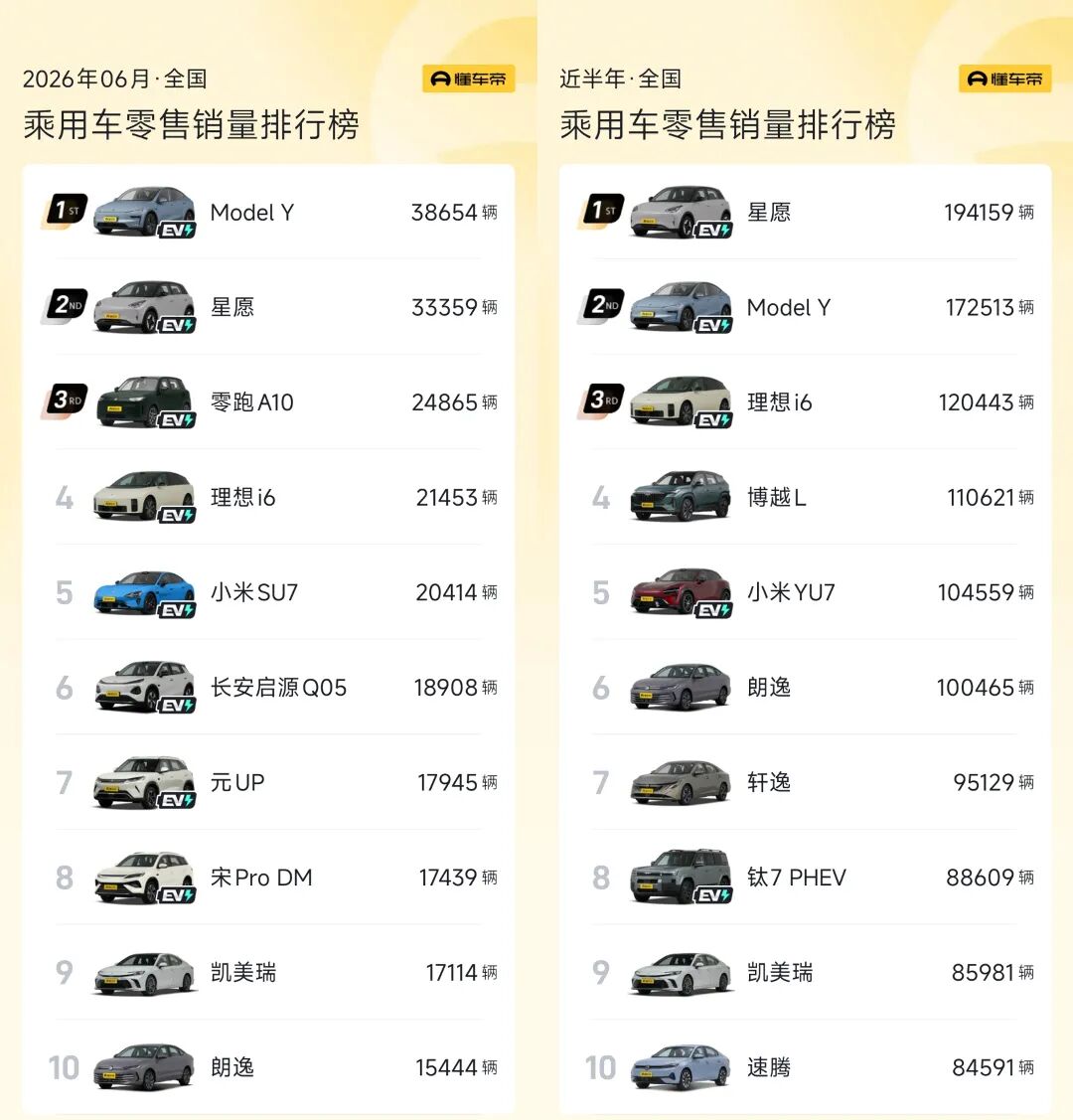
The best performance came at the start of the year, when fuel vehicles took 7 out of the top 10 spots in the passenger vehicle sales rankings; by March, 5 fuel-powered models still remained in the top 10, occupying half of the rankings; in April, only the Geely Binyue barely held onto a top-tier position; in May, the market faced the embarrassing "total wipeout" situation, with no fuel vehicle models making it into the top 10 sales rankings.
The "retreat" in fuel vehicle sales follows a clear traceable path, which is why many people are exclaiming that "fuel vehicles are finished."
It was not until June that sales of many fuel vehicles saw a phased rebound.
Focusing on the sedan segment, the return of the Camry and Lavida to the rankings is not unexpected. Both models are benchmark products that have been deeply rooted in the market for many years: the Camry is a global mid-size sedan benchmark, while the Lavida is a long-standing staple in the domestic family sedan market.
In the June sedan segment sales rankings, both models firmly secured top 5 positions, overtaking popular new energy models such as the Tesla Model 3, XPeng MONA M03, BYD Qin PLUS, and BYD Dolphin in sales. This data still demonstrates that fuel vehicles maintain strong market competitiveness in the essential family sedan market, and have not been completely replaced by new energy vehicles.
In the long run, these two models have extremely profound market heritage.
In the first half of the year, the Camry consistently ranked among the top 3 B-segment sedan sales, and together with the Volkswagen Passat and Magotan, it firmly stabilized the base market for joint-venture mid-size fuel sedans. The Lavida won the annual sales championship multiple times between 2010 and 2019. It was only in the past two years, under the impact of the electrification wave, that its market position was gradually shaken by new energy models such as the BYD Song family and the Tesla Model 3.
In addition to the two benchmark sedans, joint-venture fuel SUVs and mid-size sedans also achieved a collective rebound.
The Volkswagen brand has become the core pillar of joint-venture fuel vehicles: five models, namely the Lavida, Passat, Magotan, Tiguan L, and Tayron, all exceeded 10,000 units in sales in June, with the Passat, Magotan, and Tiguan L maintaining stable monthly sales of around 12,000 units.
Self-owned brand fuel vehicles, on the other hand, demonstrated a dominant advantage in the SUV segment. Two compact SUVs, the Geely Xingyue L and Boyue L, ranked third and fourth in fuel vehicle sales, while the Changan CS75 PLUS also delivered stable performance with monthly sales exceeding 10,000 units. The market performance of self-owned brand fuel SUVs far outshines that of joint-venture models in the same segment.
02
What Are the Favorable Factors Behind the Rebound
The rebound of fuel vehicles in June is the result of a combination of multiple short-term favorable factors and the long-term accumulated strengths of brands. However, this "recovery" does not signal a reversal of the industry trend, as the long-term shrinking trend of the fuel vehicle industry remains unchanged.
The core driving force behind the rebound first comes from the vehicle usage cost dividend brought by falling oil prices. According to domestic refined oil price adjustment records, oil prices went through two rounds of adjustments in June, with the price of No. 92 gasoline dropping by about 0.8 yuan per liter cumulatively, returning its retail price to the "7-yuan era." The significant drop in oil prices has completely dispelled consumers' anxiety about fuel costs.
For users, the daily commuting and long-distance travel costs of fuel vehicles and dual-engine hybrid models have been greatly reduced. Potential consumers who previously held off on purchases due to high oil prices quickly released their willingness to buy, directly driving up terminal sales of family fuel vehicles. For example, Toyota's dual-engine hybrid models, which combine the convenient refueling experience of fuel vehicles with the advantage of low fuel consumption, have become one of the beneficiaries of the downward oil price cycle.
Secondly, the strong product reputation and accumulated strengths of leading brands have become the core confidence for fuel vehicles to stabilize their market position.
Because judging from the results, most of the fuel-powered models that rebounded in June are long-standing proven products that have withstood long-term market tests. The Camry has been deeply cultivated in the mid-size sedan market for many years, with its quality stability, resale value, and failure rate all ranking at the upper level of the industry; the Lavida precisely meets the essential needs of family transportation, and its cost-effectiveness and durability are highly recognized by consumers.
From a brand perspective, the current fuel vehicle market is basically supported by two major joint-venture brands: Volkswagen and Toyota. Multiple models under Toyota, including the Camry, RAV4, and Wildlander, achieved sales exceeding 10,000 units in June, making Toyota the only sales pillar of Japanese fuel vehicles, while competing models such as the Honda Accord and Nissan Teana lagged far behind in sales. Volkswagen, with its comprehensive product lineup, has secured top-selling spots for multiple mainstream sedans and SUVs.
The ability of these two brands to stand out against the tide in the harsh fuel vehicle market largely stems from their deep brand reputation, solid technical reserves, comprehensive product matrix, and precise pricing strategies tailored to the family market.
At the same time, the industry-wide practice of automakers pushing for mid-year sales targets and clearing inventory in June further amplified the rebound effect.
As the final node for first-half sales, major automakers increased their terminal discount efforts, pushing prices of many mainstream fuel vehicles to new lows. Models like the Camry and Lavida saw maximum terminal discounts, significantly lowering the entry threshold for joint-venture B-segment sedans and A+ class sedans. Their extremely high cost-effectiveness attracted a large number of first-time buyers and vehicle replacement users.
However, behind the bustling sales figures lie unavoidable industry dilemmas for fuel vehicles.
According to data from the China Passenger Car Association, the overall sales of domestic fuel vehicles in June were approximately 600,000 units, a sharp year-on-year decline of 39%, indicating that the overall downward trend of the industry remains unchanged. Segmented data further highlights the harshness of the market: among the more than 10 fuel models that sold well in June, only the Camry achieved positive year-on-year growth, while all other models posted year-on-year sales declines.
This means that this rebound in fuel vehicles is still phased. Market dividends are highly concentrated on the top benchmark models of Volkswagen and Toyota, while small and medium-sized joint-venture brands and marginalized fuel models continue to lose market share.
In the long run, against the backdrop of the high penetration rate of new energy vehicles, the living space for fuel vehicles continues to be compressed. This June sales rebound does not represent a reversal of the industry trend. In the future, the fuel vehicle market will continue to show a differentiation pattern where "top players thrive while marginal players exit." New energy vehicles will continue to capture more market share from fuel vehicles, eventually reaching a new balance point.
This article is from the WeChat Official Account "Auto Community" (ID: iAUTO2010), written by Li Sijia, and published with authorization from 36Kr.