Just now, Jensen Huang posted on Twitter for the first time: Half of Silicon Valley is fully backing the open-source Kimi K3.
I've never seen anything like this before.
Just now, NVIDIA founder Jensen Huang posted his very first tweet in life:
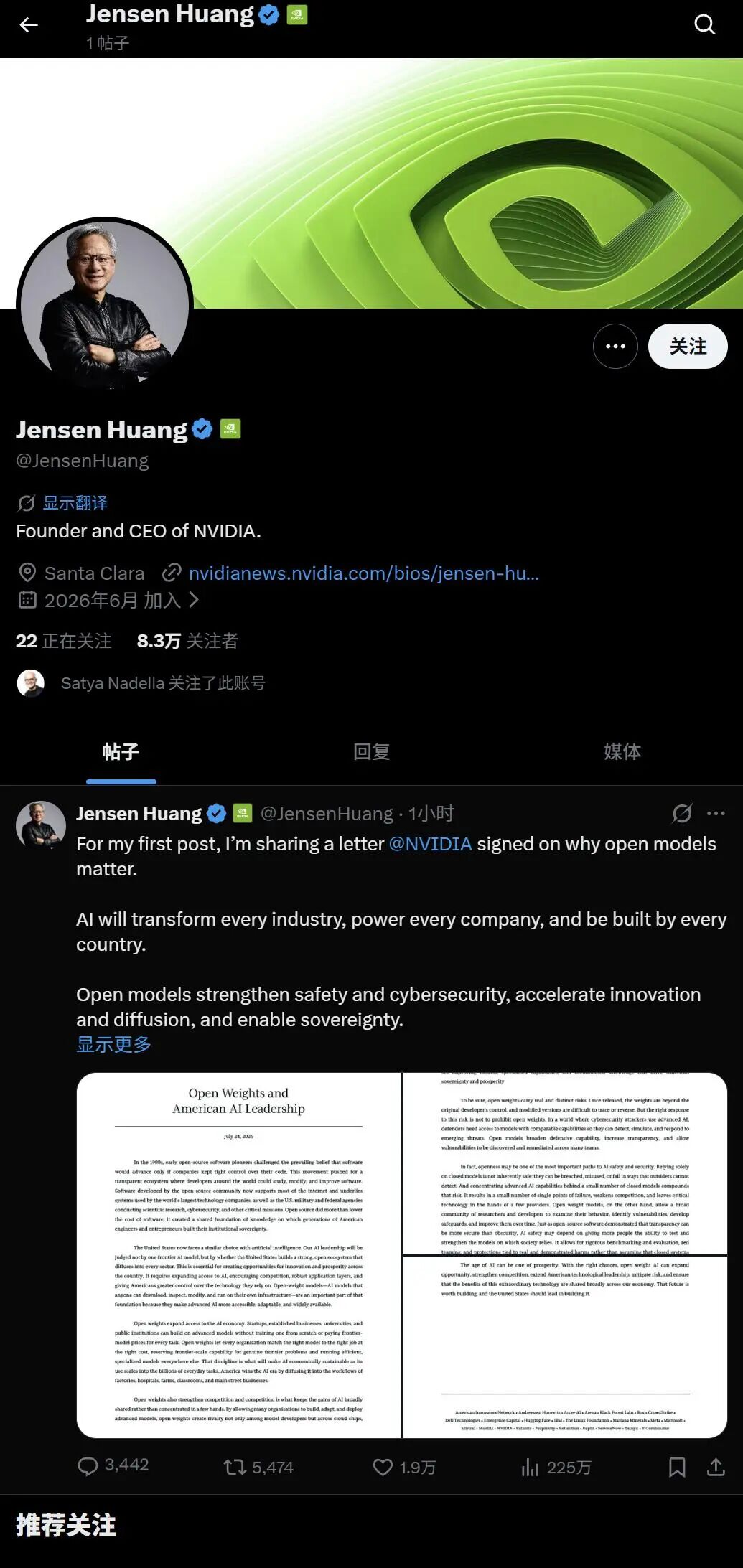
The account is newly registered, and the tweet feels a bit rushed.
In his first post, Jensen shared a letter signed by NVIDIA titled *Open Weights and U.S. AI Leadership*, explaining why open-source models matter.
He stated that artificial intelligence will transform every industry, empower every company, and be built by every nation. Open-source models enhance security and cybersecurity, accelerate innovation and dissemination, and enable technological sovereignty. The world needs both cutting-edge closed-source models and leading open-source models.
In fact, this is an open letter jointly signed by more than 20 tech giants, startups, and investment institutions, including NVIDIA, Microsoft, Meta, as well as Hugging Face, Mistral, and YC.
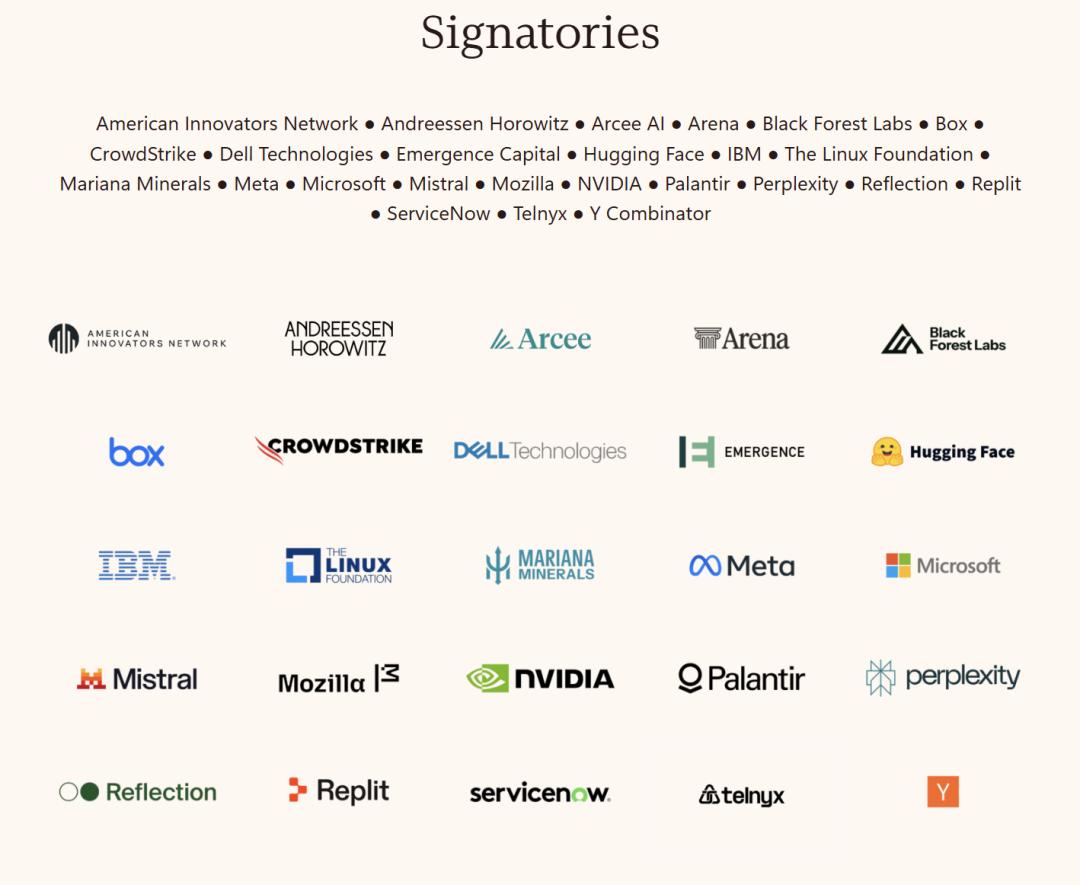
It now appears that they intend to join forces to "counter" the closed-source giants OpenAI and Anthropic.
The full translation is as follows:
In the 1980s, the early pioneers of open-source software challenged the prevailing belief that software could only progress if corporations strictly controlled the codebase. This movement drove the creation of a transparent ecosystem where developers worldwide could learn, modify, and improve software. Today, software developed by the open-source community underpins most of the internet, and powers critical systems for the world's largest tech companies, the U.S. military, and federal agencies to conduct scientific research, cybersecurity operations, and other essential missions. The significance of open source extends far beyond reducing software costs; it has created a shared knowledge foundation upon which generations of American engineers and entrepreneurs have built their institutional autonomy.
Today, the United States faces a similar choice in the field of artificial intelligence. U.S. leadership in AI will not be defined by a single frontier model, but by whether America can build a robust, open ecosystem that permeates every sector. This is essential to creating opportunities for innovation and prosperity across the nation. It requires expanding access to AI, encouraging competition, building a strong application layer, and granting the American people greater control over the technologies they rely on. Open-weight models — AI models that anyone can download, inspect, modify, and run on their own infrastructure — are a critical part of this foundation, as they make advanced AI more accessible, flexible, and widely deployable.
Open weights expand access to the AI economy. Startups, established enterprises, universities, and public institutions can build using advanced models without training them from scratch or paying exorbitant fees for frontier models for every task. Open weights enable every organization to match the right model to the right task at the right cost, reserving frontier-scale capabilities for truly cutting-edge problems, and running efficient, specialized models for all other use cases. This discipline will make AI economically sustainable, especially as its applications scale to billions of everyday tasks. For America to win the AI era, it must integrate AI into the workflows of factories, hospitals, farms, classrooms, and neighborhood businesses.
Open weights expand access to the AI economy. Startups, traditional enterprises, universities, and public institutions can build using advanced models without training them from scratch or paying exorbitant fees for frontier models for every task. Open weights enable every organization to match the right model to the right task at the right cost, reserving frontier-scale capabilities for truly cutting-edge problems, and running efficient, specialized models for all other use cases. This discipline will make AI economically sustainable, especially as its applications scale to billions of everyday tasks. For America to win the AI era, it must integrate AI into the workflows of factories, hospitals, farms, classrooms, and neighborhood businesses.
Open weights also enhance competition, which is key to ensuring that the benefits of AI are broadly shared rather than concentrated in the hands of a few. By allowing numerous organizations to build, adapt, and deploy advanced models, open weights foster competition not only among model developers, but also across cloud chips, applications, and services. This competition drives innovation, reduces costs, and spreads the benefits of AI throughout the economy.
Open weights also grant customers greater control. As organizations invest in AI, they want to ensure they are not locked into a single vendor, and do not lose the knowledge and capabilities they accumulate over time. Open-weight models help provide this assurance, enabling organizations to take ownership of their data, evaluate and adapt models to their specific needs, and deploy them wherever required for their business operations. Furthermore, as organizations leverage AI to create value, open weights allow them to own that value through self-improving models, specialized capabilities, and accumulated knowledge, advancing U.S. technological sovereignty and prosperity.
Admittedly, open weights do carry unique risks. Once released, these weights are no longer under the control of the original developers, and modified versions can be difficult to track or reverse. But the correct response to this risk is not to ban open weights. In an era where cybersecurity attackers are leveraging advanced AI, defenders need access to models with comparable capabilities to detect, simulate, and respond to emerging threats. Open models can expand defensive capabilities, improve transparency, and enable multiple teams to identify and patch vulnerabilities.
In fact, openness may be one of the most important pathways to AI safety. Relying solely on closed models does not guarantee absolute security: they can be breached, misused, or suffer malfunctions that external parties cannot detect. Concentrating advanced AI capabilities behind a small number of closed models amplifies these risks. It creates a handful of single points of failure, undermines competition, and places critical technology in the hands of a few vendors. On the other hand, open-weight models allow a broad community of researchers and developers to examine their behavior, identify vulnerabilities, develop safety measures, and continuously improve them over time. Just as open-source software proved that transparency is safer than obscurity, AI safety may depend on enabling more people to test and strengthen the models society relies on. It enables rigorous benchmarking and evaluation, red-teaming exercises, and protection measures tied to real-world harms, rather than assuming that closed systems are inherently safer by default.
A robust AI ecosystem is not a given. Policymakers have a critical window for action. This includes expanding access to computational resources for startups and researchers, investing in shared training resources (datasets, tools, evaluation frameworks), and preserving diversity at the frontier by avoiding premature restrictions on open models that would stifle competition or push innovation overseas. These efforts must also focus on how to enable widespread autonomous AI adoption across the economy through a strong application layer.
When building this ecosystem, policymakers should carefully distinguish between legitimate model development techniques and misappropriation. Model distillation — the practice of using outputs from one model to help train or improve another — is a widely used technique for model improvement, evaluation, and validation. It embodies the longstanding tradition of learning, building on, and improving existing technologies that has driven innovation since the rise of the open-source software movement. In contrast, unauthorized extraction of value from closed models raises legitimate concerns. These concerns should be addressed through targeted legal and commercial frameworks, not blanket restrictions on a technology that plays a vital role in AI innovation.
The AI era can be an era of prosperity. With the right choices, open AI can expand opportunity, enhance competition, reinforce America's technological leadership, reduce risks, and ensure the benefits of this extraordinary technology reach every segment of our economy. This future is worth building, and the United States should lead the way.
Kimi K3 That Stunned the Global Tech Community
The trigger for all this is clearly the latest large model Kimi K3, which was released and open-sourced on July 16. Last week, the launch of Kimi K3 was a "nuclear-level" event in the tech world. It is not only the largest-scale model (with a total parameter count of 2.8 trillion) currently accessible to the open-source community, but also features breakthrough innovations in its underlying architecture, achieving programming capabilities close to that of Fable 5.
Currently, Kimi K3's coding packages and web services have both sold out and encountered traffic restrictions, demonstrating the overwhelming enthusiasm of technical communities at home and abroad for the new model. Moonshot AI has stated that it will release the full model weights of K3 before July 27. Hugging Face has even set up a countdown page for the new Kimi model right now:
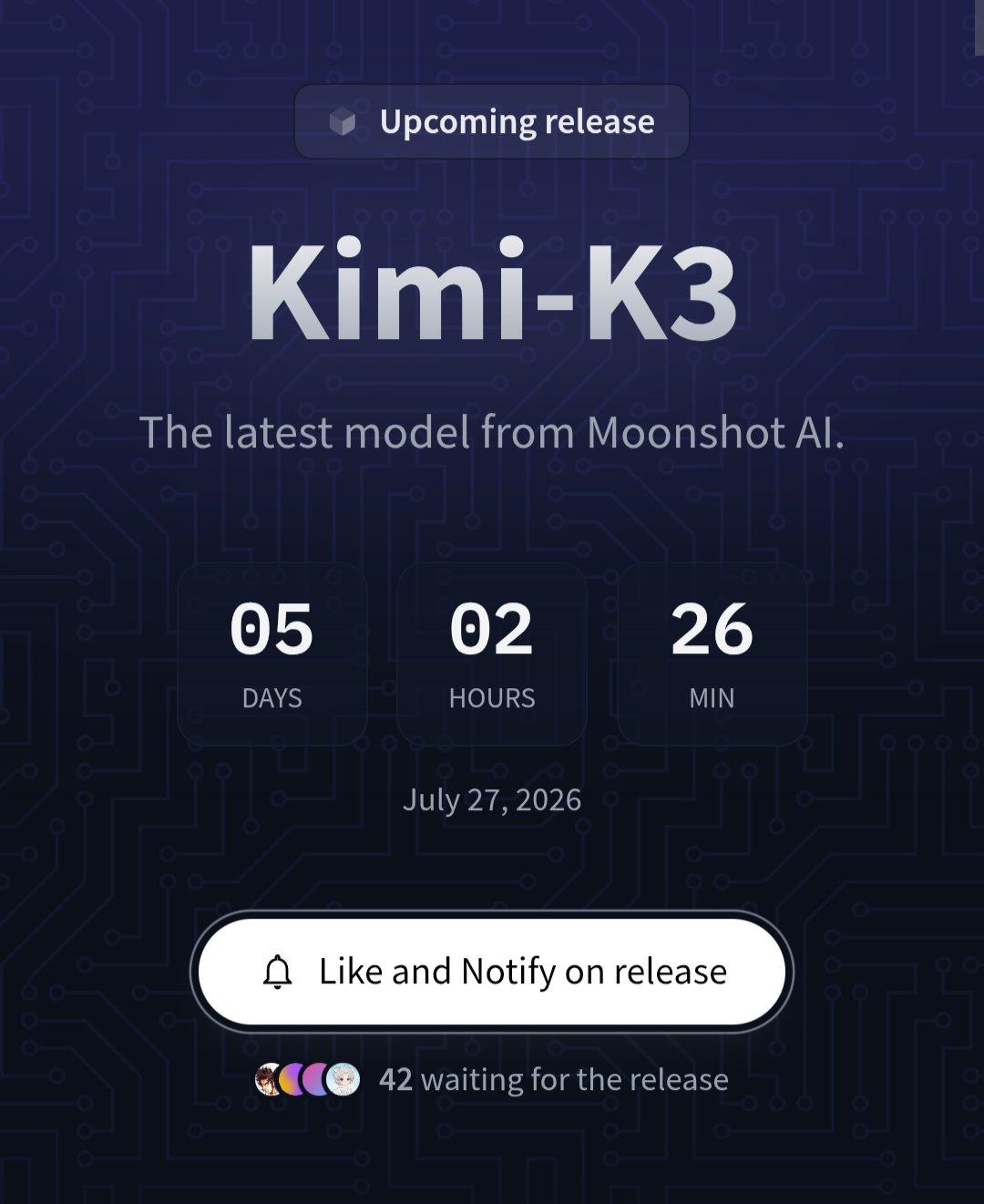
The whole world is waiting. Major overseas tech communities have already started circulating a "Deployment Preparation Guide" for K3.
However, after the launch of Kimi K3, OpenAI and Anthropic felt threatened, began to accuse Chinese companies of stealing intellectual property through Model Distillation technology, and lobbied U.S. officials. According to reports, U.S. Treasury Department and other agencies have begun to consider measures including banning some Chinese open-source AI models.
This move also caused panic among Silicon Valley startups. Nearly 200 companies and investment institutions quickly formed the "Little Tech Association" to warn the government: if cheap open-source models are blocked, startups will be forced to pay exorbitant API fees to OpenAI and Anthropic, which will directly destroy a large number of cash-strapped American startups.
Jensen Huang's debut on the X platform did not showcase GPUs or release a large model, but directly presented this joint open letter in strong support of open-weight AI. This clearly shows how deeply Silicon Valley leaders are concerned about the obstacles facing open-source models, pushing the "open-source vs. closed-source" path debate to a climax.
Where will this drama of suppressing open source ultimately lead?
References:
https://www.microsoft.com/en-us/corporate-responsibility/topics/open-weight/
This article is from the WeChat official account “Machine Heart” (ID: almosthuman2014), author: Open Source Enthusiast, published with authorization from 36Kr.