261 listed companies have quietly shelled out 50 billion yuan
Listed companies are not the dominant capital contributors in the market, but they are arguably the most closely watched LPs, as they represent the trends and preferences of market-oriented capital — a resource that has become increasingly scarce in the current landscape.
According to data from CVSource by ChinaVenture, a total of 261 listed company LPs completed 331 capital contributions, with the disclosed subscribed capital amount reaching 50.644 billion yuan.
Among the 261 listed company LPs, 254 are non-financial firms. These 254 non-financial companies completed 307 capital contributions, with a subscribed amount of 25.103 billion yuan.
Over 80% (211) of listed company LPs made only one capital contribution in the first half of the year.
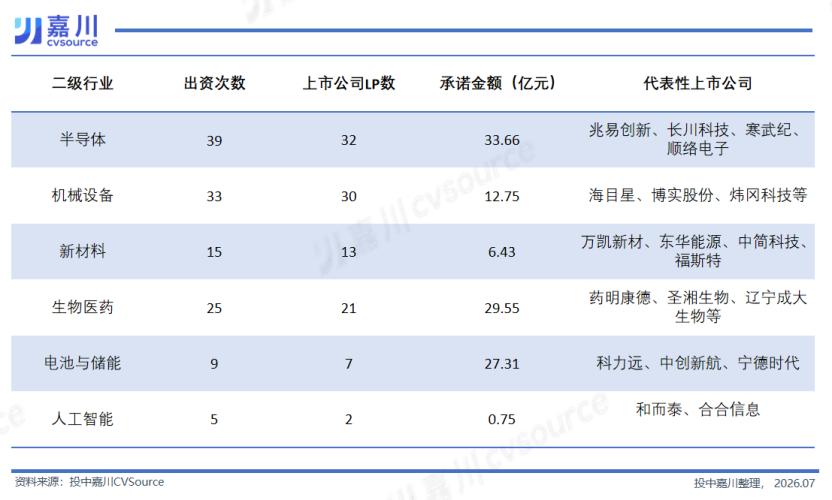
The semiconductor industry led the ranking with 39 capital contributions, involving 32 listed companies and a disclosed committed amount of 3.366 billion yuan.
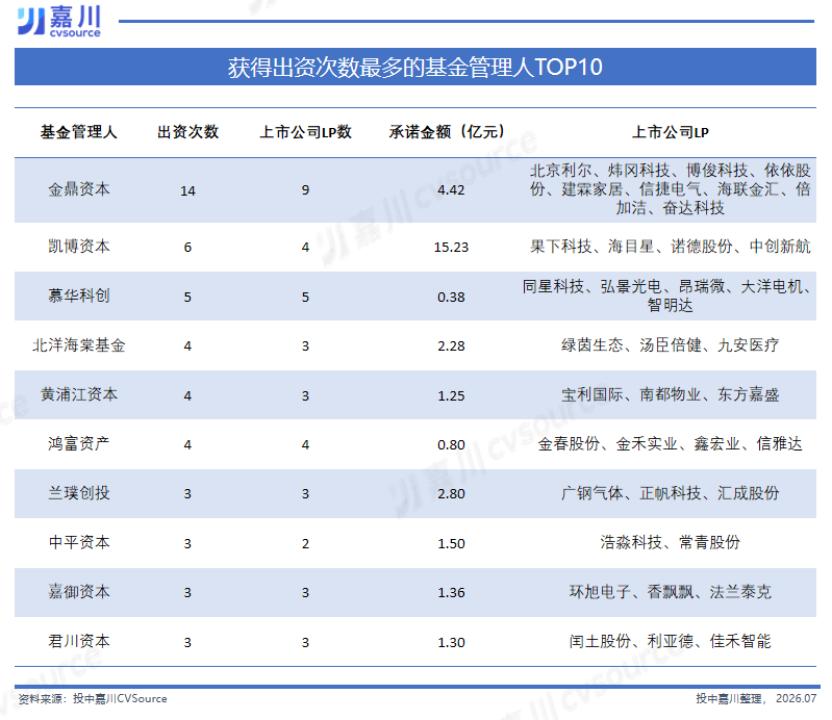
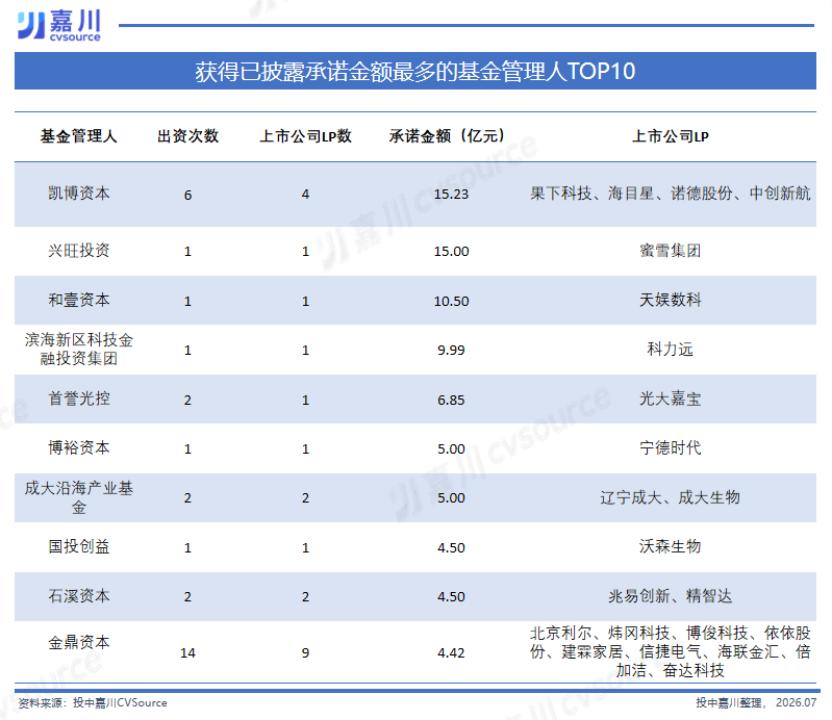
The most favored fund manager is Jinde Capital, which secured investments from 9 listed companies. Meanwhile, Kaibo Capital and Xingwang Capital received over 1.5 billion yuan in total capital contributions from listed companies, making them the institutions that obtained the most capital from listed companies in the first half of the year.
01. 261 Listed Companies Contributed 50 Billion Yuan, Yet Over 80% of LPs Made Only One Investment
The 261 listed company LPs completed 331 fund capital contributions, with a disclosed subscribed capital amount of 50.644 billion yuan. After excluding listed companies in the financial industry, 254 non-financial listed company LPs completed 307 capital contributions, with a subscribed amount of 25.103 billion yuan.
This figure is not particularly large. According to statistics from ChinaVenture, in the first half of the year, a total of 7,616 capital contributions were made across the LP market, with a subscribed amount of 989.161 billion yuan. Calculated by the number of contributions, non-financial listed company LPs accounted for 4.0% of all LP contributions in the same period; by subscribed amount, their share was only 2.5%.
In other words, out of every 100 yuan in subscribed capital, only 2.5 yuan comes from non-financial listed companies — a proportion that is indeed not high. It is no wonder that many fund managers complain to us that raising state-owned capital is not difficult, but securing that 30% of market-oriented capital is the real challenge.
Moreover, data from the first half of the year shows that most listed companies are still in the low-frequency allocation stage.
Among the 254 non-financial listed company LPs, 211 completed only one capital contribution in the first half of the year, accounting for 83.1%; only 43 completed two or more contributions, making up 16.9%.
The two companies with the highest number of contributions are JihuaTech and Bojun Technology, both completing 4 contributions and tying for first place; CALB, Zhejiang Medicine, Runtu Co., Ltd., Hailian Jinhui, Ortek, and Caixun Co., Ltd. each completed 3 contributions.
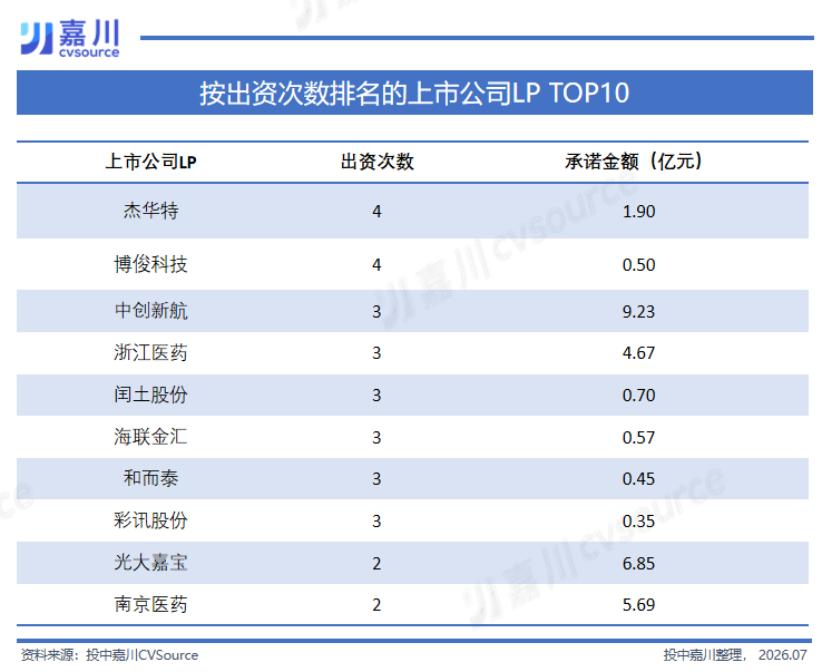
It is worth noting that the 4 contributions made by JihuaTech in the first half of the year went to four different fund managers: Xinyuan Zhenghe, Shanghai FTZ Fund, Yuanhe Hope, and Yida Capital. This represents the choice of most listed company LPs that make multiple contributions — expanding their pool of selected GPs to improve returns and certainty.
In contrast, the 3 contributions from CALB were all managed by Kaibo Private Fund Management Co., Ltd. These investments went to its own in-house CVC, essentially entrusting the capital to internal management teams.
Looking next at investment amounts.
Calculated by subscribed capital, Mixue Group ranked first with 1.5 billion yuan, followed by Tianyu Digital Technology, Keli Yuan, and CALB with 1.05 billion yuan, 999 million yuan, and 923 million yuan respectively.
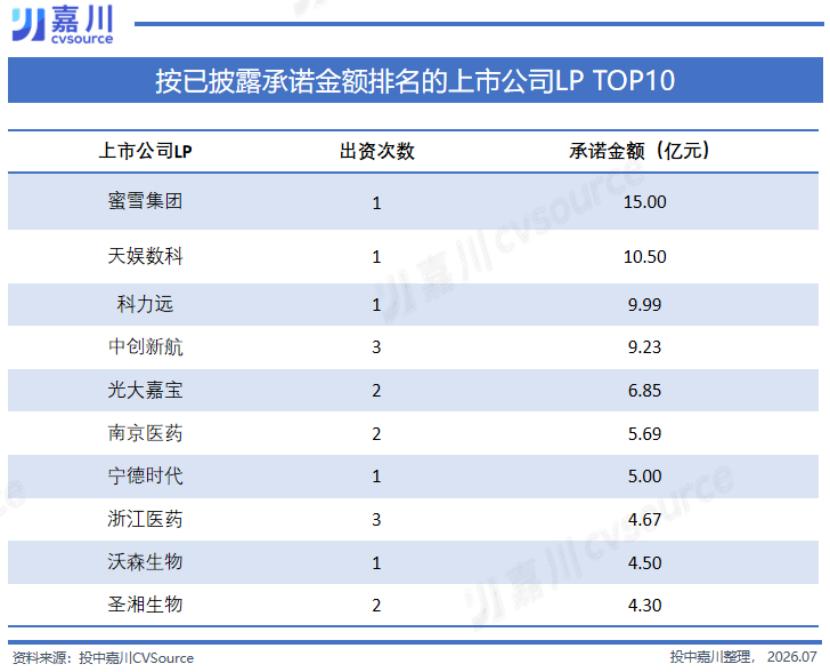
Mixue's 1.5 billion yuan investment equals a quarter of its 2025 annual profit, indicating that this is no trivial move — it represents a qualitative leap in the company's equity investment layout. The invested fund is "Shenzhen Qianhai Huaxia Tou Xingwang Technology Venture Capital Fund," managed by Xingwang Capital. Founded in 2015, this institution has been active in the hard technology and broad consumer sectors, having previously invested in projects including Ximalaya, Baixiang Food, and Yutianchuan Coffee.
Of course, Xingwang Capital is not the fund manager that received the most investments. Jinde Capital secured investments from 9 listed companies, leading clearly in transaction frequency; Kaibo Capital received 4 contributions, while Muhua Kechuang received 5.
Totaled by subscribed capital, Kaibo Capital ranks first with 1.523 billion yuan; Xingwang Investment comes second with 1.5 billion yuan; Hey Capital takes third place with 1.05 billion yuan.
Although Jinde Capital has the highest number of contributions, its total committed amount is only 442 million yuan, ranking 10th on the amount leaderboard. This reflects that its strength lies primarily in covering a large number of listed companies and high contribution frequency, rather than securing large individual fundraising amounts.
02. Electronic Information and Semiconductors Lead Capital Contributions from Listed Company LPs
Which industries do the 254 listed company LPs mentioned above come from?
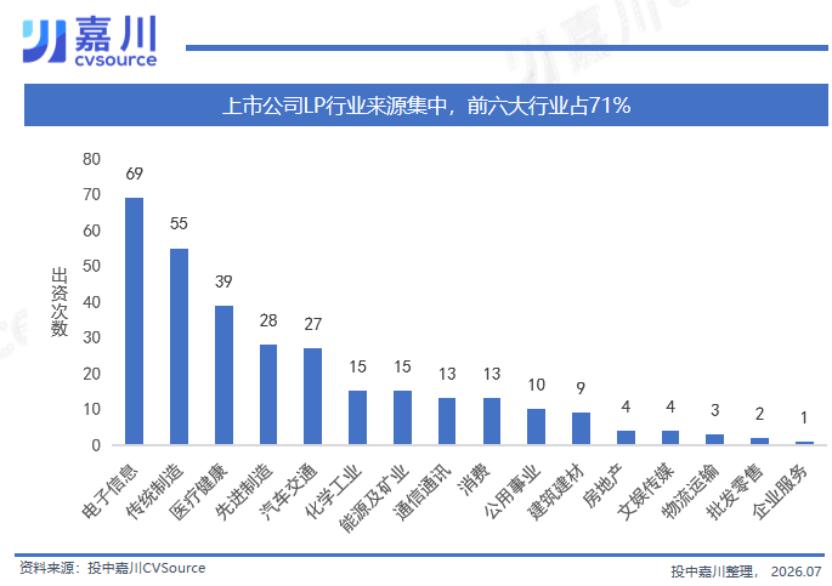
Data shows that listed companies from five industries — electronic information, traditional manufacturing, healthcare, advanced manufacturing, and automotive transportation — completed a total of 218 capital contributions, accounting for 71% of all records.
Among them, the electronic information industry recorded 69 contributions, and traditional manufacturing 55 contributions. Together, the two sectors accounted for 124 contributions (40.4%), forming the most important source of listed company LPs by industry. Healthcare, advanced manufacturing, and automotive transportation recorded 39, 28, and 27 contributions respectively.
The top five industries make up over 70% of the total, while the remaining 11 industries collectively account for only 29%, with no single industry exceeding a 5% share.
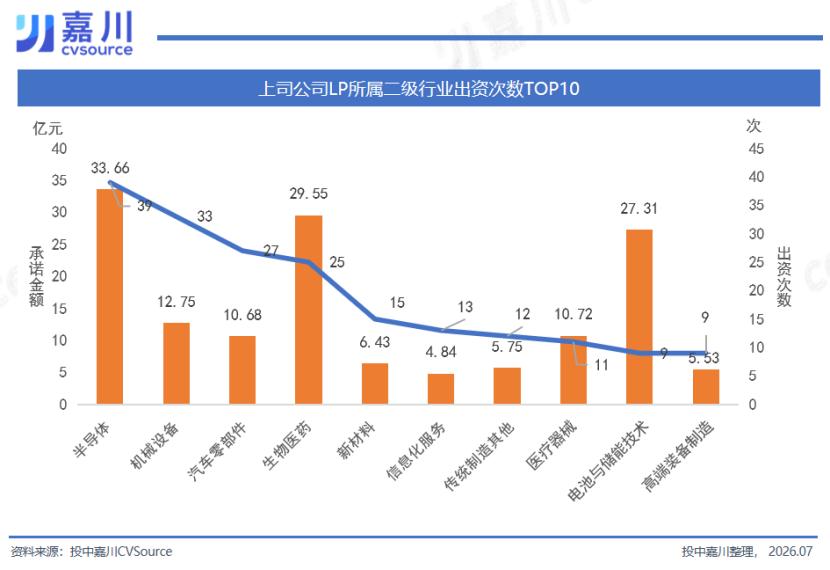
Further breaking down the secondary industries, the semiconductor industry ranks first with 39 capital contributions, involving 32 listed companies and a disclosed committed amount of 3.366 billion yuan. Machinery equipment, automotive components, and biomedicine recorded 33, 27, and 25 contributions respectively, indicating that traditional industrial chain enterprises remain an important source of listed company LPs.
Although the battery and energy storage industry only saw 9 capital contributions, the disclosed amount reached 2.731 billion yuan, with large-scale contributions from Keli Yuan, CALB, and CATL significantly boosting the industry's overall scale.
Ranked by number of contributions in the semiconductor industry, JihuaTech leads with 4 investments; by disclosed committed amount, GigaDevice ranks first with 400 million yuan.
In terms of contribution frequency, JihuaTech ranks first with 4 contributions, totaling 190 million yuan in committed capital. Its 4 contributions are managed by 4 different GPs: Xinyuan Zhenghe Private Equity, Shanghai FTZ Fund, Yuanhe Hope, and Nanjing Yida Fund Management, corresponding to 4 separate funds. JihuaTech's individual contributions range from 10 million yuan to 95 million yuan, showing a characteristic of diversified allocation across multiple GPs.
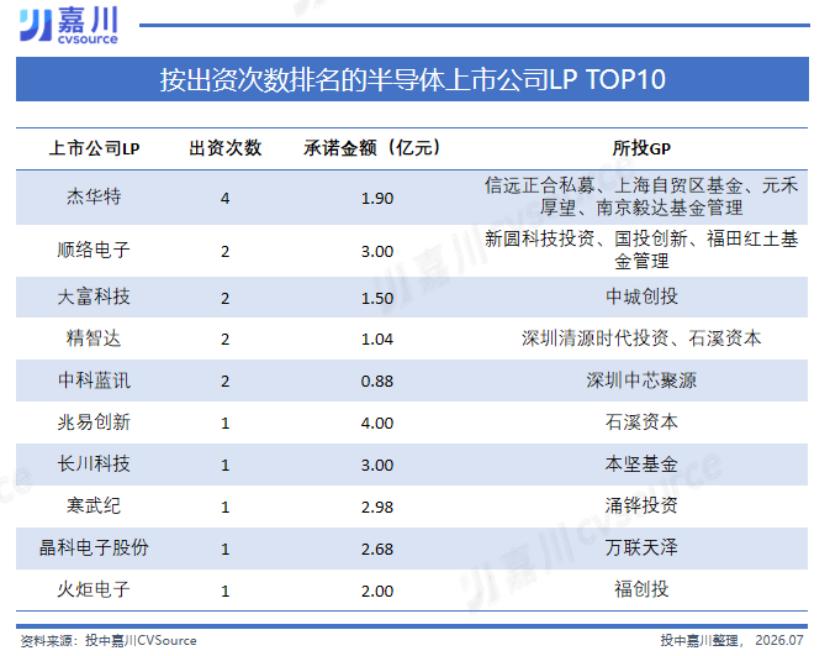
By disclosed committed amount, GigaDevice ranks first with 400 million yuan, making only one capital contribution in the first half of the year to GP Shixi Capital — a case of concentrated large-scale single investment. Sunlord Electronics comes second with 300 million yuan, with 2 contributions involving 3 GPs: Xinyuan Technology Investment, SDIC Innovation, and Futian Hongtu Fund Management; Changchuan Technology also disclosed 300 million yuan, but only invested in a single GP, Benjian Fund. The leading companies in the contribution frequency ranking and the amount ranking are not the same, reflecting that semiconductor listed companies adopt two types of strategies: diversified allocation across multiple GPs, and large-scale investment in a single GP.
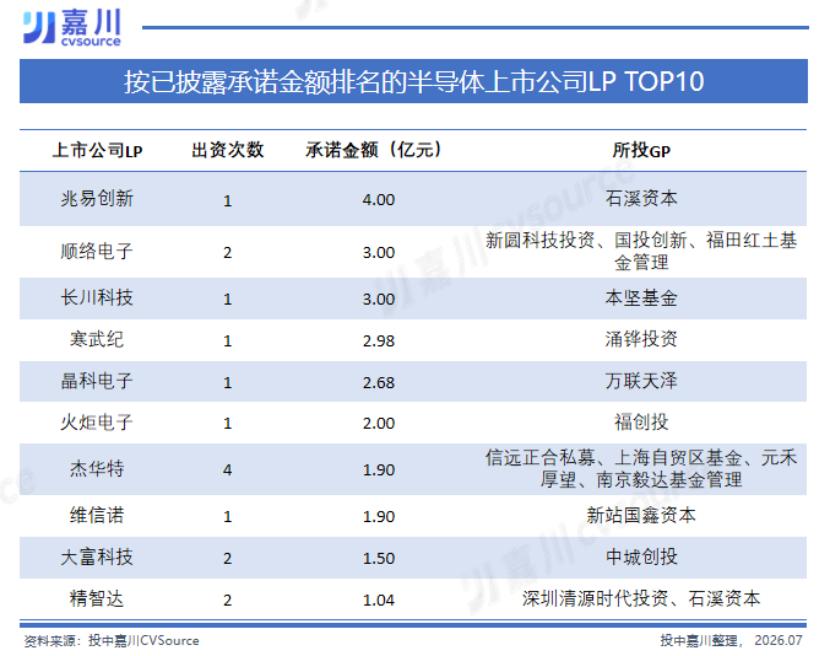
It is worth mentioning that Cambricon, the trillion-yuan market capitalization tech giant, also made a move in the first half of the year, investing in Yonghua Investment. Yonghua Investment is the equity investment division under the Yongjin Group. Founded in 1995, Yongjin Group is a comprehensive holding enterprise group focused on the financial services industry, with business segments including Sinolink Securities, Yunnan International Trust, Sinolink Futures, and Sinolink Fund. As the group's equity investment arm, Yonghua Investment participated in Cambricon's angel round and continued to invest in three consecutive rounds, making it a key supporter in Cambricon's growth history. This LP contribution can be seen as a form of feedback from Cambricon to its early investors.
The battery and energy storage industry saw a total of 9 capital contributions from listed company LPs, with a disclosed amount of 2.731 billion yuan. Keli Yuan, CALB, and CATL collectively committed 2.422 billion yuan, accounting for 88.7% of the industry's disclosed amount and serving as the main driver behind the industry's large contribution scale. However, the three companies show clear differences in their allocation approaches and GP selection.
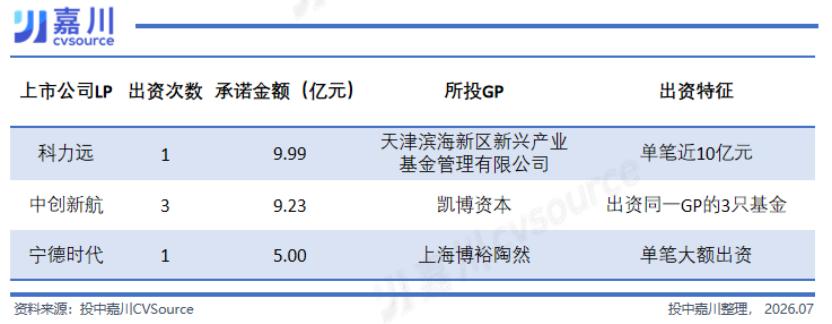
Keli Yuan ranks first in committed amount among listed company LPs in the battery and energy storage industry with 999 million yuan. It made only one contribution in the first half of the year, investing in the Tianjin Binhai Bujian New Energy Storage Equity Investment Fund, with the GP being Binhai New Area Emerging Industry Fund. Keli Yuan's allocation is characterized by a large single contribution amount, clear industrial theme, and prominent orientation toward regional industrial funds.
CALB completed a total of 3 contributions, totaling 923 million yuan, making it the company with the highest contribution frequency among the three. The 3 contributions went to the Kaihong Hongtai Fund, Kaibo Shengfu Fund, and Kaibo Gongchuang Fund, all managed by the same GP — Kaibo Capital. Among them, the single contribution to Kaibo Gongchuang Fund reached 799 million yuan, while the other two contributions were 49 million yuan and 75 million yuan respectively.
Founded in 2021 and initiated by CALB in partnership with a market-oriented team, Kaibo Capital can be regarded as CALB's external CVC arm.
CATL made only one fund contribution in the first half of 2026, committing 500 million yuan to the Boyu Xinzhi Xinchan Fund, managed by GP Boyu Capital. Instead of making frequent small investments, CATL chose a single GP for a large, concentrated allocation.
This article is from the WeChat public account "ChinaVenture", author: Li Siqi, published with authorization from 36Kr.