Dialogue with Professor Zeng Ming: In the AI era, the key to enterprise competition is to build intelligent compound interest and enable AI to truly integrate into business processes.
On July 17, 2026 World Artificial Intelligence Conference kicked off in Shanghai. As 36Kr's key content window that has delved deep into the WAIC site for three consecutive years, the "Kr Talks Future" live studio also launched on-site dialogues simultaneously on the first day of the conference. Professor Zeng Ming accepted an exclusive interview invitation from 36Kr's "Kr Talks Future" at the WAIC site, sharing his observations and judgments on how artificial intelligence is reshaping business models and value creation methods around topics such as enterprise growth in the AI era, organizational transformation, intelligent compound interest, AI-native businesses, and enterprise implementation paths.
This year's WAIC takes "Intelligent Partners, Co-Creating the Future" as its theme. As the artificial intelligence industry enters the stage of deepening application, the industry's focus is gradually shifting from competition in model capabilities to application value creation. Compared with the discussions around parameter scale, model performance and technological breakthroughs in the past few years, the 2026 AI industry is paying more attention to a core issue: how AI can truly enter enterprise business processes, lower application thresholds, and create value through actual business results.
Under this trend, the changes brought by AI are no longer just the upgrading of efficiency tools, but a redefinition of enterprise growth methods, organizational forms and business logic. Professor Zeng Ming believes that AI is a fundamental technological revolution that will drive systematic changes in the economy, business and organizations. What enterprises need to focus on in the future is not just how to use AI, but how to let AI go deep into core businesses, continuously learn through real tasks and feedback loops, and form "intelligent compound interest" for sustained growth.
From "thousand people with thousand faces" to "one person with thousand faces", AI is also changing the way enterprises understand user needs and provide products and services. Compared with traditional recommendation systems that rely on tags and historical behaviors, AI can achieve a more dynamic and personalized service experience through continuous interaction and in-depth understanding. For enterprises, truly valuable AI applications need to break through the Demo stage, enabling AI to independently complete tasks and take responsibility for the results.
In Professor Zeng Ming's view, the key to enterprise competition in the AI era will no longer just be the competition of technical capabilities, but the ability to build AI-native businesses, let AI truly enter the workflow, and form a self-reinforcing value cycle through continuous feedback. In the future, enterprises that can take the lead in completing this transformation will gain new growth opportunities.
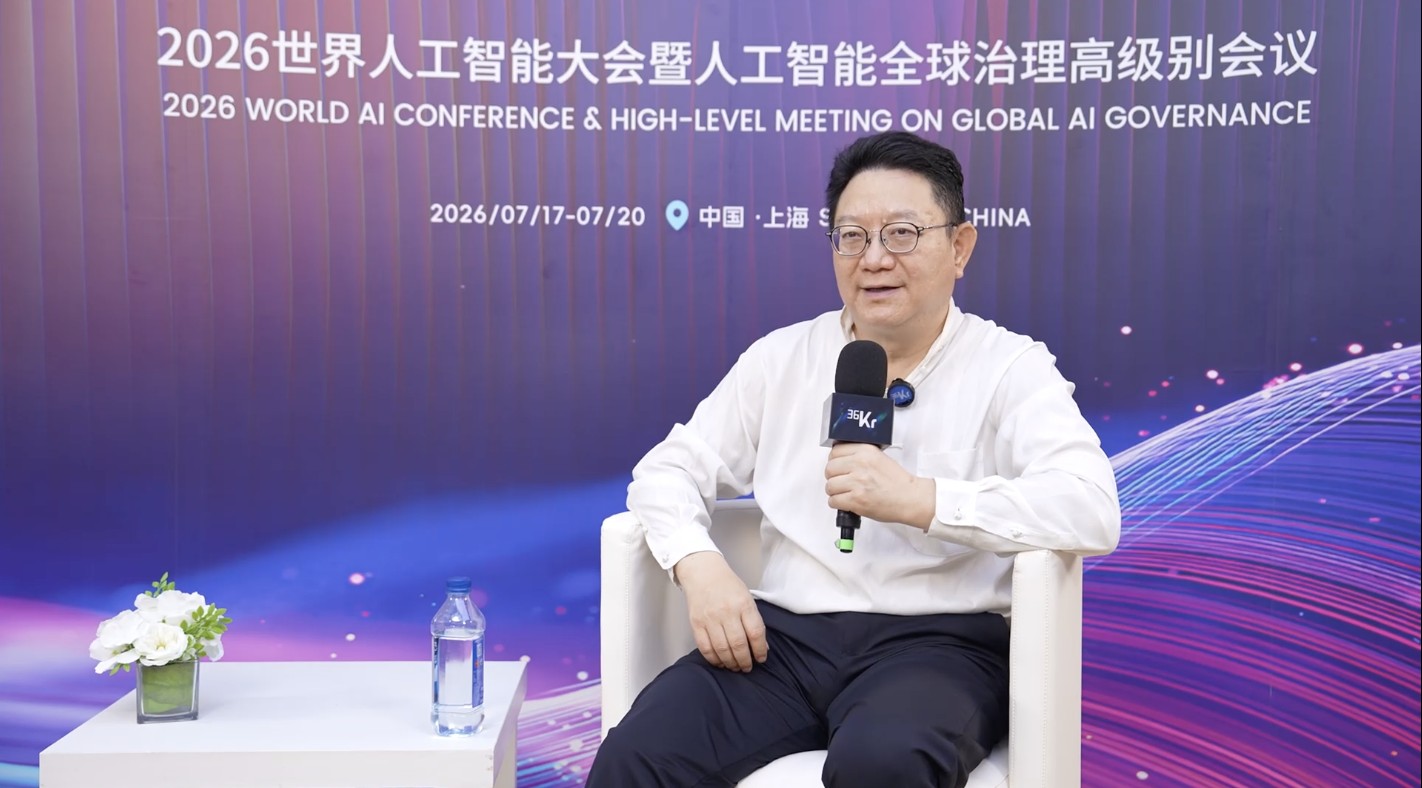
The following is the transcript of the dialogue, edited by 36Kr:
36kr: You talked about network collaboration and data intelligence in "Smart Business". In this new book "Intelligence", the discussion has moved into growth, organization and strategy in the AI era. What do you think is the biggest change in recent years? Is it the technology itself that has changed, or the way enterprises create value?
Professor Zeng Ming: I think the development of AI technology is a very fundamental revolution. People often compare its influence with the Industrial Revolution, and even believe that it may be more important and profound than the Industrial Revolution. When such a huge technological revolution occurs, basic changes will take place in the economy, business models and organizational forms. So I wrote this new book, also hoping to proceed from first principles to explore how the basic forms of future business and organizations will be different from the past.
36kr: In the past two years, many enterprises have been adopting AI, but people's experiences are very different: some feel that efficiency improvement is obvious, while others feel that it has not brought fundamental changes. What is the most common confusion you have heard when communicating with entrepreneurs recently?
Professor Zeng Ming: The biggest confusion is actually that the return on AI investment is not obvious in the short term. Enterprises may see improvements in employee efficiency, but for the entire organization, many enterprises do not yet have clear answers about what value AI has brought and what returns it has generated.
But I think this is a very natural stage. Both the development of AI technology and the methods for enterprises to use AI are still in a very early stage. Therefore, it is understandable that no particularly obvious returns have been seen for the time being.
36kr: If an enterprise wants to use AI seriously instead of just following the trend to give it a try, which specific business link would you suggest starting with? Why not start with the most dazzling technology or the most grand strategy?
Professor Zeng Ming: Different enterprises may have different entry points. But there is a very important change, that enterprises need to re-examine their own businesses: is there a business link within the company that can be truly taken over by AI? Only by achieving this can enterprises obtain real value returns.
36kr: You talked about "intelligent compound interest" in your book, the core of which is that the system continuously learns and becomes stronger in real use. In an enterprise, what kind of business has the best chance of forming such a cycle? Conversely, which scenarios look lively but are difficult to accumulate compound interest?
Professor Zeng Ming: The specific situation still depends on each enterprise's own business scenarios. But when enterprises initially explore AI, they can choose a relatively simple business to try. However, in the end, enterprises must return to their core businesses, truly integrate AI into the workflow, and re-transform the working methods based on the characteristics of AI, so as to gradually move towards AI-native businesses.
36kr: You proposed the transformation from "thousand people with thousand faces" to "one person with thousand faces". In today's business scenarios, how will AI change the way enterprises understand user needs and provide products and services?
Professor Zeng Ming: This is a very important change. Even in the recommendation era, when I proposed "thousand people with thousand faces" in 2010, we hoped to establish a better connection between consumers, commodities and services through more accurate matching. But after more than ten years of development, today's recommendation systems essentially still rely on tags and behavior data, judging what a user might like by analyzing his past behaviors.
The greatest value of AI is that it can continuously interact with a person at low cost, while having stronger understanding capabilities. Therefore, AI has the opportunity to understand a person more comprehensively, continuously and deeply, achieving true personalization. Because everyone's needs are constantly changing, only by truly realizing personalized understanding can we move from "thousand people with thousand faces" to "one person with thousand faces".
36kr: There will be many early-stage projects and AI applications at the WAIC site. You emphasized the importance of real tasks and feedback loops in your book. What do you think are the most critical types of verification that a project needs to complete to move from demo to real business?
Professor Zeng Ming: The most important thing is to establish a feedback loop. Only by forming a feedback loop can AI learn autonomously and continuously improve. But there are two prerequisites for a feedback loop: First, whether AI can complete a task end-to-end. Second, whether AI can be responsible for the results. If AI cannot take responsibility for the results, humans must step in to cover for it. And as long as humans keep intervening in the intermediate links, AI's learning process will be interrupted.
So the core point is that AI needs to be able to "work independently". I call this stage the "60-point baseline". When AI truly reaches a level where it can work independently, the flywheel of intelligent compound interest can start to rotate. It may quickly rise from 60 points to 100 points, even 200 points or 500 points. But breaking through the 60-point mark to enable AI to truly have the ability to work independently is often the most difficult stage, which requires continuous innovation, long-term experiments and a large amount of practical accumulation.