Tesla's profit margin is as thin as paper, and Elon Musk is going all in.
Tesla is drifting further away from being a traditional automotive company.
A telling sign of this shift is that even as automotive gross margins keep shrinking, Tesla is pouring massive resources into every dimension of physical AI. In other words, it is using cash generated from its vehicle business to bet heavily on a physical AI future that has yet to deliver tangible revenue or profits.
This strategic direction is clearly reflected in Tesla's recently released Q2 2026 earnings report.
In terms of revenue, Tesla delivered its strongest quarterly vehicle shipment results in recent years, with a year-over-year revenue growth rate of 26%, achieving simultaneous growth across its automotive, energy storage, and services segments. However, on the profit front, Tesla's Q2 performance was nothing short of a collapse, far exceeding market pessimism.
Put simply: more cars were sold, but far less money was earned.
Another signal that drew widespread attention was Tesla's Q2 free cash flow of -$1.092 billion, marking its first negative reading in more than two years.
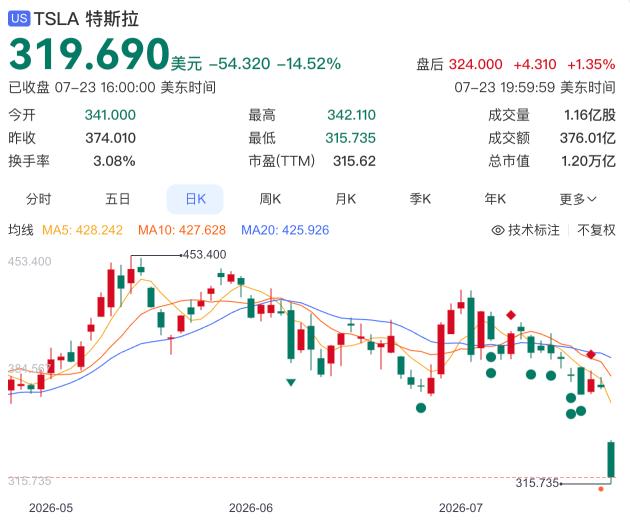
Against this backdrop, investors voted with their capital to express their doubts about Tesla. After US markets opened on July 23, Tesla's share price plunged rapidly, dropping more than 15% at one point during the session before closing down 14.52% — its largest intraday percentage drop since June 2025.
Financial Results: Revenue Up, Profits Down
Boosted by its automotive segment, Tesla posted strong top-line performance in the second quarter.
Figures show Tesla's total Q2 revenue hit $28.236 billion, up 26% year-over-year and beating market expectations. The key driver behind this result was quarterly vehicle deliveries of 480,100 units, a 25% year-over-year increase and 34% quarter-over-quarter growth — representing the best quarterly delivery performance in two years.
By business segment, all three of Tesla's core divisions recorded growth: automotive revenue reached $20.516 billion, energy storage revenue hit $3.14 billion, and services and other revenue came to $4.58 billion. This demonstrates that the automotive business remains Tesla's dominant revenue engine, accounting for roughly 73% of total revenue.
On the flip side of the coin, Tesla faced widespread pressure on profitability across all segments.
Earnings data shows Tesla's Q2 operating profit was $398 million, down 57% year-over-year. Its operating margin stood at just 1.4%, compared with 4.1% in the same period last year, while adjusted EPS came in at $0.33, down 18% year-over-year.
All these metrics fell short of Wall Street's consensus forecasts.
Gross margins also showed stark divergences. Tesla's overall Q2 gross margin was 16.8%, below the 19.4% market expectation. Within that figure, automotive gross margin reached 16.9%, falling to 16.3% when excluding regulatory carbon credits — nearly 3 percentage points lower than the 19.2% recorded in the first quarter.
Addressing this during the earnings call, Tesla CFO Vaibhav Taneja explained that Q1 had included $230 million in one-time positive items (warranty reserve reversals and tariff relief) that did not recur in Q2. Excluding these one-off factors, he noted automotive gross margins were roughly flat sequentially.
The energy storage segment saw an even more dramatic margin decline, with gross margins plummeting from 39.5% to 20.4%. Taneja cited three overlapping factors: a $240 million warranty provision related to cell failures in early deployed energy storage units, the expiration of over $200 million in tariff benefits that had applied in Q1, and intensifying competition in the industrial energy storage space driving down average selling prices. He added that the long-term steady-state gross margin for the energy storage business is expected to stabilize in the low 20% range.
Beyond automotive and energy storage, gross margins for Tesla's services and other segment rose from 9.2% to 14.1%, hitting an all-time high.
This improvement stems from used car sales, Supercharger network operations, and repair and insurance services. As more Tesla vehicles hit the roads, the company can continue generating revenue from post-sale services. The larger the existing fleet of owners, the higher this recurring service income becomes. While automotive profits have been squeezed by price competition, the services segment is helping to offset part of that gap.
Turning to expenses, heavy R&D investment pushed Tesla's Q2 R&D spending to $2.371 billion, up 49% year-over-year. Total operating expenses reached $4.353 billion, a 47% year-over-year increase. Capital expenditures hit $5.789 billion, 2.4 times the level seen in the same period last year.
Notably, operating cash flow of $4.697 billion was insufficient to cover capital spending — resulting in negative free cash flow of -$1.092 billion.
Meanwhile, FSD reached a meaningful milestone: as of the end of Q2, active users with FSD access totaled 1.48 million, up 56% year-over-year. Of these users, 55% purchased the one-time permanent access package, while 45% opted for the subscription model. More than 55% of new vehicles delivered in North America during Q2 came with an active FSD subscription at the time of sale.
During the earnings call, Musk stated that many customers visit Tesla dealerships primarily for FSD, with the vehicle itself serving merely as the hardware platform. "They explicitly say they want FSD, and they don't particularly care which model it comes on." This means FSD is evolving from an optional add-on feature to an independent demand driver.
Why Have Profits Disappeared Despite Revenue Growth?
The most notable observation from Tesla's Q2 results is that even as revenue hit a record high, the company simultaneously faced shrinking profits, divergent margin performance, surging expenses, and negative free cash flow.
The obvious question is: why?
Looking at the automotive segment, Tesla's Q2 deliveries rose from 384,000 units to 480,100 units — a 25% increase — driving a corresponding 26% rise in overall revenue.
However, this growth came with clear signs of "trading price for volume" in the automotive business. Tesla explicitly stated in its earnings report that lower average vehicle selling prices and shifts in model mix dragged down both revenue and operating profits.
Based on a rough calculation dividing automotive revenue by total deliveries, the average revenue per vehicle dropped from roughly $45,300 in Q1 to approximately $42,700 in Q2.
At the same time, the product mix shifted heavily toward lower-priced models. Of the 480,100 total units delivered, the Model 3 and Model Y accounted for 467,800 units — over 97% of the total. Tesla continues to release more stripped-down, lower-cost vehicle variants, expand financial incentives and promotional offers, phase out higher-priced models, and push mainstream model pricing further downward.
Consequently, this rebound in delivery volumes was clearly driven by a strategy of trading margins for market share. More cars were sold, but each individual vehicle generated less profit.
Adding to this pressure, revenue from regulatory carbon credits also declined.
In previous years, Tesla earned substantial profits from selling excess emissions credits to other automakers. But as legacy manufacturers increased their electric vehicle fleets, their demand for these credits fell, causing this revenue stream to shrink. Carbon credits once served as a reliable profit "safety buffer" for Tesla, but that buffer is now thinning out.
Even greater pressure came from the expense side. R&D spending rose 49% year-over-year, and total operating expenses increased by 47%. The incremental R&D spending was primarily allocated to pre-production development for new products including the Cybercab, Optimus humanoid robot, and Tesla Semi truck, as well as expanded investment in AI computing infrastructure.
Interest subsidy costs also continued to climb. As interest rates rose, the subsidies Tesla provides to vehicle buyers directly reduced top-line revenue, further compressing automotive gross margins.
Beyond the automotive segment, the collapse in energy storage margins requires separate analysis.
Specifically, the sharp drop in energy storage gross margins from 39.5% to 20.4% resulted from three overlapping factors: warranty provisions, the end of tariff benefits, and intensifying market competition. In the long run, Tesla expects energy storage gross margins to stabilize at a low 20% level, meaning there is limited room for margin recovery in the short term.
During the call, Taneja also noted the company is currently in a "large-scale investment cycle," with operating expenses set to continue rising through 2026 and beyond.
In other words, this expense growth is structural and will not simply reverse course after a single quarter.
The biggest drain on cash flow came from capital expenditures. At $5.789 billion, capex was 2.4 times the figure from the same period last year. While operating activities generated $4.697 billion in cash, this was insufficient to cover capital investments, pushing free cash flow negative to -$1.092 billion.
During the earnings call, Musk acknowledged that full-year 2026 capital expenditures are expected to exceed $25 billion — nearly three times the prior year's total. Taneja added that capital spending will rise further in the second half of the year and continue growing over the next two to three years, with free cash flow expected to remain negative through 2029.
Additionally, Tesla is seeking to secure up to $30 billion in debt financing to accelerate its investment program — the company is not only spending all the cash it generates, but also borrowing heavily to spend even more.
This all points to a simple core logic: Tesla is using the profits from its automotive business to fund investment in its future ventures. Cash generated from selling cars and energy storage systems is being immediately redeployed into Robotaxi, Optimus, AI computing infrastructure, and chip manufacturing facilities.
The Bets Are Already Placed
A notable detail from this earnings release is that even though the automotive business remains Tesla's primary revenue source, most of the discussion during the earnings call had little to do with cars, focusing instead on topics like Robotaxi, Optimus, and AI infrastructure.
Underpinning these conversations was Tesla's implicit justification for why it needs to spend over $25 billion in a single year, and why it deserves to maintain a valuation far higher than traditional automakers.
First, consider the Robotaxi business.
Tesla reported that its autonomous vehicles have completed more than 380,000 miles of driverless operation without safety drivers across six cities in two US states, with zero major safety incidents. Tesla's VP of AI Ashok Elluswamy stated that all recorded incidents involved stationary vehicles being struck by other road users, arguing that Tesla's pure vision-based autonomous driving system has proven its operational viability through real-world deployment.
Musk noted that the only constraint on business expansion is maintaining strict safety standards, with operations currently active in multiple cities across Florida, Texas, and the San Francisco Bay Area.
However, Tesla did not disclose the current size of its Robotaxi fleet, order volumes, or revenue figures. The vehicles currently in operation are primarily modified Model Y units. The Cybercab has entered production in Texas, but Musk warned that initial production volumes will be "painfully slow."
The earnings call still did not provide specific production targets or a clear timeline for launching paid passenger services at scale. There remains a very long path ahead before full commercialization is achieved.
Next, consider the Optimus humanoid robot program.
Musk made an unusual public statement about production readiness: every single component of Optimus is entirely new, with no existing supply chain available, meaning Tesla must build the entire ecosystem from scratch or develop and manufacture all parts in-house. Tesla has already converted its former Model S/X production line at the Fremont factory into a dedicated manufacturing line for Optimus.
In terms of production ramp-up, Tesla targets an annual production capacity of 1 million units for the third-generation Optimus robot, rising to 10 million units per year for the fourth generation. However, production scaling will follow a classic S-curve pattern, with very slow growth in the early stages. Tesla also emphasized that the first batch of robots is currently being deployed internally within its "Optimus Academy" to perform tasks and collect data, with no public sales date announced.
Tesla is also simultaneously developing a "digital Optimus" — a software agent capable of independently operating computers, co-developed with SpaceX and managed by the Grok AI system at the top layer. Musk explained that digital Optimus shares the same underlying AI architecture as the physical humanoid robot: processing visual pixel inputs and generating motion command outputs.
At the foundational infrastructure level, Tesla is building a fully integrated physical AI industrial chain. Its Texas AI computing cluster has already scaled to 250MW of capacity, with plans to expand to 400MW. The site selection for the Terafab chip manufacturing facility will be announced soon, representing a critical prerequisite for large-scale Optimus production.
Tesla has already placed equipment orders for its Austin-based R&D wafer fab, which will cover the entire semiconductor manufacturing process including photomask production, logic chip fabrication, memory chip production, and packaging and testing. Tesla also updated its semiconductor roadmap: the AI5 chip will enter mass production in mid-next year, prioritized for deployment in Optimus units, while the AI6 chip is currently under development, with Musk claiming it will become the world's best edge computing processor.
Meanwhile, Starlink satellite internet is being integrated into the Cybercab platform. Musk explained that autonomous driving systems cannot afford to lose connectivity due to cellular network outages, so future Tesla vehicles will all be equipped with onboard Starlink terminals that can also function as mobile network relay nodes.
Notably, when an investor asked about the possibility of a merger between SpaceX and Tesla, Musk neither confirmed nor denied the idea.
Overall, whether through its $25 billion capital expenditure plan or its pursuit of $30 billion in debt financing, Tesla is clearly striving to transform itself from an electric vehicle manufacturer into a fully integrated end-to-end "physical AI" company in the broadest sense.
Under this strategic vision, Tesla aims to control every layer of the stack: batteries, vehicles, humanoid robots, AI models, computing infrastructure, and semiconductors — forming the architecture of a veritable "physical AI empire." As Musk stated during the call, "This represents the fastest full-industry-chain industrial expansion cycle the United States has witnessed since World War II."
However, the cost of this transformation will inevitably be enormous.
Based on Tesla's projections, free cash flow will remain negative through 2029. This means that long before Robotaxi, humanoid robots, and other new segments begin generating meaningful profits, Tesla's difficult transition toward a physical AI-focused business model will continue for several more years. Heavy cash burn is guaranteed, but the path to profitability remains highly uncertain.
This article was originally published on the WeChat public account "Timelines", authored by WANG Zhi, edited by ZHOU Yi, and republished with authorization from 36Kr.