Shing-Tung Yau invited Wang Hong and Deng Yu to return to China to teach. After two decades of rivalry, Tsinghua University and Peking University surprisingly found that their real competitors were not each other.
Late at night on July 23, the Fields Medal, the highest global mathematics award awarded every four years, was announced, and two Chinese mathematicians won the prize simultaneously: Hong Wang and Yu Deng.
Both of them were undergraduate classmates in the Peking University School of Mathematical Sciences, Class of 2007. One solved the century-old 3D Kakeya conjecture that had puzzled the mathematics community, and the other cracked the restricted Hilbert's sixth problem.
This is the first time that mathematicians who completed their undergraduate studies in mainland China have won the Fields Medal, and it happened that two of them claimed the award in the same year.
Shortly after the results were announced, Shing-Tung Yau stated at a public event at Tsinghua University: "I sincerely invite scholars Hong Wang and Yu Deng to return to teach. Tsinghua University Qiuzhen College will always welcome them."
This is not the first time Shing-Tung Yau has competed for talent with Peking University, nor is it the first time Tsinghua University has engaged in head-on rivalry with Peking University in the field of mathematics.
These two top-tier Chinese universities have been vying openly and covertly for decades in mathematics, the most fundamental and rigorous discipline.
From competing for teenage middle school prodigies, to snatching established Fields Medal laureates, from the university student competition arena to the new AI battlefield, from the rift between Shing-Tung Yau and his former student Gang Tian, the rivalry has persisted all the way to the Fields Medal award ceremony stage this year.
But the origin of all this dates back to a faculty reorganization event 70 years ago.
01
Why Have Peking University and Tsinghua University Been Locked in a Fierce Math Rivalry?
During the 1952 national faculty reorganization, the entire Department of Mathematics of Tsinghua University was incorporated into Peking University. All the faculty, books and materials were moved to the Yan Yuan campus, leaving Tsinghua's mathematics program completely disrupted for nearly 30 years, until the Department of Applied Mathematics was re-established in 1979.
After that reorganization, the Peking University School of Mathematical Sciences was the undisputed leading institution in the Chinese mathematics community, and the most promising math talents across the country would default to choosing Peking University.
It nurtured the "Golden Generation" of the Chinese mathematics world: Yitang Zhang, Chenyang Xu, Zhiwei Yun, Wei Zhang. The vast majority of young mathematicians who later received the Sloan Research Fellowship, Ramanujan Prize, and New Horizons in Mathematics Prize graduated from Peking University.
Gold medalists from national mathematics competitions would automatically prioritize the Peking University School of Mathematical Sciences when filling out their college applications. Wei Dongyi, who earned perfect scores in two consecutive International Mathematical Olympiads, was recommended for admission to Peking University, which was a completely logical outcome at that time.
In the early days, Shing-Tung Yau actually intended to support Peking University. When he first returned to China to give lectures in 1979, Peking University was his first stop. Back then, he hoped to help China build a world-class mathematics center, and Gang Tian was the student he recruited in China at that time, later bringing him to Harvard University for his PhD, making Gang Tian one of his most proud disciples.
Over the following two decades, he traveled back and forth, establishing mathematical institutes at the Chinese Academy of Sciences and Zhejiang University, donating books and giving lectures at Peking University. Even he himself once believed that the foundation of Chinese mathematics would definitely be rooted in Yan Yuan.
Around 2000, Shing-Tung Yau wanted to build platforms according to international standards, opposing inbreeding in academic circles, and criticizing Peking University for retaining too many of its own graduates and adopting a seniority-based academic evaluation system.
This contradiction fully erupted in 2005, triggering a major earthquake in the global Chinese mathematics community. Shing-Tung Yau publicly condemned the Peking University School of Mathematical Sciences, specifically targeting Gang Tian, the PhD student he personally supervised at Harvard University, accusing him of academic misconduct and poor academic ethics, even directly stating that Peking University's mathematical research center was "forming a small clique."
A retired Peking University professor retorted: "Shing-Tung Yau wanted to dominate the Chinese mathematics community, but he failed." The master and former student completely fell out, and never interacted with each other again. Since then, Shing-Tung Yau has never stepped foot in the Peking University School of Mathematical Sciences again.
In 2009, he officially joined Tsinghua University and became the director of the Yau Mathematical Sciences Center. Here is a detail: since Shing-Tung Yau first returned to China to give lectures in 1979, for more than 40 years, he has never received any salary from China for his lectures and center-building work, and even donated 1 million US dollars of his own money to Tsinghua University to cultivate mathematical talents.
In 2010, he funded the Shing-Tung Yau College Student Mathematics Contest on his own. The competition system is directly benchmarked against the world's top Putnam Competition, with a difficulty level several notches higher than ordinary domestic college student mathematics contests.
Shing-Tung Yau's goal was clear: to establish a competition platform under his full control, attracting the best mathematical talents across the country to Tsinghua University. To outperform Peking University, Shing-Tung Yau spared no expense.
In 2018, he launched the Shing-Tung Yau Mathematics Elite Program, recruiting no more than 30 prodigies from 11th and 12th grades every year, allowing them to enter Tsinghua directly without taking the national college entrance examination. In 2021, he went even further by founding Qiuzhen College and launching the "Leading Mathematics Talent Program," starting to scout talents as early as the 9th grade. As long as you have exceptional mathematical talent, you can skip both the high school entrance exam and the college entrance exam, enjoy an 8-year integrated bachelor-doctorate training program, with a maximum of 100 recruits per year, access to top-tier faculty, and all-English teaching.
In July 2026, 20% of the 90 pre-college program students were dismissed for failing the two core courses of Mathematical Analysis and Advanced Algebra. More than 20 parents protested at the university, and several vice deans persuaded him to show leniency, warning that it would affect future enrollment, but he firmly rejected them: "Students scoring 20 or 30 points are just wasting educational resources if they stay."
To beat Peking University, Shing-Tung Yau went all out without showing any mercy.
But the decades-long accumulation of the Peking University School of Mathematical Sciences is not that easy to catch up with. Every year, 80% of the national Mathematical Olympiad gold medalists end up joining Peking University's School of Mathematical Sciences. Take the well-known "God Wei" Wei Dongyi as an example: he won two consecutive IMO gold medals with perfect scores, an achievement that very few people around the world can accomplish. During his undergraduate years, he won numerous awards in the Yau Contest, and a popular saying circulated in the community back then: "When God Wei participates, others can only compete for second place."
After graduating, he directly joined the Beijing International Mathematical Research Center, where Gang Tian serves as the director, and has now become the iconic face of the Peking University School of Mathematical Sciences.
02
Competing for Students, Faculty, and AI Supremacy
The rivalry between the two universities has expanded from poaching middle school students to competing for faculty, research funding, and academic resources. Even in the currently booming AI mathematics field, the two sides have pushed the competition to new heights.
First, let's talk about competing for students. Tsinghua's Leading Talent Program lowered the admission threshold to the 9th grade, and Peking University immediately followed suit by launching its own mathematics elite program, also starting to recruit prodigies before the 11th grade. Every year when the results of the CMO (Chinese Mathematical Olympiad) are released, admissions teams from Tsinghua and Peking University wait outside the exam venues, surrounding gold medalists immediately and offering attractive admission terms on the spot for fear of losing them to the rival university.
Many participating students have revealed that right after stepping out of the exam room, the Tsinghua teacher just handed them a business card, and the Peking University teacher would directly pull them into their car.
Some students were blocked in their hotels by teachers from both sides for negotiations, which lasted from the afternoon to the middle of the night. There were even admissions teams that promised: "As long as you come, you can choose any major, and we will add an extra recommended admission spot for your high school."
After competing for students, the rivalry shifts to recruiting faculty. Over the years, Tsinghua has recruited a large number of young mathematicians from overseas, offering high salaries, permanent positions, and generous research start-up funds. Peking University is not to be outdone, leveraging its decades-old alumni network to bring back many top mathematicians who graduated from Peking University.
In 2021, Tsinghua recruited 40-year-old Fields Medalist Caucher Birkar to the Yau Mathematical Sciences Center. This was the first time a Chinese university directly hired a Fields Medalist in their academic prime, offering Tsinghua's highest standard of treatment, essentially setting up a golden signboard right across from Peking University.
In addition, Tsinghua has also recruited a group of young mathematicians from overseas, including Jun Liu, tenured professor from the Department of Statistics at the University of Pennsylvania, and Zhengwei Liu from Vanderbilt University. Notably, Zhengwei Liu completed his undergraduate studies at Peking University.
In 2024, Peking University invited Jian Ding, tenured professor at the Wharton School of the University of Pennsylvania, back to the School of Mathematical Sciences as a distinguished chair professor. Jian Ding, an undergraduate of Peking University's 2003 cohort, is a recipient of the David Prize, the highest honor in probability theory. Tsinghua also extended an offer to him at that time, but he ultimately chose to return to the Yan Yuan campus.
Earlier, Peking University also welcomed back representatives of the "Golden Generation" including Chenyang Xu, Zhiwei Yun, and Wei Zhang. Although Chenyang Xu later moved to MIT, Peking University's alumni recruitment strategy has never ceased.
The two sides have even offered nearly identical packages when competing for a young scholar who just received the Sloan Research Fellowship, and the final decision only depends on which university has a better personal relationship with the candidate's supervisor.
But the most intense new battlefield is the currently booming AI sector.
Shing-Tung Yau once said this: "Without mathematical breakthroughs, large language models will always be mere showy toys that only pile up parameters."
In Shing-Tung Yau's view, the current bottleneck in the reasoning capability of large models is essentially a bottleneck in mathematical capability. Whoever first enhances the mathematical capability of AI will secure the ticket to the next generation of large models.
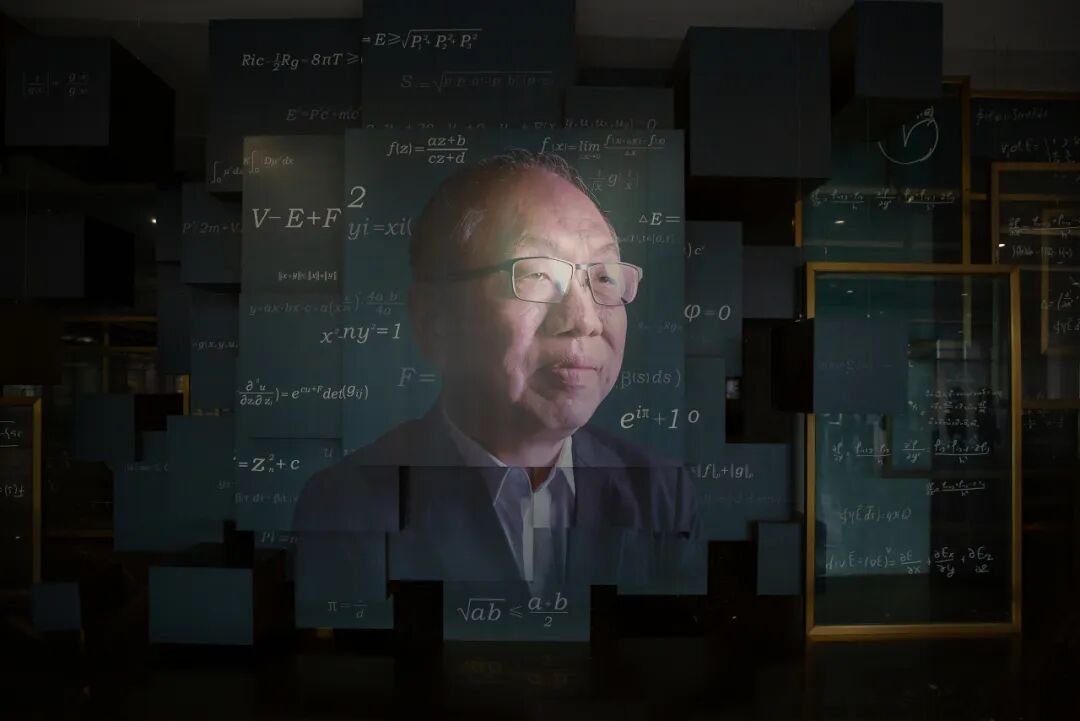
Image Source: Visual China
Tsinghua took the lead, collaborating with Tencent Hunyuan's team to develop the STARE algorithm, specifically solving the long-standing problem where "one wrong step in the middle of a math problem leads to all subsequent calculations being wasted" for large models. On the two most authoritative mathematics competition benchmarks, AIME24 and AIME25, the algorithm directly boosted accuracy by 4% to 8%.
The Zhipu AI system developed by the team led by Tang Jie from Tsinghua's Department of Computer Science has long been a top-tier domestic large model in terms of mathematical capabilities, supported by a group of scholars from Tsinghua's Department of Mathematics.
On Peking University's side, in collaboration with the Beijing General Artificial Intelligence Research Institute, they developed the TongGeometry geometry large model, building the world's largest geometry theorem library, specifically designed to solve the most challenging geometry problems in IMO, and even capable of discovering new geometry theorems independently.
The core team behind the M3 model released by MiniMax that can win IMO gold medals also includes members from the Peking University School of Mathematical Sciences.
At the 2025 WAIC World Artificial Intelligence Conference, Shing-Tung Yau personally designed test questions, gathering several leading domestic large models for an on-site closed-book exam. In the end, the scores were extremely close, with no clear winner emerging.
03
At the End of the Day, It All Boils Down to AI
Twenty years ago, China's mathematical research was barely noticeable on the global stage. Top graduates all went to the United States, and there was not even a decent mathematical research center in China.
But now, among the awardees of the ICCM International Congress of Chinese Mathematicians, one-third of the scholars are from mainland China, a figure that has tripled compared to a decade ago. Tsinghua's Qiuzhen College and Peking University's School of Mathematical Sciences now publish papers in the four top mathematics journals every year, and several young scholars at the level of Sloan Research Fellows emerge annually.
Shing-Tung Yau harshly criticized Peking University back then, but he clearly knows in his heart that it is precisely because Peking University, such a strong rival, is right next door that Tsinghua has gone all out to build mathematical centers and cultivate students.
It is also precisely because Tsinghua is chasing closely behind that Peking University has continuously improved its training system to recruit the best talents.
On June 28, 2026, the 17th Shing-Tung Yau College Student Mathematics Contest award ceremony was held at the Meng Minwei Concert Hall of Tsinghua University. Shing-Tung Yau himself stood on the stage, facing a group of the brightest mathematical prodigies across China in the audience.
In the most prestigious individual all-around award, the "Shing-Tung Yau Award," the gold medal went to Haojia Shi from Peking University, the silver medals to Junpeng Lu and Huankun Guo from Peking University, and the bronze medal to Yuhang Ye from Peking University. The top four positions were all claimed by Peking University.
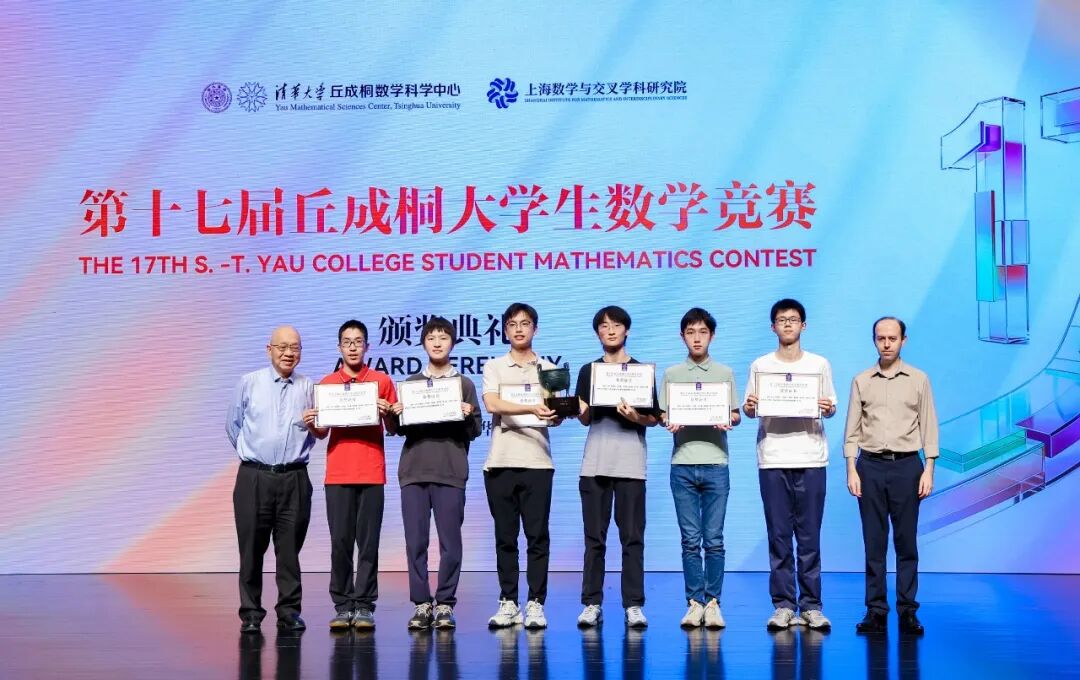
Image Source: Tsinghua University Official Website
All six individual gold medals, including the Hua Luogeng Award, Shiing-Shen Chern Award, Wei-Liang Chow Award, Chia-Shun Yih Award, and Pao-Lu Hsu Award, as well as the all-around award, were won by Peking University. Even the team gold medal was shared by Tsinghua University and Peking University.
But when Shing-Tung Yau presented the awards to Peking University's gold medalists, he wore a smile on his face, showing no sign of anger. He even called in his speech for young domestic scholars to collaborate across universities, jointly promoting the development of Chinese mathematics.
After years of rivalry, Shing-Tung Yau knows clearly that what he wants is never Tsinghua's unilateral dominance, but the rise of Chinese mathematics as a whole.
Back then, he traveled alone from Hong Kong to mainland China, establishing one mathematical center after another, launching one competition after another. Ultimately