Mindray Medical: The five-year agreement has been adjusted to a ten-year one, what has Li Xiting seen?
Mindray Medical's Hong Kong IPO application has been submitted for over eight months, yet it still has not entered the hearing stage. For a publicly traded medical company with an A-share market value exceeding 100 billion yuan, this pace is indeed rather slow. Per existing policy provisions, it could have qualified for the "fast-track approval channel for A-share companies seeking a Hong Kong listing," a path previously taken by Hengrui Medicine when it completed its H-share listing in just six months. In May this year, the China Securities Regulatory Commission (CSRC) issued the "Six Core Questions" for Hong Kong stock listings, covering data compliance, fundraising use, technology import and export, overseas subsidiaries, foreign investment access, and equity pledges. This has added an extra layer of uncertainty to the listing process.
Another noteworthy event occurred even earlier. In May 2025, to build momentum for its Hong Kong IPO, founder Li Xiting set a clear goal at the annual general meeting: within five years, by 2030, Mindray would rank among the top ten global medical device companies in terms of comprehensive strength.
By 2026, Li Xiting revised his stance in the investor relations records, extending the timeline for achieving the goal from five years to ten years. The tone of the two letters to shareholders also underwent a quiet transformation: the 2025 letter was filled with grand narratives about how new AI technologies would break the medical "Impossible Trinity," while the 2026 letter shifted to a pragmatic assessment of de-globalization risks and a refined execution roadmap for industrial upgrading. Hope remains, but the timeline has been stretched out. The once-categorical five-year commitment has evolved into a more prudent ten-year timeline.
Behind the shift from five years to ten years, after in-depth research on Mindray, we believe that the predicament is ostensibly a dual blow to fundamentals and valuation. In 2025, Mindray recorded its first simultaneous negative growth in revenue and profits, declining by 9% and 28% respectively. The downward trend continued in the first quarter of 2026, with the sluggish performance of its three major business segments evolving from structural to systemic; its stock price has fallen by 70% from its 2021 peak, and its price-to-earnings ratio has dropped to an extremely low percentile of approximately 2% since its listing. However, the underlying industrial logic of the predicament is more about the temporal rhythm of three overlapping industrial cycles, rather than a loss of long-term competitiveness. When the market linearly extrapolates the cyclical bottom based on a 70% price drop and a historically low P/E percentile, the time-rebound value of the cycle itself may well be the overlooked part in pricing and the insufficiently valued upside potential.
01
Marginal Shifts in Goals and Confidence
From the early preparation stages of its Hong Kong IPO submission to the present, Mindray has undergone a transformation from the radical optimism of proclaiming a "Top 10 Global Ranking by 2030" to an objective discussion of globalization risks and execution pathways.
At that time, to build momentum for its Hong Kong IPO, founder Li Xiting put forward an aggressive globalization goal at Mindray's annual general meeting in May 2025: "Within five years, by 2030, we will become one of the top ten global medical device companies in terms of comprehensive strength."
Referring to the 2024 revenue rankings from Medical Design and Outsourcing, this means Mindray's revenue must at least reach the $15 billion threshold. Calculated over the 2024-2030 timeframe, the compound annual growth rate (CAGR) would need to hit 20%. Furthermore, assuming the top ten global giants maintain an annual growth rate of 10% in the coming years, Mindray would need to achieve a revenue CAGR of at least 30% to secure a top-ten spot by 2030 — and this is without accounting for mergers and acquisitions.
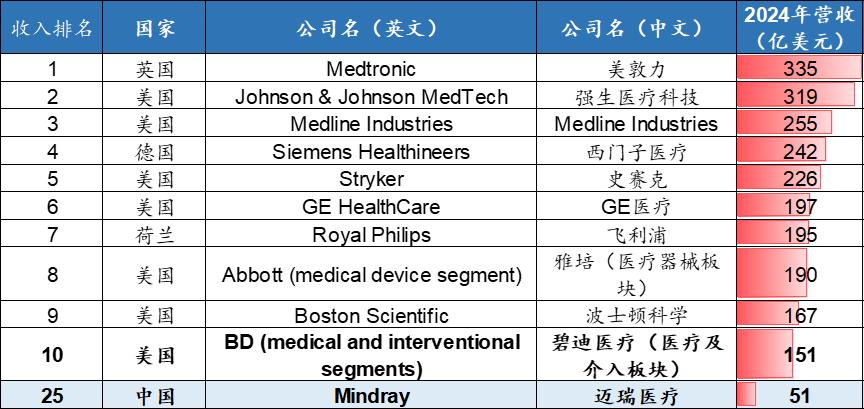
Figure: 2024 Global Medical Device Company Revenue Rankings | Data Source: MedicalDesign & OUTSOURCING
Now, looking back at Li Xiting's two letters to shareholders in 2025 and 2026, the tone has shifted from the grand optimistic narrative of believing new AI technologies can break the medical "Impossible Trinity" to an objective discussion of de-globalization risks and refined execution pathways for industrial upgrading; it has evolved from a radically optimistic grand strategic narrative to a more objective and neutral discussion of tactical execution.
Additionally, in the investor relations records from April 2026, Li Xiting adjusted his timeline to a longer period for achieving the top-ten global goal, stating: "We hope to enter the list of the world's top ten medical device companies within the next ten years." Li Xiting's industrial confidence and strategic planning for Mindray's future have undergone marginal changes.

Figure: Word Cloud Statistics of Li Xiting's 2025 and 2026 Letters to Shareholders | Data Source: Mindray Medical
02
Dual Pressures on Fundamentals
Following the performance decline starting in 2024, the downward trend in results has not seen significant improvement. Mindray maintained revenue growth rates above 20% for six consecutive years from 2017 to 2022, until its revenue and profit growth rates dropped sharply in 2024. In 2025, it recorded its first simultaneous negative growth in revenue and profits, with revenue falling by 9% and profits declining by 28%. The downward trend continued in the first quarter of 2026, with revenue rising 1% year-on-year and profits dropping 10% year-on-year.
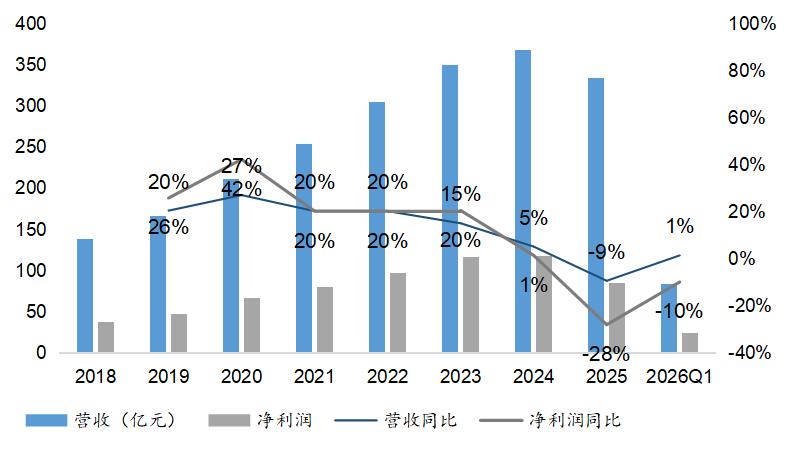
Figure: Mindray's Historical Revenue and Net Profit | Data Source: Tonghuashun
This performance decline has also evolved from structural to systemic across Mindray's various business segments. Based on 2025 revenue figures, life information and support products decreased by 11%, in vitro diagnostic products fell by 27%, and medical imaging products dropped by 24%.
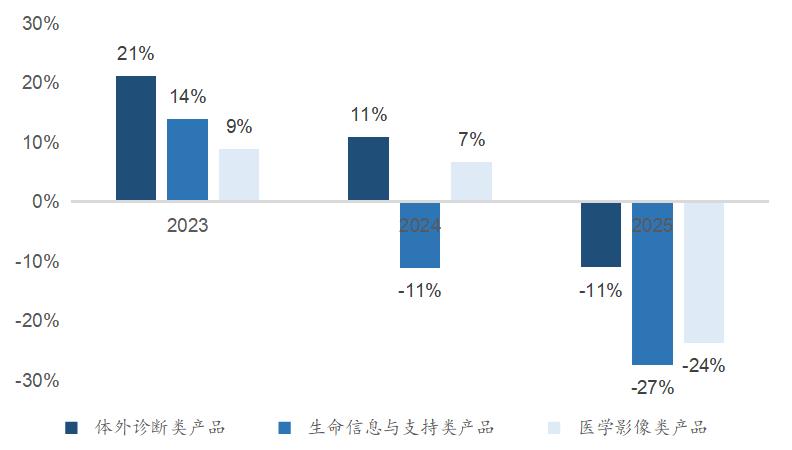
Figure: Year-on-Year Revenue of Mindray's Major Business Segments | Data Source: Tonghuashun
Mindray's stock price has experienced a five-year long decline, falling by 70% in market value from its highest closing price of approximately 495 yuan in 2021 to the closing price of 152.25 yuan on July 21 this year. The current P/E ratio offered by the market has also dropped to an extremely low percentile level of around 2% since its listing.
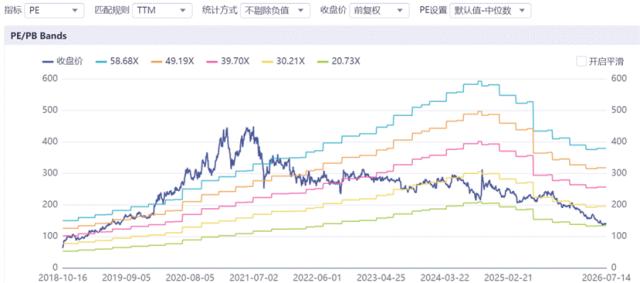
Figure: Mindray's Historical Closing Prices and Historical PE Percentiles: Median, ±1σ, ±2σ
03
Original Confidence: Overseas Growth and Upside Potential
The primary source of confidence behind the top-ten global goal is the growth of its overseas business.
Since 2023, the performance gap between Mindray's domestic and overseas revenue has gradually widened. On one hand, domestic revenue has continued to decline with an expanding drop margin; on the other hand, overseas revenue has maintained steady growth, and in 2025, overseas revenue exceeded domestic revenue for the first time, accounting for 53% of total revenue.
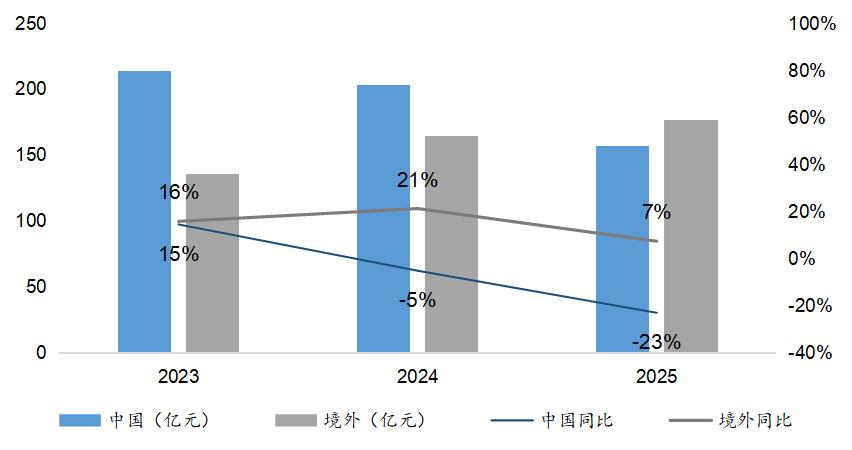
Figure: Mindray's Domestic and Overseas Revenue Performance (2023-2025)| Data Source: Tonghuashun
Optimistic expectations for overseas market potential form another pillar. Regardless of the calculation logic, against the backdrop of a global population of 8 billion, the overseas market can always yield a satisfactory total addressable market size.
In 2024, a securities firm projected a market space of 450 billion yuan, while by the end of 2025, another securities firm estimated it could exceed 100 billion U.S. dollars; coupled with the extremely low penetration rate calculated based on Mindray's current revenue scale, its future growth prospects appear very substantial. In July 2024 and December 2025, two well-known securities firms gave Mindray valuations of 335-377 yuan per share and approximately 200 yuan per share respectively.
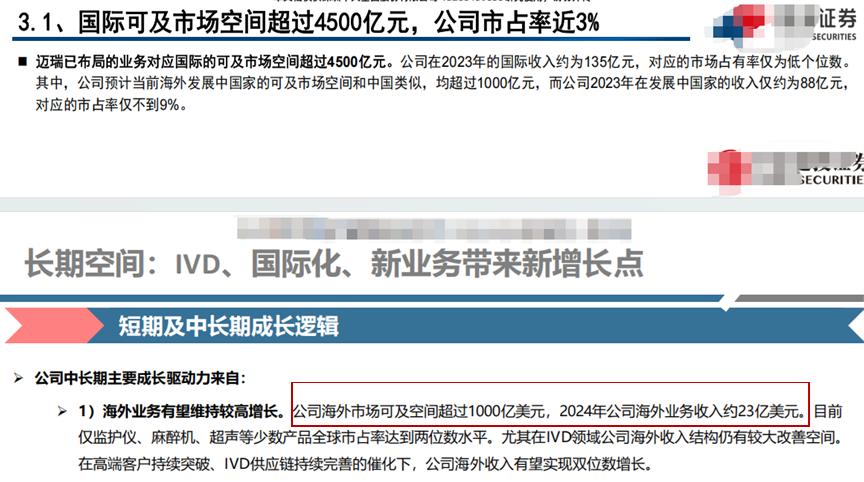
Figure: Excerpts from 2024-2025 Domestic Securities Firm Reports| Source: Public Resources
Of course, Mindray's growth plan is a comprehensive layout integrating multiple initiatives including overseas breakthroughs, product upgrades, scaled business model optimization, and external mergers and acquisitions, but overseas growth is the main pillar supporting Mindray's "top ten global" goal.
04
Overlapping of Three Industrial Cycles
The sluggish performance of the three major business segments all exhibits distinct industry cyclical characteristics, rather than a systemic loss of competitiveness.
1. The life information instrument segment is facing the aftereffects of the COVID-19 pandemic reshaping the industrial cycle.
Mindray's life information instrument business is a "capital expenditure-oriented" business for hospital clients. Under a strict budget control system, hospitals generally adopt a relatively smooth pace of equipment procurement and renewal, but the COVID-19 pandemic disrupted the normal rhythm of industry equipment updates.
The intensive equipment procurement driven by the pandemic from 2020 to 2023, under the budget management system, forced hospitals that originally arranged equipment budget funds smoothly to continuously reduce expenditures in the post-pandemic years to make up for the previous overspending on equipment, thus pushing the industry into a longer cyclical trough.
Whether it's Yuyue Medical, which focuses on overseas markets, or domestic players like Mindray Medical and United Imaging Healthcare, their revenue performance has all been affected by this industrial logic.
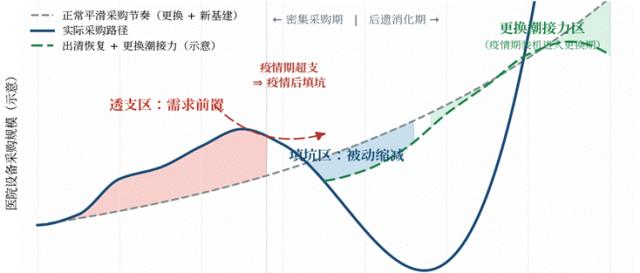
Figure: Schematic Diagram of the Pandemic Reshaping the Industry's Smooth Procurement Cycle | Source: Original Work
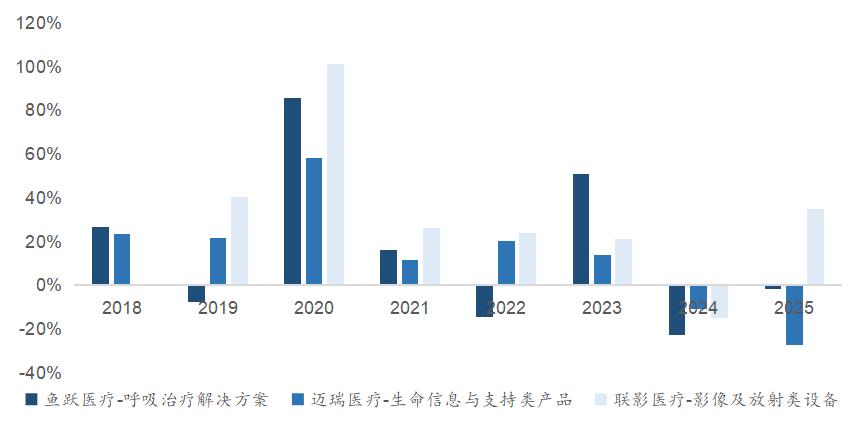
Figure: Year-on-Year Revenue of Equipment Business for Mindray and Peer Companies | Data Source: Tonghuashun
2. The in vitro diagnostic segment is at the bottom of a policy-driven profit squeeze cycle that inevitably follows industry maturation.
The surface main reason for the revenue decline in Mindray's in vitro diagnostic business segment is the sharp drop in product prices caused by provincial-level collective procurement alliances, with typical examples being the three consecutive years of alliance procurement in Jiangxi Province from 2023 to 2025, and the two consecutive years of alliance procurement in Anhui Province from 2024 to 2025.
The underlying industrial reason is the common industry practice where medical insurance cost-control policies force mature tracks to transfer benefits to innovation-focused tracks.
The main payer for the entire medical industry comes from the public medical insurance fund, whose growth is anchored to the growth of national income. To ensure that this "nearly stock-based" fund can continue to stimulate innovation and progress in medical products, cost-control policies are implemented to make mature tracks in the medical industry yield benefits to innovation tracks, allowing innovation tracks to obtain excess returns to cover high upfront R&D expenses.
In terms of data performance, from 2024 to 2025, the revenue of the in vitro diagnostic industry continued to decline year-on-year, while the revenue of the innovative drug track maintained steady growth.
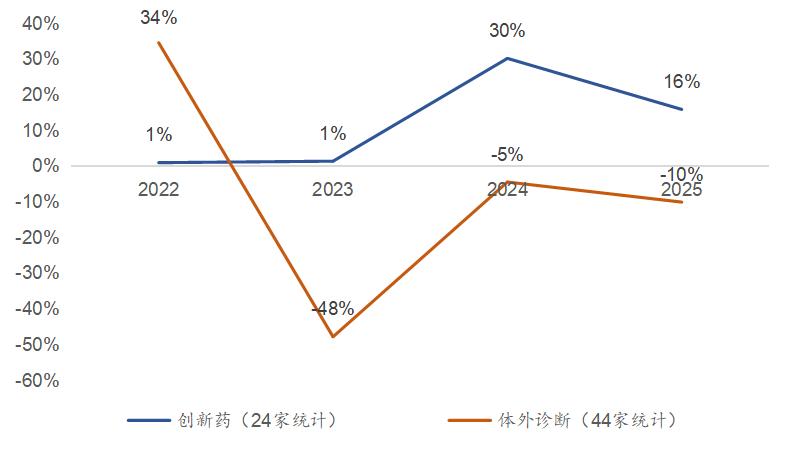
Figure: Year-on-Year Revenue of the Innovative Drug Industry and the In Vitro Diagnostic Industry | Data Source: Tonghuashun
