The last co-founder has left, leaving Wang Xiaochuan with no one behind him.
On July 16, Ru Liyun officially stepped down from his position and took office as the President of Hithink RoyalFlush Information Network Co., Ltd.
This news itself did not cause much of a stir in the market — over the past 18 months, one co-founder after another left Baichuan Intelligence, and public opinion had long grown weary of the trend. But when the name Ru Liyun finally appeared on the resignation list, sharp observers realized that a landmark event had taken place. He was the last remaining co-founder, essentially the second-in-command at Baichuan, the top scorer in the science stream of the 1998 Zhejiang Provincial College Entrance Examination, a top student who completed his bachelor's, master's, and doctoral degrees consecutively in the Department of Computer Science of Tsinghua University, and Wang Xiaochuan's old partner who fought side by side with him at Sogou for 13 years.
Let's lay out the full timeline. In December 2024, Hong Tao left — the former Chief Marketing Officer of Sogou and head of commercialization at Baichuan was the first to depart. In March 2025, the storm reached its peak: Jiao Ke, head of internet business, and Chen Weipeng, head of model R&D, both resigned; almost at the same time, Deng Jiang, business partner and president of the Financial Business Group, and Li Shizheng, vice president of medical business, also left one after another. In July of the same year, technical co-founder Xie Jian — the former youngest director-level R&D architect at Baidu and a technical expert holding 35 patents — submitted his resignation.
Then came the last one: Ru Liyun. On July 16, 2026, the former COO of Sogou and President of Baichuan Intelligence turned and walked away.
The founding team was completely gone.
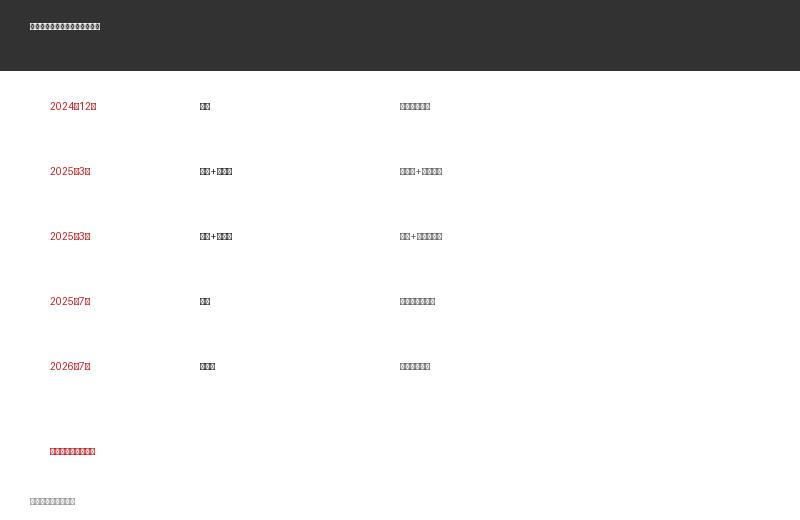
Source: Compilation from public information
According to previous reports from 36Kr, multiple sources close to Baichuan's core leadership revealed to 36Kr that a consistent thread runs through the departure of all co-founders: they disagreed with Wang Xiaochuan's strategic choice to bet everything on medical AI. The divergence reached a boiling point in April 2025 — Wang Xiaochuan released a company-wide letter announcing a contraction of business lines and an all-in commitment to healthcare. The co-founders collectively opposed this decision, but Wang Xiaochuan ultimately overruled their objections. The team size was drastically reduced from 450 to less than 200 people, and the two vertical business divisions of finance and healthcare were dissolved.
A fundamental question thus surfaced: when all co-founders do not agree with your direction, are they the ones who are wrong, or are you?
01
All Co-Founders Depart: The Final Outcome of a Route Dispute
The wave of co-founder resignations at Baichuan Intelligence cannot be explained by "personnel optimization" or "normal iteration". This is the most extreme case among large model startups — the core team collectively vetoed the strategy, then left together.
Ru Liyun's importance is particularly worth elaborating. Born in 1979, a native of Cixi, Zhejiang Province, he was admitted to the Department of Computer Science of Tsinghua University in 1998 as the top scorer in the Zhejiang science stream, completing his bachelor's, master's, and doctoral degrees consecutively. He joined Sogou in 2005, rising from General Manager of the Search Business Division to Vice President, and became COO of Sogou in 2016. His tenure at Sogou almost completely overlapped with Wang Xiaochuan's — from the early days of the startup to its listing on the New York Stock Exchange, and through the difficult transformation from PC search to the mobile internet era. After Sogou went public in 2018, he chose to leave and founded AI education company GrapeLearning.
When Baichuan Intelligence was founded in April 2023, Ru Liyun was one of the first to join. He participated throughout the entire financing process: $50 million in the angel round, $300 million in the A1 round (with Alibaba, Tencent, Xiaomi, and others participating), and 5 billion RMB in the A round at a $20 billion valuation (July 2024). By Wang Xiaochuan's side, he was the one who "could speak up".
Within Baichuan, Ru Liyun had always advocated for investing resources in the Coding (code generation) track. According to insiders, his judgment was based on a simple logic: code is a natural advantage area for large models, with clear rules, instant feedback, and structured data, and enterprises have a strong willingness to pay, making it the fastest scenario to achieve a commercial closed loop.
This judgment coincided with the choice of Tang Jie from Zhipu AI. Zhipu was the first to enter the capital market relying on breakthroughs in the Coding direction and its agent platform, with its market value exceeding one trillion yuan. Anthropic has even made Coding its core strategy, with its ARR (Annual Recurring Revenue) soaring to $470 billion and a valuation as high as $9.65 trillion.
"No one could persuade Wang Xiaochuan; he trusted his own judgment more," a person close to Wang Xiaochuan recalled when talking about the internal debates at the time.
The company-wide letter in April 2025 was a watershed moment. Wang Xiaochuan announced a contraction of business lines and a full bet on medical AI. The co-founders unanimously opposed this — they believed that Coding was the current must-win battlefield, and while healthcare had value, it should not come at the cost of abandoning general-purpose models and other vertical scenarios. The debates were fierce, but produced no results. Wang Xiaochuan overruled all objections, the team was drastically reduced from 450 people to less than 200, and the finance and healthcare business divisions were successively dissolved.
Hong Tao left, Jiao Ke left, Chen Weipeng left, Deng Jiang left, Li Shizheng left, Xie Jian left, and finally Ru Liyun also left.
When the last person who could say "no" departed, Baichuan Intelligence became a thoroughly one-person company.
02
Sogou's Success Became a Shackle in the AI Era
To understand why Wang Xiaochuan is so certain about healthcare, one must go back to Sogou.
Sogou's story is a classic case in the history of Chinese internet. Under the absolute dominance of Baidu, Wang Xiaochuan used input methods as an entry point to build a three-stage rocket system of "input method → browser → search", forcing a gap through the cracks between giants and taking Sogou public on the NYSE in 2017. The core of this methodology is "finding scenarios" — do not fight head-on with giants in core battlefields; first find an entry point that meets a strong user need, accumulate users and data, and then naturally extend upstream.
This methodology once saved Wang Xiaochuan's career. In a search market completely crushed by Baidu, if not for the clever entry point of input methods, Sogou might have died long ago.
Healthcare was not a last-minute decision. Back in the Sogou era, Wang Xiaochuan had invested in Xiaolu Chinese Medicine (later acquired by Alibaba Health) and DeepCare (an AI dental medical company that reportedly had only about 4 employees at the time). His observations of the healthcare sector date back a long time, but the technical capabilities were previously insufficient. When Baichuan Intelligence was first established, healthcare was one of the key deployment directions.
"I am not looking for a direction; I am waiting for the technology," Wang Xiaochuan explained his choice on multiple occasions. The implication was clear: I had long identified the healthcare scenario, and was just waiting for large model capabilities to mature enough to support it.
But the competitive logic of the AI era is fundamentally different from the internet era he was familiar with.
The rule of the internet era was indeed "scenario-driven": find a high-frequency, high-demand scenario (input methods), accumulate users, and then naturally extend to related businesses (search). If you picked the right scenario and built a good product, you had a chance to succeed. In that era, products and technologies were decoupled — input methods and search could be two completely different technology stacks.
The large model era is completely different. The rule here is "capability-driven": model capabilities determine the upper limit of applications. Whoever makes breakthroughs in the foundational model first can achieve dimensionality reduction strikes in downstream applications. The reason why Coding became the fastest entry point for commercialization is not because "the right scenario was chosen", but because large models' capabilities in understanding and generating code were the first to reach the threshold of enterprise usability. It is not scenarios that determine models, but model capabilities that determine which scenarios will break out first.
Wang Xiaochuan himself actually indirectly acknowledged this point. When talking about Dario Amodei of Anthropic, he said: "I think Dario has a deep understanding of technology, which is a judgment at the aesthetic level. Later facts verified it — Claude really achieved success in the code scenario."
"Judgment at the aesthetic level" — this wording is very subtle. Wang Xiaochuan acknowledged that Dario's judgment on Coding was correct and profound, but he did not follow that judgment. Why? Because Sogou's experience told him that "finding scenarios" is more important than "competing on model capabilities". Input methods were not the best technology at the time, but they found the best scenario. This logic is deeply ingrained in his mind, becoming his unconscious default setting when facing the AI era.
The double-edged sword effect of empiricism is vividly reflected in Wang Xiaochuan. Sogou gave him certainty — "I have been through all this and benefited from it". But it also gave him blind spots: the competitive order of the AI era has changed; model capabilities determine application capabilities, not scenarios determining models.
While Zhipu went public relying on Coding, Anthropic's valuation approached one trillion US dollars relying on Coding, and Kimi reached a $31.5 billion valuation with its K3 model, Baichuan was focusing on scoring high on HealthBench. The score of 68.6 is indeed the world's highest, but is this the first place Wang Xiaochuan wants?
03
The Healthcare Direction Itself Is Not Wrong, But What Is the Cost?
The fairest way to evaluate Wang Xiaochuan is to separate the direction from the execution.
In terms of direction, medical AI is not a pseudo-demand. Medical resources in China are extremely unbalanced: top-tier hospitals are overcrowded, and the quality of grassroots doctors varies unevenly. The value of AI-assisted diagnosis is self-evident. Moreover, the healthcare industry has high barriers and high data thresholds; once an advantage is established, it is difficult to be overturned. From this perspective, healthcare is a track worthy of long-term investment.
In terms of execution, Baichuan's M4 has indeed delivered world-class results.
Baichuan-M4, released on June 22, 2026, achieved a comprehensive score of 68.6 in the HealthBench evaluation, ranking first in the world. This figure is more than 10 points ahead of OpenAI's GPT-5.5, and 15.9 points ahead in the Hard subset. Even more impressive is the hallucination rate — M4's is only 3.3%, the lowest in the entire industry. For horizontal comparison: GPT-5.5's is 3.8%, Claude Opus 4.7's is 6.9%, and DeepSeek-V4-Pro's is as high as 9.8%.
At the WAIC 2026 conference on July 17, Baichuan demonstrated the implementation of M4 in specialized fields: tumor AI co-built with the National Cancer Center / Cancer Hospital of the Chinese Academy of Medical Sciences, and an AI pediatrician co-built with Beijing Children's Hospital. The latter achieved a diagnostic accuracy of 91.7%, 14.58 percentage points higher than the human doctors participating in the same competition. In addition, Baichuan has established a cooperative relationship with Shanghai Ruijin Hospital, and its AI family doctor product "Baixiaoyi" is also being gradually rolled out in the WeChat ecosystem.
At the technical and product levels, Wang Xiaochuan has not disappointed people.
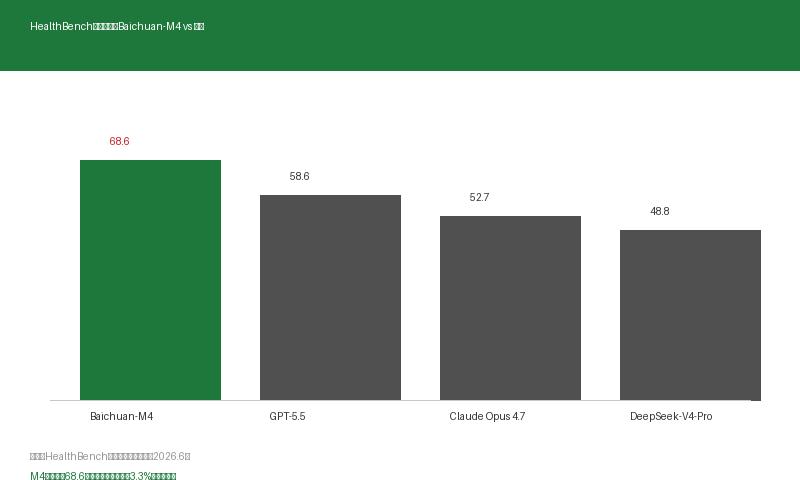
Source: Public data from the HealthBench international evaluation (June 2026)
But business is not a laboratory, and entrepreneurship is not publishing papers. The price Baichuan paid for betting on healthcare needs to be carefully calculated.
The first cost is the general model battlefield. While Baichuan contracted most of its resources to medical AI, competitors are accelerating iteration in Coding, multimodal, agents, and other fields. Zhipu AI was the first to go public relying on breakthroughs in the Coding direction, with a market value exceeding one trillion yuan; Moonshot AI reached a valuation of $31.5 billion with the release of its K3 model; under the leadership of Lee Kai-Fu, 01.AI was the first to shrink and transform, achieving 1.5 billion yuan in orders in 2025 with annual operating costs of only over 200 million yuan, and is doing very well.
What about Baichuan? Although its API revenue in 2024 exceeded 100 million yuan, "far higher than other model vendors such as Zhipu" (in the words of a former Baichuan employee), this was mostly due to Baichuan's earlier API commercial layout and customer resources accumulated in the Sogou era, rather than continuous technical leadership. In Coding, the most lucrative track, Baichuan has almost no presence.
The second cost is the rhythm of the capital market. Healthcare is a slow business — clinical verification cycles are long, medical device approvals are strict, and business models are heavy. What the capital market wants to hear is not just a story of technological leadership, but a commercial narrative that can be rapidly scaled. Zhipu tells the story of "China's version of OpenAI", Kimi tells the story of "long-text revolution", and 01.AI tells the story of "practical monetization". Baichuan tells the story of the HealthBench 68.6 score — does it sound good? Yes. Is it easy to sell? No.
Baichuan was one of the earliest domestic model manufacturers to push for an IPO. Wang Xiaochuan revealed in January 2026 that the IPO is expected to start in 2027. But with a founding team that has all left, a team size of less than 200 people, and the long-term investment cycle of medical AI — how can the IPO story be told with all these elements combined?
The healthcare direction itself is not wrong; what may be wrong is that at the wrong time, in the wrong way, they went all in on a correct direction.
04
Wang Xiaochuan's Self-Consistency and Loneliness
"I see healthcare clearly, not just gambling on it."
The tone of Wang Xiaochuan when he said this was not a defense, but a statement. He has sufficient data support, a sufficiently closed logical loop, and sufficient industry observations. He sees a certain future, not a game of probability.
Another sentence better illustrates his underlying mindset: "I have been through all this and benefited from it. So today I am on this ship again, standing on the main track of large models. To complain too much would be a bit too much, wouldn't it?"
This is the declaration of a veteran who has fully experienced the entire cycle of Chinese internet entrepreneurship. He has seen the burst of bubbles, the strangulation by giants, and the IPO bell-ringing moment. It took Sogou 13 years from its birth to IPO, and he survived countless life-and-death moments in between. So he feels that the difficulties of the healthcare path are nothing.
But excessive self-consistency is a dangerous signal.
When a person's logic is completely closed-loop and their beliefs are completely firm, the thing they need most — precisely — is questioning. When Ru Liyun was there, there was at least one person inside Baichuan who could argue with Wang Xiaochuan on an equal footing. They worked on Sogou together, knew each other's capabilities and personalities, and Ru Liyun would not compromise his judgment just because of the other person's status. Arguments do not necessarily change the outcome, but they at least force decision-makers to examine their own blind spots.
Now