Kimi's targeted valuation has skyrocketed to more than 330 billion yuan.
After capturing Elon Musk's attention with the outstanding performance of the K3 model, Kimi has once again become a hot favorite in the capital market.
According to a report by 21st Century Business Herald, domestic large model enterprise Moonshot AI plans to launch negotiations for its final pre-IPO financing round in August, targeting a pre-money valuation of $500 billion (approximately 3.385 trillion yuan). The company expects to complete a round of financing with a pre-money valuation of $315 billion in the short term, and immediately proceed to negotiate the Pre-IPO round afterward. It has already sent listing proposals to investors, and is expected to complete its Hong Kong stock listing as soon as within 6 months.
If the target pre-money valuation is achieved, the company's valuation will have increased by 1.5 times in just two months, and soared more than a hundred times over more than three years, setting a new record for the valuation of domestic independent large model startups.
Although Moonshot AI has not yet responded positively to the financing reports, and no specific shareholder list has been released, sorting out its past investor list reveals that state-owned capital entities are becoming core participants in Moonshot AI's financing activities.
Information from Tianyancha shows that Beijing Moonshot AI Technology Co., Ltd. was established in April 2023, with Yang Zhilin as its legal representative and an initial registered capital of 1 million yuan. As of now, the company has completed a total of seven rounds of financing. The latest round is the D+ round, which was disclosed on June 30 this year, but the financing amount was not publicly announced. Investors include the China Life Yangtze River Delta Science and Technology Innovation Fund, Shenzhen Harmony Growth Phase III Technology Development Equity Investment Fund Partnership (Limited Partnership), Lingang Frontier Canadian Solar Yangzhou New Energy Equity Investment Fund Partnership (Limited Partnership), and others.
Moonshot AI currently has 13 shareholders, among whom Yang Zhilin holds 51.8304% of the shares, serving as the controlling shareholder, actual controller, and beneficial owner. He has subscribed for 789,680 yuan of capital contribution, with 789,680 yuan fully paid in. He first held shares on April 17, 2023, and completed the latest subscription confirmation on June 29 this year, making him the absolute largest domestic shareholder of the company.
Among the remaining founding natural person team members, Zhou Xinyu holds 6.5635% of the shares, with subscribed and paid-in capital contributions of 100,000 yuan; Wu Yuxin holds 3.9099% of the shares, with subscribed and paid-in capital contributions of 59,570 yuan; Zhang Yutao holds 3.3310% of the shares, with subscribed and paid-in capital contributions of 50,750 yuan. The four founding natural persons directly hold a total of 65.6348% of the shares domestically, firmly maintaining control over the domestic entity.
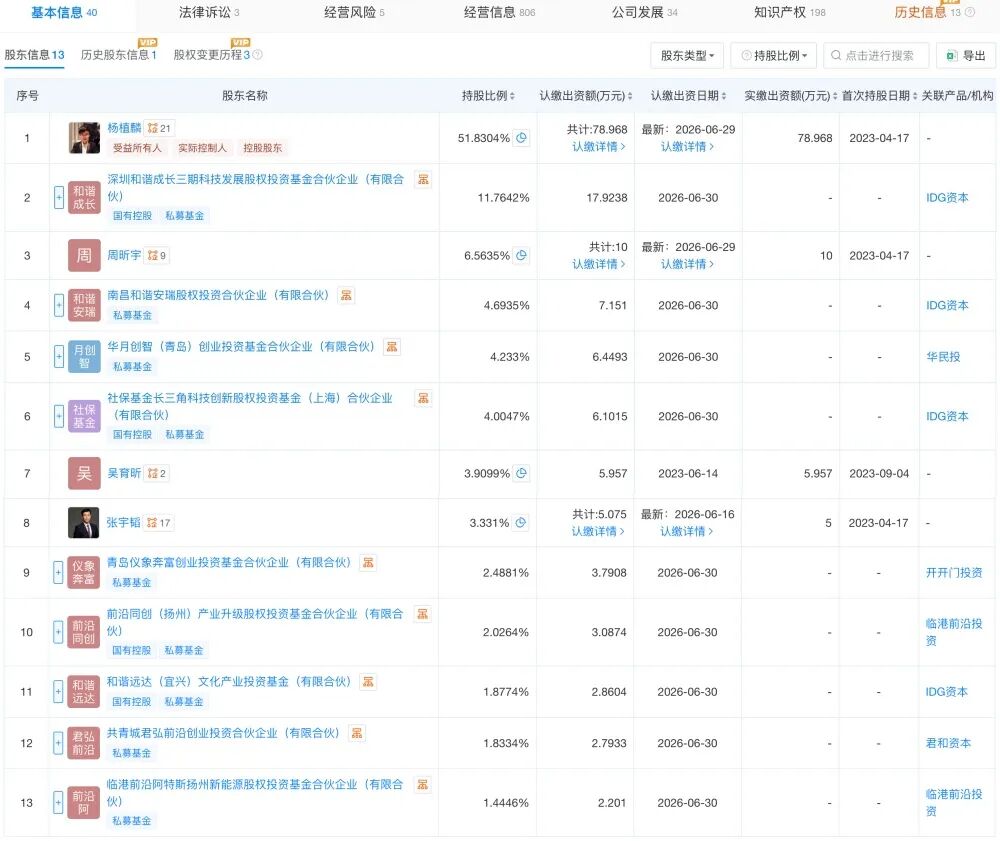
Current shareholder structure of Moonshot AI. Data source: Tianyancha website
The IDG Capital management system also holds a significant number of shares. Shenzhen Harmony Growth Phase III Technology Development Equity Investment Fund (Limited Partnership) holds 11.7642% of the shares. This institution is a state-controlled private equity fund whose underlying LP includes the National Council for Social Security Fund, managed by IDG Capital, with a subscribed capital contribution of 179,238 yuan, making it the largest domestic institutional shareholder. Nanchang Harmony Anrui Equity Investment Partnership (Limited Partnership) holds 4.6935% of the shares, with a subscribed capital contribution of 71,510 yuan, and is a private equity institution under IDG Capital.
In addition, the Social Security Fund Yangtze River Delta Science and Technology Innovation Equity Investment Fund (Shanghai) Partnership (Limited Partnership) holds 4.0047% of the shares. This fund is a purely state-controlled special social security fund, with a subscribed capital contribution of 610,150 yuan.
Also on Moonshot AI's shareholder list are local state-owned industrial investment funds. Frontier Tongchuang (Yangzhou) Industrial Upgrading Equity Investment Fund Partnership (Limited Partnership) holds 2.0264% of the shares, with a subscribed capital contribution of 308,740 yuan; Lingang Frontier Canadian Solar Yangzhou New Energy Equity Investment Fund Partnership (Limited Partnership) holds 1.4446% of the shares, with a subscribed capital contribution of 222,010 yuan. Both entities are under Lingang Frontier Investment.
On the industrial capital side, Alibaba, Tencent, Meituan Longzhu, and Xiaohongshu have continued to increase their investments across multiple rounds. Among them, Meituan Longzhu led the D-round financing in May with a $2 billion investment, contributing over $200 million as a single investor. Leading venture capital firms such as HSG, IDG Capital, ZhenFund, and 5Y Capital have continuously followed their investments since the angel round, covering the entire development cycle of Moonshot AI.
The capital market's willingness to set a valuation of over 3.3 trillion yuan is directly related to the Kimi K3 model released on July 16. The K3 has a total of 2.8 trillion parameters and is equipped with an ultra-long context window of 1 million Tokens, making it the open-source large model with the largest parameter scale in the world currently. It adopts a self-developed KDA hybrid linear attention and attention residual architecture, which improves the overall scaling efficiency by 2.5 times compared to the previous-generation K2, and natively supports multi-modal visual understanding. This model topped the global Frontend Code Arena programming leaderboard, ranking third in the world in overall intelligence index, behind only two overseas leading closed-source models.
According to a report by National Business Daily, in response to rumors about model distillation, Huang Zhenxin, a business leader at Moonshot AI, denied the claims, stating that "the leapfrog improvement in Kimi K3's performance is fundamentally based on underlying original architectural innovation, rather than distilling and replicating any existing model. Chinese large models should not be labeled as low-priced. We have developed a SOTA-level model that can also match reasonable commercial pricing."
After the K3 was released, Elon Musk, founder and CEO of Tesla and xAI, commented that it was "Impressive", publicly recognizing the model's technical level. Just one day later, Musk revealed that xAI is training Grok 4.6 with 2 trillion parameters, completing the first round of training within a week, and "is expected to surpass Kimi in all aspects". In response, Kimi stated that "we welcome everyone to join the 2 trillion+ club".
It is worth noting that Jensen Huang, founder and CEO of NVIDIA, mentioned when asked how the United States should respond to competition from China's AI industry that "Chinese models are very excellent", and the market has misunderstood the influence brought by the open-source model Kimi, just as it previously misunderstood DeepSeek.
In addition to Kimi, the valuations of other domestic independent large model startups have also been continuously rising. Recently, two listed companies, Kairun Co., Ltd. and By-Health, issued announcements on the progress of related investments. Calculated based on the capital contribution ratio disclosed in the announcements, DeepSeek's valuation after completing its latest round of financing ranges from 325 billion yuan to 350.877 billion yuan. As of press time, the market value of Zhipu AI is 554.6 billion Hong Kong dollars, while the Hong Kong stock market value of MiniMax is slightly lower, at 68.1 billion Hong Kong dollars.
Behind the high valuations, objective challenges also exist. An institutional research report pointed out that computing power procurement and continuous training for large models are permanent heavy asset investments. Even if Moonshot AI completes large-scale fundraising, it still needs stable operating income in the long term to cover R&D expenses. In addition, competition in the AI track continues to intensify, with large internet companies and state-owned technology platforms simultaneously increasing their investments in general large models, which may compress profit margins in the long run.
This article is from the WeChat official account "Jiemian News", written by Song Jianan, and published by 36Kr with authorization.