Wang Hong, a Fields Medal laureate, has also published papers at NeurIPS.
Wait a minute? The newly crowned Fields Medalist Hong Wang once dabbled in AI across disciplinary boundaries?
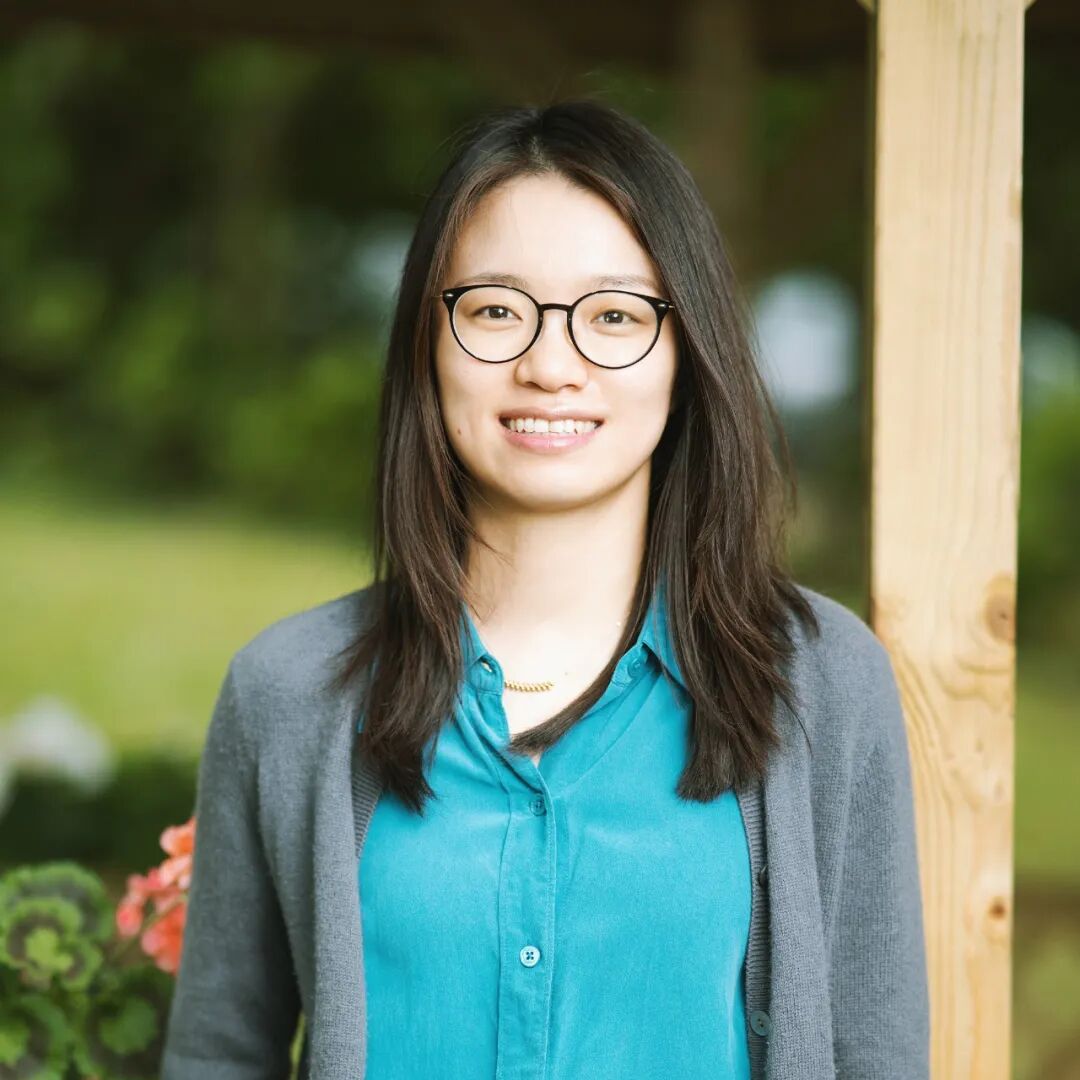
With NeurIPS 2026 results soon to be released, some netizens dug up that Professor Hong Wang published a paper at NeurIPS 2019.
And it was not just a nominal authorship, but a genuine co-first authorship.
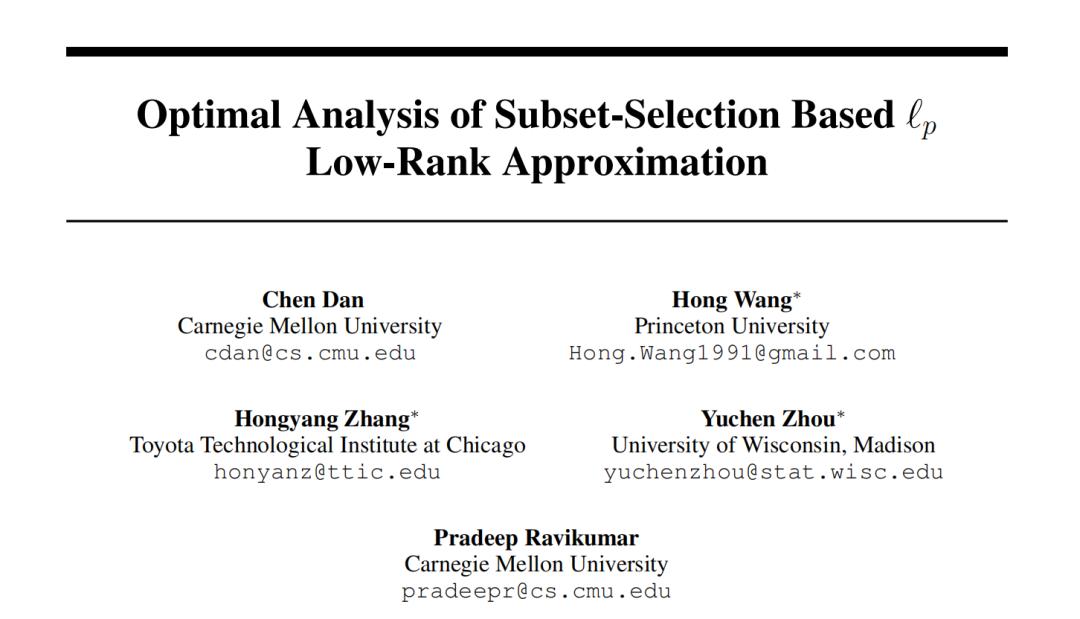
So the question arises: why would a top mathematician specializing in pure mathematics publish a paper at a top-tier AI conference?
After a full review, our conclusion is that this paper is a prime example of the perfect combination of mathematical theory + machine learning.
Interestingly, among the nearly 40 papers and preprints listed on Hong Wang's personal homepage, almost every one comes with a complete accessible link.
This particular paper is the only exception.
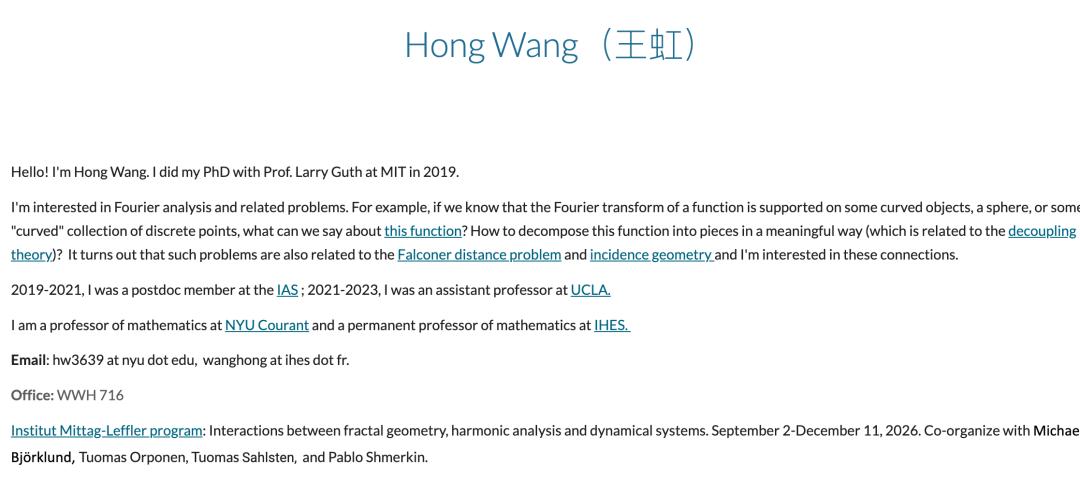
Hong Wang's Cross-Disciplinary Foray into AI
The research of this paper focuses on a fundamental task in machine learning and data analysis: Low-Rank Matrix Approximation.
Simply put, real-world data can usually be organized into a matrix, but these matrices are often extremely large, resulting in prohibitively high costs for direct storage and processing.
Low-rank approximation aims to restore the original matrix as accurately as possible using a matrix with a simpler structure and lower rank.
A commonly used approximation algorithm in recent years is Column Subset Selection (CSS).
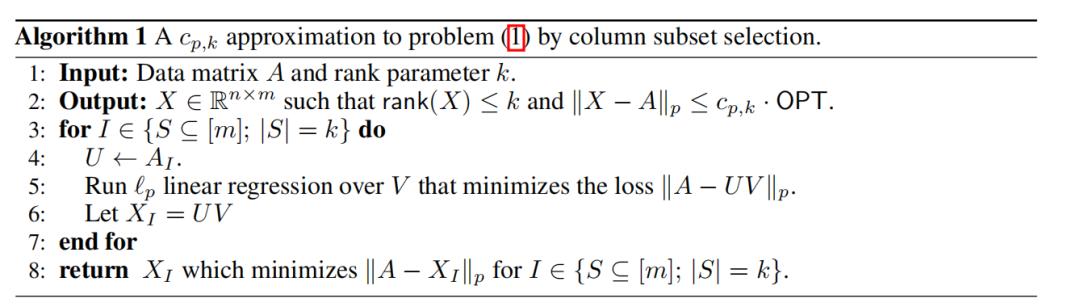
The idea behind it is actually very intuitive.
When dealing with a data matrix containing a large number of columns, instead of directly deriving a completely new low-rank matrix, we select a number of representative columns from the original matrix, and then use the space spanned by these columns to approximate the entire matrix.
Since the columns selected by CSS come directly from the original data, they are much easier to interpret than the abstract vectors obtained from ordinary matrix decomposition. Meanwhile, it also reduces storage and computational costs, making it suitable for processing large-scale datasets.
Previous studies have proven that for general low-rank approximation, the upper bound of the approximation ratio of the CSS algorithm is approximately O(k+1).
Here, k refers to the rank of the target matrix. The larger k is, the greater the theoretically allowable worst-case error will be.
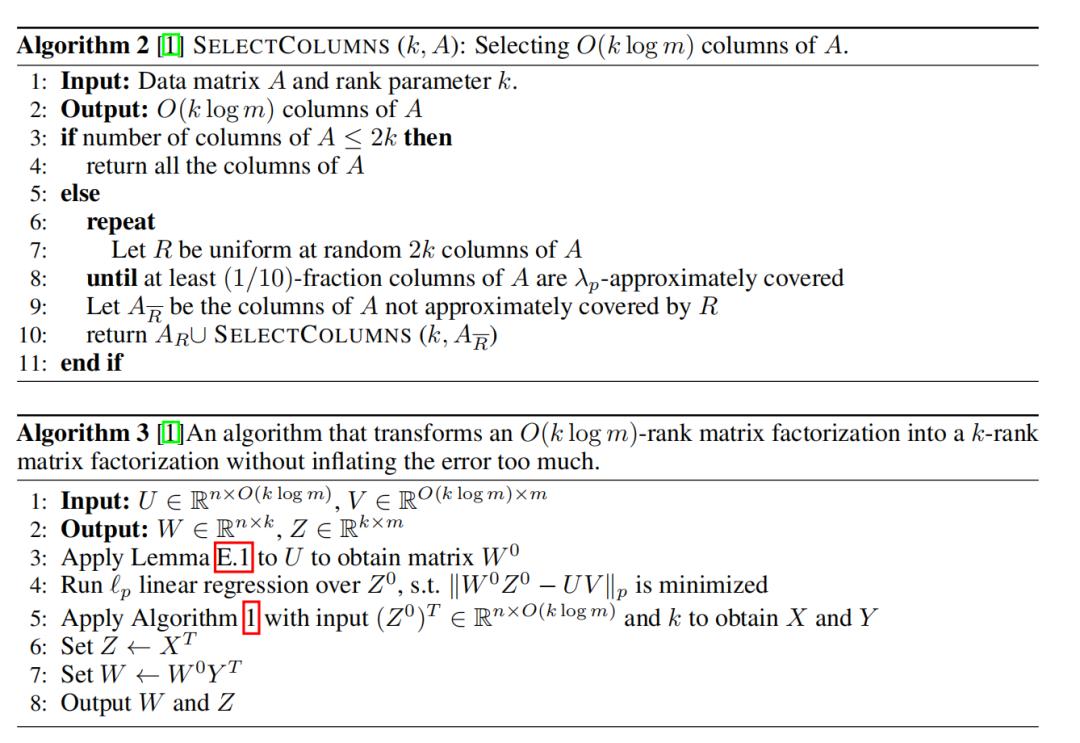
The work led by Hong Wang further tightens this bound:
When 1≤p≤2, the approximation ratio is (k+1)^(1/p);
When p≥2, the approximation ratio is (k+1)^(1−1/p).
Compared with the previous uniform O(k+1) result, this bound is significantly tighter. The algorithm can be strictly constrained, and the worst-case performance is only slightly worse than the optimal solution.
In addition, for the case where p≥2, the paper also constructs the corresponding lower bound, proving that its result is accurate up to the constant 1.
In other words, this paper provides a nearly optimal theoretical answer.
The most critical part of this paper that best reflects Hong Wang's mathematical background is the adoption of the classic tool from harmonic analysis, the Riesz–Thorin Interpolation Theorem.
Typically, to prove that an algorithm holds for all values of p, one needs to carry out complex analyses separately for different p values.
For certain endpoint cases, such as p=1, p=2, and p=∞, the processing is relatively easier.
Then the Riesz–Thorin Interpolation Theorem can be used to "interpolate" the conclusion to all p values in the middle after these endpoint results are obtained.
Specifically, the paper first proves three special cases: p=1, 2, and ∞, and then derives the approximation bounds for the entire range through the interpolation theory.

In fact, this set of tools is a classic method in harmonic analysis and operator theory, but it was not the most commonly used technique by researchers in theoretical computer science at that time.
The reviewers of NeurIPS that year also noticed this point.
The reviewers finally recognized that the most important technical innovation of this paper was the introduction of the Riesz–Thorin theorem into the computer science field, and the final Meta Review evaluated it as a paper with very solid argumentation.
From today's perspective, this paper actually provides a very typical interdisciplinary case: tough problems in machine learning may find breakthroughs in pure mathematics.
NeurIPS 2026 Results Are About to Be Released
Fast forward to the present, the NeurIPS review mechanism is undergoing a noticeable adjustment.
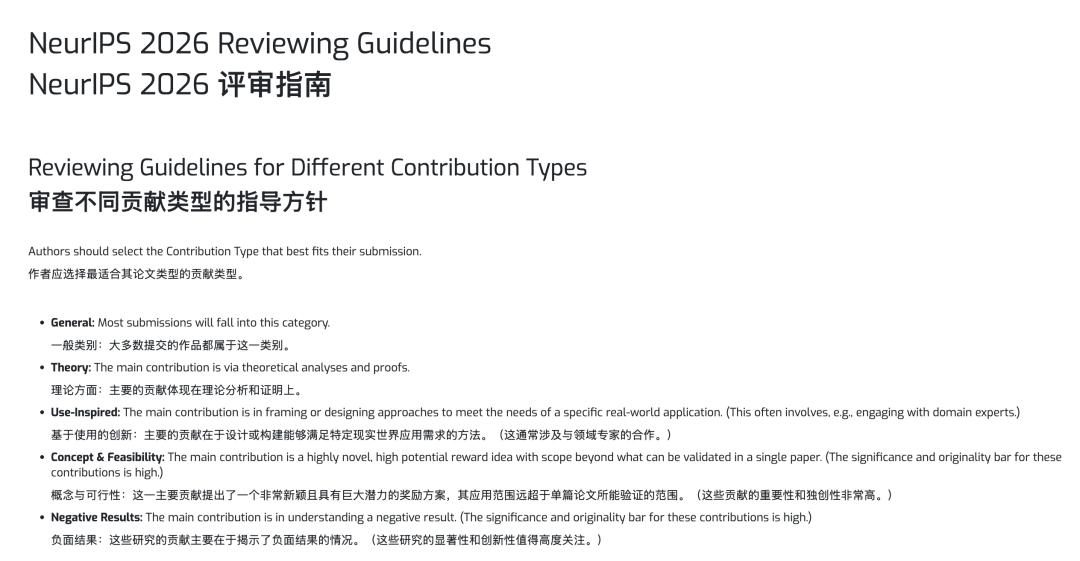
NeurIPS 2026 requires authors to select the most appropriate category that matches their paper from five contribution types during submission: General, Theory, Use-Inspired, Concept & Feasibility, and Negative Results.
There is no doubt that Hong Wang's 2019 paper falls into the Theory category.
In accordance with the latest NeurIPS 2026 review guidelines, theoretical papers are first evaluated for mathematical rigor and correctness. The proofs, lemmas, and overall logic must be valid, so theoretical papers should not be overlooked simply for lacking experiments.
At the same time, NeurIPS 2026 clearly states that theoretical contributions can stand independently, and the purpose of designing new algorithms does not necessarily have to be outperforming the latest application models or achieving SOTA on the largest datasets.
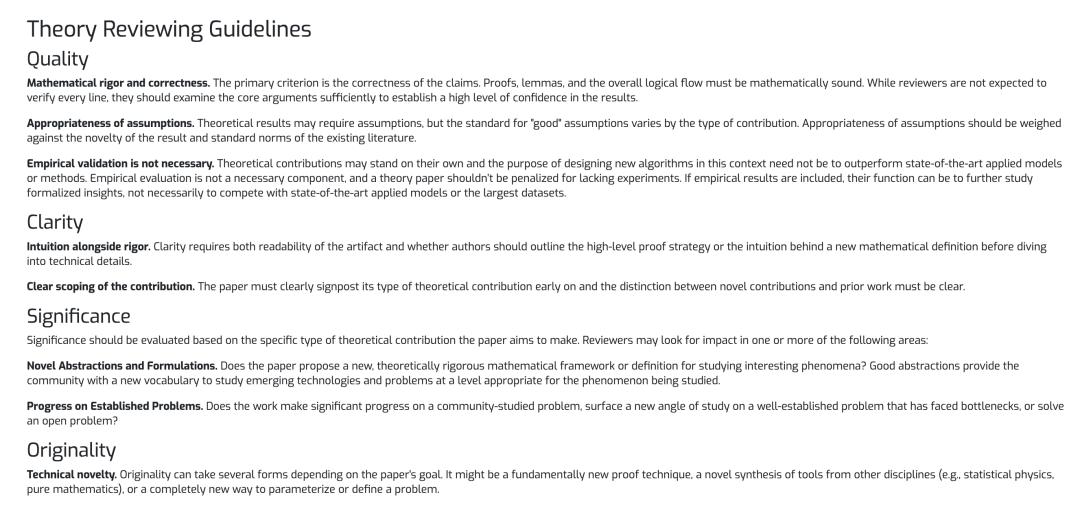
In terms of originality, researchers can also introduce new proof tools from other disciplines, or conduct innovative integration of existing tools.
And this is almost an exact description of Hong Wang's paper.
They did not propose a neural network architecture in the modern sense, nor did they train a model with a huge number of parameters. Instead, they introduced the interpolation theorem from harmonic analysis into low-rank approximation to solve the boundary problem of approximation algorithms.
Under the 2026 review framework, it is still a very standard NeurIPS theoretical paper.
It also illustrates from the opposite perspective that NeurIPS is not equivalent to a neural network model launch event. Providing new understandings of existing methods, discovering new properties, and establishing tighter theoretical bounds are all valuable original contributions.

As for the boundary between mathematics and AI, it has never been as clear as people imagine.
Fields Medalists can publish papers at NeurIPS, and the language of mathematics can also help AI find its true general solution.
References:
[1]https://proceedings.neurips.cc/paper_files/paper/2019/file/80a8155eb153025ea1d513d0b2c4b675-Paper.pdf
[2]https://neurips.cc/Conferences/2026/ReviewerGuidelines
[3]https://sites.google.com/view/hongwang/home
[4]http://xhslink.cn/o/8oQ3gm7qaxu
This article is from the WeChat official account QbitAI, written by Lu Yu, and published with authorization by 36Kr.