The newly crowned Fields Medalist announced on the very same day that he joined OpenAI.
Having just received the highest honor in mathematics, he immediately announced: I'm joining OpenAI.
Jacob Tsimerman, the man who stood alongside Wang Hong and Deng Yu on the award stage, demonstrated to everyone the moment he stepped down:
How dramatic the pinnacle moment in a mathematician's career can be.
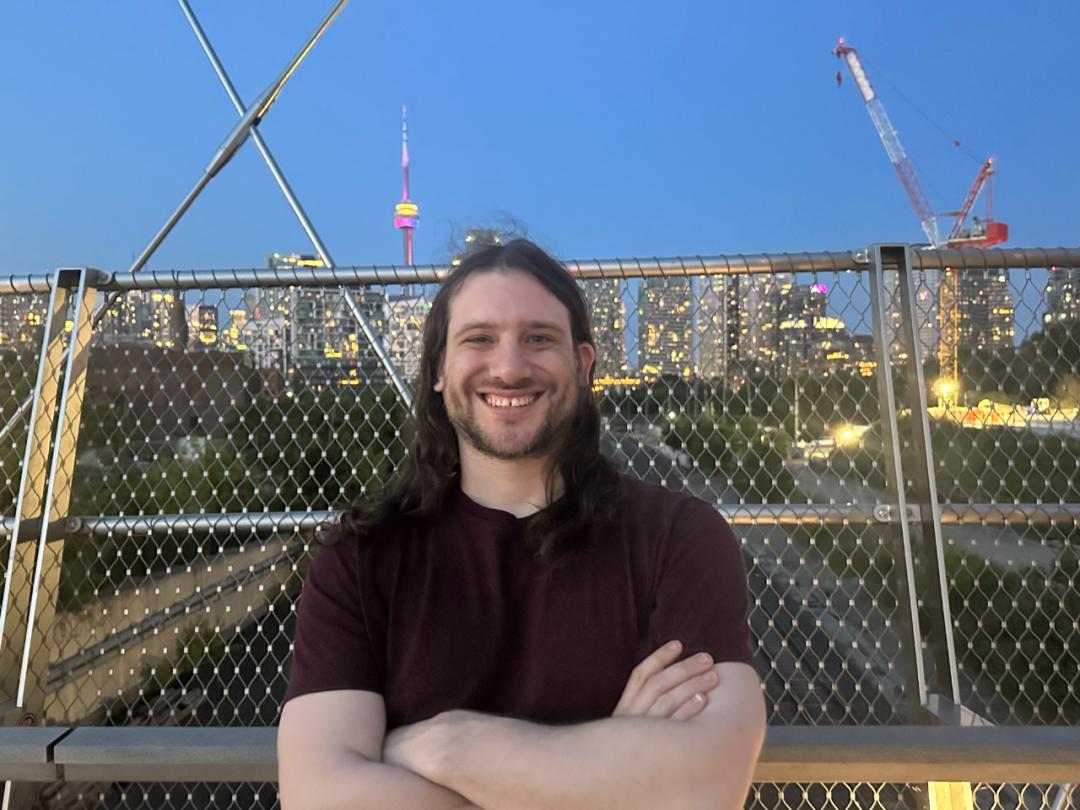
The reason for using the word "dramatic" is that there are too many contrasts in this person:
Can you believe it? A person who believes that "AI will lead to human extinction" has now joined an AI company.
He even wrote a paper dedicated to establishing a taxonomy for "how AI could cause human extinction."
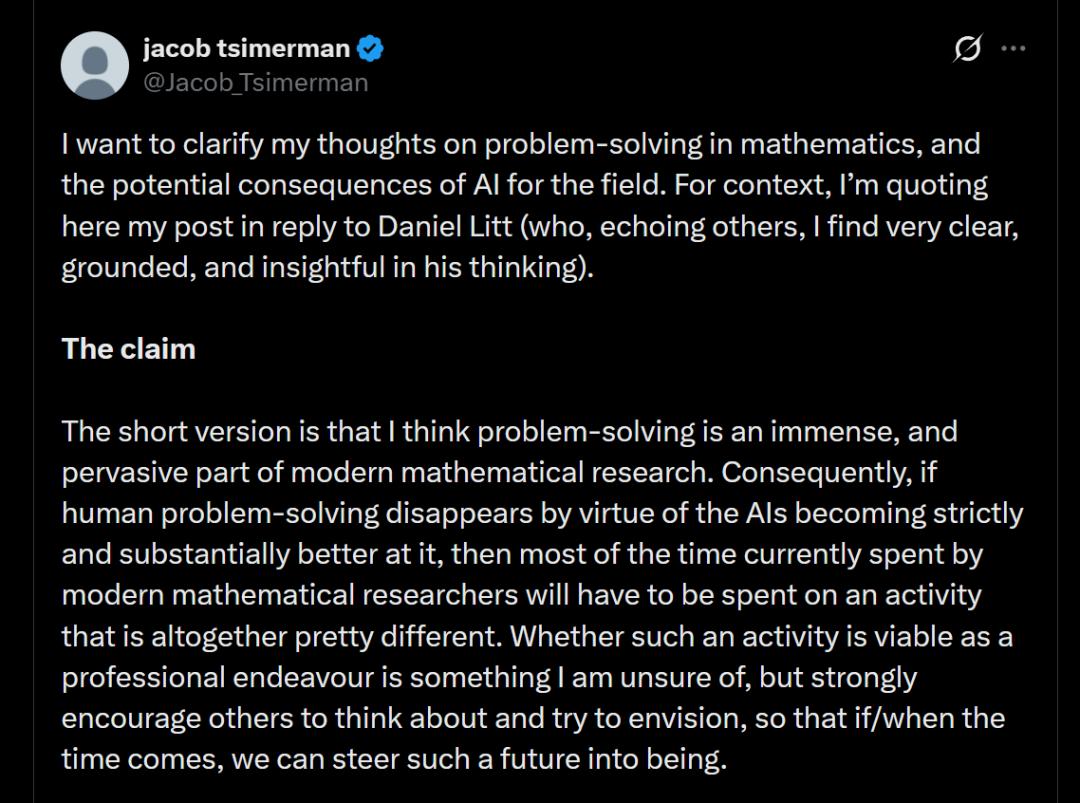
His X account has only posted one post, on the topic of how mathematicians will lose their jobs.
Yet now, he is the first one to "lose his mathematician job."
He has a student who, three days ago, used Claude Fable 5 to overturn the 87-year-old unsolved Jacobi Conjecture overnight, and that student is at Anthropic.
Now, the teacher has signed with OpenAI. The two, master and apprentice, each at a different company.
And there's more—Jacob's own life is full of legendary stories...
Perfect score at IMO, the youngest full professor in the history of the University of Toronto
Jacob was born in 1988 in Kazan, Russia, and moved with his family first to Israel, then settled in Canada.
He represented Canada in the International Mathematical Olympiad (IMO) for two consecutive years in 2003 and 2004, winning two gold medals, with a perfect score in 2004.
At the age of 16, he entered the University of Toronto to study mathematics and completed his undergraduate studies in two years.
In 2011, he obtained his doctorate at Princeton University under the supervision of Peter Sarnak. After that, he polished his experience at the Harvard Society of Fellows, returned to teach at the University of Toronto, and became the youngest full professor in the history of the university's Department of Mathematics.
This award recognizes his work on the proof of the André-Oort Conjecture, a core problem in the field of arithmetic geometry that had remained unsolved for nearly 40 years.
He thus became the first mathematician to win the Fields Medal while working at a Canadian university.
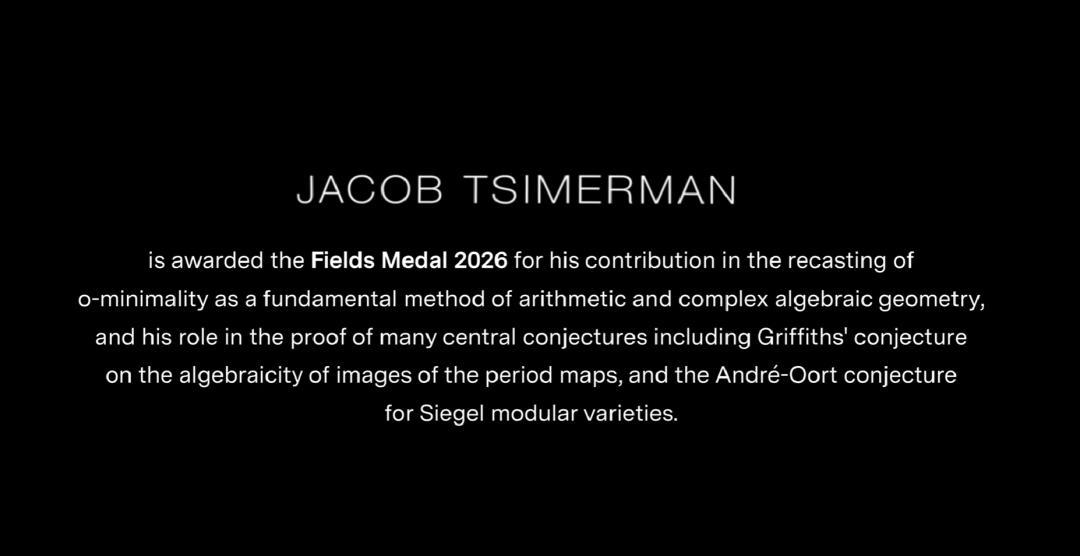
By the way, the prestige of this year's Fields Medal winners is somewhat staggering: the Kakeya Conjecture, which has been unsolved since 1917; the kinetic theory part of Hilbert's Sixth Problem, proposed in 1900; plus the André-Oort Conjecture.
Three century-old unsolved problems were all resolved within the same four-year period.
In other words, Jacob is the one who stood out from the strongest group of competitors in a "great year" for mathematics.
Perfect score at IMO, the youngest full professor, the terminator of a 40-year unsolved case.
According to the usual script, a person with such a resume should stand on the stage, thank his teachers and elders, and look forward to the future of the discipline.
But what happened instead?
On July 23 local time, at the opening ceremony of the International Congress of Mathematicians (ICM) in Philadelphia.
At the press conference, when someone asked about his future plans, the newly awarded winner directly revealed: He will soon join OpenAI, focusing on AI safety.
I think the world is changing. The mathematical profession as we know it now... I don't think it will continue to exist in its current form.
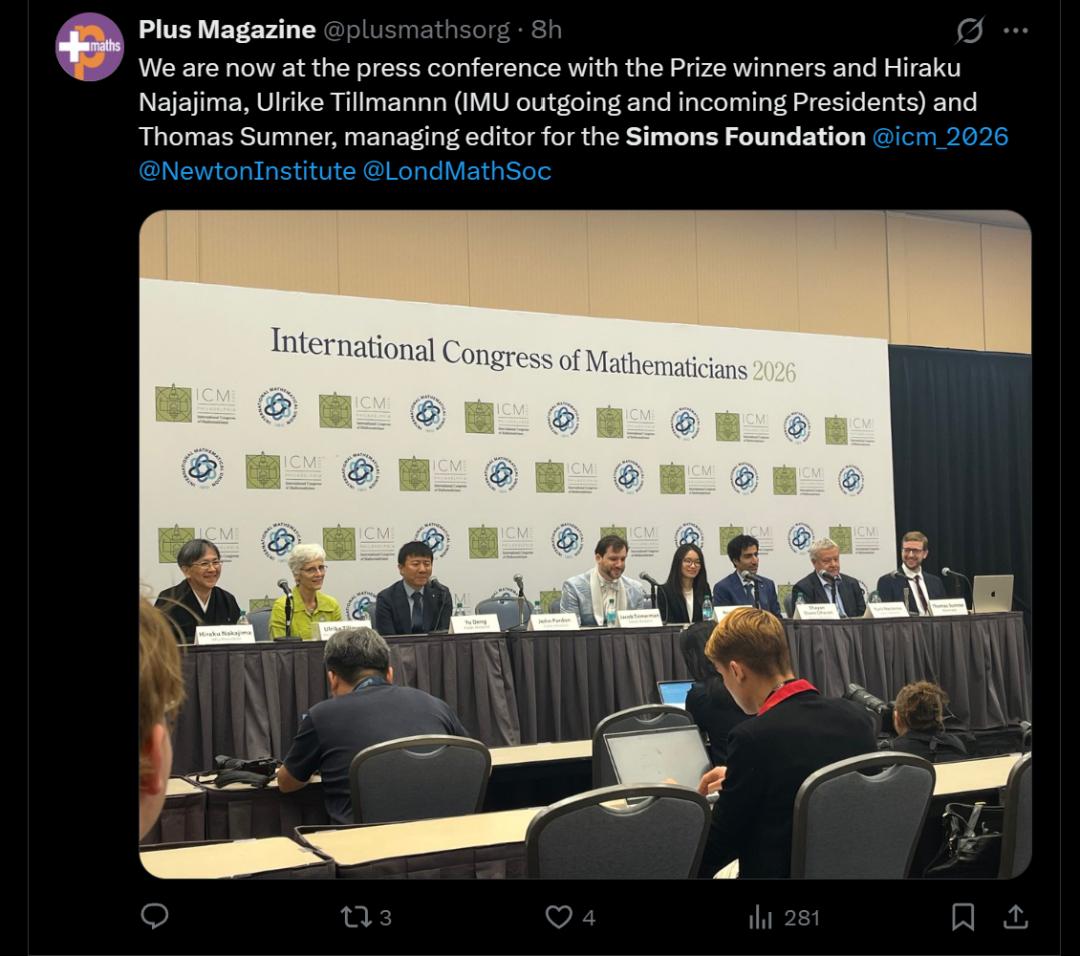
With one sentence, he turned the award ceremony into a transfer announcement press conference.
The reaction speed from OpenAI was as fast as snatching a limited-edition item:
Boaz Barak, a security researcher and Harvard professor, tweeted: He is looking forward to and "deeply humbled" to welcome Jacob to join and work on AI safety together.

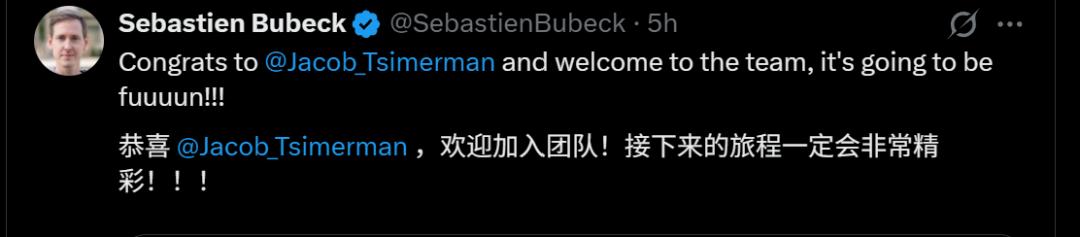
Sebastien Bubeck, former vice president of Microsoft and now at OpenAI, also followed up: Welcome to the team. The days ahead will be very interesting.
Just as everyone was either surprised or taken aback by this news, people dug into his research and statements over the years.
It turns out that everything has traces to follow.
His only post
Opening Jacob's X account homepage, it shows that he joined the platform in 2014.
But after more than ten years, there is only one post on it, so this post has become a key key for us to understand him.

The content of the post is his response to a mathematician Daniel Litt, discussing a very simple question:
How much of mathematical research does problem-solving account for?
His answer is: Almost all of it.
Then he said something very "heart-to-heart." He said that he spends almost all his time solving problems, and as soon as someone solves the general form of the Zilber-Pink Conjecture...
My entire main research field will disappear.
An entire academic community—mathematicians, postdocs, graduate students—all revolve around this one conjecture: breaking down special cases, trying strategies, finding analogies.
And on the day this conjecture is solved, everyone will have to find new problems to work on.
He described that process as "disorienting, energy-consuming, neither simple nor always fun."
In the past, the "person who solves the conjecture" could only be another mathematician, and such a thing happened once in a hundred years.
Now, it could be a model, and it could happen at any time.
How fast could it be exactly? He gave a timeline in an interview with AMS Notices (Notices of the American Mathematical Society) this year:
Five years? I think within two years, it will probably be better than us at proving theorems. By then we just need to say: Here is the proposition, go prove it.
In the post, he also conducted a thought experiment: Suppose you have an AI oracle machine in your hand, and any mathematical proposition you put into it will immediately tell you whether it is true or false.
What would the daily life of a theoretical builder look like then?
You come up with a definition, and immediately ask it a thousand questions. From "Do these basic properties hold?" to "Oh right, is this deep conjecture true?" The answers keep coming back, and you keep revising the definition. An entire research direction can be created and ended within a few days.
His judgment on this scenario is calm yet weighty: This is something very, very different from modern mathematics.
Interestingly, he himself is already living a low-end version of this life.
In the same interview, he revealed that AI has doubled his research efficiency. In 2025 alone, he uploaded 5 mathematical papers to arXiv. His daily workflow is to use ChatGPT and Claude to figure out the boundaries of problems, ask for references, and let the model prove lemmas:
The proofs it gives are usually wrong. But it can usually pull out methods in the right direction, helping me complete 80% of the work, and I finish the rest myself.
In other words, the oracle machine hasn't arrived yet, but he uses the prototype every day.
Precisely because he uses it deeply, he is particularly blunt about the mentality of his peers:
There is a lot of cope (self-consolation) in the mathematics community. Everyone focuses on the fact that AI is not as good as mathematicians now, and concludes that it will never be as good as mathematicians.
To his peers, this statement may already sound radical enough.
But for Jacob, "AI surpassing mathematicians within two years" is only the most mild judgment he has made.
His real judgment is:
I think there is a considerable chance that AI will lead to human extinction.
This is not a casual remark. In 2025, the sixth article he uploaded to arXiv was not about mathematics at all. Its title is "A Taxonomy of Extinction Futures Involving AI," co-authored with Andrew Critch, an old friend who studies AI safety.
The abstract is written very straightforwardly: This paper classifies and gives examples of AI-induced extinction events, that is, scenarios where all or almost all humans are eliminated. These events are not inevitable, but possibilities that we can strive to avoid.
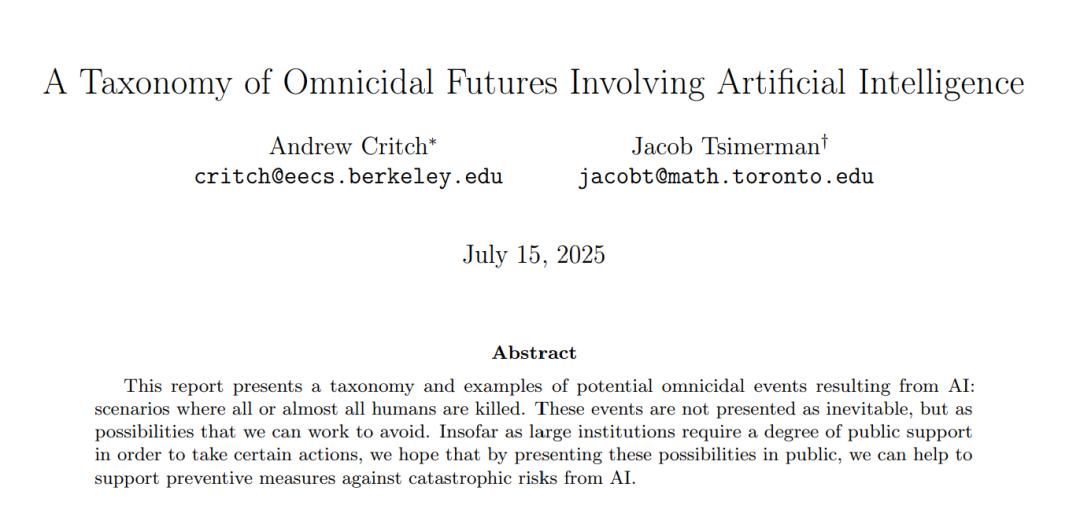
A mathematician of Fields Medal caliber, with the rigor of writing an academic paper, has established a taxonomy for "how AI could wipe out all humanity."
Since he is so afraid of that, why join an AI company?
He actually answered this in the interview: He supports a pause in AI development, but doesn't think it will happen. Since it can't be stopped, instead of standing outside resisting, it's better to go inside to figure it out and participate in shaping it, otherwise "we might get left behind".
Joining OpenAI, and specifically its safety division, makes perfect sense logically.
Moreover, at the end of the post, he said that some people claim to do mathematics only to pursue truth, and some people regard this as the only noble motivation.
He disagrees.
I do mathematics mainly because I enjoy it, and I am good at it. Mathematicians are also human beings, who need money, housing, food, love, exercise, and various forms of meaning. If the joy of solving problems disappears, many people may no longer want to do mathematics, even if there are other paths available.
Through these words, it is not difficult for us to see the reasons behind some of his choices.
A list of four people, also a "talent poaching map"
Jacob's move makes another thing worth sorting out:
Where are these four Fields Medalists now, and who else might be targeted by big tech companies.

Before sorting out, let's borrow the framework from Jacob's own post.
He divided mathematical work into two categories: problem-solving and theory-building.
And what AI labs are most eager for right now is precisely the former type of people:
Given a proposition, determining its truth, and finding a proof or counterexample is exactly the most relevant capability for training and evaluating reasoning models.
In other words, the more a mathematician resembles a "problem-solving machine," the higher their value in the transfer market.
Let's go through the list according to this standard.
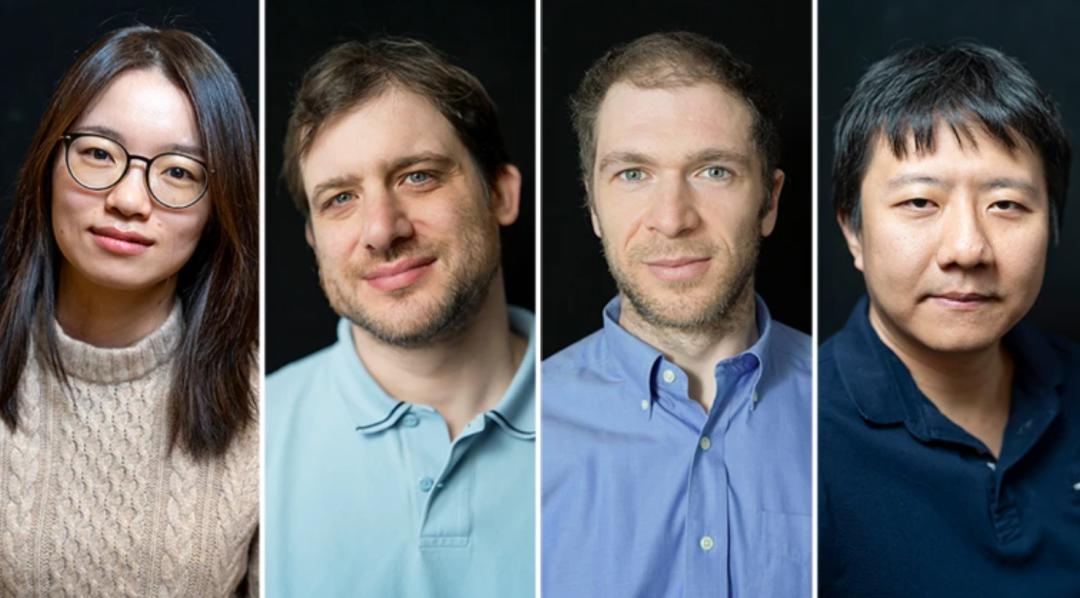
Wang Hong, currently a professor at New York University, and also works at the Institut des Hautes Études Scientifiques (IHES) in France.
The 127-page proof of the Kakeya Conjecture that she and her collaborator Joshua Zahl produced is called "once in a century," which also made her the third female winner in the 90-year history of the Fields Medal.
Before winning the award, she had already swept a long list of awards including the Salem Prize, Ostrowski Prize, Clay Research Award, and New Horizons in Mathematics Prize, making her the one with the highest academic exposure among the four.
Such a great master in harmonic analysis happens to be in the direction that AI reasoning research needs most.