Tencent Retains Its Matrix, Alibaba Consolidates Entries: Major Tech Giants Begin to Rein In AI Agent
This week, Tencent issued an internal notice: the relevant business and partial team of the QClaw Product Center will be transferred to the 6th Cloud Product Division, placing them under the same department as WorkBuddy, while QClaw will continue its operations.
One day later, media reports stated that Alibaba plans to launch "Qianwen Office", integrating three major products: QoderWork, Wukong, and MuleRun, to be led by Chen Yusen, the newly appointed CEO of DingTalk. As of press time, Alibaba has not issued a response.
This is a microcosm of the major tech firms entering an integration phase after the concentrated launch of office Agents at the start of the year.
The latest report from Analysys shows that in June 2026, the total visits of 17 mainstream desktop AI-native office agents exceeded 60 million. WorkBuddy ranked first with 20.97 million visits, surpassing the sum of the second and third place. The domestic version of TRAE IDE and QoderWork also entered the first tier.
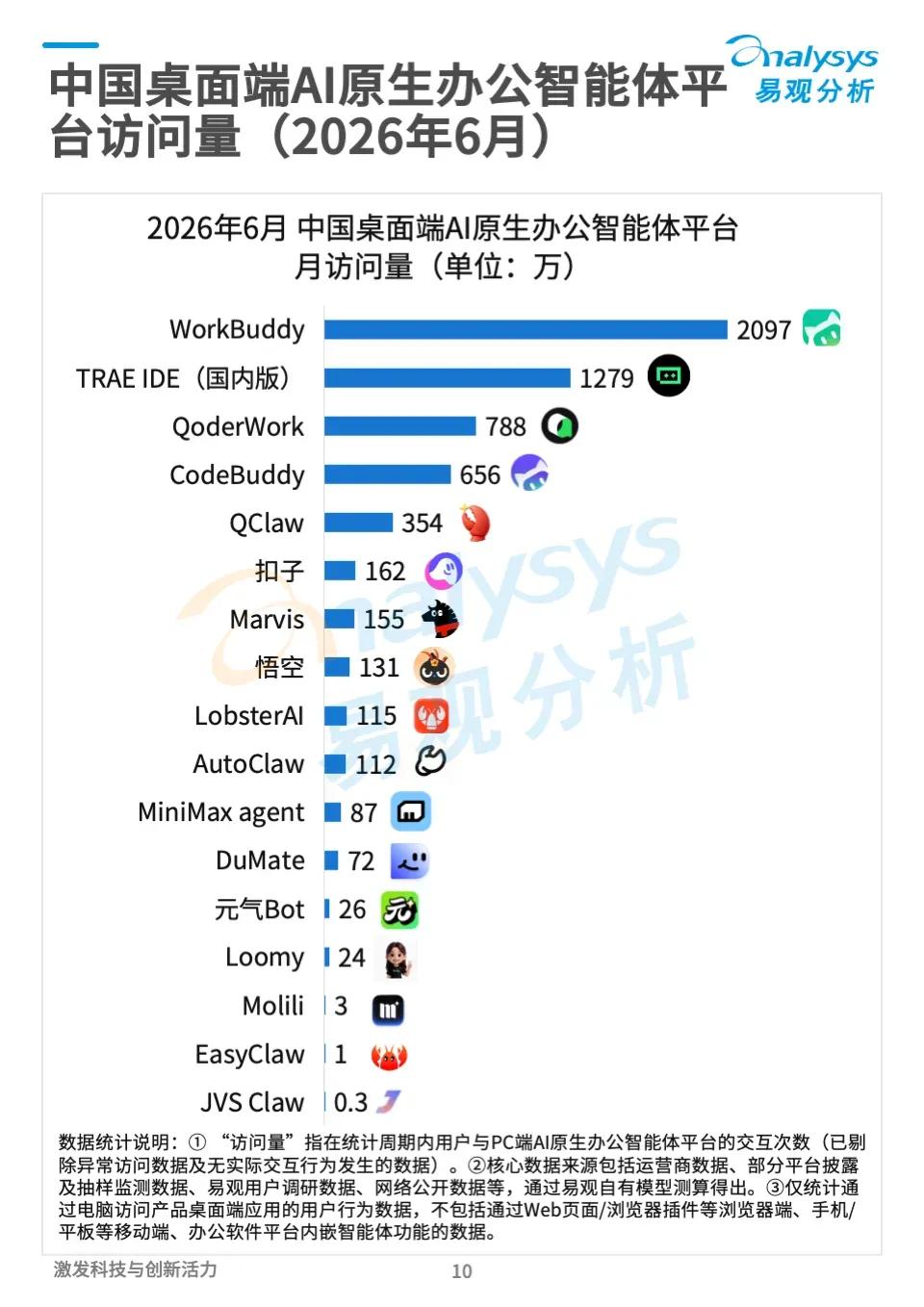
The gap in traffic has already widened. Next, major tech firms will centralize their scattered projects, teams, and computing power resources. The competition for Agents has also shifted from launching new products to the organizational and commercialization stages.
01.
Traffic Has Identified the Main Development Path
The growth of WorkBuddy is the most direct reason why Tencent is consolidating QClaw at this time.
Previous data from Analysys shows that WorkBuddy recorded 8.85 million monthly PC-side visits in March this year. By June, this figure reached 20.97 million, representing a roughly 2.4-fold increase in three months.
It is important to note that monthly visits count access frequencies, which are not equivalent to deduplicated monthly active users. Tencent only stated in its first-quarter financial report that, measured by daily active accounts, WorkBuddy is the most widely used efficiency AI agent service in China, without disclosing the absolute number of users.
Alibaba lacks directly comparable data. Analysys has included QoderWork in the first tier. Media reports, citing Alibaba insiders, state that QoderWork is the product with the largest user base and best market reputation among the three, Wukong has long remained in a semi-finished state, and MuleRun previously primarily targeted overseas markets.
These figures are sufficient to influence the company's resource prioritization, but they cannot determine the ultimate winner. Visits only indicate whether users are willing to try a product, while retention, payment conversion, and enterprise subscription renewal are the truly critical hard metrics.
02.
Tencent Integrates Backend Resources First, Without Rushing to Consolidate Frontend Entries
Tencent's adjustment this time is relatively mild. While the organizational affiliation has changed, both products will still be retained.
QClaw is built on the OpenClaw open-source ecosystem, emphasizing local operation, WeChat remote recall, and device data security. It is more akin to a long-running personal assistant.
WorkBuddy, on the other hand, centers on task delivery. After users authorize files and tools, it can generate documents, spreadsheets, PPTs, and analysis results. The enterprise version will also integrate organizational permissions, team management, and Tencent's office ecosystem.
The capabilities of the two products overlap, but their entry points differ. QClaw enters the market through local devices and WeChat, while WorkBuddy functions more like a desktop workspace and enterprise productivity product.
In May, Tencent Cloud established the 6th Cloud Product Division, with Wang Huixing, CTO of Tencent Cloud, concurrently serving as its head, responsible for capability building and commercialization of agents such as CodeBuddy and WorkBuddy. More than two months later, the relevant business and partial team of QClaw were transferred to this division.
This provides an organizational foundation for the reuse of model integration, Skills, security capabilities, cloud resources, billing systems, and enterprise sales. Tencent does not need to choose between the two entry points for now. It will first merge the backend systems, then observe whether stable demand can emerge across different scenarios.
This matrix-style approach aligns with Tencent's past product development habits: retaining multiple entry points at the frontend while concentrating resources at the backend. As long as user scenarios are genuinely distinct, maintaining an additional brand does not necessarily become a burden. What truly needs to be reduced is redundant R&D and internal friction.
03.
Alibaba Aims to Build a Unified Office System
Alibaba's adjustment is more substantial. It plans to consolidate the three products into a single entry point based on QoderWork. This is essentially a natural progression following the previous phase of AI-related organizational adjustments at Alibaba after Wu Zha departed.
The three Alibaba products are not entirely identical. QoderWork runs locally, allowing access to authorized folders, browser operation, and generation of Word, Excel, PPT, and PDF files, serving as the desktop entry and local execution layer.
Wukong connects to documents, schedules, and approval workflows within DingTalk, underpinned by enterprise identities, permissions, collaborative relationships, and business data. MuleRun, meanwhile, focuses on long-running cloud tasks and continuous execution.
Alibaba intends to connect the three previously scattered organizational and product capabilities: QoderWork handles local execution, Wukong and DingTalk provide organizational structure and data support, and MuleRun complements the cloud operation capabilities. A unified brand can lower user understanding costs, while a single responsible leader reduces resource conflicts between teams.
The challenges lie within the product itself. Three sets of accounts, permissions, task records, Skills, and computing power quotas need to be interconnected, and the billing system must be redesigned. The security boundaries for local operation, cloud execution, and enterprise governance are not identical.
Even more critical is DingTalk. Media reports indicate that DingTalk's 2025 revenue exceeded 4 billion yuan, amassing a large customer base in the manufacturing, government, education, and SME markets. If Qianwen Office cannot integrate with these customers, permissions, and workflows, the value of adopting a unified brand name will be limited.
04.
ByteDance Temporarily Retains Multiple Entry Points
Another typical enterprise is ByteDance. In the Analysys report, the domestic version of TRAE IDE entered the first tier, but ByteDance's office Agents are not limited to a single product line.
The underlying layer is the Doubao large model. The middle layer is Coze, which undertakes Agent construction, Skills development, and workflow development. The upper layer consists of specific products such as Coze and TRAE Work.
Coze has expanded from a low-code development platform to an AI team collaboration tool, covering office work, programming, video creation, and file processing. TRAE Work, meanwhile, has extended from programming scenarios to general office use, offering two modes: Work and Code, capable of handling documents, spreadsheets, research, and coding tasks.
The boundaries between the two are converging. Both can read files, invoke tools, and directly deliver results, differing only in their product origins and core user groups.
ByteDance has not publicly announced the merger of these entry points. Sources indicate that ByteDance is internally discussing deep integration between Doubao Office and Feishu. Feishu brings enterprise customers, collaborative relationships, and organizational data, Doubao provides consumer-facing entry points and model capabilities, while Coze and TRAE are responsible for Agent development and task execution.
ByteDance has a higher tolerance for trial and error, allowing it to temporarily retain multiple product lines, connected through the model and development ecosystem. However, the more products there are, the harder it becomes to avoid issues such as overlapping entry points, fragmented branding, and redundant investment.
ByteDance has not merged all its products like Alibaba, but it has begun to define priorities among the multiple entry points. Coze and TRAE will continue to handle development and execution, while Feishu aily, leveraging organizational relationships, enterprise knowledge, and permission systems, will compete to become the permanent entry point for enterprise-grade Agents.
05.
After the "Horse Racing" Phase Comes the Stage of Operational Accountability
Earlier this year, OpenClaw spurred domestic vendors to collectively launch office Agents. The parallel operation of multiple teams was suitable for early-stage trial and error, but it also led to redundant investment. Resources for models, computing power, R&D, branding, and sales were scattered across multiple similar products.
Now that traffic has begun to stratify, companies have a clear basis for consolidating resources.
Tencent has already launched paid services. The monthly subscription price for the personal version of WorkBuddy ranges from 99 yuan to 999 yuan, and the enterprise SaaS version is priced at 198 yuan per person per month. The personal membership of Wukong is divided into two tiers: 39 yuan and 99 yuan. Office Agents have transitioned from free customer acquisition to the paid testing phase.
However, public pricing does not equate to a proven business model. Tencent has not separately disclosed the revenue and paying user numbers for WorkBuddy, and Alibaba has not released comparable revenue figures for its three products. While Analysys' visit data can reflect market popularity, it does not provide metrics on commercialization outcomes.
The adjustments by Tencent and Alibaba primarily aim to improve internal efficiency. Tencent hopes multiple entry points can share a unified backend system, while Alibaba wants a single entry point to connect desktop, DingTalk, and cloud capabilities. ByteDance is still retaining multiple product lines, but the relationship between its office Agents and Feishu also needs to be reorganized.
In the next phase, the true measure of success will be whether users can integrate Agents into their daily work, whether enterprises are willing to renew their subscriptions, and whether the revenue from each task can cover the corresponding computing power costs.
This article is sourced from the WeChat Official Account "Qiangdiao Next" (ID: leo89203898), written by Yixiu, edited by Xiaobai, and published with authorization from 36Kr.