GPT-5.6 Disproves a 30-Year-Old Graph Theory Conjecture, Peking University Alumni Crack 6 Problems in 5 Consecutive Days
A 30-year "cold case" in graph theory has collapsed overnight.
Just today, GPT-5.6 Pro falsified a 30-year-old conjecture in the field of graph theory — the Dinitz-Garg-Goemans conjecture.
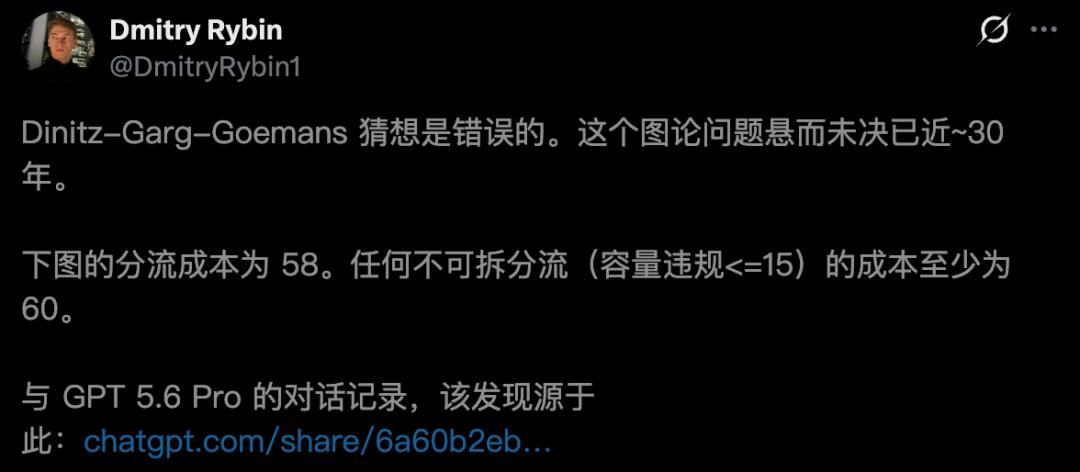
The evidence it presents is extremely straightforward: a single graph with a fractional flow cost of 58.
Meanwhile, for any indivisible flow with capacity violation not exceeding 15, the cost is at least 60.
58 < 60 — a 30-year-old graph theory conjecture has fallen.
On the same day, Shouqiao Wang, a PhD candidate at Columbia University, used GPT-5.6 Sol paired with the Codex workflow to solve six open Erdős problems in just 5 days.

Last night, the new Fields Medal winners were announced.
But now a widespread claim is circulating in the academic community: this could very well be the "last Fields Medal awarded exclusively to humans."
A 30-Year-Old Conjecture
Falsified by GPT-5.6 Pro
This time, the full chat history with GPT-5.6 Pro has been made completely public.
Dmitry Rybin noted that "AI overturning long-standing conjectures" is quickly becoming an internet meme.
But he genuinely cared about this problem, having spent weeks working through both potential proof and disproof directions back in the day.
He added that this human-AI conversation itself is an absolutely legendary moment.
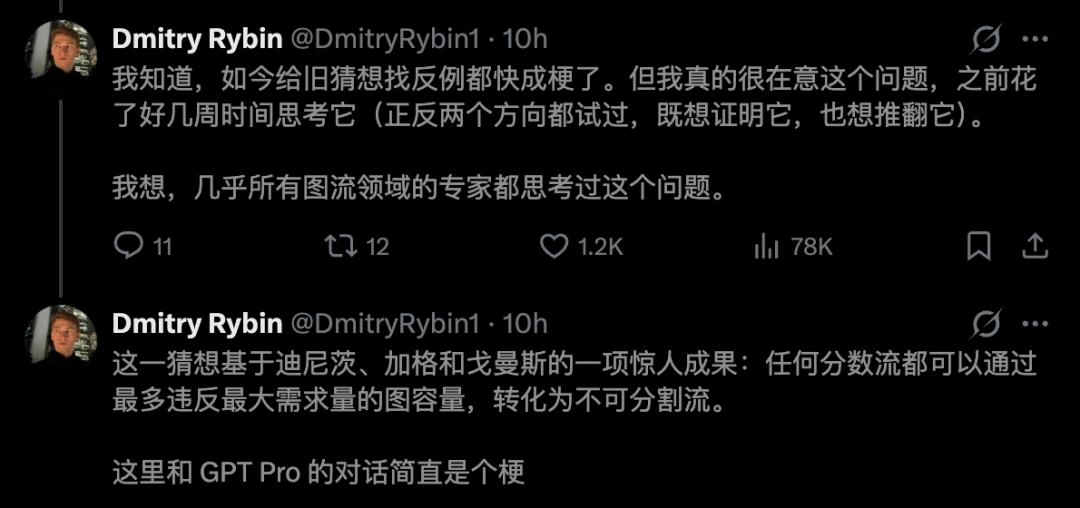
Let's first clarify what this problem is. Back in the day, Dinitz, Garg, and Goemans proved a very elegant result:
As long as a feasible fractional flow satisfying capacity constraints exists, there must exist an indivisible flow whose capacity is exceeded by at most the value of the maximum demand.
Goemans later put forward a very natural conjecture: is it possible to avoid such large capacity overruns while also keeping the cost from increasing?
This cost-focused version of the problem remained unsolved for years.
It was marked as an open problem in a 2023 arXiv paper, and was still listed as open in academic literature as recently as January 2026.
Virtually every researcher working on graph flows has attempted to tackle it.
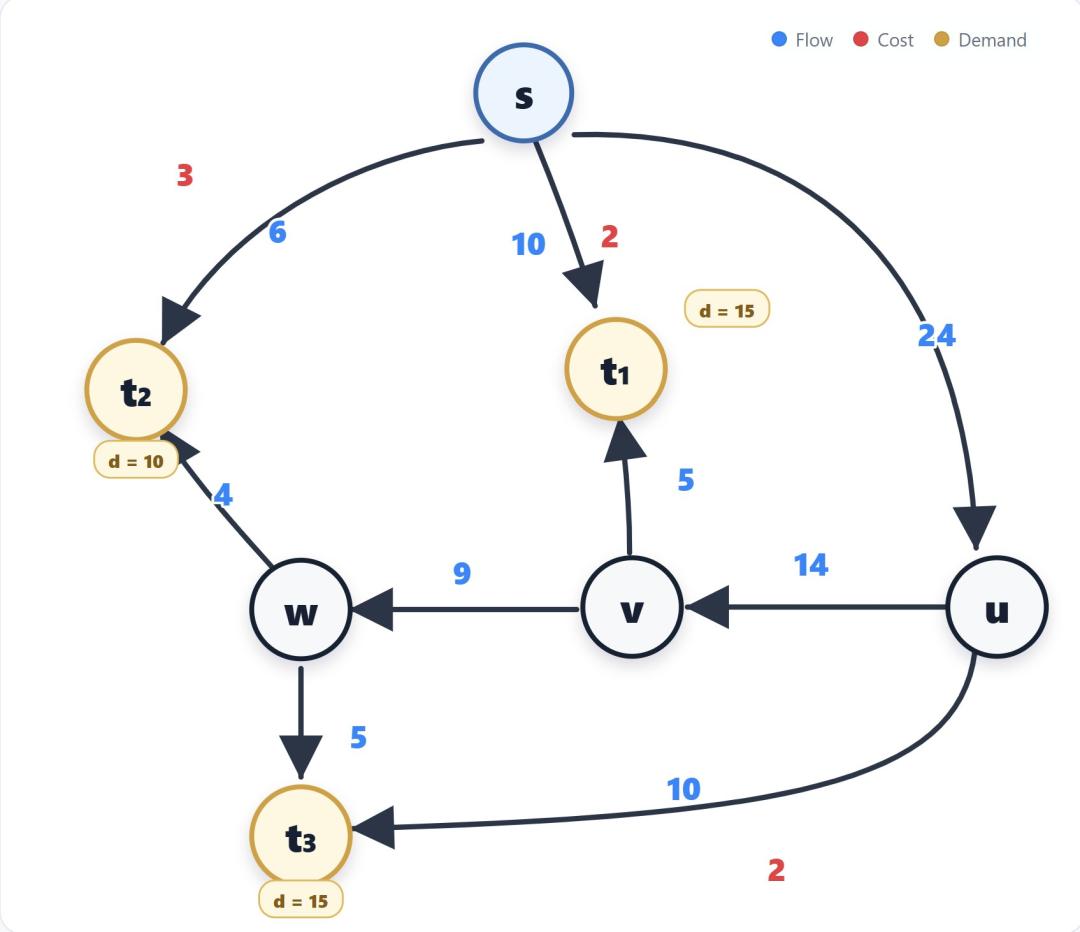
The counterexample provided by the model is structured as follows: there are three terminals with demands of 15, 10, and 15 respectively. Each terminal has one "cheap path" (zero cost) and one "expensive path" (cost 30).
The key detail is that the three cheap paths are pairwise conflicting. If any two are used simultaneously, at least one edge will exceed its capacity limit.
As a result, any valid solution can use at most one cheap path, meaning the remaining two terminals must use their expensive paths, leading to a total cost of at least 60.
However, the fractional flow can utilize all three cheap paths simultaneously at ratios of 1/3, 2/5, and 1/3, resulting in a total cost of only 58.
Anyone familiar with combinatorial optimization will immediately recognize this: it is exactly the stable set inequality for a triangle graph.
The integer solution satisfies z₁+z₂+z₃ ≤ 1, while the fractional solution gives 1/3 + 2/5 + 1/3 = 16/15, which is greater than 1.
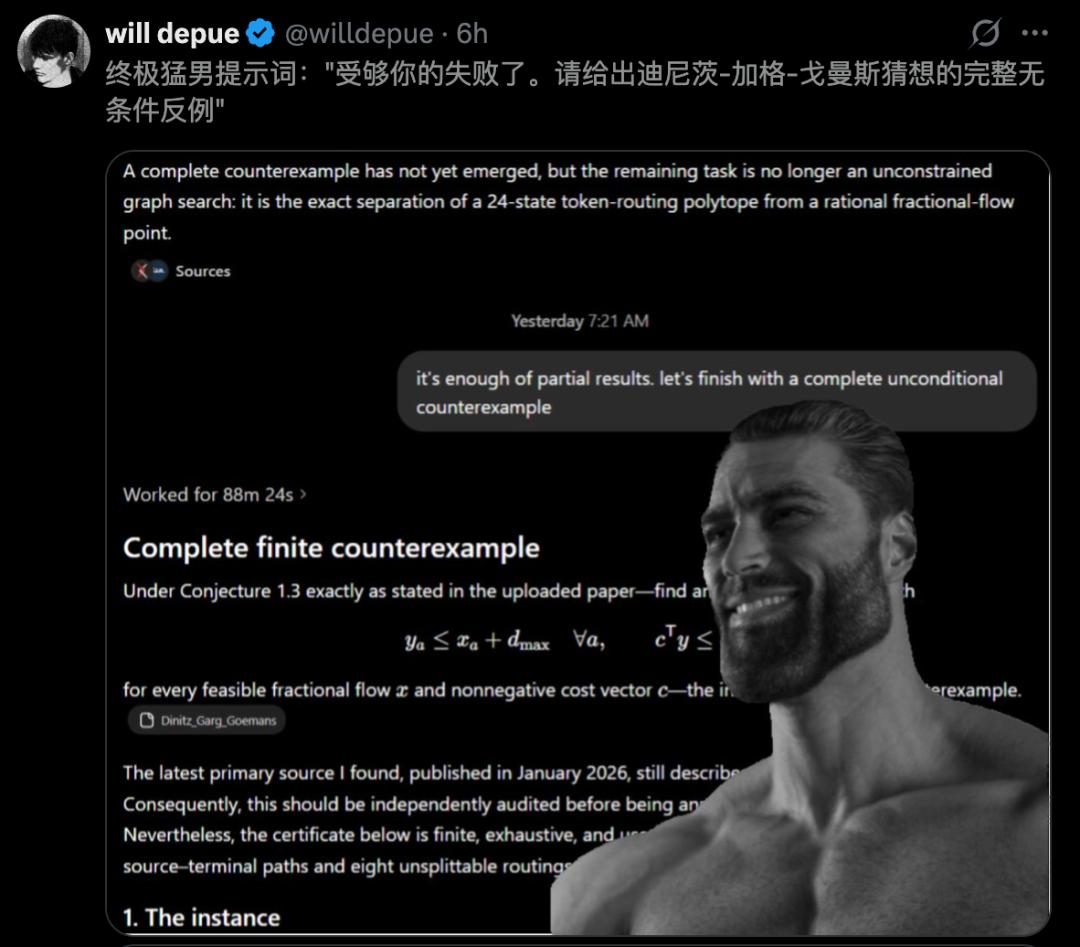
Throughout the entire conversation, Rybin only spoke three sentences in total.
- First: Construct a counterexample. You need to make a breakthrough and find a structured counterexample.
- Second: Keep searching. Develop a clear strategy derived from a deep understanding of the problem's structure.
- Third: Partial results are enough. Let's directly present a complete, unconditional counterexample.
The Olympiad Gold Medalist Who Turned to Algorithm Research
Dmitry Rybin, the researcher who overturned the 30-year graph theory conjecture, is currently the co-founder of a $100 million AI startup.
According to his personal profile, Rybin earned his PhD in Machine Learning from The Chinese University of Hong Kong, Shenzhen.
Most notably, he has also won gold medals in the International Mathematics Competition for University Students and the Chinese National Mathematical Olympiad.

He first gained widespread recognition in the academic community with a paper published in May 2025 —
Rybin discovered a faster algorithm for computing the product of a matrix and its transpose.
This operation sounds abstract, but it is the foundation of covariance matrices in statistics, chip design, and wireless communications, and it is also a computation that is performed repeatedly during large model training today.
Shortly after, in October, he published another paper that reduced the computational cost of exact causal attention calculation by 10%.
His GitHub repository, titled "Experiments in Algorithm Discovery and Optimization with OpenEvolve," is publicly accessible.
This Olympiad gold medalist did not follow the mainstream trend of focusing on large models during his doctoral studies. Instead, he dedicated himself to exploring "how to enable machines to help humans discover new algorithms."
A Chinese Alumnus of Peking University School of Mathematical Sciences
Cracked Six Major Open Problems in Five Days
There is another major event happening on the same timeline.
Shouqiao Wang, a PhD candidate at Columbia University, stated that using GPT-5.6 Sol paired with Codex, he solved six previously open Erdős problems in just five days.
He attempted approximately 13 problems in total, achieving a 46% success rate, with one individual problem running continuously for 32 hours.
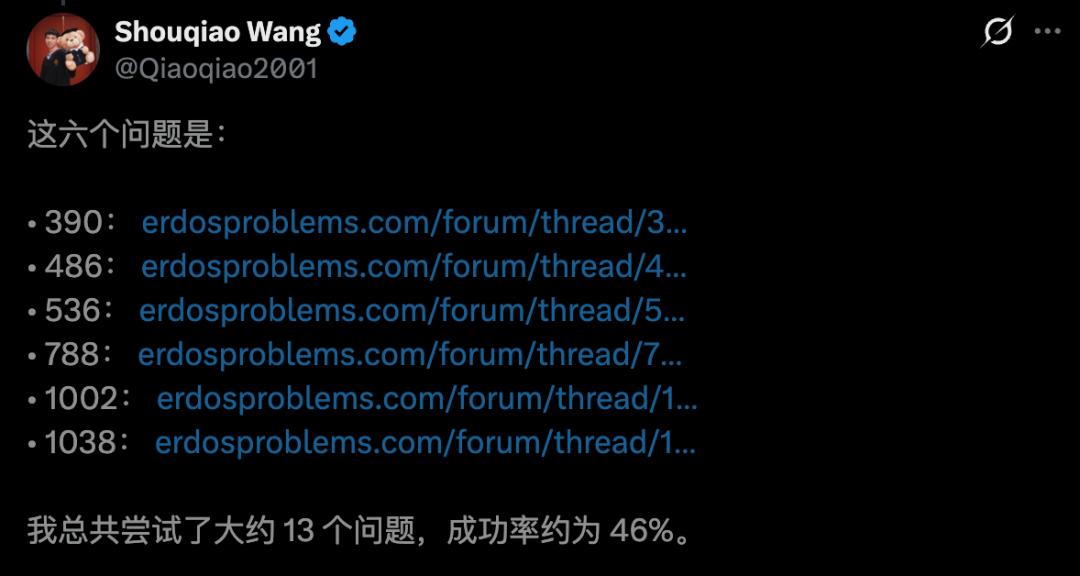
He broke his methodology down into three core steps.
For problem selection, he only chose topics that mathematicians were actively discussing, then used AI to eliminate problems that were inextricably tied to major unresolved conjectures.
He explicitly defined "what constitutes a valid solution": restate the problem precisely, clarify what a complete proof must establish, list which weaker conclusions do not count, and identify the unique pitfalls specific to each problem.
Finally, he required independent adversarial agents to challenge every candidate conclusion.
The entire process formed a closed loop: Attempt → Failure → Diagnosis → Route Adjustment → Draft Proof Writing → Adversarial Audit → Revision.
The model repeatedly overturned its own arguments and attacked its own reasoning until no more substantive flaws could be identified.
It is worth noting that one of the problems solved was a longstanding unsolved topic that Terence Tao had previously studied.
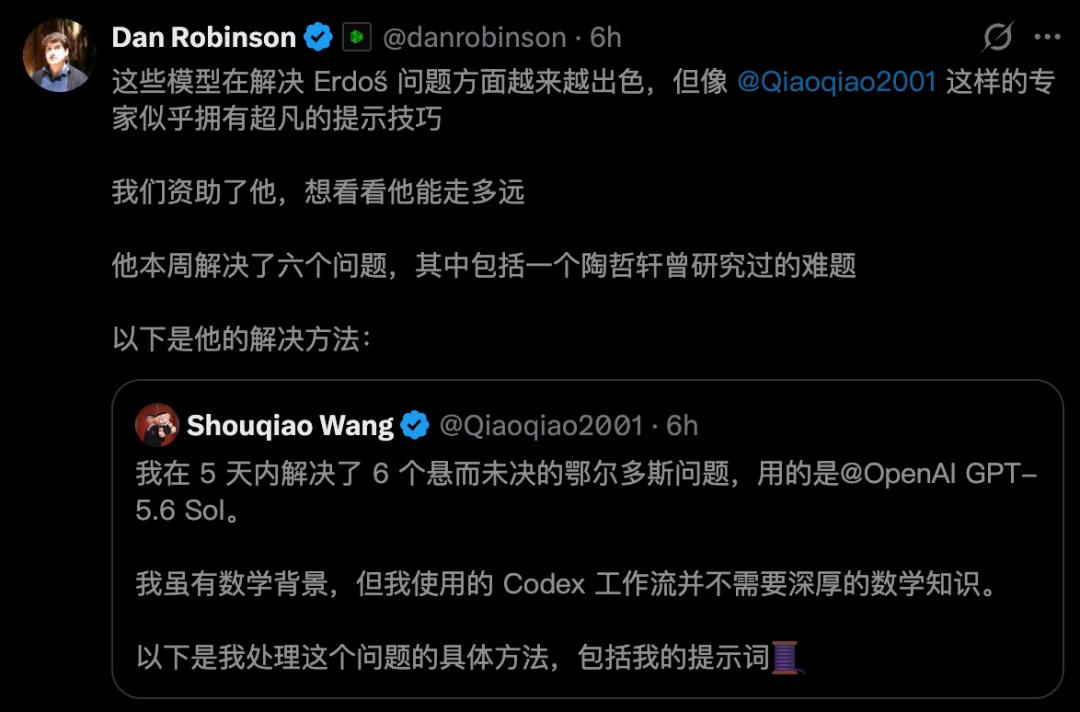
Regarding this, Shouqiao Wang downplayed his achievement, noting: "I have a mathematical background, but this workflow does not require deep mathematical expertise."
But the so-called "some background" he mentioned is far more impressive than it sounds.
At the age of 13, while his peers were following the standard middle school curriculum, he registered for the University of Waterloo Euclid Mathematics Contest and won first place globally.
In 2016 and 2017, he went on to win two consecutive silver medals in the Chinese Mathematical Olympiad (CMO), and unsurprisingly took first place in the 2017 Chinese National High School Mathematics League.
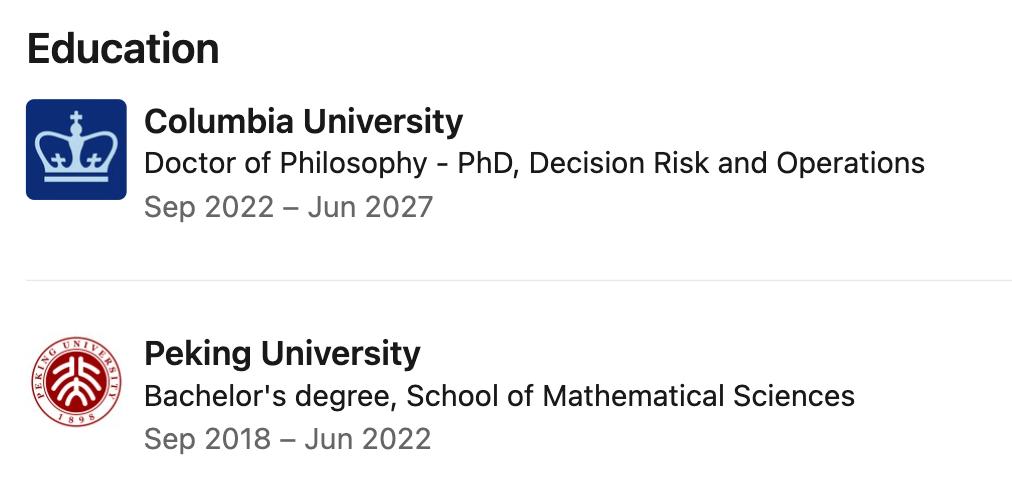
In 2018, armed with his exceptional talent, he was admitted to Peking University's School of Mathematical Sciences, an institution where top mathematical minds gather.
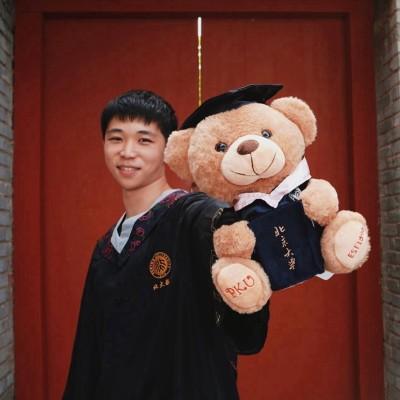
The most interesting part of his story is that he did not follow the conventional path to remain in the field of pure mathematics.
Today, he is pursuing his PhD in Decision, Risk, and Operations at Columbia Business School.
He has redirected the sharp analytical skills he once used to deconstruct mathematical equations toward more practically impactful cutting-edge research areas: mechanism design and game theory.
The "Last Human-only" Fields Medal?
In 4.5 hours, a 30-year cold case was shattered; in 5 days, six major problems were consecutively solved.
The Fields Medal announced this year may truly become the "swan song" of purely human intellectual achievement.
But this is not the end — it is the beginning of a "new era" of symbiotic exploration between AI and humans.
Evolving from individual operation to multi-agent autonomous adversarial collaboration, AI is gradually becoming a genuine "research partner" that can expand the boundaries of human cognition.
How far do you think AI is from winning its own Fields Medal?
References:
https://x.com/DmitryRybin1/status/2079904005652893709?s=20
https://x.com/Qiaoqiao2001/status/2080003441821163958
This article is from the WeChat official account AI Era, author: ASI Revelation, editor: Taozi, published with authorization from 36Kr.