The 8-billion-yuan tier makeup brand has closed its stores.
Another international beauty group has been added to the "store closure list" in China.
Recently, QY noticed that a netizen posted on social media platforms stating that the Tmall Global Flagship Store of German beauty giant Cosnova Beauty will voluntarily cease operations on July 31. Upon immediate search, QY found that the Cosnova Global Flagship Store is no longer retrievable.
As a well-known German beauty group, Cosnova Beauty owns popular mass-market makeup brands such as Essence and Catrice, with annual sales approaching 8 billion RMB in 2025. Among them, Essence is even hailed as "the No.1 makeup brand in Europe". Data shows that the signature "Banana Powder" of Essence has accumulated total sales exceeding 2.3 million units.
What has happened to this German makeup giant in the Chinese market?
02
German Makeup Giant with Nearly 8 Billion RMB Annual Revenue
Set to Cease Operations of Its Chinese Online Store
According to screenshots shared by users on Xiaohongshu, the Cosnova Tmall Global Flagship Store plans to voluntarily cease operations on July 31, 2026. Currently, consumers who do not follow the store can no longer find it through keyword searches.
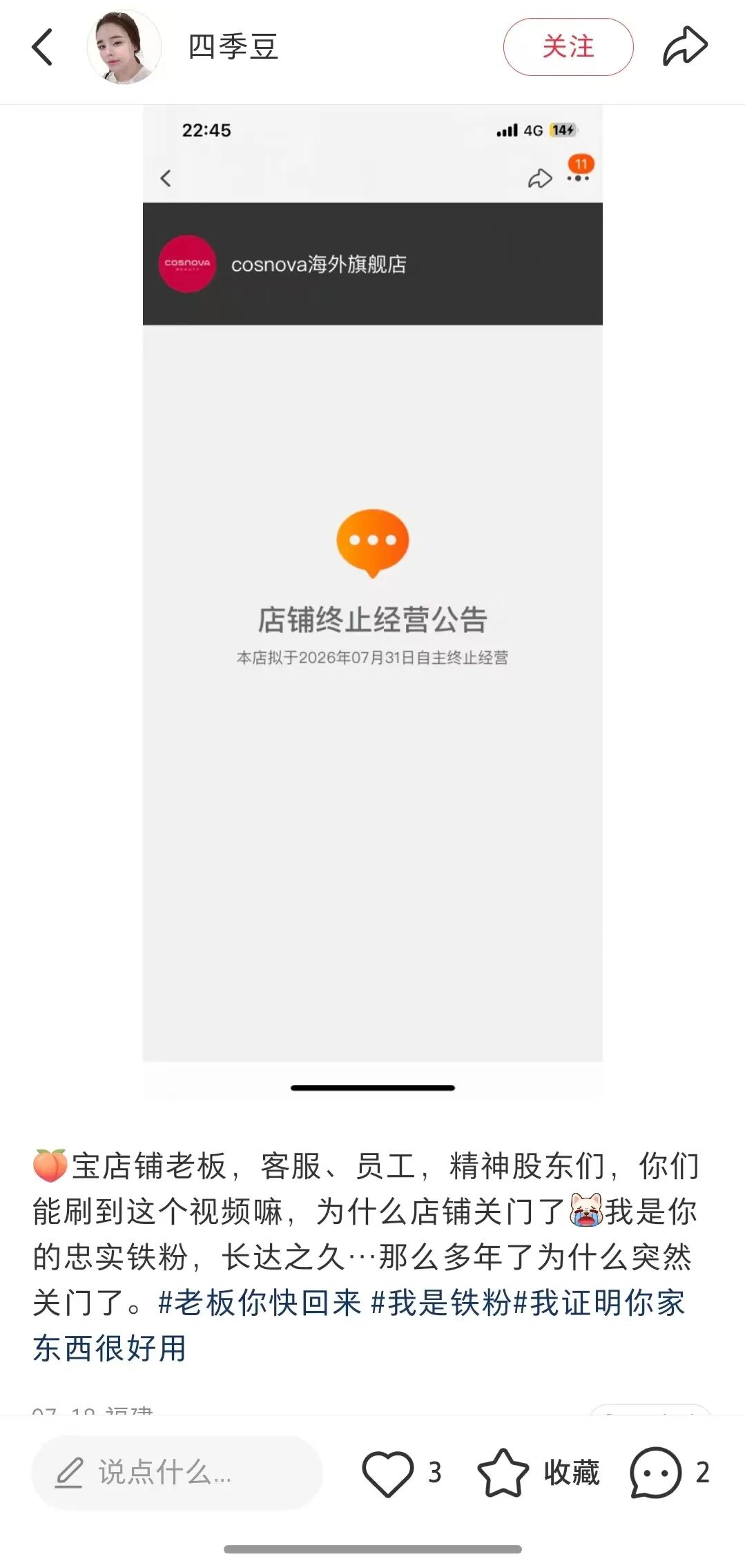
Source: Xiaohongshu
Public information shows that Cosnova Beauty, founded in 2001, is one of the largest cosmetics companies in Germany with deep roots in the makeup sector. It owns makeup brands including Essence and Catrice, with business covering more than 90 countries and regions across Europe, North America, South America, the Middle East, Asia and Africa.
According to foreign media reports, Cosnova Beauty achieved a revenue of 991 million euros (approximately 7.665 billion RMB) in 2025, a year-on-year increase of about 4%. Based on NielsenIQ MAT data for Q4 2025, Cosnova Beauty ranks 6th in the value ranking and 2nd in the volume ranking among global makeup companies; its brand Essence is even named the best-selling makeup brand in Europe.
It is worth noting that, as reported by foreign media, Essence is also one of the earliest beauty brands in Germany to deploy on TikTok Shop, and has developed into the No.1 makeup brand on TikTok globally.
In the Chinese market, Essence has also built significant visibility. According to previous reports from QY, the Cosnova Tmall Global Flagship Store was still operating normally in February this year, with 463,000 followers at that time. The store listed more than 50 products under Essence and Catrice, covering categories such as powder compacts, lipsticks, blushes, contouring products and concealers, priced between 20 and 146 RMB. The star product "Essence Banana Powder" showed sales of over 50,000 units, demonstrating certain market influence.
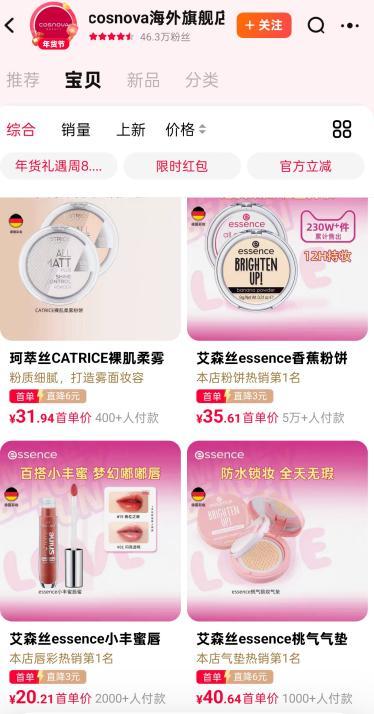
Screenshot from Cosnova Tmall Global Flagship Store
Given that the Cosnova Tmall Global Flagship Store has accumulated a considerable number of followers and seemingly strong product sales performance, why did it ultimately choose to close?
Currently, the operations of all brand stores under Cosnova Beauty are managed by Cosnova Cosmetics (Shanghai) Co., Ltd. (hereinafter referred to as "Cosnova Shanghai"), a wholly-owned subsidiary of cosnova Overseas GmbH. QY immediately contacted the company, but when asked about the reason for the store closure and whether it would reopen in the future, the staff only responded with "unable to disclose".
Up to now, among the brands under Cosnova Beauty, only Essence still retains its official Tmall and Douyin flagship stores, while Catrice no longer has official online channels and is only available in some individual Taobao stores.
02
7 Years in the Chinese Market
Surviving Only on the Banana Powder Hit?
Compared with other leading international beauty groups, Cosnova Beauty entered the Chinese market relatively late. In 2019, Cosnova Beauty officially entered the Chinese market by opening its Tmall Global Flagship Store, introducing three beauty brands: Essence, Catrice and L.O.V. Prior to that, Chinese consumers could only purchase these products through cross-border shopping and daigou (personal shopper) channels.
In addition, Cosnova Beauty has actively deployed digital consumer markets on Chinese social platforms, successively opening official social media accounts for Essence and Catrice on platforms such as Weibo.
At that time, Elisa, then Regional Marketing Manager for Asia at Cosnova Beauty, stated in a public interview, "The purpose of opening the Cosnova Tmall Global Flagship Store is to provide high-quality and trendy products for everyone at any time, and to be on the front line to meet the diverse needs of consumers as much as possible."
At the initial stage of entering China, leveraging its extreme cost-effectiveness and the reputation accumulated through previous daigou channels, Cosnova Beauty's products quickly achieved strong market performance. The most viral product was undoubtedly Essence's "Banana Powder". The full name of this product is "BRIGHTEN UP! banana powder", which was directly translated as "Banana Powder" after entering China. With its extreme cost-effectiveness of around 30 RMB, it quickly became popular among Chinese beauty consumers, becoming a "out-of-stock favorite" on social platforms. Up to now, the accumulated sales of this affordable powder compact in China have exceeded 2.3 million units.
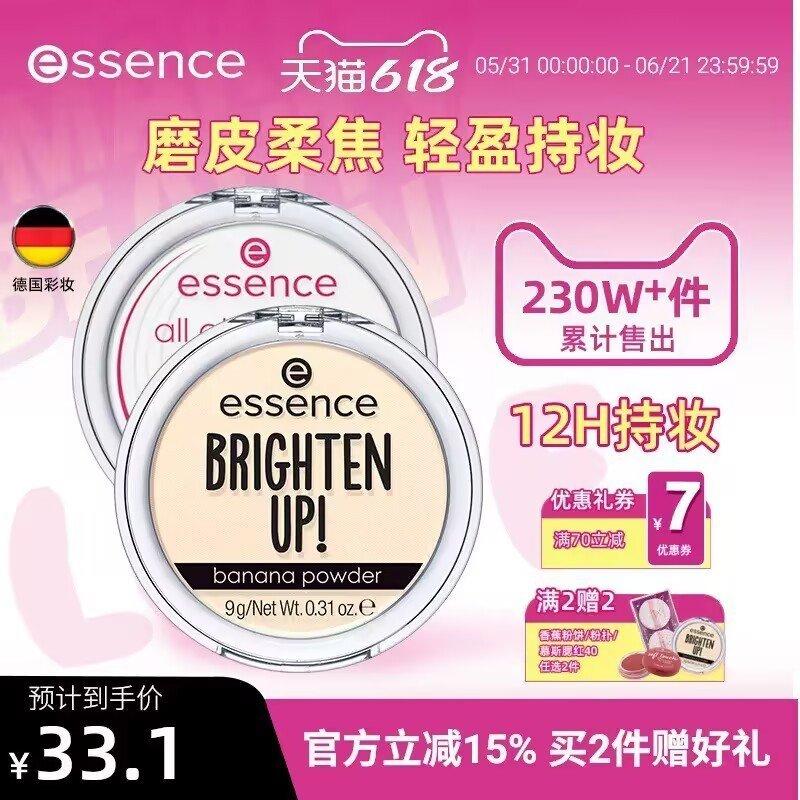
Source: Internet
However, Cosnova Beauty has always faced an awkward situation in the Chinese market: its products are well-known, but the brand itself is not. Consumers are familiar with "Banana Powder", but may not know the Essence brand, let alone Cosnova Beauty behind it.
Currently, Cosnova Beauty's online presence in the Chinese market has shrunk significantly, retaining only the Essence official Tmall Flagship Store and Douyin Flagship Store, both operated by Cosnova Shanghai. However, the total number of followers of these two stores is still far less than that of the recently closed Cosnova Tmall Global Flagship Store. The Essence Tmall Flagship Store has 125,000 followers, and the Douyin Flagship Store has 65,000 followers; the best-selling product in both stores is still "Banana Powder", with sales showing over 30,000 units each.
According to QY Intelligence data, in 2025, Essence's annual GMV on Douyin exceeded 16 million RMB. On a monthly basis, June, July, September and October were the annual sales peaks, with monthly GMV ranging from 2.5 million to 5 million RMB. In the first 6 months of this year, the overall GMV has dropped significantly. Even in January, the month with the highest GMV, the figure only ranged from 1 million to 2.5 million RMB.
Meanwhile, Catrice, another makeup brand that once entered the Chinese market with a high cost-effectiveness positioning, has long disappeared quietly: its official brand stores are no longer searchable, and its WeChat official account, Weibo and Xiaohongshu accounts all stopped updating in April 2022, completely fading out of consumers' sight.
In other words, after many years in China, apart from "Banana Powder", Essence under Cosnova Beauty has failed to create a second hit product, long operating in an unbalanced state. In addition, many overseas makeup brands generally face the shortcoming that their new product iteration efficiency cannot keep up with the pace of local Chinese supply chains. Under the combination of multiple factors, Cosnova Beauty's decision to close its original Tmall Global Flagship Store and shrink its domestic online channel layout seems reasonable.
03
Affordable Makeup Is in Urgent Need of a New Narrative
In recent years, the "wave of store closures" among international beauty brands has continued to spread. According to previous statistics from QY, since 2026, 9 overseas beauty brands including Filorga and Mamonde have taken actions to shrink or withdraw from the Chinese market.
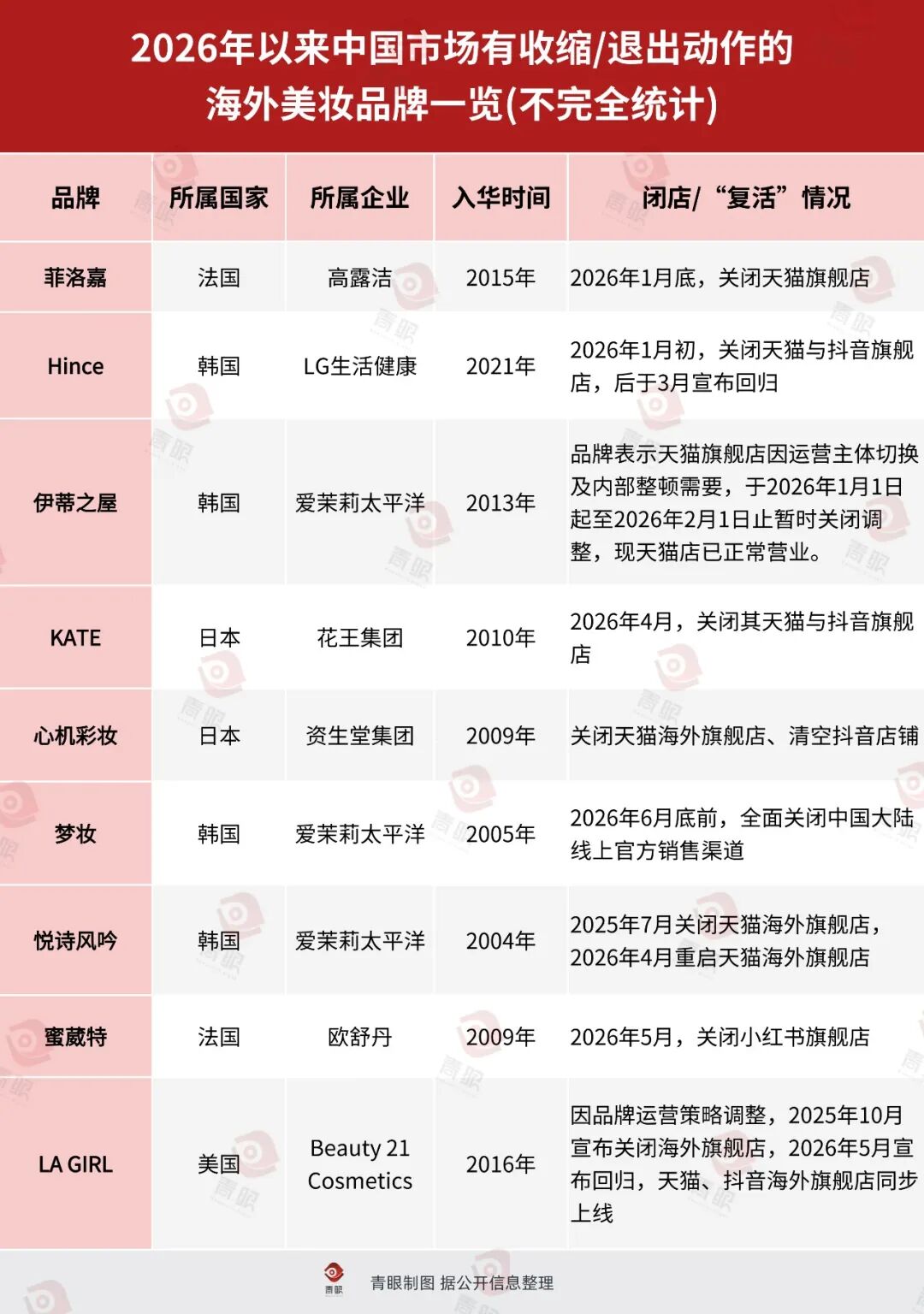
For example, Filorga, the high-end professional anti-aging skincare brand under the Colgate Group, closed its Tmall Flagship Store at the end of January; Melvita, the organic skincare brand under L'Occitane Group, also closed its Xiaohongshu Flagship Store in May this year.
At the same time, the affordable makeup track where Essence and Catrice under Cosnova Beauty are located is the most fiercely competitive area. In recent years, many well-known international affordable makeup brands have chosen to close their China operations.
The most typical example is e.l.f, the representative American mass-market makeup brand, which withdrew from the Chinese market in 2023. In addition, affordable makeup brand NYX Professional Makeup under L'Oréal and AUBE under Kao also successively announced store closures or product discontinuation in 2024.
Against the backdrop of a sluggish domestic economy and intensifying market competition, the reshuffling of domestic Chinese makeup brands is also drastic. For example, VENUS MARBLE, which once ranked first in the Taobao eyeshadow category for 8 consecutive months, VNK, which once topped Li Jiaqi's affordable lipstick ranking, and blank me, once hailed as "the No.1 domestic Chinese base makeup brand", all ceased operations in the past one or two years.
In the final analysis, high operating costs and continuously increasing online traffic investment costs make it difficult for brands to achieve profitability. The person in charge of the Shui Yi brand once admitted that the reason why the brand could not continue was "almost no profit"; Chen Shiyi, the founder of emerging domestic makeup brand Najixizi, also stated in a public "farewell letter": "The slowdown of innovation speed and increasing financial pressure have deprived the brand of the ability to keep growing. Despite the team's full efforts to adjust, it is still difficult to reverse the reality of long-term losses."
However, closing stores does not mean the end. Since the beginning of this year, many brands have "revived" in the Chinese market. A total of 4 overseas beauty brands including Hince, Etude House, Innisfree and LA GIR have all announced the restart of their previously closed China market channels this year, and started to expand the Chinese market in new ways.
Overall, in China, the world's most fiercely competitive beauty battlefield, the old model that relies solely on past brand prestige and a single hit product to reap dividends is no longer viable. When "cost-effectiveness" is no longer a moat and traffic dividends are gradually exhausted, the new era market is in urgent need of a new makeup narrative — not a one-sided story of "cheap alternative to luxury brands" or "affordable imported products", but a diverse expression rooted in local consumer insights and emotional connections.
This article is from the WeChat public account "QY", author: San Si, published with authorization from 36Kr.