The Chinese moment of the Fields Medal, and the global coordinates of Chinese mathematics
On the morning of July 23 local time, at the opening ceremony of the International Congress of Mathematicians in Philadelphia, Wang Hong, Deng Yu, Jacob Tsimerman and John Pardon were awarded the 2026 Fields Medal.
Two of the four names are from China. Both Wang Hong and Deng Yu studied at the School of Mathematical Sciences of Peking University, then went to the United States to complete their doctoral training, and grew into important scholars in their respective fields in the international mathematics community. When they stepped onto the podium at the same time, Chinese mathematics ushered in a moment that had never existed before.
The Fields Medal is awarded every four years to mathematicians who are under 40 years old in the year of the award. It is often called the "Nobel Prize in Mathematics", but it not only summarizes the achievements that have been completed, but also includes judgments about the future: which problems are worthy of the entire mathematics community to continue to pursue, which methods are changing the direction of research, and which young mathematicians may redraw the boundaries of this discipline.
How Much Space Can a Single Line Occupy
In 1917, the Japanese mathematician Sōichi Kakeya raised a problem that looked like an intellectual game: a needle with no thickness needs to complete a 180-degree turn on a plane. What is the minimum space required?
Intuitively, the longer the needle, the larger the area it sweeps through when rotating. But mathematicians soon discovered that as long as they keep translating and changing directions, the needle can complete its turn in an arbitrarily small area. After that, the problem gradually changed from "how to make a needle turn around" to a more abstract conjecture: if a set contains unit line segments in all directions, how small can it be in space?
The "smallness" here can no longer be simply measured by area or volume. Some special sets can have zero area, but they are still too complex to be compressed into a single line. Mathematicians therefore introduced the concept of "dimension" to judge to what extent a set occupies the surrounding space. The Kakeya conjecture states that in three-dimensional space, a set containing unit line segments in all directions should have full three-dimensional properties no matter how tiny its volume is.
This problem has perplexed mathematicians for more than half a century. The difficulty comes from the extremely complex overlap between line segments: thin tubes facing different directions can be squeezed together, and they will also present completely different structures as the observation scale changes. Mathematicians not only need to calculate how much space these thin tubes occupy, but also understand why they gather and where they begin to disperse.
The Kakeya conjecture is not an isolated geometric puzzle. It is connected to a series of problems in Fourier analysis, such as the restriction conjecture, how waves propagate, and how the solutions of partial differential equations concentrate. Every advance in it often drives a whole set of research in harmonic analysis and geometric measure theory.
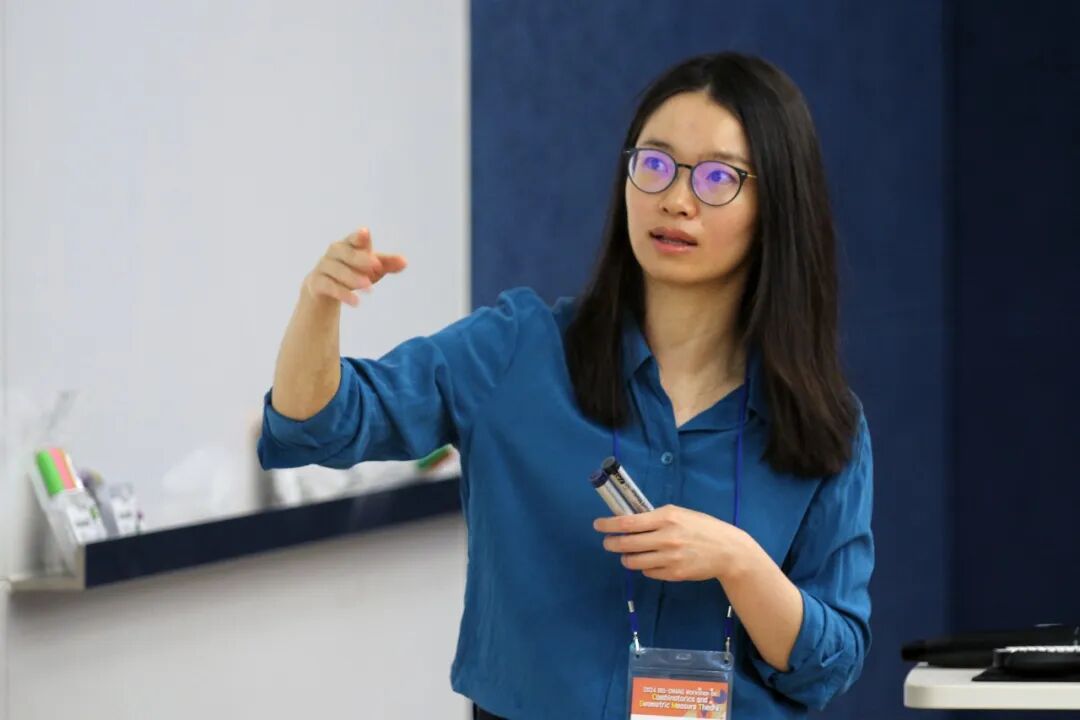
It is precisely this field that Wang Hong entered, a field that has accumulated decades of methods and also decades of obstacles.
She collaborated with the American mathematician Joshua Zahl, starting with a class of relatively special "sticky Kakeya sets". The so-called "viscosity" can be roughly understood as that the thin tubes at different scales will not disperse randomly, and they still maintain a certain aggregation relationship when zoomed in or out. In 2022, the two solved this key case. Three years later, they published a 127-page paper, advancing these methods to the general case and completing the proof of the three-dimensional Kakeya conjecture.
The importance of this proof lies not only in solving an old problem. Wang Hong and Zahl need to deal with multiple scales at the same time: from a distance, a bunch of thin tubes may gather into a whole; when the local part is continuously magnified, new directions and overlapping relationships will appear inside. They disassembled the space layer by layer, estimated the volume of the union of thin tubes at different scales, and then recombined the local information. A seemingly continuous and chaotic geometric object was thus transformed into a structure that can be controlled layer by layer.
This research method also presents a typical path for contemporary mathematics to move forward. Major breakthroughs rarely come from a suddenly emerging formula. Researchers often need to first identify the specific position where the old tools fail, then re-divide the problem and invent new scales and classification methods. The work of Wang Hong and Zahl absorbed the long-term achievements of harmonic analysis, combinatorial geometry and geometric measure theory, and also changed the way these tools cooperate with each other.
Looking back at Wang Hong's growth experience, she does not fit the public's familiar template of a "competition genius".
In 1991, Wang Hong was born in Pingle County, Guilin, Guangxi Zhuang Autonomous Region. She had no experience in the International Mathematical Olympiad, nor did she enter the national training team for domestic mathematics competitions. In 2007, 16-year-old Wang Hong was admitted to Peking University through the regular college entrance examination. She initially studied at the School of Earth and Space Sciences, and transferred to the School of Mathematical Sciences a year later.
After graduating from undergraduate, she went to France for further studies, and then entered the Massachusetts Institute of Technology, studying under Larry Guth, a mathematician specializing in harmonic analysis. After receiving her doctorate in 2019, she successively worked at the Institute for Advanced Study in Princeton, the University of California, Los Angeles, and the Courant Institute of Mathematical Sciences at New York University, and later was appointed by the Institut des Hautes Études Scientifiques in France.
This resume is often summarized as a story of moving from a county in Guangxi to the forefront of world mathematics. What is more noteworthy is that the process of her truly entering the research frontier took place in a transnational academic network: Peking University provided basic training, and research institutions in France and the United States allowed her to access the most core problems in harmonic analysis. Mentors, collaborators and peers together formed an environment for the growth of her achievements.
The emergence of a top mathematician proves the possibility of talents. The formation of a mathematical center means that important problems can be raised here, young people can find mentors and peers here, and long-term and high-risk research can also get enough time to proceed.
From Particle Collisions to the Fluid World
What Deng Yu faces is another scale problem: why does the motion of countless tiny particles eventually form the gases and fluids that we can see?
A glass of water placed on a table looks calm and continuous. But in the microscopic world, the particles that make it up are always moving at high speed, constantly colliding, separating, and meeting again. The motion of each particle can be described by Newtonian mechanics; at the macroscopic level, people use tools such as the Euler equations and the Navier-Stokes equations to describe the changes of water flow, gas and heat.
Both theories have withstood long-term tests. The really difficult question is: can the latter be rigorously deduced from the former?
In 1900, the German mathematician Hilbert put forward 23 famous problems in Paris. The sixth problem required establishing a rigorous mathematical foundation for physics. One of the core paths is to start from the Newtonian motion of microscopic particles, go through the Boltzmann equation that describes the statistical behavior of a large number of particles, and finally derive the macroscopic fluid equations.
Physicists have long believed that this path is valid, but mathematicians have never been able to complete it entirely. The microscopic system contains an astonishing number of particles. As long as the time is slightly longer, the collision relationships will quickly become complex. A particle may collide with another particle, then go around a circle and collide with the particle it encountered before. This kind of "back-collision" will destroy the approximation of random collisions, and also cause uncontrollable correlations in calculations.
Over the past hundred years, mathematicians have only been able to prove part of it under additional conditions such as extremely low particle density, very short time, or other restrictions. There has always been a mathematical gap that has not been completely connected between the microscopic, mesoscopic and macroscopic scales.
Deng Yu collaborated with mathematicians Zaher Hani and Ma Xiao to study an idealized hard-sphere particle system: each particle moves freely in space like a tiny sphere, and obeys definite mechanical laws when colliding.
As the number of particles increases, the possible collision histories grow explosively. Mathematicians must simultaneously track which particles have collided, in what order the collisions occurred, and how these histories will affect subsequent motions.
The team designed a "cutting algorithm" to split the huge and chaotic collision graph into manageable basic units. They identified relatively normal collision chains, while controlling the abnormal parts containing complex back-collisions, and transformed the high-dimensional integrals that could not be directly estimated originally into a combination of a series of basic operators.
In 2025, they published a paper proving that the hard-sphere particle system can rigorously derive the Boltzmann equation on a sufficiently long time scale, and further deduce the Euler equations and the Navier-Stokes-Fourier equations from the Boltzmann equation. This work is the first to rigorously explain on a long time scale how the deterministic motion of a large number of hard spheres forms statistical laws, and further manifests as macroscopic fluid motion.
Its significance also goes beyond the fluid equations themselves.
Newtonian mechanics has time symmetry at the microscopic level. If you play a video of a particle's motion backwards, it is still mathematically possible. But the macroscopic world shows a clear direction of time: heat flows from a high-temperature place to a low-temperature place, gas will not gather on its own after diffusion, and spilled water will not return to the cup.
Why an irreversible macroscopic world emerges from reversible microscopic motions is one of the deepest problems in statistical physics. The work of Deng Yu and others has not exhausted all the meanings of the "arrow of time", but it uses rigorous mathematics to explain how macroscopic laws are formed from the complex motions of a large number of microscopic particles.

Compared with Wang Hong, Deng Yu is closer to the public's familiar "competition genius" path.
He was born in Shenzhen in 1989 and entered the mathematics competition system from middle school. In 2006, 17-year-old Deng Yu represented China in the International Mathematical Olympiad and won a gold medal, and then was admitted to the Department of Mathematics of Peking University without taking the college entrance examination. When he enrolled in 2007, he was in the same grade as Wang Hong.
In 2009, Deng Yu transferred to the Massachusetts Institute of Technology. In 2010, he became one of the top winners of the Putnam Mathematical Competition. After that, he entered Princeton University to pursue his doctorate, studying under Alexandru Ionescu, who researches harmonic analysis and dispersive equations. He received his doctorate in 2015, and later taught at the University of Southern California and the University of Chicago.
The competition experience allowed Deng Yu to show his ability to solve difficult problems very early. But real research is different from competitions. Competition problems usually have answers, which means there is a path that can be completed within a limited time. Hilbert's sixth problem has no such guarantee. Researchers may invest many years and still not be sure whether the obstacle comes from insufficient skills or the original path itself is infeasible.
Deng Yu once mentioned that many of the ideas in this work gradually grew out of repeated failed attempts. Speed and skills can help a person reach the known boundary, but original research requires him to re-judge what is worth calculating, which failures need to be retained, and how to invent new structures for complex problems where there is no standard answer.
Wang Hong and Deng Yu were briefly classmates at Peking University. One had no experience in mathematics competitions, and the other was an International Olympiad gold medalist. More than ten years later, they set off from geometric space and mathematical physics respectively, and reached the forefront of world mathematics. The juxtaposition of the two shows that China's talent cultivation has been able to provide more than one entry point leading to top-level research.
Their common experience is also very clear: after the undergraduate stage, both of them entered the most core mathematical training system in the United States, completed their doctoral education under top mentors and in research communities, and established their main academic careers at overseas universities.
Therefore, their achievements cannot be simply attributed to a single country or a single education system. Peking University provided the starting point, and the international mathematics community completed the subsequent training, cooperation and verification. Chinese mathematics has been able to send the best students to the forefront of the world; the longer-term question is whether they can also access the most important problems, find the strongest collaborators, and undertake research that may not yield results for ten years in their home country.
People Working at the Boundaries of Mathematics
Compared with the achievements of Wang Hong and Deng Yu, the achievements of Jacob Tsimerman and John Pardon are more difficult to explain with an everyday problem. But the work of both of them also points to a clear clue of this year's Fields Medal: important breakthroughs in contemporary mathematics often occur at the intersection of different branches.
Tsimerman studies the André-Oort conjecture in number theory and arithmetic geometry. This conjecture attempts to describe how objects called "special points" are distributed in a highly complex geometric space. It is connected to the Langlands program, and also involves many fields such as algebraic geometry, number theory, and model theory. Many previous advances relied on unresolved premises such as the generalized Riemann hypothesis, so they could never be regarded as complete proofs.
Tsimerman, together with mathematicians such as Jonathan Pila, finally gave a proof that does not depend on unproven conjectures. They did not just advance along the traditional number theory tools, but introduced methods from model theory, using the language of logic to control the number of special points in geometric space, and then connected them with the results in arithmetic geometry. In 2021, the team completed an unconditional proof of the André-Oort conjecture.
Tsimerman's life experience also spans multiple countries. He was born in Kazan, Russia, moved to Israel with his family when he was young, and later settled in Canada. As a teenager, he represented Canada in the International Mathematical Olympiad for two consecutive years, and got a perfect score in the second time. After that, he completed his undergraduate studies at the University of Toronto, pursued his doctorate at Princeton University under Peter Sarnak, and then returned to teach at the University of Toronto.

If Tsimerman's characteristic is to connect distant mathematical languages, then Pardon is more like a person who constantly creates new tools for different fields.
Pardon became famous for solving difficult problems in his early years. In his last year of undergraduate studies, he independently solved the knot distortion problem, and his paper was published in *Annals of Mathematics*. Shortly after graduating with a doctorate, he became a full professor at Princeton University at the age of 27.
His research spans topology, symplectic geometry and algebraic geometry. During his graduate studies, he solved the Hilbert-Smith conjecture in the three-dimensional case. After that, he entered the field of curve counting problems, developed new transversality tools, and proved the MNOP conjecture on a large class of Calabi-Yau threefolds.
Pardon's contributions often go beyond completing a certain proof. He will also rebuild the technical framework required for the proof, allowing theories that previously relied on intuition or local skills to be processed uniformly.
From Tsimerman to Pardon, the research directions of the four winners almost cover several of the most active fields in contemporary pure mathematics: harmonic analysis, geometric measure theory, partial differential equations, mathematical physics, number theory, arithmetic geometry, topology and symplectic geometry. There is no simple common theme among the four achievements, but they share a research orientation: crossing scales, borrowing the language of adjacent fields, and re-establishing structures for old problems.
This also explains why the Fields Medal can hardly be understood as a simple "difficult problem ranking list". The jury not only pays attention to whether a conjecture has been proven, but also judges whether a certain work has changed the tools, vision and future direction of a field.
Wang Hong connected combinatorial geometry, harmonic analysis and geometric measure theory; Deng Yu integrated particle mechanics, kinetics and fluid equations; Tsimerman introduced model theory into arithmetic geometry; Pardon established new foundations for multiple counting theories in topology and geometry.