Just now, a Chinese mathematician has won the Fields Medal for the first time, and the two Fields laureates from Peking University fear no AI.
On July 23, the quadrennial Fields Medal was announced in Philadelphia, USA. Every time this moment comes, mathematics briefly steps out from blackboards, papers and university departments, and enters public discourse.
The Fields Medal is awarded once every four years, with a maximum of four recipients per session. This year, Deng Yu and Wang Hong are the most widely discussed names on Chinese-language internet platforms, marking the first time in the history of the Fields Medal that two mathematicians born in China have been awarded in the same edition. Prior to this, Shing-Tung Yau received the award in 1982, and Terence Tao (Australian-Chinese) received it in 2006.
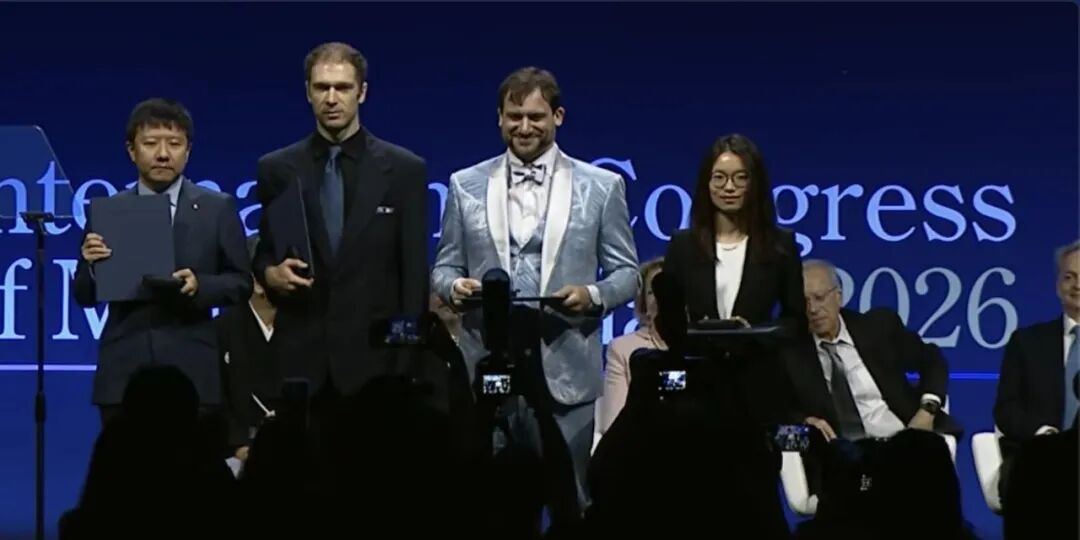
Deng Yu, born in Shenzhen, studied at Peking University and the Massachusetts Institute of Technology, earned his PhD in Mathematics from Princeton University in 2015, and is currently a Professor of Mathematics at the University of Chicago.
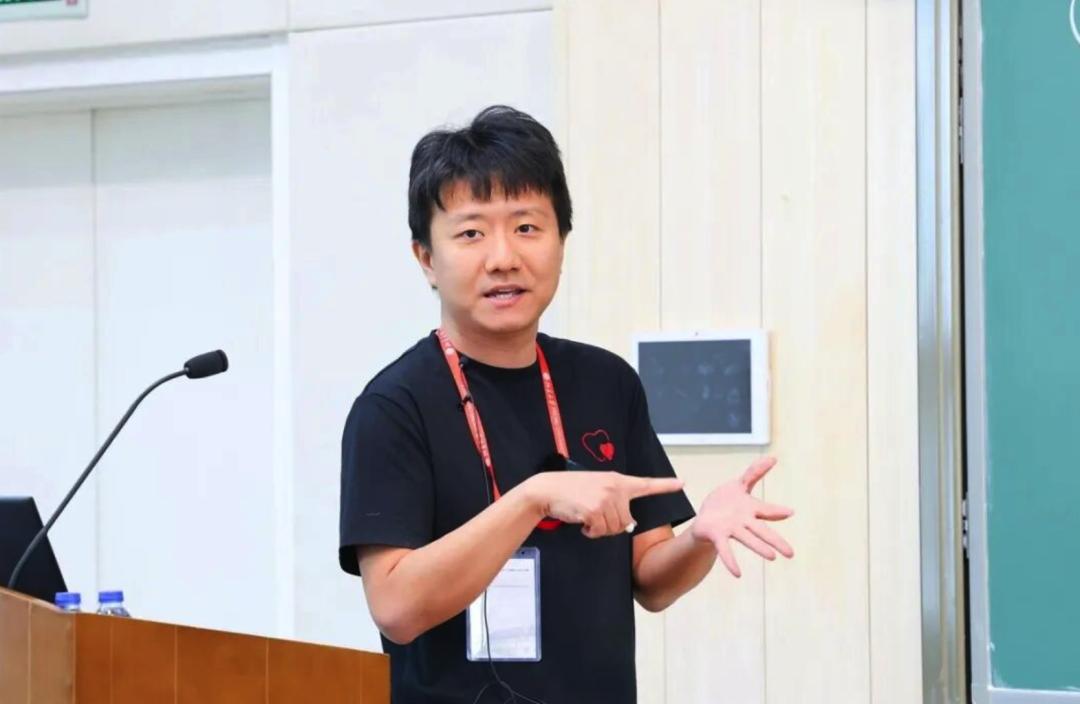
His main research focuses on nonlinear dispersive partial differential equations, wave turbulence and kinetic theory. Together with Zaher Hani, he rigorously derived the Boltzmann equation over long time scales starting from the hard-sphere particle system, making a major breakthrough in research related to Hilbert's Sixth Problem.
Wang Hong is currently a Permanent Professor at the Institut des Hautes Études Scientifiques (IHES) in France and a Professor at the Courant Institute of New York University. She completed her undergraduate studies at Peking University, later obtained her master's degree from Université Paris-Saclay and her doctorate from the Massachusetts Institute of Technology, with research interests in harmonic analysis and geometric measure theory.
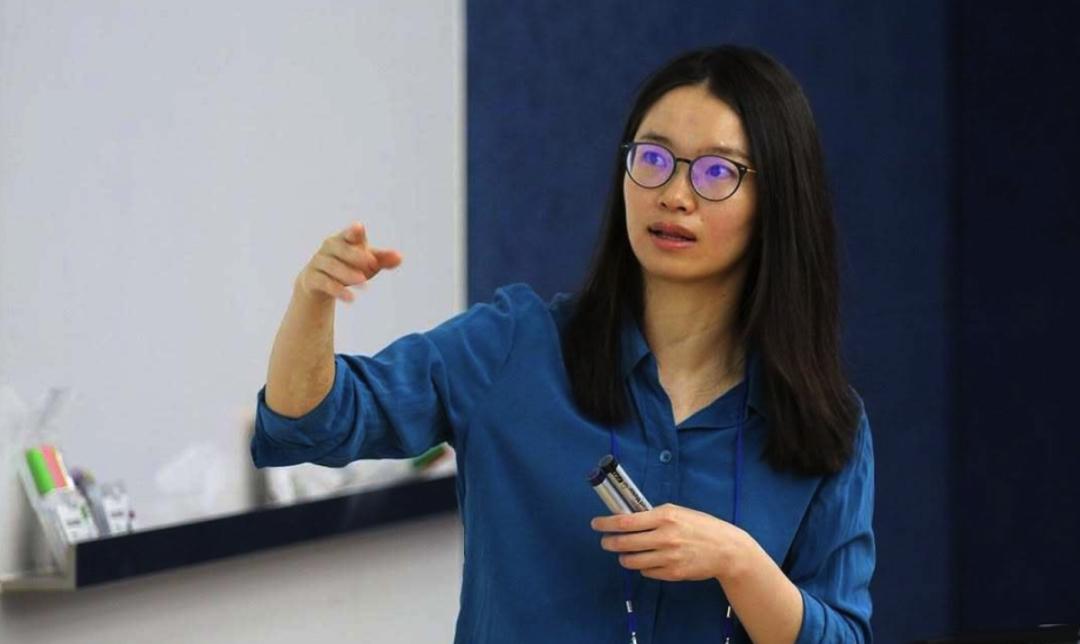
In 2025, she and Joshua Zahl proved the three-dimensional Kakeya conjecture, and made outstanding contributions to fields including the restriction conjecture and the local smoothing conjecture.
The other two recipients are respectively:
Jacob Tsimerman, a Canadian mathematician who studied under number theorist Peter Sarnak. His research spans transcendental number theory, analytic number theory and arithmetic geometry, with representative achievements including proving the André-Oort conjecture, establishing the Ax–Schanuel theorem for Hodge structures, and resolving the Griffiths conjecture.
John Pardon, an American mathematician who studied under Yakov Eliashberg, whose main research focuses on geometry, topology and symplectic topology. He solved the knot deformation problem proposed by Gromov during his undergraduate years, later proved the three-dimensional Hilbert–Smith conjecture, and made important achievements in the moduli space of pseudo-holomorphic curves, virtual fundamental chains and contact homology.
This year is jokingly referred to as "the last Fields Medal that belongs exclusively to humans". At this historical juncture where AI has infiltrated almost every industry, as AI can already solve Olympiad math problems, verify proofs, and even start tackling research-level mathematical problems, what exactly are top mathematicians working on? And how do mathematicians view the relationship between their own work and AI?
A Shorter Proof vs A Better Proof
At the recently concluded WAIC, a group of mathematicians discussed similar issues. Even as professional mathematicians, they have to admit that the progress of AI in mathematics has been so rapid that practitioners have had to change their daily work methods. Even those who previously held doubts now have to face this new normal.
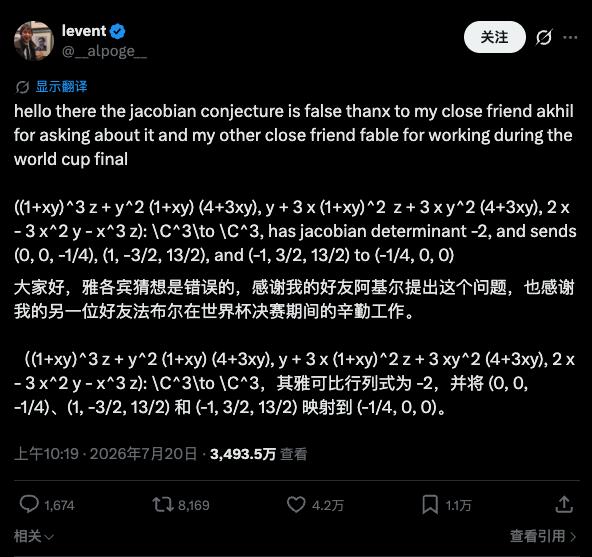
During the World Cup, a mathematics researcher at Anthropic posted a tweet that very few people could understand, yet it received 20 million views — he used Fable 5 to prove that the Jacobian conjecture is false.
On the other hand, GPT-5.6 Pro overturned the 30-year-old unsolved Dinits-Garg-Goemans conjecture.
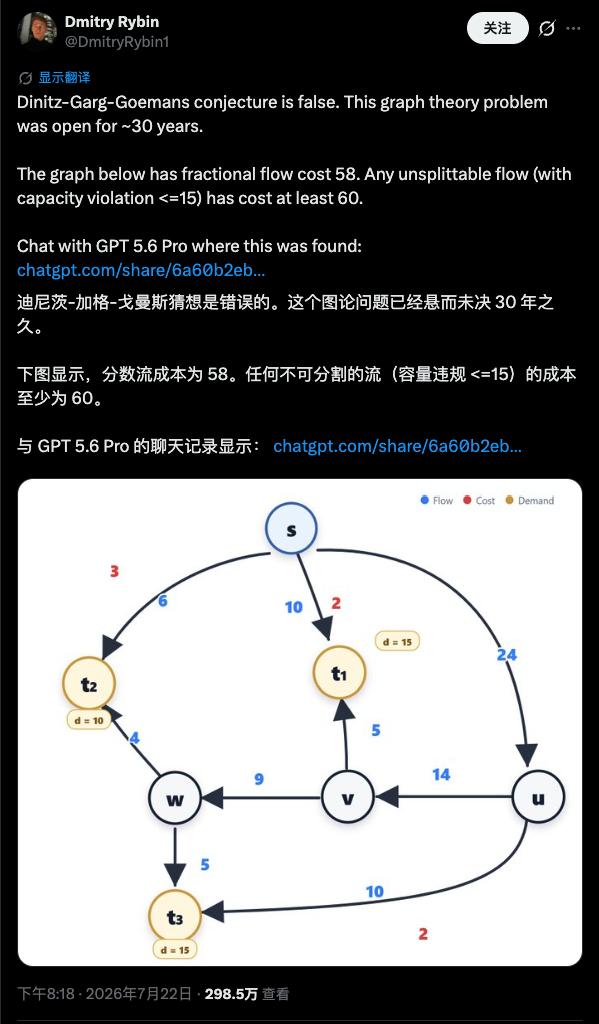
However, between a tweet sparking discussion and being "recognized by the mathematical community", there are usually still steps such as formal verification and expert review. These examples more illustrate that AI has been integrated into daily mathematical work, and its penetration is even deeper than imagined.
He Yanghui, a researcher at the London Institute for Mathematical Sciences, said at the forum that six months ago, he did not trust anything AI produced; now he spends several hours every day conversing with ChatGPT Pro, "just like working with a very good collaborator".
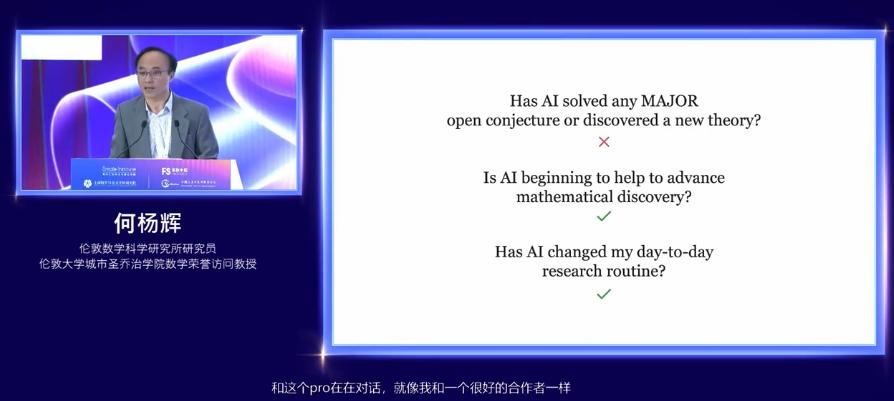
AI provides hints and humans then verify them. For a professional mathematician, this change may be more meaningful than a model scoring a few extra points on leaderboards. AI has evolved from a problem-solving tool to a part of the mathematical research workflow.
But becoming a collaborator is never the same as becoming a mathematician. Zhang Liang, a researcher of underlying algorithms at Huayuan Computing, reminds that shorter code does not mean simpler mathematics. A formally shorter proof may just call on more powerful automated tools, or hide complexity in external theorem libraries. It may appear to have been condensed from a hundred lines to ten, but the truly difficult parts have not disappeared — they have only been moved to places invisible to readers.
This is somewhat like compressing a full-length novel into a smaller file: the file does become smaller, but the story does not become any easier to understand as a result.
Genuine simplification of a proof is not just about reducing characters and steps, but also about lowering logical complexity, eliminating unnecessary external dependencies, restructuring the proof, and preserving the most critical mathematical ideas. In other words, AI can help mathematicians "write out the answer", but judging why a proof is elegant and which step contains the real insight still requires understanding.
This is also the most important difference between mathematics and ordinary problem-solving. Exams usually present a clear problem, and the answer already exists; mathematical research not only seeks answers, but also determines what problems are worth posing, and whether an answer opens up new paths.
Can AI Be a Mathematician?
The British mathematician Hardy said that mathematicians, like poets and painters, are also creators of patterns.
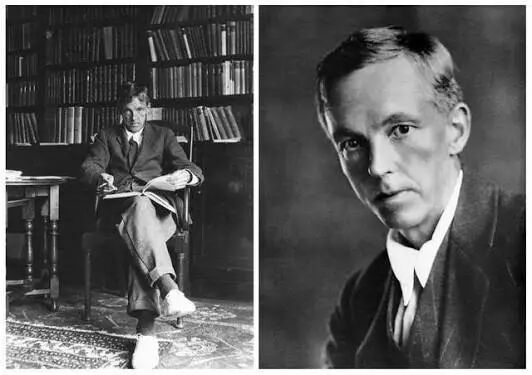
British mathematician G. H. Hardy
Mathematical papers always seem to start from definitions, axioms and theorems, and advance step by step to the conclusion. But when mathematicians actually work, they often go in the opposite direction. Relying on experience, intuition and extensive calculations, they first vaguely perceive a pattern, then go back to seek a rigorous proof.
He Yanghui calls these two paths "bottom-up" and "top-down". The former path is suitable for machines: formalize all axioms, definitions and existing theorems into a formal language, and let the computer check them step by step. The latter path is closer to the work of human mathematicians: identifying patterns from data, graphs and incomplete clues, posing conjectures, and then exploring the reasoning behind them.
This also explains why AI is well-suited for mathematics, but cannot yet be simply equated with a mathematician.
AI is very good at finding patterns from a large number of cases. It can search proof paths that are impossible for humans to exhaust, and can also find potentially relevant tools in the vast libraries of literature and theorems. But mathematical creation also requires researchers to judge: is this pattern important? Can it be explained? Is it repeating existing knowledge, or introducing a structure that never existed before?
Therefore, an AI mathematical discovery must at least pass three layers of tests: whether it is truly generated autonomously by the system, whether it can be explained by humans, and whether it is sufficiently important rather than a mediocre variant. There are many answers that can pass verification, but answers that can change how a field thinks about problems are still very rare.
Mathematics Flows in AI's Veins
Although AI is still far from being a mathematician, mathematics is very close to AI. AI itself is the result of long-term accumulation in mathematics.
Liu Jun, an academician of the US National Academy of Sciences and a professor at Tsinghua University, used an intuitive metaphor at the forum: today's AI is like a huge Boeing aircraft, where statistics and probability theory are the engines, and data is the fuel.
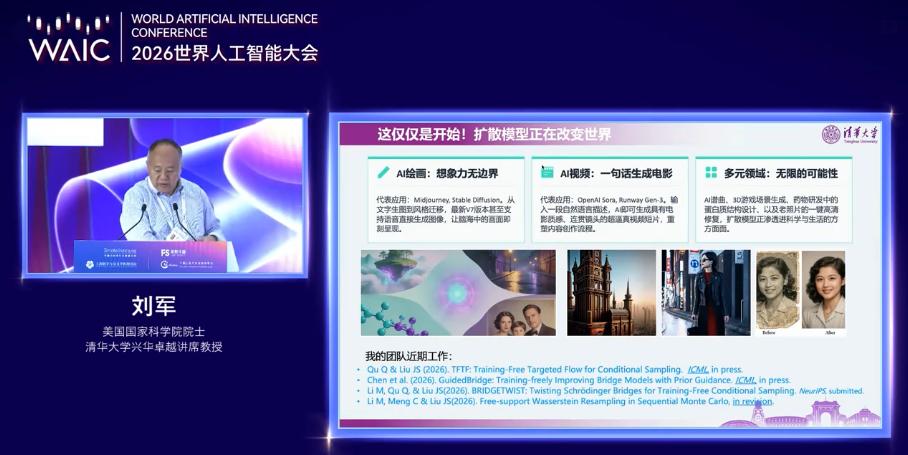
Indeed, everything behind AI has the shadow of mathematics. Gauss's use of probability distributions to describe errors can be regarded as one of the earliest ideological origins of generative models; diffusion models generate images by continuously adding and removing noise, with stochastic differential equations and partial differential equations as their underlying foundation; the mapping of text, images and speech into computable spaces by models relies on geometry and linear algebra; reinforcement learning can be traced back to Markov decision processes.
Ordinary users see AI generating images from a sentence and voice assistants answering questions, while mathematicians see a complete set of structures about uncertainty, distance, probability and decision-making.
Liu Jun believes that the relationship between mathematics and AI should not only be "additive". If we only use existing AI to help prove a theorem, that is AI plus mathematics; but if we want to invent a new AI system that can work stably in real-world scenarios with limited data, complex noise or high risks, mathematics and AI must form a multiplicative relationship.
This is also why, as models become larger and more capable, mathematical problems become more prominent. Data and computing power can enable a system to gain capabilities quickly, but when people start to ask why it works, when it will fail, how confident the conclusions are, and how to extend it from one case to a class of problems, they will eventually return to mathematics.
The Next Fields Medal Still Belongs to Humans, But the Next Generation of Mathematics May Not
There is a rumor that at the current speed of AI, this year will be the last Fields Medal that is 100% exclusive to humans.
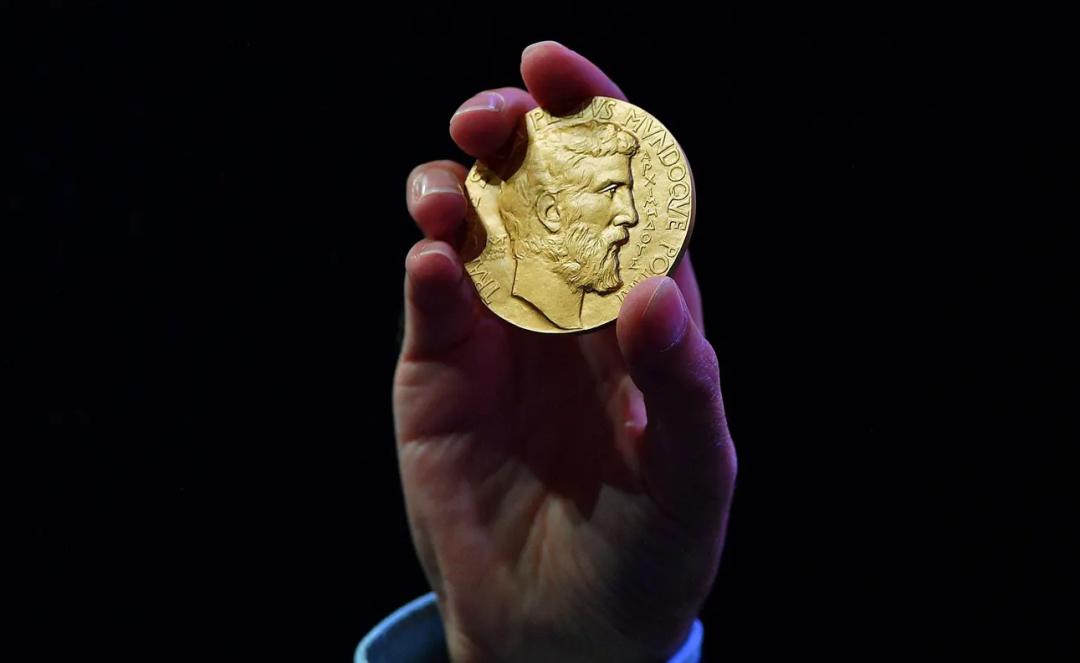
In fact, the Fields Medal has never rewarded those who solve problems the fastest. It honors those who change the paths of mathematical research and create new methods and structures — which is the real reason why Wang Hong and Deng Yu have received widespread attention.
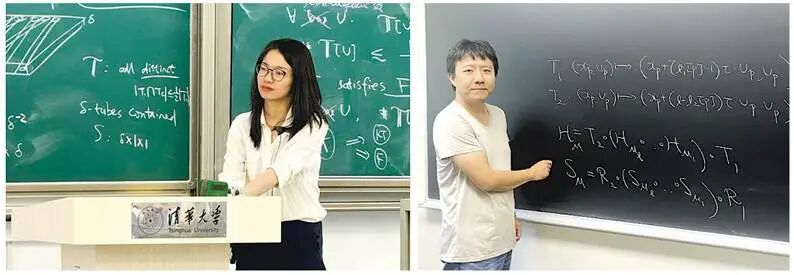
The value of top-level mathematical work lies precisely not in solving a test paper with pre-existing answers, but in inventing new languages and tools for problems that could not be described before.
The most certain change brought by AI today is that it speeds up a large number of search, calculation, formalization and verification tasks in mathematical research. It may help mathematicians read more literature, try more paths, and discover patterns that humans have not noticed. As He Yanghui said, it may gradually become a collaborator that can be communicated with, provide hints, but still requires verification.
As for whether it can become a real mathematician, the answer may not depend on how many problems AI can solve, but on whether it can raise problems that are worth humans spending years exploring, understand why a proof is important, and organize isolated answers into a theory that can continue to grow.
The next Fields Medal will still be awarded to humans. However, from now on, AI will appear more and more frequently in the toolkits behind the winners. At that point, mathematicians will not lose their value just because machines can prove theorems. On the contrary, when answers become easier and easier to obtain, choosing which problems to work on, identifying which structures are meaningful, and explaining what an answer means will become scarcer capabilities.
This article is from the WeChat Official Account "APPSO", authored by APPSO that discovers tomorrow's products, and published with authorization by 36Kr.