AI can finish one chapter of a doctoral dissertation in less than two hours, will the Fields Medal still be able to hold on until 2030?
On July 23rd, the 30th International Congress of Mathematicians (ICM) will kick off in Philadelphia, where the Fields Medal will be awarded during the opening ceremony.
But 18 days before that, Alek Dimitriev, a technical employee at Anthropic, posted on X: The Fields Medal to be awarded next week will be the last time a human being ever receives this award.
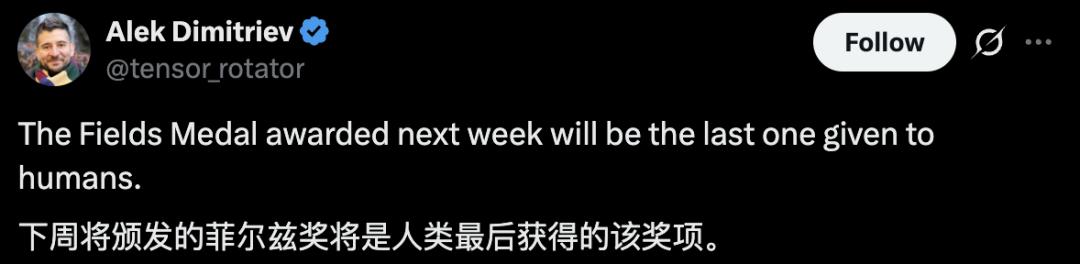
Alek previously worked as a senior machine learning engineer at Google, participating in the fine-tuning and inference system development for Gemini, and he holds a PhD in Machine Learning from UT Austin.
The next day, Christian Szegedy retweeted Alek's post.

Szegedy is a highly influential figure in the deep learning community. He is the first author of the Inception network (GoogLeNet), co-author of Batch Normalization, and the first person to systematically discover and study adversarial examples.
All of these are critical cornerstones of modern deep learning.
Szegedy holds a PhD in Mathematics from the University of Bonn. He joined the founding team of xAI in March 2023, and founded Math Inc in 2025, focusing on using autoformalization to build verifiable superintelligence.
One of them works with cutting-edge models every day, while the other is a foundational figure in deep learning who is now researching how to enable machines to verify mathematical proofs.
Yet both of them are saying the Fields Medal has reached its end.
That afternoon, Fields Medal recipient Timothy Gowers appeared in the comments under Szegedy's retweet:
I have had similar thoughts. But there is a lag in this process, so I think they will probably last until around 2030.
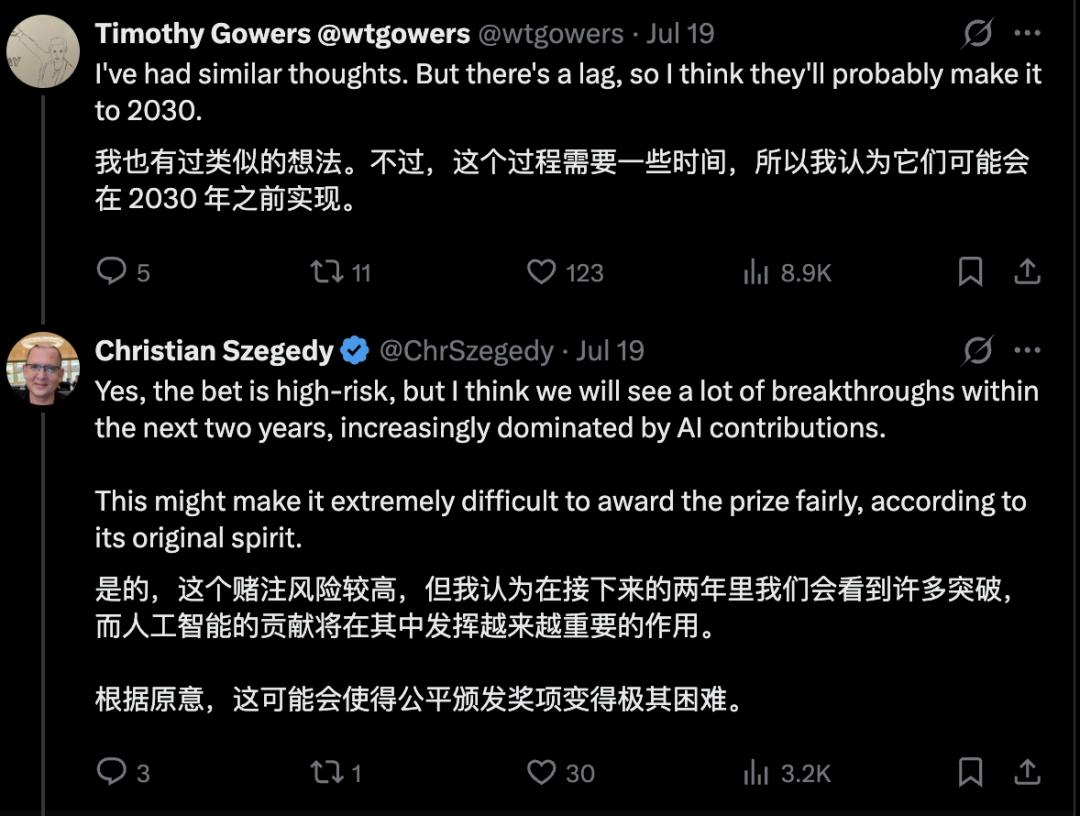
Szegedy immediately responded:
This is a high-stakes bet. But I believe a large number of breakthroughs will emerge in the next two years, and AI's contributions will become increasingly dominant. This will likely make it very difficult to award the medal fairly in accordance with its original spirit.
Although Gowers did not explicitly say "the Fields Medal is coming to an end," he did have similar thoughts and gave a rough timeline: 2030.
And he has reasons for this speculation.
Just two months before that tweet, he had just completed an experiment himself.
In Less Than Two Hours
AI Completed a Full Chapter of a Doctoral Dissertation
On May 8, 2026, Gowers shared his recent experience using ChatGPT 5.5 Pro in a personal blog post.
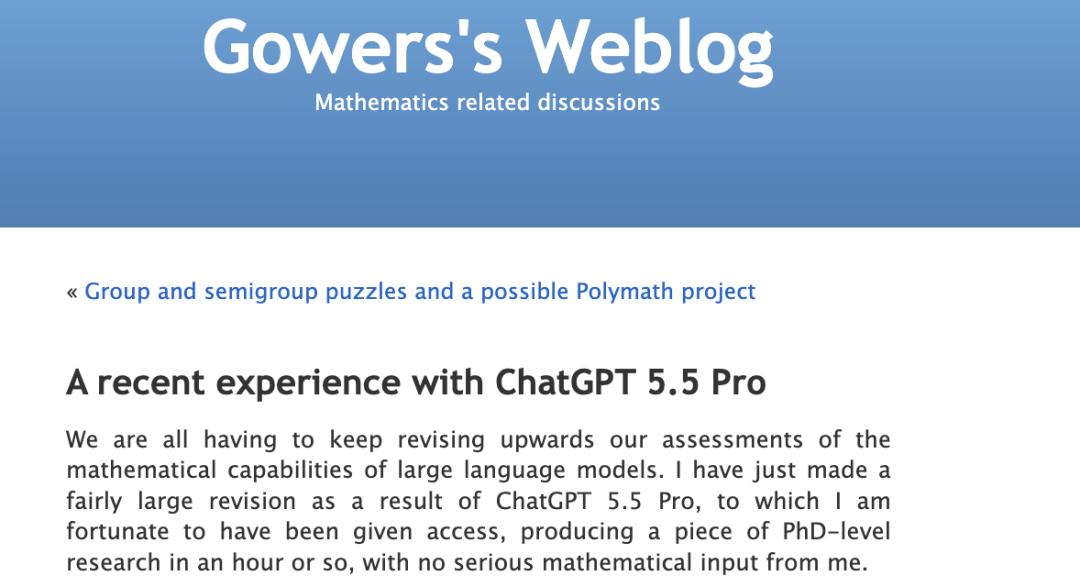
He stated that all of us have to keep raising our assessments of the mathematical capabilities of large language models, and this time the increase is quite significant.
The problem he gave the large model was taken from a paper by mathematician Melvyn Nathanson.
The problem is roughly as follows.
Select k integers to form a set A, add any two numbers in A together, and collect all distinct results to form another set called the sumset. Nathanson specified in advance exactly how many elements A should have and exactly how many elements the sumset should contain.
There is only one question: Under these constraints, what is the smallest possible value that the largest element in A can reach?
In simpler terms, how compactly can these k integers be arranged?
Nathanson's own answer was on the order of 2 to the power of k. For example, with 20 numbers, the largest one would need to be around a million. He left a question in his paper: Can this bound be improved?
ChatGPT 5.5 Pro thought for 17 minutes and 5 seconds and returned a construction that reduced the bound to a quadratic order. For the same 20 numbers, the largest element only needed to be a few hundred. And this is already optimal, with no room for further reduction.
Gowers then asked it to format the argument as a formal mathematical preprint, which was completed in 2 minutes and 23 seconds.
Then he raised the stakes, switching to a more difficult version: Can the bound in the paper by MIT student Isaac Rajagopal be improved?
In 16 minutes and 41 seconds, the model reduced the bound from "exponential growth with k" to "exponential growth with the square root of k," and it took another 47 minutes and 39 seconds to write the preprint. Rajagopal himself reviewed it and said it appeared to be correct.
Gowers asked if it could go even further, pushing the bound down to a polynomial level, meaning completely eliminating exponential growth.
In 13 minutes and 33 seconds, the model said it was feasible, but two technical propositions needed to be verified. Gowers asked it to verify them. In 9 minutes and 12 seconds, the verification was done. After another 31 minutes and 40 seconds, the preprint was completed.
Rajagopal's review after reading it was: Almost certainly correct. He specifically emphasized that it was not just a line-by-line check that passed, but that the underlying ideas were also correct.
The entire process took less than two hours. Gowers evaluated this achievement as: Equivalent to a perfectly reasonable chapter in a combinatorial mathematics doctoral dissertation.
The truly striking part is the sentence he added later:
I contributed zero mathematical input. I didn't even do any special tricks with the prompts.
Mathematicians
Gradually Stopped Finding It Funny
Gowers recalled on his blog that in the early days, the so-called "large models solving research-level problems" could be dismissed with a laugh:
Many of these so-called solutions were actually cases where the model discovered that the answer already existed in the literature, or that it could be easily derived from known results.
Slowly, these laughs faded away.
Later, when encountering seemingly clever arguments, careful checks would often find precedents. So people could still comfort themselves: It's just assembling existing knowledge, not a truly original idea.
This time, there is no such comfort left.
Isaac Rajagopal, whose paper was revised by AI, wrote a dedicated section on Gowers's blog explaining exactly what ideas the model came up with.
Instead of praising it right away, he scored the two-step improvement made by the model separately.
The first step, reducing from exponential order to square root order, he evaluated as a conventional modification to his work. It could be derived by following the line of reasoning in his paper.
What really made him take notice was the second step: completely eliminating exponential growth.
The original sequence of numbers kept doubling: 1, 4, 16, 64, growing far too fast.
ChatGPT changed its approach: First, find a set of numbers whose pairwise sums never collide, meaning no sum of a few numbers will equal the sum of another group; then multiply each number by the same factor to create a copy of the set.
In this way, the relationship in the doubling sequence where "four small numbers exactly equal one large number" is replicated, while all numbers are contained within a very small range.
Rajagopal said this is like tucking half a geometric series into a polynomial interval, which is quite counterintuitive. And as far as he knows, this idea is completely original:
This is the kind of idea I would be very proud of after thinking about it for a week or two. Yet ChatGPT found it and proved it in less than an hour.
The Fields Medal Recipient-to-Be
Lost to AI on This Problem
Shortly after Gowers's blog was published, OpenAI announced another development: an internal general reasoning model had disproved the planar unit distance conjecture proposed by Erdős in 1946.
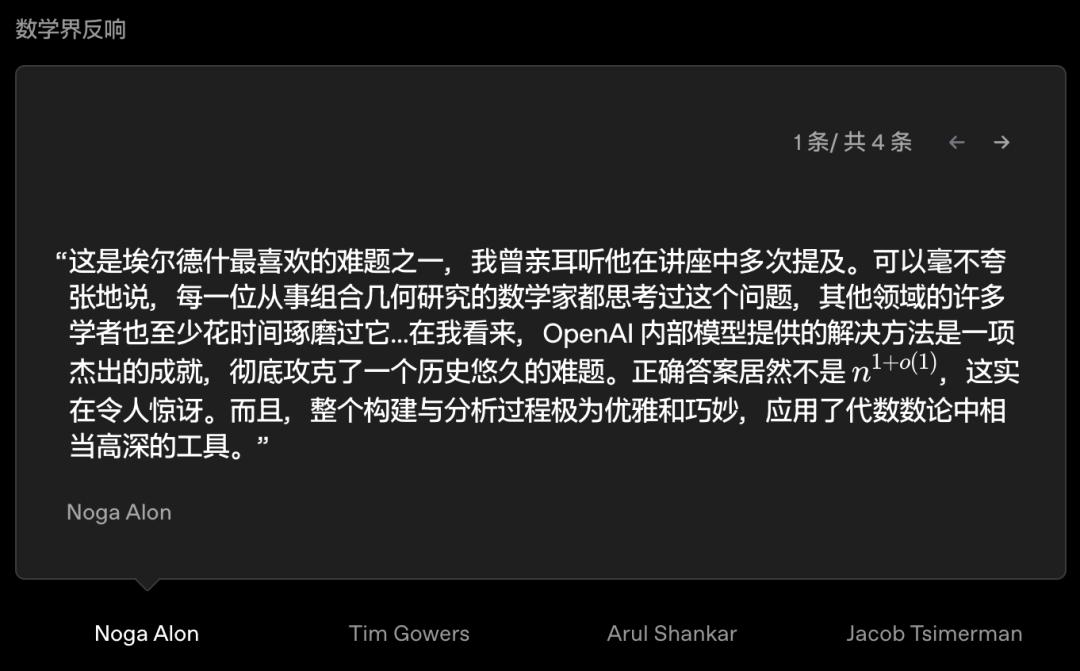
Noga Alon from Princeton said this is one of Erdős's favorite tough problems, and the solution from OpenAI's internal model, in his opinion, completely solves this long-standing problem and changes the consensus that has existed for decades.
Number theorist Arul Shankar went even further, stating that it proves current AI models are not just assistants to human mathematicians — they are capable of producing original, brilliant insights and turning those insights into tangible results.
Joining Alon, Shankar, and Gowers in speaking for the mathematical community is Jacob Tsimerman, who is about to step onto the Fields Medal podium on July 23rd.
On the evening of July 13th, an incident occurred on the official ICM 2026 website. Four entries marked as "HIDDEN Fields Medal Lectures" were exposed, leaking this year's recipient list in advance:
Yu Deng (University of Chicago), John Pardon (Stony Brook University), Jacob Tsimerman (University of Toronto), Hong Wang (NYU Courant and IHES).
According to reports, each of these four people has solved a problem that had been unsolved for between 30 and 125 years.
And Tsimerman revealed something when evaluating that AI proof: He himself had briefly studied this problem, tried to construct counterexamples, but failed to make progress.

He is about to receive mathematics's highest honor on behalf of humanity, yet on this Erdős problem, he has just lost to AI.
How AI Will Transform Mathematics
Let's go back to Szegedy.
He said the Nobel Prize honors achievements that push a discipline forward, while the Fields Medal honors relatively young geniuses, with the goal of encouraging them to continue doing mathematics.
If the AI component in such achievements becomes impossible to assess accurately, then the entire meaning of the Fields Medal becomes questionable.
Of course, some people in the comment section disagreed. Someone replied: That doesn't make sense. The Fields Medal, by definition, is a medal for the best human mathematicians.
But the focus of the controversy has shifted. The real question now is what criteria the medal should use in the AI era to confirm "you did this."
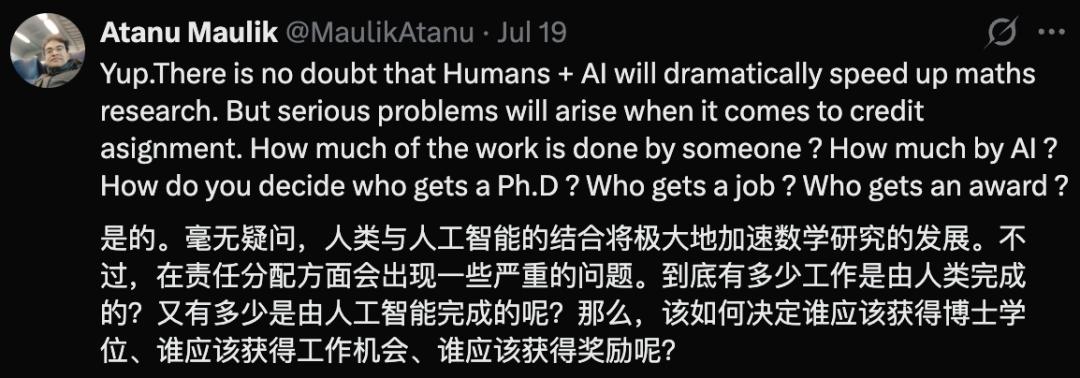
Gowers once posed a hypothetical question on his blog:
Suppose a mathematician solves a major problem by having a long conversation with a large model, where he provides effective guidance, but all the technical work is done by the large model, and the main ideas also come from the large model. Would we consider this a major achievement of the mathematician?
His answer is: No.
He also said that if your goal in doing mathematics is a form of immortality, having your name forever tied to a theorem or definition, you need to understand that this may not last much longer.
But grappling with hard problems is still worthwhile.
Gowers says the value lies in the insight you gain into the problem-solving process itself — an insight that you cannot get just by reading someone else's answer.
He used an analogy: Someone who is good at coding will write better code with AI than an average person; someone with a solid grasp of arithmetic fundamentals will more easily notice when a calculator's answer is wrong.
The era of having your name attached to a theorem may be coming to an end. But the "intuition" you gain from solving hard problems is becoming the entry-level skill for mastering AI.
At the upcoming International Congress of Mathematicians, another Fields Medal recipient, Terence Tao, will deliver a public lecture titled "Mathematics in the Age of AI."
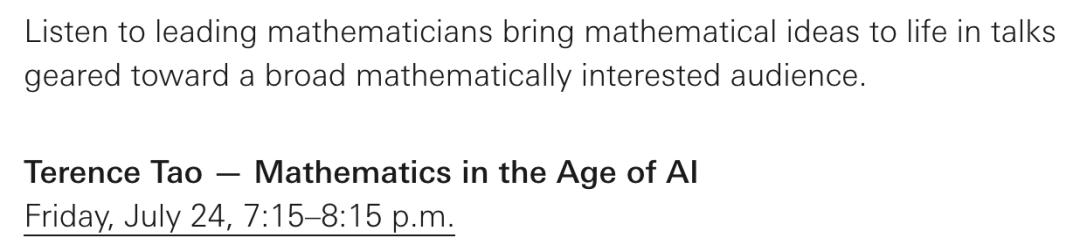
The Simons Foundation's ICM public event schedule: On the evening of July 24th, Terence Tao will give a talk titled "Mathematics in the Age of AI." (Image source: Simons Foundation)
In May this year, after giving a lecture on "The New Mathematical Workflow" at Stanford, he announced on Mathstodon that he was changing his work habits: He would no longer try to keep up with every new proof in real time.
Because the speed at which AI generates proofs has already exceeded the speed at which humans can digest them.
He also suggested that perhaps separate publication venues should be established for AI-generated mathematics and human-generated mathematics, just like highways and sidewalks.
Being pushed toward 2030 are not just the Fields Medal selection committee, but every doctoral student choosing a research topic, every supervisor guiding students, and the entire existing academic evaluation system.
Gowers once did a time calculation: Doctoral students starting their studies this autumn will not graduate as early as 2029 at the earliest.
His guess is that by then, what it means to do mathematical research may have become completely unrecognizable.
References:
https://x.com/tensor_rotator/status/20783357911