Behind the continuous audience loss of AI-generated manhua dramas: the template-style faces trigger people's "physical disgust", and with thousands of dramas following identical plot routines, who can still immerse themselves in the content to release their emotions?
According to Manju Wang, Hongguo Short Drama is conducting a small-scale grayscale test to remove the independent animation drama section from its app. This adjustment is only implemented for some users and has not yet been fully rolled out to all clients.
This grayscale test is the latest measure by the platform to continuously tighten control over AI animation dramas. Previously, Hongguo has carried out multiple large-scale special rectifications of animation dramas. In June alone, it intercepted and removed 14,357 non-compliant AI animation dramas, with the volume of violations far exceeding that of live-action short dramas. The platform also merged the total rankings of animation dramas and live-action short dramas, eliminating the traffic isolation mechanism for the two types of content, allowing AI animation dramas and live-action works to compete for traffic on the same stage.
Industry analysis suggests that the removal of the independent animation drama section has multiple industry implications. First, AI animation dramas have long had high-frequency violations such as mass-produced low-quality content, portrait infringement, distorted plot values, and improper guidance for minors, making them a severely affected area for platform content governance. Weakening the independent entry can reduce the concentrated exposure of low-quality content.
Second, it supports the platform's shift of focus to live-action short dramas under the "Thousand Works Plan", guiding traffic to high-quality live-action content through adjustments to the product interface, to counter the impact of purely AI assembly-line short dramas on the live-action track.
Third, it responds to the regulatory requirements of the National Radio and Television Administration for layered supervision of AI short dramas, gradually reducing the traffic channels for extensive mass-produced AI animation dramas.
The revenue per 10,000 views of AI animation dramas plummeted by 90%, with only 180,000 yuan settled for 180 million valid views. The peak completion rate dropped from 42% to 19%, and more than 5,200 low-quality works were removed in half a year.
Since 2025 was widely regarded as the "first year of AI animation dramas" in the micro-short drama industry, the launch speed of domestic AI animation drama-related products and content has significantly accelerated. As a leading manufacturer of micro-short drama platforms, Hongguo Short Drama has also ridden this trend.
As the core position of the ByteDance system that carries the production capacity of micro-short dramas and AI animation dramas, Hongguo Short Drama was once at the center of the AIGC short drama boom from the end of 2025 to the beginning of 2026, capturing more than half of the AI animation drama traffic across the network, and was regarded by the entire industry as a benchmark for low-cost mass production and skyrocketing traffic.
But the good times did not last long. The speed of the industry bubble bursting far exceeded market expectations. In just half a year, the user stickiness and overall traffic scale of Hongguo Short Drama have undergone structural adjustments simultaneously.
According to the official special governance announcement released by Hongguo Short Drama, the platform launched a centralized removal of low-quality AI animation dramas on April 7. As of the release of the announcement, a total of 3,522 non-compliant low-quality works have been intercepted and removed. In addition, according to statistics from the Animation Industry, Hongguo removed a total of 1,718 non-compliant animation dramas in the first quarter of 2026. With the superposition of the first quarter and the April special rectification, the total number of low-quality AI animation dramas removed across the platform exceeded 5,200.
The reason for this large-scale centralized removal is the continuous cliff-like decline in user data. According to industry statistics, the peak completion rate of Hongguo's AI animation drama section has dropped significantly from 42% to 19%, and the average daily viewing duration of platform users has also decreased by 23% month-on-month, showing a continuous shrinking trend in user stickiness.
AI animation dramas seem to have begun to show signs of being unable to retain audiences.
I
AI Animation Dramas "Born on the Assembly Line"
The root cause of the loss of AI animation drama users lies not only in the poor ecological environment construction of the entire industry in its early growth stage, but also in the assembly-line logic of AI production.
According to the official AI solution released by Volcano Engine, creators can directly rely on the Seed and Seedance series of large models to automatically split online novel scripts, batch-generate character scenes, and perform AI one-click dubbing and editing. Compared with the traditional hand-drawn dynamic animation, which takes 3-7 days to produce a single episode, the production cycle is directly compressed to half an hour.
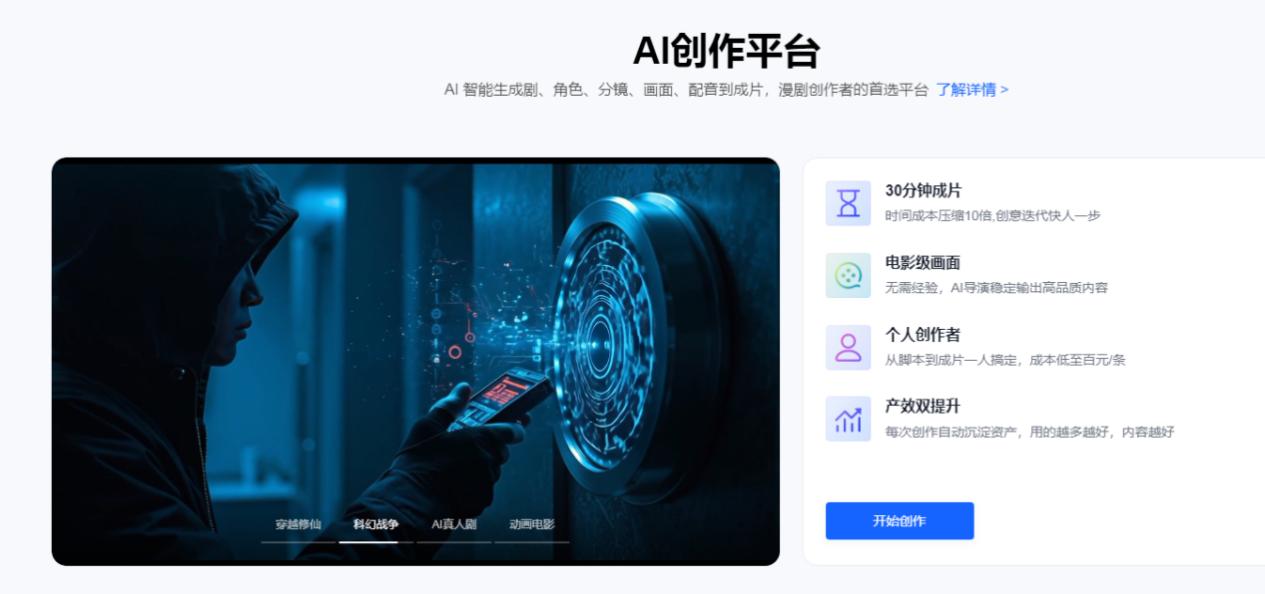
The production cost of a single script can be reduced by 80%. A single person can complete the entire finished film without the need to spend time and effort building a director team and finding actors like live-action short dramas or traditional animation dramas. The only costs incurred are the Token calls and product recharge fees.
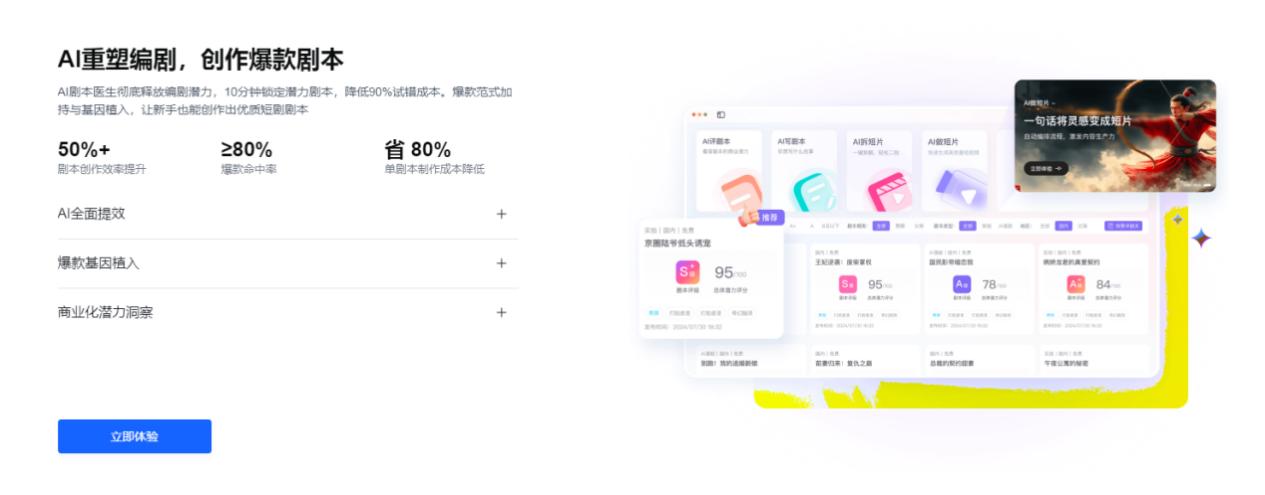
AIGC tools themselves have positive industrial value. They can greatly lower the threshold for content creation, allowing online novel authors without art foundations to independently complete finished films, spawning a large number of low-cost niche content.
However, due to the extremely low production threshold and the infinite imagination of the emerging field of AI animation dramas, a large number of laymen and small studios with no content experience, no compliance awareness, and no technical accumulation have rapidly poured in in a short period of time. Due to the convenience and high productivity of AI tools, the entire industry has directly faced a situation of uneven quality and overcapacity.
In addition, due to the inherent templated characteristics of AI tools, coupled with the fact that most content creators do not actually pay much attention to "content" itself, but mainly follow the routine of copying existing online IPs, the homogenization of AI animation dramas is particularly serious.
According to 36Kr, due to the reduced technical threshold and the convergence of underlying production tools, AI animation dramas have highly similar themes, art styles, and routines, especially in tracks such as "cultivation of immortals" and "time travel" which are severely crowded. This accelerates user aesthetic fatigue, makes it difficult for works to break through conventions in visual presentation and narrative form, lacks refreshing highlights that can break into the mainstream, and the phenomenon of "same script with different paintings" is rampant in the industry.
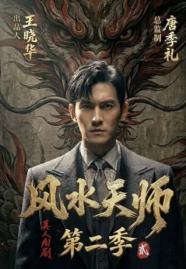
Even though "Feng Shui Master" set a track record of over 100 million views in 12 hours in its first season, the number of favorites shrank by half directly after the second season sequel was launched, and the peak popularity plummeted. The homogenized master-themed works can no longer arouse user freshness.
AI animation dramas lack appeal to good screenwriters and good stories. Most creations still remain at the simple replication of successful routines, leading to an awkward situation where AI animation dramas quickly have products but no excellent works. The lack of high-quality and differentiated original content is directly limiting the expansion of the core audience base of AI animation dramas.
High-quality content is scarce, and most creators hope to acquire users through paid traffic. The common problem of "heavy investment in promotion, light investment in production" has also led to a distorted cost structure. Producers compress production costs to allocate more budget to later promotion under the fixed total project budget, hoping to quickly recover funds, thus forming a vicious cycle that continuously overdraws the overall content ecology and audience reputation of AI animation dramas.
II
"Foolish Audiences" Are No Longer Sufficient
A large number of audiences' disappointment with AI animation dramas did not happen overnight, but was caused by three reasons: visual perception, emotional involvement, and content demand.
First, the templated AI faces, which is also the most criticized defect by users. In June this year, the topic of "physiological aversion to AI faces" once became a hot search, with a total of 52 million views and 20,000 netizens participating in discussions. The standardized AI facial features and unified templated character models generated by batch assembly lines make the appearances of characters in different episodes highly similar.
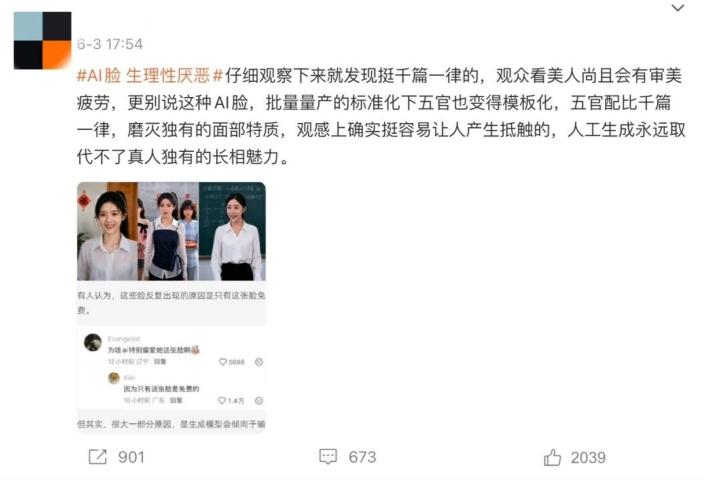
Image source: TMT Media
Audiences find it difficult to distinguish character images, leading to a continuous decline in their sense of involvement. According to DataEye-ADX industry version data, in May 2026, the number of new AI dramas/animation dramas launched on Douyin's native platform was 39,500, a decrease of 10.43% compared to April. The total views of new dramas reached 1406.28 billion, a month-on-month increase of 7%, but the growth rate has dropped significantly compared with the 176% month-on-month growth rate in April.
Second, AI-generated images lack emotional appeal, breaking the audience's sense of involvement. Although AI tools provided by platforms such as Volcano Engine can automatically generate images, algorithms cannot recognize the core of the plot. The same set of body templates is used for joys, angers, sorrows, and happiness. The micro-expressions of characters are empty and stiff, lacking the human touch and dramatic tension that live actors and hand-drawn characters naturally have.
Repetitive and stiff AI facial expressions and homogenized character designs will quickly wear out users' viewing patience, directly lowering core data such as completion rate and rewatch rate.
According to data from iiMedia Research, nearly half of the users pointed out that AI animation dramas have obvious deficiencies in the unity of picture style and the emotional expression of dubbing. Deepening character shaping, optimizing user interaction and community operation, and optimizing themes and audiences are the main aspects that domestic users expect animation dramas to improve.
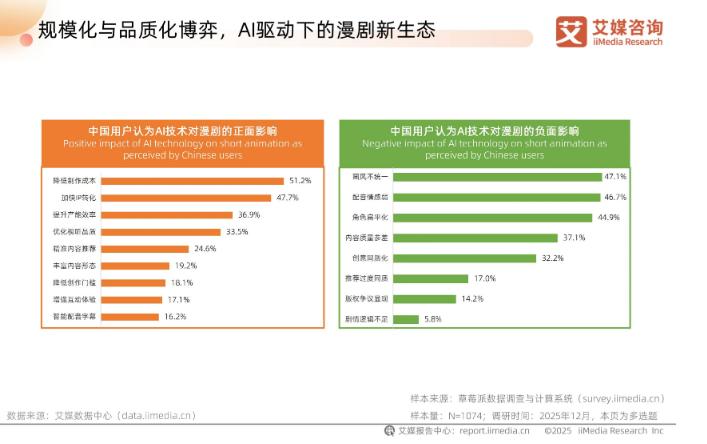
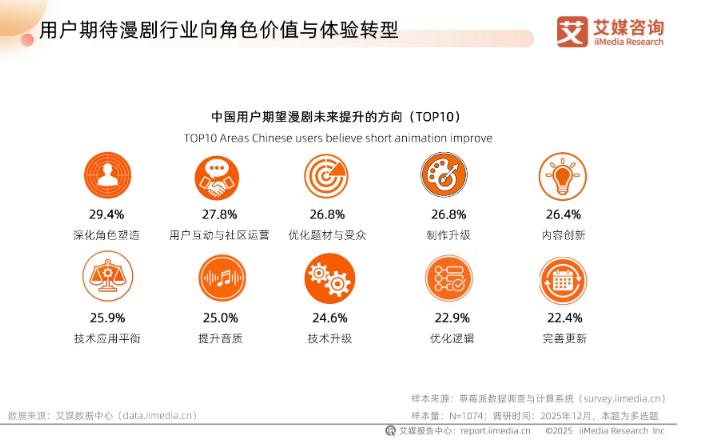
Image source: iiMedia Research
Finally, user content demands have upgraded. At present, the audience's demand for AI animation dramas has shifted from trying out AI technology to pursuing complete narratives, three-dimensional character designs, and delicate emotional value. The extensive approach that purely relies on mass-produced AI templates and piles up the number of plots can no longer drive traffic growth.
For example, "The Demi-Gods and Semi-Devils" (produced by Sparkly Key Animation) as a yearly blockbuster, its peak number of online viewers plummeted from 90,000 to just over 20,000, and the number of followers decreased by more than 30%.
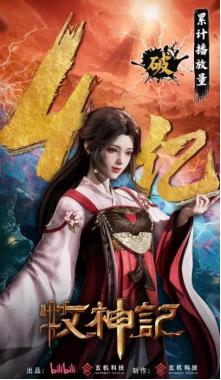
The core contradictions that make audiences abandon the drama are concentrated in two points. First, the plot is extremely dragging, with only one chapter of the original work advanced per episode, and the narrative rhythm is loose. Second, in the later stage, AI is widely abused to generate backgrounds in batches, resulting in blurry images and dazzling colors, which triggers concentrated complaints in the bullet screens that "the AI flavor is too strong" and the hand-drawn texture disappears.
If the industry continues to ignore the polishing of character images and the upgrading of picture quality, the pressure of subsequent user loss and further shrinking traffic will only continue to intensify.
III
From Production to Launch to Commercialization, Is the Ecological Chain of AI Animation Dramas Narrowing?
If the templated AI technology leading to user loss is an external factor, then the three major industry chaos spawned by the assembly line are the core internal factors for the continuous loss of AI animation drama users.
First, the theme narrative is highly solidified, with low content innovation capabilities. At present, more than 90% of the AI animation dramas on the platform are concentrated in four major templates: rebirth and counterattack, son-in-law slapping in the face, system apocalypse, and wealthy family revenge. The narrative logic is highly unified: being humiliated at the beginning, a strong reversal within three minutes, and dense accumulation of pleasure points throughout the whole process.
Creators only need to change the names of characters and slightly adjust the background to complete a reskinned new launch. Without the supply of original themes and differentiated plots, long-term repeated content will raise users' aesthetic threshold and completely consume their sense of freshness.
According to DataEye data, there were more than 50,000 animation dramas on air in December 2025, of which 96 had over 100 million views, with a hit rate of only 0.18%. By February this year, the number of animation dramas on air soared to 120,000, but the number of works with over 100 million views was less than 150, and the hit rate further dropped to 0.12%. Under the massive supply of works, high-quality content is extremely scarce.
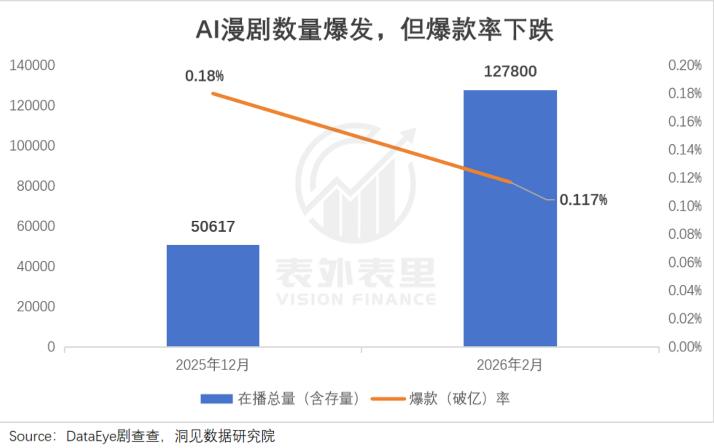
Image source: Insight Data Research Institute
Second, the long-term narrative logic of AI animation dramas is generally flawed. Large language models are good at shaping fragmented conflicts, but they do not have complete long-term narrative capabilities. The vast majority of episodes have the common problem of being high-energy in the early stage and ending badly in the later stage, with plot foreshadows not being retrieved and character designs being inconsistent before and after.
Creators ignore the emotional core and narrative logic of the story itself. There are many cases where there is only a visual shell piled up by AI, and they deliberately add water to lengthen the episodes and force reversals to sacrifice the integrity of the story, losing the tension and warmth that "dramas" should have, leading to a significant decline in users' willingness to follow updates.
Third