The AI "Great Leap Forward" is so overwhelming that even Google and Tesla can no longer hold up.
In the early hours of July 23, Beijing time, U.S. stock tech giants Alphabet (parent company of Google) and Tesla released their Q2 2026 financial results almost simultaneously.
Judging purely from revenue figures, both companies can be rated as "top performers".
For instance, Alphabet's Q2 revenue reached $119.796 billion, up 24% year-on-year, marking the 12th consecutive quarter of double-digit growth. Google Cloud surged 82% to $24.8 billion, becoming a standout growth driver.
Tesla also posted its "strongest quarter on record", with Q2 revenue of $28.236 billion, up 26% year-on-year and hitting its highest growth rate in three years.
However, the capital markets did not cheer for these two sets of results.
After earnings releases, Google's after-hours share price fell nearly 5% at one point, while Tesla's dropped over 4% after hours. The market's anxiety stems not only from the substantial "artificial component" in Google's net profit, or Tesla's continuously eroding gross margins amid the automotive price war.
More importantly, for both Google and Tesla, AI investments are burning cash at an alarming rate, leading both giants to record negative cash flow for the first time simultaneously.
In the past, capital was willing to tolerate heavy investments; but now, the market is growing wary about when massive capital expenditures will finally translate to stable profits.
Clearly, the market has put forward a more direct proposition: amid the AI Great Leap Forward, even the world's most profitable tech giants are starting to struggle to keep up.
01
Both Are "Losing Blood"
It can be said that both companies boast impressive revenue figures, but they cannot hide their "internal bleeding".
Let's look at Google first.
With quarterly revenue of $119.8 billion and net profit of $112.1 billion, surging 298% year-on-year, these numbers alone would suggest Google delivered an absolutely outstanding performance this quarter.
But a closer look reveals that Google's explosive net profit growth was mainly supported by around $99 billion in equity investment gains, including unrealized profits from holdings in companies like Anthropic and SpaceX.
After excluding these "paper profits", Google's adjusted earnings per share stood at $2.85, below Wall Street's prior expectation of $2.89.
What made the market catch its breath in shock was the cash flow situation.
This quarter, Google's capital expenditures reached $44.92 billion, almost doubling year-on-year. As a result, its free cash flow directly turned negative at $5.9 billion.
This is the first time Google has posted negative free cash flow in a single quarter since its IPO. Simply put, Google spent $5.9 billion more than it earned in one quarter.
During the earnings call, Google's Chief Financial Officer Ruth Porat not only failed to reassure investors, but added fuel to the fire. She noted that Google had just raised its full-year capital expenditure guidance to $195–205 billion, with spending set to increase "significantly" again in 2027.
Thomas Monteiro, an analyst at Investing.com, commented: "The most reliable cash flow generator in the market is now spending more than it earns."
To fill this "gap", Google has even gone out to "borrow money". Earnings data shows Google recently issued $49.6 billion in new shares, along with $20.3 billion in bonds.
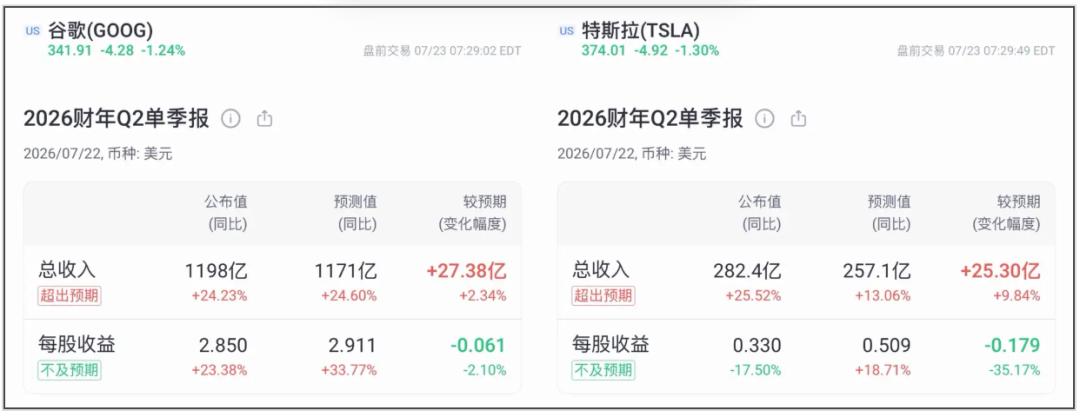
Figure: Summary of Google and Tesla Financial Results Source: Screenshot of "Tingting Tech" via Tiger Brokers
Turning to Tesla, its situation is even more awkward.
Car sales hit a record high, but the money didn't follow.
In Q2, Tesla delivered 480,000 vehicles, up 25% year-on-year to an all-time high. However, net profit attributable to common shareholders was only $1.114 billion, down 5% year-on-year. Adjusted earnings per share came in at $0.33, a full 35% lower than the market expectation of $0.51.
Where did the profits go? One answer is that they were eaten up by operating expenses.
In Q2, Tesla's operating expenses surged 47% year-on-year to $4.35 billion. This drove its operating margin down directly from 4.1% in the same period last year to 1.4%. CFO Vaibhav Taneja added that these expenses would only go higher for the rest of the year.
On one hand, operating expenses are skyrocketing; on the other, capital expenditures are rising rapidly. Earnings data shows Tesla's Q2 capital expenditures reached $5.789 billion, a 142% year-on-year surge.
These expenses mainly include the expansion of the Dojo supercomputer cluster at the Texas factory, the deployment of battery production lines at Giga Texas, ongoing testing of the Robotaxi fleet across multiple U.S. cities, and continuous reworking and debugging of the Optimus robot's mass production lines.
During the earnings call, Elon Musk made a rare show of frustration, stating that Optimus is the hardest product Tesla has ever attempted to mass-produce. "When making cars, we can buy wheels and rearview mirrors from outside, but there is no existing supply chain for robots. We have to build everything from scratch ourselves."
This also led Tesla's Q2 free cash flow to drop directly from a positive $1.44 billion in Q1 to negative $1.09 billion, marking the first time Tesla has posted negative free cash flow in a single quarter in over two years.
02
Racing Headlong Into the AI "Great Leap Forward"
In fact, the core reason that has trapped both Google and Tesla is that the AI or robotics industry they are currently investing in seems like a bottomless pit, leaving very little cash left on their balance sheets.
Google is a veritable AI infrastructure fanatic, and its heavy investments did not start this year.
In 2023, Alphabet's capital expenditures stood at $32.3 billion. In 2024, that figure jumped to $52.5 billion. By 2025, Google's full-year capital expenditures surged to $91.45 billion, almost entirely poured into AI infrastructure.
But all of this is just an "appetizer" compared to 2026.
In February this year, Google estimated 2026 capital expenditures would be $175–185 billion. By Q2 this year, that guidance was raised again to $195–205 billion.
Where is all the money being burned? In Q2, out of Google's $44.9 billion in capital expenditures, roughly 60% went to servers, and 40% to data centers and network equipment.
In addition, Google is expanding data centers worldwide, purchasing large batches of TPUs and NVIDIA accelerator chips, building the Gemini training cluster, and scaling up its Virgo supercomputing network.
Currently, the Gemini model API can process 220 billion tokens per minute; the Gemini App has 950 million monthly active users; and the cloud business's backlog of orders has exceeded $514 billion. But these achievements still have a long way to go before they turn into tangible, real-money profits.
When pressed by analysts about "when the investment will pay off", Google CEO Sundar Pichai admitted: "Returns are still in the early stages."
Now let's look at Tesla.
In fact, if Google's AI Great Leap Forward is described as "spreading its bets widely", then Tesla is "betting its entire existence" on this push.
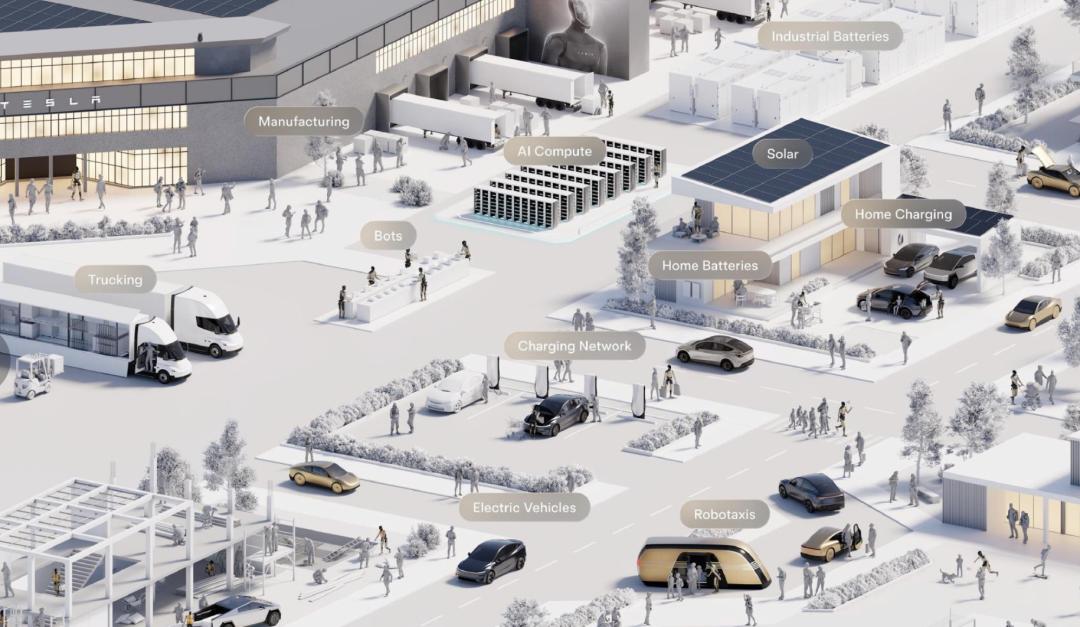
In 2025, Tesla's annual revenue declined for the first time, and the ceiling of its automotive business is increasingly coming into view. Elon Musk decided to pivot Tesla into a "physical world AI company". In early 2026, Musk directly announced that AI and robotics would become the core business focus going forward, and the company would no longer pursue larger automotive sales volumes.
To break open new AI growth avenues, Tesla invested about $10 billion in the AI space back in 2024, even before the business restructuring was announced, and around $8.5 billion in 2025. By 2026, that figure has been pulled up directly to over $25 billion, almost three times the 2025 level.
Nearly $20 billion of this $25 billion is directly allocated to AI-related projects, including Dojo computing power, data centers, Robotaxi self-driving taxis, and the Optimus humanoid robot.
By Q2 2026, Tesla's capital expenditures hit $5.789 billion, up a whopping 142% year-on-year. During the earnings call, Musk reiterated that this year's capital expenditures are expected to exceed $25 billion, and will continue to grow over the next two to three years.
Meanwhile, to support this high-stakes gamble, Tesla is seeking to secure a debt financing line of up to $30 billion.
But the problem is, investments are racing ahead, while returns are still nowhere in sight.
This is rooted in real-world realities. For example, the Robotaxi service is currently operating in Austin, Dallas, and Houston, but its fleet size is a tiny fraction of Waymo's. Even Optimus's mass production lines are still undergoing reworking and debugging.
While active FSD subscriptions stand at around 1.5 million, up 56% year-on-year, this revenue is simply a drop in the bucket compared to AI capital expenditures.
Tesla CFO Taneja openly acknowledged that the company is in a "large-scale investment cycle". A Morgan Stanley analyst put it more politely but plainly: "With capital expenditures doubling and free cash flow turning negative, investors are watching closely whether this money can truly strengthen Tesla's AI moat."
Overall, both Google and Tesla have chosen different AI paths. But what they have in common is that the consensus to push forward this AI investment leap is extremely strong, and the speed at which cash is being burned is clearly visible.
03
Winner Takes All, or Collective Overdraft?
The market is increasingly feeling that in this era of collective AI advancement, the industry may be creating a collective financial illusion.
Beyond Google and Tesla, if we shift our gaze back to China, a similar scenario is playing out.
Public information shows that ByteDance is discussing raising its 2026 capital expenditures to as high as $70 billion, with all funds directed to data centers and AI computing infrastructure.
There are also reports that to "replenish ammunition" for this "arms race", Byte is in talks with multiple banks to secure roughly $20 billion in new offshore loans.
On Alibaba's side, CEO Wu Yongming has explicitly stated that for the next five years, AI infrastructure investment will be "far exceeding" the previously announced plan of 380 billion yuan over three years. But the cost is that in the fourth quarter of fiscal 2026 alone, Alibaba posted an operating loss of 848 million yuan, with free cash flow recording an outflow of 173 billion yuan.
At Tencent, in Q1 2026, AI-related capital expenditures reached 37 billion yuan, a single-quarter record high, with full-year AI spending projected to be around 90–100 billion yuan. At the same time, Bank of America Securities also raised its forecast for Tencent's 2026 capital expenditures to 185 billion yuan.
The entire industry is sprinting forward, but capital's patience is dwindling.
An Investing.com analyst stated directly: "As long as revenue keeps growing, investors can tolerate it. But capital costs are a real factor, and the margin for error is shrinking every quarter."
Divisions on Wall Street are also widening.
Peter Berezin, Chief Economist at BCA Research, believes the U.S. stock market is in an "earnings bubble" phase. Chip sales directly boost suppliers' revenue and profits, while cloud computing companies typically treat chip purchases as capital expenditures. As a result, reported profit growth may overstate actual cash flow improvements.
Regarding the market's divergence, many analyses point out that the industry's "lack of patience" mainly stems from the fact that in the past, the market was willing to pay for "disruptive innovation" with extremely high tolerance. But in 2026, the high interest rate environment has not fundamentally changed, and money remains expensive.
The most direct manifestation is that capital has reacted quickly.
After earnings releases, Google's after-hours price fell nearly 5%, and Tesla's dropped over 4%, as investors directly voiced their concerns about "rising spending without rising cash returns".
More notably, shortly after Google and Tesla released their earnings, the content of a 4-hour investor meeting held earlier by DeepSeek founder Liang Wenfeng began circulating within the industry. During the meeting, he repeatedly emphasized one word: restraint.
Liang Wenfeng stated: "Restraint is a kind of strategy." He explained: "I have no doubt that AGI will have enormous commercial value. On this basis, my top priority is not to grab as much market share as possible, but to increase the probability of success. The more restrained you are, the more likely you are to achieve this goal."
In Liang Wenfeng's thinking framework, the AGI market space is vast enough. Short-term traffic, orders, and niche sector dividends are merely "sesame seeds", while conquering artificial general intelligence is the ultimate goal.
However, blindly launching multiple fronts and chasing every trend will only disperse computing power, talent, and capital resources.
Therefore, DeepSeek has abandoned tracks like video generation and consumer super apps, concentrating all its resources on the AGI main line, refusing to get dragged into an all-out capital consumption war.
On one side, global tech giants and large domestic firms are willing to burn through their own cash flows to start an unlimited AI capital race, chasing short-term market share. On the other side, AI entrepreneurs believe in the "philosophy of restraint", actively making strategic cutbacks and prioritizing the success rate of their ultimate goal.
In fact, neither of these two paths is absolutely right or wrong, but they pose a question: in the final AI competition, will victory come from continuous, endless capital investment to build an advantage, or from extreme focus, avoiding disorderly consumption, and steadily advancing toward the finish line?
AI is undoubtedly the future, but one thing is certain: if the end of this cash-burning game comes at the cost of a collective financial overdraft by tech giants, when the tide recedes, far more than just Google and Tesla will be left stranded.
This article is from WeChat Official Account "Tingting Tech", author: Yang Lin, editor: Rao Xiafei, republished with authorization from 36Kr.