Behind the 42-page exchange meeting transcript: The other half of the story Liang Wenfeng did not mention
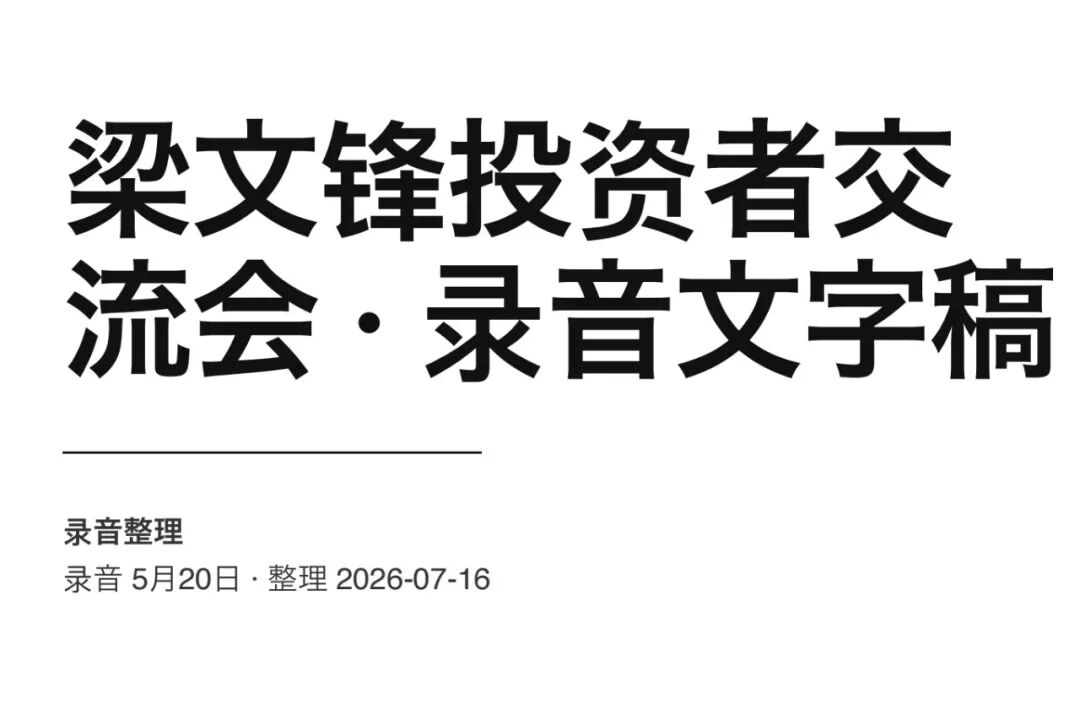
Today, the transcript of Liang Wenfeng's investor exchange meeting has gone viral across the entire internet.
The three-hour-plus recording was organized into a 42-page document, shared and praised by countless people, who commented "this is the true breadth of vision" and "the restrained entrepreneurial spirit".
In the document, Liang Wenfeng talks about vision, restraint, and open source.
He says that the original intention of building DeepSeek is not to maximize commercial profits, but to pursue things beyond money;
He says that the API pricing only aims to recover equipment costs within ten months, and reasonable profits are sufficient;
He says that assuming AI eventually accounts for 10% of humanity's GDP, even a tiny share for DeepSeek will be more than enough.
In this era where everyone is talking about valuations, IPOs, and monetization, a founder at the helm of a top-tier AI company who states he does not pursue profit maximization almost inherently carries an idealistic aura.
However, if we shift our focus away from DeepSeek to Liang Wenfeng's other business — High-Flyer Quant, then examine the equity structure behind his personal 20 billion yuan investment in DeepSeek, some interesting contradictions begin to emerge.
The Same Person, Two Sets of Business Logic?
Liang Wenfeng has two core companies: one is DeepSeek, which emphasizes vision, restraint, and reasonable profits; the other is High-Flyer Quant, a money-making machine operating at maximum efficiency.
Let's first look at the accounts of High-Flyer Quant.
According to data from Private Equity Ranking websites and multiple financial media outlets, High-Flyer Quant had assets under management exceeding 70 billion yuan in 2025, with an estimated scale that could exceed 100 billion yuan in 2026, making it a leading domestic quantitative private equity firm.
In 2025, High-Flyer's products posted an average return rate of 56.55%, ranking second among quantitative private equity firms with assets under management exceeding 10 billion yuan.
The private equity industry typically adopts a "management fee + performance compensation" fee model, where management fees generally range from 1-2%, and performance compensation ratios are around 20%-25%.
Based on a rough calculation using a 70 billion yuan scale and 56.55% return rate, High-Flyer's management fee income alone in 2025 was approximately 7-1.4 billion yuan, with performance compensation reaching around 7.9 billion yuan, bringing total annual revenue to over 8 billion yuan.
This is no ordinary company — it is a highly precise, astonishingly efficient money-making machine.
Of course, this does not mean High-Flyer has done anything wrong. As a private equity fund management institution, generating returns for clients is inherently its core business responsibility.
DeepSeek pursues AGI, and the two businesses face different clients, responsibilities, and competitive landscapes, so naturally they can adopt different profit strategies.
But this also raises a more thought-provoking question:
If "restraint" and "reasonable profits" are the universal philosophy Liang Wenfeng applies across all his business activities, why are these principles not similarly reflected in High-Flyer's business model?
Liang Wenfeng says "the more restrained you are, the easier it is to succeed" — then why isn't High-Flyer restrained? Why does it maximize profit extraction from the market?
The same founder, the same set of management philosophies, yet two businesses exhibit diametrically opposite profit strategies.
Is this ultimately due to different visions, or different narratives?
The Real Accounts Behind DeepSeek's Absolute Controlling Stake
The second contradiction is hidden within DeepSeek's financing structure.
In June 2026, DeepSeek completed its first round of financing at a scale of approximately 500 billion yuan, with a post-money valuation of around 3.5 trillion yuan (500 billion USD).
In this financing round, the largest single investor is not Tencent, not CATL — it is Liang Wenfeng himself, who personally invested 200 billion yuan, accounting for 40% of the total financing amount.
Where did this 200 billion yuan in personal capital come from?
Public opinion widely agrees that High-Flyer is the critical foundation that allowed Liang Wenfeng to support DeepSeek.
Liang Wenfeng is the actual controller of the High-Flyer system, holding 85% equity in Zhejiang Jiuzhang Asset, and owning over 75% equity interests in Ningbo High-Flyer Quant. With High-Flyer generating billions in annual revenue, years of accumulation are more than sufficient to support this massive capital contribution.
What's even more noteworthy is the equity design.
Industrial and commercial penetration data shows that Liang Wenfeng directly and indirectly holds approximately 84.29% of DeepSeek's ultimate beneficial shares, and controls nearly 100% of the disposable voting rights.
Most external investors including Tencent, CATL, JD, NetEase, and IDG only enjoy financial income rights, with no voting rights, no board seats, and their relevant shareholdings are locked for five years.
In other words, capital injected funds into the company, but did not gain corresponding decision-making power.
This is an extremely centralized founder governance structure: a company valued at 3.5 trillion RMB, where the founder holds absolute final say.
Liang Wenfeng's explanation is that this structure allows him to avoid being influenced by capital's short-term demands and focus on long-term technological research and development.
This reasoning makes sense, but it does not explain everything.
If the goal is truly not to maximize commercial benefits, why hold 84% of the equity instead of diluting more shares to the team, employees, and the broader public?
If the vision is to benefit humanity, why not donate a portion of the equity to a foundation?
After DeepSeek completed its financing, Bloomberg estimated Liang Wenfeng's net worth at 36 billion USD, making him the world's richest large language model entrepreneur.
And this is only after the first round of financing. The proposed valuation for the second round of financing has already risen to 71 billion USD, and an IPO is also in preparation.
Once DeepSeek goes public, the return on Liang Wenfeng's investment could be tenfold, or even dozens of times.
Of course we can say Liang Wenfeng has ideals and a sense of purpose, but in this story, ideals and sentiment have never been mutually exclusive with commercial interests — they are two sides of the same coin.
If the Vision Is Pure, Why Not Adopt a Non-Profit Structure?
If DeepSeek's vision is truly to "transcend money" and "benefit humanity", why is the company structured as a purely for-profit limited liability company?
OpenAI was initially founded as a non-profit organization, with the mission of "ensuring that artificial general intelligence benefits all of humanity". It was not until 2019, when training costs skyrocketed, that it transitioned to a capped-profit structure that set a 100x return cap for investors.
After further adjustments in 2025, the non-profit foundation still retains ultimate control over OpenAI.
Non-profit structures, profit caps, public welfare foundations, and public trusts — these are all institutional designs intended to "make technology benefit humanity". They use legal and structural constraints to curb commercial impulses, rather than relying solely on the personal integrity of the founder.
But what about DeepSeek?
There is no non-profit parent company, no profit cap mechanism, no public welfare foundation, no public trust. It is a standard for-profit limited liability company.
Liang Wenfeng once said a phrase himself: "Vision is not a slogan hung on the wall — vision is about what you do, not what you say."
This is an excellent statement, so let's look at what he has done:
If he truly believes in "restraint", High-Flyer Quant could also set a profit cap, and invest excess returns into public welfare AI research;
If he truly believes in "benefiting humanity", DeepSeek could donate a portion of its equity to an independent foundation;
If he truly believes in being "vision-driven", he could use a legal structure to ensure the vision does not change with the founder's personal whims.
Writing this far is not meant to denigrate Liang Wenfeng, nor to dismiss DeepSeek's technical achievements.
On the contrary, DeepSeek has managed to become one of China's top-tier large model companies in just a few years, and its technical capabilities are beyond doubt.
As a founder, Liang Wenfeng's strategic vision and execution capabilities are both at the top tier.
Restraint, as a business strategy, is indeed extremely brilliant — by proactively giving up partial profits, it wins over the developer ecosystem, talent recognition, and public goodwill, ultimately capturing a larger market share.
The problem is not whether restraint is good or bad, but whether we should deify a brilliant business strategy into a moral virtue.
When someone reaps high profits through High-Flyer Quant on one hand, while telling the story of restraint through DeepSeek on the other, we might as well ask one more question:
Is this ultimately two sides of the same person, or two expressions of the same business acumen?
The answer is left for each person to judge for themselves.
This article is from the WeChat Official Account "World Model Workshop", authored by World Model Workshop, and published with authorization from 36Kr.