Exclusive Interview with Guo Lie: After creating hit products such as FaceMoji, FaceU and CapCut, he elaborates for the first time on how to develop products in the AI era.
Text by | Xinyu ZHOU
Edited by | Yuxin ZHANG
What kind of AI entrepreneur profile will attract widespread attention? Different investors may have different answers in their minds, but one of them must be: the Jianying (CapCut) faction.
Mian CHEN, the creator of popular creative tools such as Lovart and LibTV; Chaoming MING, founder of YouWare, an AI Coding community, the most popular post-95s entrepreneur in the 2025 primary market; Nao NAO, whose AI video creation tool OiiOii has received investments from GL Ventures and Jinqiu Capital......
Their resumes share one thing in common: they once worked in the Jianying and CapCut teams — participating in the polishing of these two products with over 100 million daily active users, which gives investors reason to believe that this group of "Jianying faction" entrepreneurs understand users, have product aesthetics, and are more likely to seize consumer-grade opportunities in this AI wave.
But for a long time, the true originator of the "Jianying faction", Lie GUO, has hidden himself in the AI wave that started in 2022.

△ Lie GUO, founder of Flova, Meng Face and FaceU. Source: Photo provided by the interviewee.
As the founder of Meng Face and FaceU, he once created some of the most successful C-end tool products in China's mobile Internet era. In 2018, the Meng Face team was acquired by ByteDance for approximately 300 million US dollars.
After that, Lie GUO began to be responsible for ByteDance's imaging business, and participated in incubating a series of products such as Jianying, CapCut, Xingtu, and Qingyan. In 2022, he established his own game company "Boat Island Games".
But two years later, Lie GUO, who ended his game entrepreneurship, disappeared from the public view. Until October 2025, a video creation Agent named Flova.ai was launched globally.
The overall usage logic of this video creation Agent is similar to most tools on the market: through conversations, Agents encapsulated with different capabilities can complete script creation, character design, storyboard design, final film generation and editing work.
But Flova is a bit different. For example, it does not adopt the most mainstream canvas form to allow users to freely create nodes; for another example, many early Flova users gave us feedback that Flova's "memory" and semantic understanding are very outstanding among similar products, "after creating more than a dozen episodes, it can still remember a certain storyboard from the first episode".
During his nearly one year of "seclusion", the one thing Lie GUO and his team thought about the most was: how to design products for both humans and Agents at the same time?
"When I was making Meng Face and Jianying, I only needed to think about how to make people feel easy to use. But in the AI era, you must provide Agents with sufficiently flexible containers," he told us.
This proposition inherently has a sense of contradiction: human users need a space that supports infinite divergence of creativity, but to maximize the intelligence of Agents, the Context must be sufficiently orderly and structured.
In the end, the team's answer was to set the product container as a work panel that can freely switch views.
In the "Conversation" area, users issue instructions to the Agent through natural language, that is, let the Agent receive the Context; and the process of the Agent executing operations will be directly presented in the "Storyboard" area. Once a new idea comes up, users can interrupt and adjust the Agent's workflow at any time, and the visual effect of each step will appear in the "Preview" area.
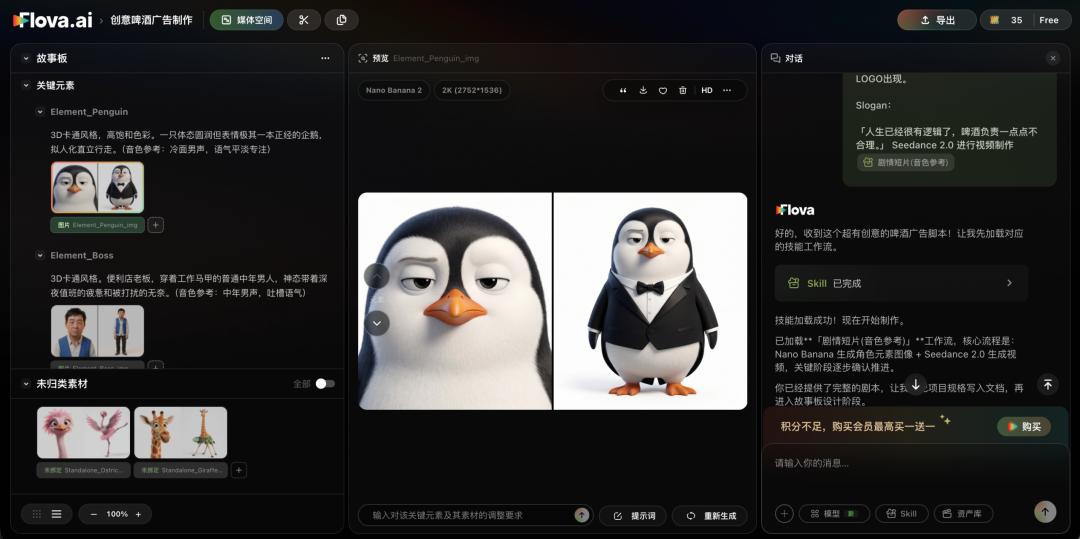
△ Flova.
For a long time after starting his business, Lie GUO rejected many TS (Term Sheets) thrown by investors. "Intelligent Emergence" learned that since its establishment, Flova has completed two rounds of financing led by HSG, IDG Capital and Yunjiu Capital, with a total amount of 80 million US dollars — among them, IDG Capital and Yunjiu Capital are still the old shareholders of Meng Face.
In the current atmosphere of generally pursuing "large-scale financing" and "rolling financing", this figure can be described as restrained. The reason given by Lie GUO is: for an Agent product, 80 million US dollars is already enough. What really matters is products, growth and business cycles, not the cash figure in the account.
Lie GUO has always been an emotional person. He is a 20-year fan of "One Piece", a film enthusiast, and starts businesses and builds teams "based on interests" and "by fate". For more than 10 years, this sensibility has also driven him to continuously create interesting image and video creation tools.
But different from 10 years ago, Lie GUO has become more rational now. After Meng Face was merged into ByteDance, he described himself as "making up lessons" — systematically learning how to do A/B Tests, team management, growth and commercialization.
The glory of the Internet era has passed. Standing on the new battlefield of AI, Lie GUO needs to re-understand humans and Agents like a novice. He doesn't care whether what he does is consensus or non-consensus — in the end, all decisions will be explained by scientific observation results.
"Will there be pressure to continue your previous success when starting a business now?" we asked him.
"The enjoyment far outweighs the pressure," this is Lie GUO's answer.
Recently, we talked with the Flova team about how to make products for both humans and Agents, and how to compete with "ByteDance-like companies". The following is the conversation between "Intelligent Emergence" and Lie GUO, founder and CEO of Flova, Ruier, head of growth and commercialization, and Tang GUO, head of Agent products:
From Meng Face and Jianying to Flova
Intelligent Emergence: You have made many successful products before. Will you feel pressured to continue your previous success when starting a business now?
Lie GUO: Actually, there's not much pressure. This feeling is a bit like participating in the World Cup. No matter whether you win the championship in this session or not, you have to participate in the next one. The reason you participate is still that you are interested in playing football.
Flova is the direction I like, and I enjoy entrepreneurship far more than I feel pressured.
Intelligent Emergence: What is the driving force that keeps you making products?
Lie GUO: Both interest and positive feedback are very important. When you do something you are interested in and get positive results and feedback, it will become a steady stream of motivation. I watch a lot of movies and animations in my daily life, and I really like content creation itself.
Secondly, you will meet different partners in the process of making products, and growing together is also very meaningful.
Intelligent Emergence: How did you and Flova's founding team meet?
Lie GUO: Entrepreneurship itself has some randomness, it really depends entirely on fate. Everyone happens to be interested in content creation, and their methodologies and values are also very consistent. These fates are a bit like making products, which are more emotional.
Intelligent Emergence: You seem to be someone who enjoys the state of entrepreneurship, so why did you choose to join ByteDance in the middle?
Lie GUO: I had only worked for one year when I first started my business, which was more like a graduate starting a business. At that time, I had a big confusion: when a group of good friends start a business together, how to manage the company after it grows bigger?
So I chose to join ByteDance to make up for my management lessons. At that time, my mentality was like an intern, and ByteDance provided me with a lot of management methodologies. ByteDance's product methodologies also benefited me a lot, including how to drive product growth and achieve a positive cycle for a product.
Intelligent Emergence: Which methodologies are still timeless today?
Lie GUO: I used to make products more emotionally, and planned some product functions based on feelings. But ByteDance has a scientific A/B Test system. Of course, first of all, you have to propose A and B plans with sufficiently high quality, otherwise the Test will be useless.
I learned to make products by combining sensibility and rationality. When I put forward some hypotheses with sensibility, rational verification can provide timely support.
Another point is the collaboration between product and R&D. At ByteDance, technology has a strong voice, so technical colleagues are very proactive. Also, ByteDance's growth team and marketing team have extremely high freedom.
All in all, I used to be "partial in some subjects". After joining ByteDance, I completed all the courses in technology, growth, and commercialization. In addition to making a good product, I also learned how to survive.
Intelligent Emergence: Which ByteDance methodologies are not applicable to current entrepreneurship?
Lie GUO: ByteDance values OKRs very much. But I tried it when I was starting my game business and found it useless. The reason is that for large companies, management is very important. But the earlier management of a startup team should be as light as possible. Team building does not rely on management tools, but on internal drive. When the team grows larger, you need to set a minimum standard for employees' capabilities, so you have to set a passing line through some management tools.
Intelligent Emergence: You have been starting businesses for so many years. What do you think is the biggest difference between entrepreneurship in the AI era and entrepreneurship in the Internet era?
Lie GUO: The mobile Internet era was more about "end-side" changes from PC to mobile phones, or changes in traffic entrances from 3G to 5G, and from text to video.
But now we can clearly feel that there is a major technological update every once in a while, which requires you to be able to predict technological development, and have the ability to design products for the future. You need to know which problems can be solved through model iteration, and which ones need to be solved by the product itself or the Agent.
So now everyone in our team is paying attention to technology. Now that AI can do more things, everyone needs to share more Context, and information barriers must be reduced.
Intelligent Emergence: To do the same thing, does the team size required in the AI era smaller than that in the Internet era?
Lie GUO: Yes, the number of people is much smaller than in the Internet era.
But there are still some positions where AI cannot improve efficiency. For example, in marketing-related work, AI cannot completely solve the communication problems between people.
Ruier: Regarding AI efficiency improvement, I think AI Coding is not just about making one programmer as productive as five people, but reconstructing the collaborative relationship between product R&D, operation, and design.
For example, our company has built a lot of internal observation tools based on product Context and user Context. Based on these Contexts, we can efficiently complete a lot of work that was inefficient but inevitable in the Internet era.
Take the update of product capabilities as an example. In the previous era, product update requirements had to be synchronized with R&D, and everyone spent a long time aligning. But now, based on the shared Context, people from any position and perspective can participate in decision-making and collaboration.
Another example is the monitoring of user behavior. In the Internet era, you needed to make targeted product funnel tracking points, or temporarily launch questionnaires. Today's Agent system itself has a large amount of Context accumulation and semantic understanding of users. The flow of user information will be more complete, smooth, and more efficient.
Every creation of a video Agent is a continuation of previous creations
Intelligent Emergence: Before founding Flova, you also ran a game company "Boat Island Games". Why didn't you consider starting a business in the AI game direction?
Lie GUO: The core competitiveness of games is that they are fun enough. Compared with video content creation, games are a more complex carrier.
But games require coding and 3D modeling, so their maturity period will be later. For example, 3D games need to solve the rationality of modeling polygon count and skeleton binding, which are problems that AI is currently difficult to solve.
Intelligent Emergence: Why didn't the game company continue to operate at that time?
Lie GUO: Game entrepreneurship made me realize that I still need to make things that the times demand. At that time, the regulation of game version numbers was very strict, and users' requirements for high-quality games were also higher. After making games, I realized that my previous Internet entrepreneurship was very smooth.
In terms of my personal capability model, although I am very interested in the content creation industry, I am not a genius producer. What my team and I are better at is making products. If our products can allow more people to make better videos, that will also be very meaningful.
Intelligent Emergence: What was the opportunity that led to the founding of Flova?
Lie GUO: At the end of 2024, DeepSeek V3 was open-sourced, and at that time I felt that there was an opportunity to make AI applications.
At first, it was also driven by interest. I love movies, and sometimes I would handcraft some AI short films. At the beginning, I spent two weeks first generating reference images with Midjourney, then generating videos with Keling, adding post-production in Jianying, and handcrafting an AI short film of more than 3 minutes.
At that time, I felt that the workflow was relatively complicated, and the consistency of characters was not high. It just so happened that Agent technology was also developing. This form might be able to make up for the shortcomings of video generation technology and assist users in making AI videos.
Intelligent Emergence: Looking back, was that a good time to enter the Agent track?
Lie GUO: Entering the Agent track now is still in a very early stage, because AI has only been developed for three years.
Referring to the mobile Internet era, the iPhone was released in 2007, and Android was released in 2008, but the real explosion of applications happened from 2014 to 2016.
Intelligent Emergence: There are various directions for applications. How did you finally narrow down to the video creation Agent?
Lie GUO: At first, I wanted to make C-end applications, but Token prices were relatively expensive, so products for To B or professional creators would be more appropriate. I also had experience making Jianying before, so I would have a better understanding of creators' needs.
At that time, I was browsing Douyin, Bilibili, Xiaohongshu, as well as overseas TikTok and YouTube. It was obvious that AI content on social media was increasing. So AI content creation must be a big trend.
Tang GUO: As mentioned earlier, when we handcrafted videos together, we felt that the threshold was too high for most people.
It just so happened that Manus was released (March 2025), which gave us some inspiration. We realized that by letting Agents execute tasks, users' creative energy can be focused on aesthetic decision-making.
Intelligent Emergence: There are many companies in the same track as you, such as LibTV and OiiOii. How do you find your own position?
Ruier: According to different evolution stages of the industry, I divide AI video creation tools into three categories:
The first category is <