Unwilling to confine his business to selling water, Zhong Shanshan, the richest man, is making massive aggressive investments in hard-tech companies.
A traditional consumer giant that has never established a CVC (Corporate Venture Capital) arm or engaged in conventional financial investments has recently emerged as a standout player in the primary market.
"Nongfu Spring has been making remarkably aggressive moves lately," a primary market investor focused exclusively on hard tech sectors commented to Phoenix Tech.
For most people, Nongfu Spring founder ZHONG Shanshan is China's most successful water-selling businessman. With the iconic slogan "We don't produce water, we are just transporters of nature," he has long secured his position as China's richest person, and consistently refers to himself as a farmer in public remarks.
Despite being a listed company with a market capitalization of HK$480 billion, Nongfu Spring has never set up its own corporate venture capital department since its founding — a stark contrast to Alibaba and Tencent, which invested across nearly half of the internet sector during the internet era. Even Wahaha, a peer in the traditional consumer space, has its own CVC arm, Zhejiang Wahaha Venture Capital Co., Ltd., which has been actively making investments in smart manufacturing, robotics, new materials, and biomedicine. Back in 2021, 76-year-old ZONG Qinghou personally obtained a fund practice qualification certificate, which sparked widespread market discussion.
But since last year, the tide has been quietly shifting.
Phoenix Tech has learned from multiple independent sources that Nongfu Spring has significantly ramped up its activity in the primary market. By examining the equity structure of its affiliated Yangshengtang ecosystem, a side of ZHONG Shanshan far removed from the "water-selling" business has emerged: he is directing substantial capital at an unprecedented pace into semiconductors, sensors, synthetic biology, and even upstream materials for nuclear fusion.
In mid-July, embodied intelligence firm Acorn Robotics drew public attention for being founded by "9 Tsinghua PhDs" and its "instinct-driven technology roadmap." Few noticed that among the joint lead investors of the company's nearly 100 million-yuan seed round, there is an institution named "Qiantang Materials Laboratory Technology (Hangzhou) Co., Ltd."
Through equity tracing, this company is fully owned by Yangshengtang Co., Ltd. And the actual controller of Yangshengtang is precisely ZHONG Shanshan.
Around the same time, another major piece of news spread widely in the new energy circle: ZHONG Shanshan, via the Kunshan Gewuzhizhi Fund under Yangshengtang, invested approximately 500 million yuan in Zhejiang Zhibang Lithium Battery New Materials Co., Ltd., a solid-state battery material enterprise, securing roughly a 10% equity stake.
This reveals the unique investment logic ZHONG Shanshan follows: no pursuit of controlling stakes or public brand prominence, focusing on early-stage, small-scale investments with strong technological barriers. This approach is far more characteristic of a seasoned hard tech VC than an industrial capital player.
A Hidden Hard Tech Network
In 1993, Yangshengtang was founded, and Nongfu Spring was essentially spun off from the Yangshengtang system.
Yangshengtang's core investment platform is structured into three tiers: the top tier directly holds controlling stakes in two major listed companies, Nongfu Spring and Wantai Biological; the middle tier consists of fully owned industrial operation platforms, including Yangshengtang Pharmaceutical and the Institute of Natural Medicine; the bottom tier, which has been the most active in recent years, comprises two rarely public-facing entities: Kunshan Gezhi Phase I Venture Capital Partnership (Limited Partnership), also known as Gezhi Capital, and Hangzhou Qiantang Technology Co., Ltd., also called Qiantang Laboratory.
The former acts as an LP financial investment platform, while the latter undertakes the functions of hard tech pilot-scale testing and deep incubation. These two entities serve as key extensions for ZHONG Shanshan's hard tech investments.
Starting with Qiantang Laboratory: this 100% Yangshengtang-owned subsidiary invested in a large number of new materials companies in 2024. Entering 2025, its investment scope gradually expanded. In August of that year, it took its first equity stake in photonic chip firm Qiming Photonics, which claims to hold patents for lithium niobate-silicon nitride integrated devices and their fabrication methods, with product performance surpassing overseas competitors. In January 2026, it went on to invest in embodied intelligence company Acorn Robotics.
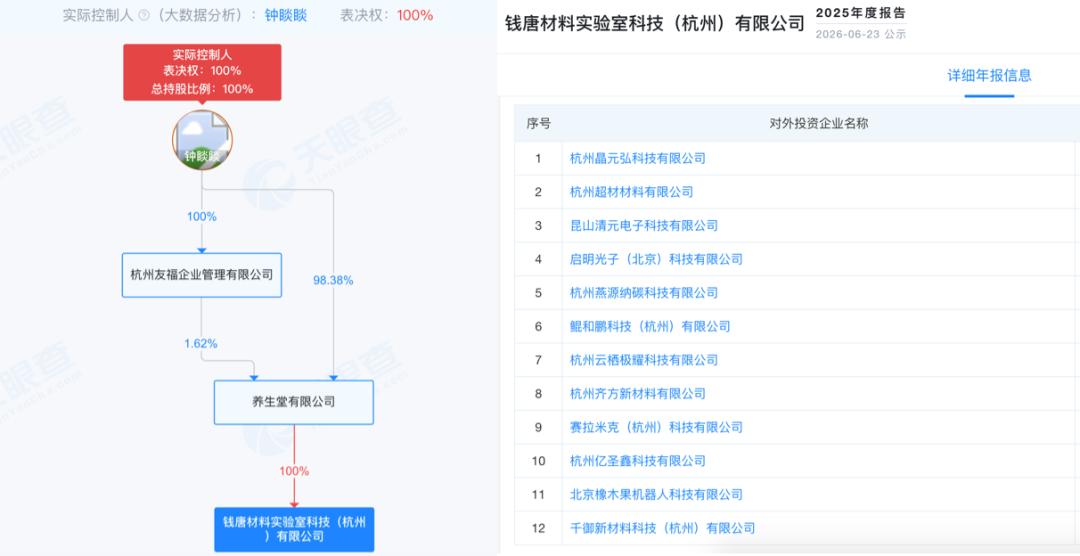
Gezhi Capital made its moves even earlier, conducting a series of concentrated investments in 2024, including Shanghai Liuyuan (focused on new energy materials and high-energy batteries) and Saicun Biological (engaged in bio-cryopreservation agent R&D). In 2025, it invested in Zhongke Tiansuan, a space computing enterprise, though it had fully exited this investment by June 2026. Also in 2025, it invested in Huake Lengxin, a provider of high-end micro-pumps and liquid cooling system solutions, and in early 2026, it made a large-scale investment in Zhibang Lithium Battery.
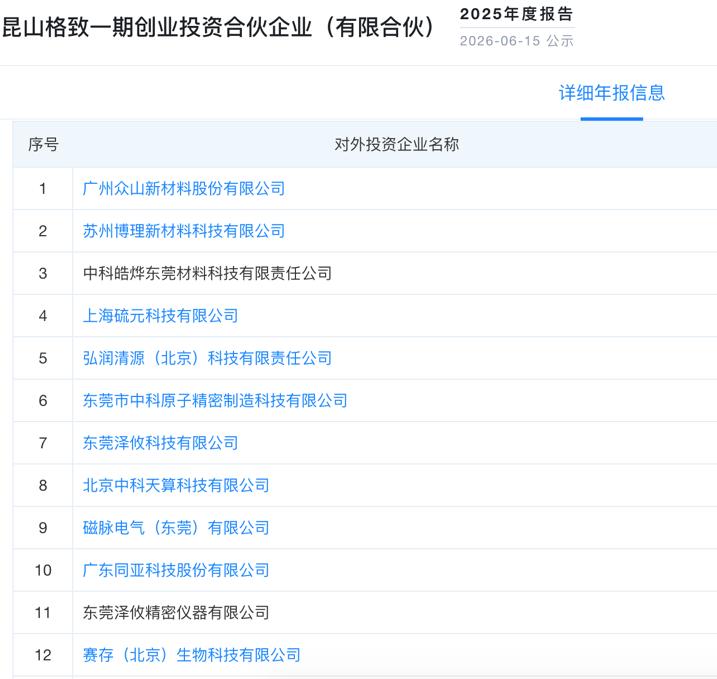
Since 2025, these two entities have entered a period of intense investment activity. Especially since the first half of this year, they have been actively expanding their hard tech portfolio, with a specialized focus on precision manufacturing, semiconductor equipment, and new materials.
The Richest Man Who Never Talks About Investing
Despite reaching the top of global wealth rankings, ZHONG Shanshan rarely discusses investment in public settings.
In 2025, during his appearance on the *Dialogue* TV program, he spoke about the differences between himself and Elon Musk: "What was I doing at 24? I only completed four years of primary school, and then worked as a farmer for 17 years. When Elon Musk was 24, he was already a PhD student at Stanford University." This remark was made in response to comparisons between the richest men of China and the US: "Elon Musk's path is about pushing the boundaries of technology. My experience makes me think more from the perspective of a farmer, about what I can achieve within the scope of my knowledge."
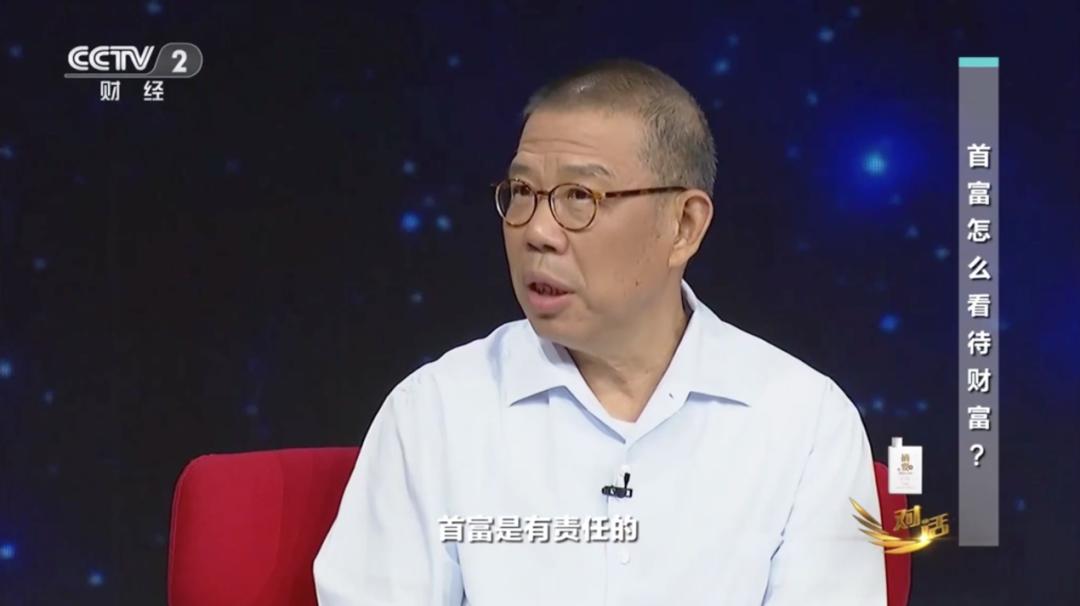
Figure | In April 2025, ZHONG Shanshan was a guest on the *Dialogue* program
Over the past decades, ZHONG Shanshan has consistently put this philosophy into practice.
Wantai Biological represents a special case from his early investment career. In 2001, ZHONG Shanshan completed a transaction that almost no one at the time could understand. He acquired Wantai Biological from a Hong Kong-based company for 17.1 million yuan — a small pharmaceutical enterprise that was barely surviving on a single low-end diagnostic reagent, with annual profits of just a few million yuan. After the acquisition, Wantai Biological was integrated into the Yangshengtang system, becoming an industrial asset under ZHONG Shanshan's personal controlling ownership.
This transaction drew no public attention at the time — that is, until 2018.
In that year, the domestically developed bivalent HPV vaccine "Cecolin," co-developed by Wantai Biological and Xiamen University, completed clinical trials and entered the marketing approval phase. On December 31, 2019, Cecolin was approved for launch, becoming the world's third and China's first domestically produced HPV vaccine. Prior to this, the global HPV vaccine market had been monopolized by GlaxoSmithKline and Merck for over a decade, with a single vaccine dose costing more than 3,000 yuan, putting it out of financial reach for many Chinese women who struggled to access it.
In April 2020, Wantai Biological listed on the A-share main board. Its share price closed at 44 yuan on the first trading day, followed by 26 consecutive daily limit-ups. By August of the same year, its market value exceeded 100 billion yuan. ZHONG Shanshan held more than 75% of Wantai Biological's shares through direct and indirect ownership, an asset that secured his position as China's richest person twice, in 2020 and 2021.
However, this investment approach is widely regarded as "unreplicable" in the capital circle. Not because of any extraordinary technological barriers, but because no venture capital fund can tolerate a 17-year holding period without exits, revaluation, or reporting returns to investors. Only capital that is completely unconstrained by return timelines — that is, personal capital — can operate this way.
A scientist who previously collaborated with Wantai Biological recalled in an interview with *Caijing*: "ZHONG Shanshan never interfered with project progress. He only asked one question at the annual meeting: Do you have enough funds? If not, we'll transfer more."
At the 2021 Nongfu Spring general meeting, ZHONG Shanshan responded to investor questions about diversification by stating: "Crossing boundaries does not mean crossing industries, but crossing dimensions. If you don't understand a field, you shouldn't venture into it. But once you grasp its underlying logic, and that logic aligns with your existing knowledge system, you can explore it."
But this time, by entering the hard tech track, ZHONG Shanshan has embarked on a thorough cross-disciplinary journey, breaking away from his long-held past adherence.
Take Acorn Robotics as an example: its core team consists of 9 PhDs from the Department of Mechanical Engineering at Tsinghua University and the Department of Neuroscience at Harvard University. Their proposed "instinct-driven" technology roadmap is entirely unprecedented, and appears particularly unconventional in an era where the entire embodied intelligence industry is fixated on iterating VLA models.
If the investment in Acorn Robotics was just a small test of his new strategy, then the 500 million-yuan bet on Zhibang Lithium Battery represents ZHONG Shanshan's first major heavyweight commitment in the hard tech sector.
Clues about this investment first emerged in May this year. On May 8, Zhejiang Zhibang Lithium Battery completed its Series A financing round, with Kunshan Gewuzhizhi Phase I Venture Capital Partnership as the lead investor. Equity tracing reveals that the core capital contributor to this fund is precisely Yangshengtang Co., Ltd., with a subscribed investment of approximately 500 million yuan, accounting for 81% of the fund's total shares. After the transaction, the fund holds roughly a 10% stake in Zhibang Lithium Battery, making ZHONG Shanshan an indirect major shareholder of this solid-state battery materials enterprise through this ownership structure.
In contrast to the low-key profile of Qiantang Laboratory, this 500 million-yuan investment has caused considerable stir in the new energy industry. After all, this marks ZHONG Shanshan's first foray into the new energy sector, and he immediately deployed a massive 500 million yuan into the widely recognized next-generation technology track of solid-state batteries.
Zhibang Lithium Battery was founded in March 2024, two months earlier than Qiantang Materials Laboratory, with its headquarters located in Quzhou, Zhejiang Province. Its technical leader, XU Xiaoxiong, is a doctoral supervisor at the Ningbo Institute of Materials Technology and Engineering, Chinese Academy of Sciences, with nearly 20 years of R&D experience in lithium battery materials, and previously served as a core technical staff member for the solid-state battery business at Ganfeng Lithium. The company has adopted a PVDF-based polymer solid electrolyte technology roadmap, while also concurrently advancing multiple technical routes including oxides and sulfides. It publicly announced a high-performance solid electrolyte patent as recently as April this year.
According to local disclosures from Quzhou, Zhibang Lithium Battery's annual 11,000-ton solid-state battery electrolyte production project is about to go into operation, and will supply critical materials to automakers including Geely and BYD in the future.
Despite the cross-industry nature of this new track, the investment logic remains consistent: the solid-state battery sector is currently a classic "gold rush" scene. Industry giants such as CATL, BYD, and Ganfeng Lithium have all entered the arena, and countless startups are pouring in, all competing to be the first to develop fully functional solid-state batteries and achieve mass production for vehicle installation. The cell manufacturing segment has already become a fiercely competitive red ocean, but solid-state electrolytes — the core material that accounts for over 40% of solid-state battery costs and determines battery performance and safety — still has not fully finalized its technology roadmap, with a very low domestic localization rate, making it a typical high-barrier, high-value-added upstream segment.
This is exactly the type of position ZHONG Shanshan prefers most.
At 71, Entering a New Battlefield: Why Has the Low-Profile Richest Man Changed?
In the public perception, ZHONG Shanshan is now an "elderly" figure.
At 71 years old, he has reached the age when many entrepreneurs choose to retire. He controls two listed companies: Nongfu Spring is the undisputed leader in China's bottled water market, with annual revenue of 52.553 billion yuan last year and a net profit of 15.868 billion yuan, earning it the nickname "Nature's Money Printer." Meanwhile, Wantai Biological, the domestic HPV vaccine leader, despite once delivering one of the most impressive stock price surges in the A-share market, has fallen into consecutive losses in the past two years. Even the continuously growing sales of its self-developed 9-valent HPV vaccine have failed to reverse its troubled operational situation.
It is precisely against this backdrop that ZHONG Shanshan has had to step back into the front lines, in search of the next "Wantai Biological."
This time, he has once again positioned himself at the very top of the industrial chain, consistent with his strategy over the past 20 years: he always enters the market at a time when most other people are skeptical.
He acquired Wantai Biological back in 2001, and waited 17 years for its HPV vaccine to finally launch on the market. In 2011, he launched the Oriental Leaf tea drink, which was widely mocked as "the worst-tasting tea" for a full decade. When the sugar-free beverage trend arrived in 2021, the product became a super blockbuster with annual sales exceeding 10 billion yuan. This time, he has made a massive investment in a solid-state battery materials firm that was founded only two years ago, at a time when the industry is still navigating the painful transition from "laboratory achievements" to "mass-produced commercial products."
In fact, his hard tech layout began quietly in May 2024 with the establishment of Qiantang Materials Laboratory. Over more than a year, spanning from robotic materials to solid-state battery electrolytes, from electronic chemicals to biomaterials, his investment matrix has gradually taken shape: all projects are centered on the core theme of "materials," and all investments are targeting the industrial foundation of the next decade.
With billions of yuan in cash flow generated annually, ZHONG Shanshan needs to secure new growth drivers for the next 10 years.
More importantly, he has recognized the profound shifts of the times.
Over the past four decades, opportunities for Chinese entrepreneurs were concentrated in the consumer sector, the internet sector, and business model innovation. But today, hard tech has become the most certain growth direction. From new materials to new energy, from robotics to semiconductors, all opportunities with real long-term value are located in the hard tech domain. And the very foundation of hard tech is materials.
This time, ZHONG Shanshan still has not chased the most hyped market trends. He has not dabbled in large language models, complete robot manufacturing, or new energy vehicles. Once again, he has chosen the upstream segment, focused on materials, selecting the most arduous, challenging, and seemingly unglamorous position — yet the one that delivers the greatest long-term value.
At 71 years old, ZHONG Shanshan is embarking on the third