With a revenue of 119.8 billion US dollars and its capital expenditure raised again, Google continues to "generate power for AI".
Google CEO Sundar Pichai. Image generated by AI
On July 22 local time in the United States, Google parent company Alphabet released its financial results for the second quarter of 2026, which ended on June 30. Total revenue for the quarter reached $119.796 billion, up 24% year-on-year; driven by a massive surge in equity investment gains, net income skyrocketed to $112.107 billion, with diluted earnings per share hitting $9.11.
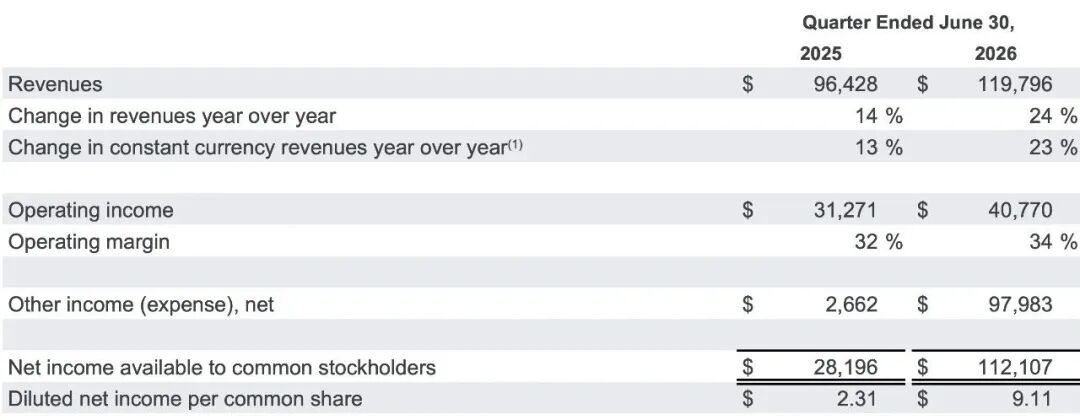
Key financial metrics of Alphabet
However, the strong financial results did not spark a rally in the capital market. After the earnings release, Alphabet's stock price fell more than 4% at one point in after-hours trading.
The lukewarm market sentiment reveals investors' deeper concerns amid the massive book profits: against the backdrop of a deadlocked AI race and a frenzied doubling of capital expenditure, can Google's robust cloud business and solid search fundamentals sustain the cash-hungry AI infrastructure expansion?
01. Business Breakdown: Cloud Business Surges 82%, Search and Advertising Fundamentals Remain Stable
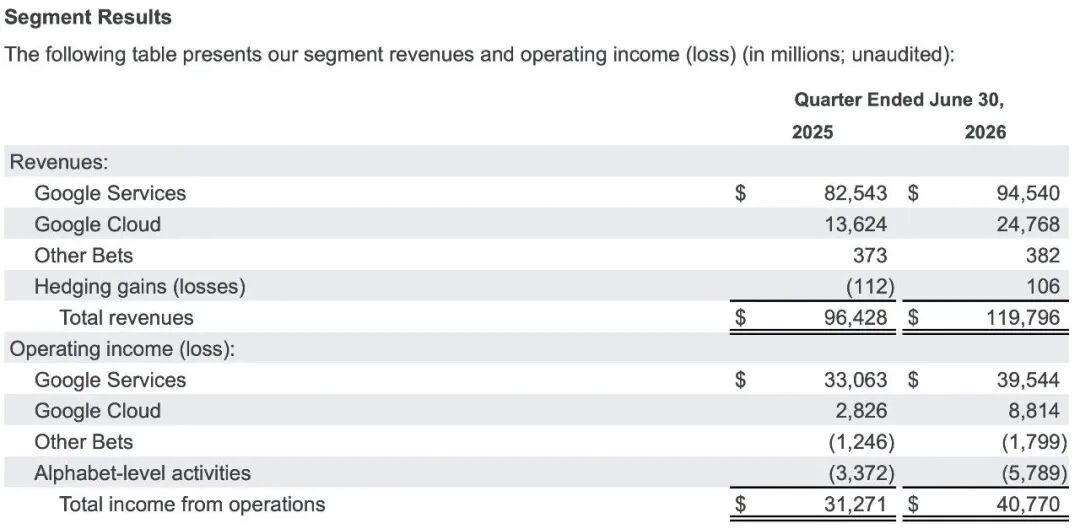
Financial data of Alphabet's business breakdown
Looking at specific business segments, Alphabet's core businesses in this quarter showed a pattern of "sharp growth in cloud business, steady support from search and advertising".
Google Cloud, the primary platform for hosting AI tools and enterprise-level services, delivered the most standout performance. Google Cloud's revenue for the quarter reached $24.768 billion, a substantial 82% year-on-year increase that far exceeded market expectations. This breakthrough was primarily driven by strong demand for Google Cloud Platform (GCP) in the fields of enterprise AI infrastructure and AI solutions.
As scale effects kicked in, Google Cloud's operating profit rose from $2.826 billion in the same period last year to $8.814 billion, with its operating margin increasing from 20.7% to 35.6%.
It is understood that boosted by the rising penetration of commercial solutions such as Gemini Enterprise, nearly 90% of Fortune 100 companies are currently using its products, which has pushed Google Cloud's backlog of orders up from $4600 billion in the first quarter to $5140 billion.
The "Google Services" segment, the group's cash flow source, recorded total revenue of $94.540 billion this quarter, up 15% year-on-year, with an operating profit of $39.544 billion.
Among the sub-segments of "Google Services", the flagship search business generated revenue of $63.271 billion, up 17% year-on-year, mainly driven by the growth in search query volume brought by the integration of AI Overviews and the brand new "AI Mode" feature. Currently, AI Overviews has more than 250 million monthly active users.
YouTube's advertising revenue, boosted by global events including the 2026 FIFA World Cup in the United States, Canada and Mexico, achieved 13% growth to reach $11.055 billion, during which more than 1.7 billion unique users watched World Cup-related content on YouTube.
The "Subscriptions, Platforms and Hardware" business, which includes hardware and subscriptions, posted revenue of $12.911 billion, up 15% year-on-year. The traditional ad network advertising business saw a slight 0.7% decline to $7.303 billion, reflecting the concentration of advertiser budgets on search and short video platforms. Total traffic acquisition cost (TAC) for the quarter was $16.179 billion, with its proportion in advertising revenue remaining stable, demonstrating Google's control over channel user acquisition.
At the level of frontier projects and the group, the "Other Bets" segment, which includes the Waymo autonomous driving business, recorded revenue of $382 million in the second quarter, with operating losses expanding from $1.246 billion in the same period last year to $1.799 billion, mainly due to increased upfront investment as autonomous driving accelerates its commercial rollout across multiple cities.
In addition, the operating loss from "Group-level Activities", which reflects the group's shared R&D costs for AI fundamentals and frontier model development, reached $5.789 billion, a 71.7% increase from the $3.372 billion in the same period last year, highlighting the rapid consumption rate of large language model R&D expenses.
02. The Paper Wealth of $98 Billion in "Other Gains"
The most notable figure in this quarter's earnings report is none other than the $112.107 billion attributable net income.
A breakdown of the profit composition reveals that this is mainly attributable to an easily overlooked accounting line item: Alphabet's "Other Gains" reached $97.983 billion this quarter, compared to just $2.662 billion in the same period last year. The earnings report explicitly notes that this massive gain primarily comes from unrealized gains on equity securities held by Alphabet, meaning paper profits that have not yet been cashed out.
Behind this gain lies Alphabet's early bets on several tech companies.
Alphabet acquired approximately 7% equity in SpaceX through an investment as early as 2015. Following SpaceX's IPO completion in June, its surging valuation brought Alphabet a paper return of roughly 133 times.
Meanwhile, Alphabet holds around 14% equity in AI unicorn Anthropic, whose valuation has approached $1 trillion after its financing round in May. In addition, Databricks, in which Alphabet holds a stake, saw its valuation reach $188 billion in its July financing round.
Although this nearly trillion-dollar paper profit boosted the quarter's net income, since it is a non-operational and unrealized paper figure, the capital market did not regard it as an improvement in the company's core business operating capabilities.
03. Hidden Worries and Risks: Skyrocketing Capital Expenditure and Pressured Free Cash Flow
Beyond the cloud business and investment gains, the core reason why investors chose to sell after the earnings release is their concerns over the company's capital expenditure and free cash flow situation.
To maintain production capacity in the AI infrastructure competition, Google's capital expenditure in the second quarter reached $44.9 billion, directly doubling from the $22.5 billion in the same period last year. What further concerns the market is that Google has raised its full-year 2026 capital expenditure guidance range from the $180 billion to $190 billion range set in the previous quarter to $195 billion to $205 billion.
With massive funds poured into data centers and GPU procurement, the company's free cash flow officially turned negative in the second quarter.
To support capital expenditure, Google carried out frequent financing activities in the second quarter, including raising $49.6 billion in net proceeds through the issuance of stocks and convertible preferred shares, signing an ATM stock issuance agreement with a maximum value of $400 billion, and issuing $20.3 billion in senior unsecured bonds.
However, alongside rising investment, Google encountered certain difficulties in the R&D breakthrough of its core large language models. The originally scheduled launch of the new flagship model Gemini 3.5 Pro was delayed as it failed to meet internal expectations, and only three lightweight models were released this week.
Against the competitive backdrop where Anthropic launched Mythos 5 and OpenAI announced GPT-5.6, Google's main model has not been updated for several months. Coupled with the departure of two core researchers to Anthropic in June, this has also drawn external attention to the rhythm of its technical iteration and the stability of its talent team.
Alphabet's Q2 earnings report reflects the reality the company faces during the AI transition period: the traditional search and advertising fundamentals remain solid, the cloud business has achieved 82% growth driven by AI demand, and early tech investments have brought hundreds of billions of dollars in paper returns; on the other hand, the extremely high capital threshold of AI infrastructure has squeezed free cash flow, and massive capital expenditure has forced the company to raise funds intensively through the bond and equity markets.
For the capital market and investors, the key to observing Alphabet going forward lies in whether its annual $200 billion-level investment in hardware infrastructure can drive Google to achieve technological breakthroughs in the next-generation flagship model as soon as possible, and translate them into implementable commercial outputs.
This article is from the WeChat official account "Tencent Tech", written by Su Yang, and published with authorization from 36Kr.