Many enterprises do not die from poor economic conditions, but from the failure of outdated growth models, which is derived from two months of frontline thinking.
Preface:
In this article, I want to talk about the consumer market as I see it, and explain why so many businesses struggle to achieve growth.
Growth never comes by waiting. It is earned by seeing the truth clearly and making the right decisions again and again.
This piece is a bit long, so I recommend reading it patiently.
If the only problem were a poor economy, all retail businesses would decline together.
But that is not what is happening. I looked up the data:
In the first half of 2026, convenience stores grew by 6.6%, while warehouse club stores and unmanned stores grew by more than 25%, and instant retail maintained double-digit growth.
However, department stores, brand specialty stores, and traditional home appliance and home furnishing channels are clearly under pressure. I have also written dedicated articles about Vanward and Oppein.
This points to one fact: the market is not lacking demand, but demand is shifting.
More importantly, I also observed that under the strict statistical standard for fast-moving consumer goods, sales volume increased by 1.3% in the first quarter, but sales revenue decreased by 1.3%.
This shows that consumers are still buying, but the prices, brands, specifications, and channels they choose have all changed.
After recent conversations with several owners of retail and consumer brands, I increasingly feel that many people attribute problems to a poor economy, which actually downplays the real underlying issues.
The macroeconomy is only a source of pressure. What causes a large number of retail businesses to fall behind is that the environment and demand have changed, but their operating models have not.
In other words, many businesses do not fail because of a poor economy, but because their old growth models are no longer effective.
1. The Old Growth Formula Begins to Backfire on Businesses
In the past, the growth formula for many retail businesses was very simple:
More Stores × More Traffic × More Products × Larger Promotions = Scale Growth
This formula worked extremely well in a growing market.
Opening a few more stores would bring more sales; buying more traffic would increase transactions; adding more SKUs would create more opportunities; running bigger promotions would make it easier for users to place orders.
But today, this formula may be draining resources from businesses.
The number of stores increases, but single-store output drops; traffic grows, but customer acquisition costs rise; SKUs expand, but inventory turnover slows down; promotions increase, but gross margins and brand value decline.
Therefore, in the past these actions drove growth, but today they often lead to overdraw.
Previously, businesses could use new store openings to mask same-store sales declines, use financing to cover cash flow problems, and use channel expansion to hide insufficient product competitiveness.
But after overall market growth slows down, many problems will surface at the same time.
2. Consumers Are Not Downgrading Consumption — They Are Differentiating Consumption and Recalculating Value
I have never liked the term "consumption downgrade". It is one-sided.
It easily leads businesses to a misjudgment: if they just lower prices, consumers will come back.
But the real situation is not like that.
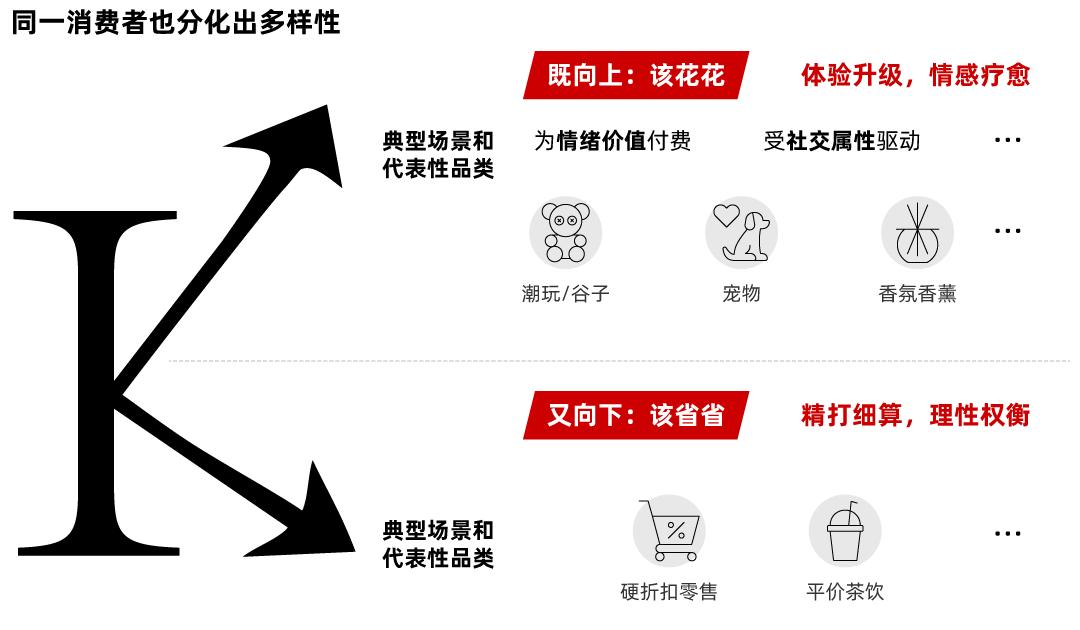
Figure / Sourced from the Internet
Consumers are not stopping buying, but they have become much better at calculating value. When I gave a lecture to top-performing brand sales teams at Intime Retail in May, I shared a viewpoint: today's consumers are less receptive to persuasive sales, and instead hope you help them analyze options and support their decision-making.
They will downgrade purchases for products with no differentiation, but continue to upgrade for products with clear functional benefits; they will compare prices, switch brands, and adjust product specifications for basic daily consumption, while continuing to spend in areas such as health, beauty, pets, travel, and personal interests.
They are unwilling to pay for vague so-called "brand prestige", but are willing to pay for reliable quality, proven effectiveness, and good experiences.
Consumers are not simply downgrading consumption. They are shifting from "judging by brand and price" to "judging by total value".
Many businesses interpret consumers' refusal to buy as "prices are too high", so they keep cutting prices.
But the real problem may be: consumers do not understand why the product is worth buying.
If the product value cannot be clearly communicated, the experience value cannot be felt, and brand trust has not been established, further price cuts will only erode profits.
I previously wrote an article titled Why the Best Products Often Underperform Competitors? The reason is simple: consumers do not only buy the product itself, they buy a sense of value.
3. Channels Are Not Just Diversifying — They Are Reshaping Demand
Today, the pressure on retail businesses comes not only from changing consumers, but also from simultaneous changes in supply and channels.
China's retail market has moved from a stage of "insufficient products" to a stage of "extremely abundant products".
Products are highly homogenized, supply chains are mature, imitation happens extremely quickly, and a large number of new brands, new products, and new stores are pouring into the market.
E-commerce has made product prices across the country highly transparent, and white-label, local, and private-label brands are continuously squeezing the premium of traditional brands. Consumers' choice cost is getting lower and lower, while businesses' risk of being replaced is getting higher and higher.
More importantly, channels are not just diverting traffic.
Channels are redefining consumers' value judgment.
Membership stores curate selections and use private labels to make choices for consumers; discount stores offer long-term low prices; bulk snack stores create frequent discovery opportunities; instant retail satisfies the "need it now" demand; content e-commerce creates new demands; and AI is starting to help consumers compare products.
If traditional retail businesses still view stores as places only for displaying goods and processing payments, they will be squeezed from all sides.
They cannot beat e-commerce on price, instant retail on speed, membership stores on curation, discount stores and bulk snack stores on novelty, and renovated supermarkets and themed stores on experience.
Physical stores are not obsolete. What is needed is to redefine their value in the business chain. Different types of retail stores should take on different roles such as creating awareness, delivering experiences, providing services, and driving sales.
It is not that a single channel has stolen customers; it is that consumers have formed new purchasing habits.
4. Much of the Growth Is Actually Pseudo-Growth
I see many businesses drinking poison to quench their thirst. The more the environment changes, the more businesses must be alert to one situation: they seem to be growing, but are actually in great danger.
The number of stores increases, but same-store sales decline, and new stores only dilute the problem.
GMV grows, but it relies heavily on subsidies, high return rates, and low-margin orders.
Franchise revenue increases, but franchisees do not make money, so store closures and disputes will only erupt later.
New product sales grow, but this mainly comes from channel stockpiling, with no real repeat purchases formed.
Truly healthy growth should not only look at sales revenue, but also simultaneously track same-store growth, repurchase rate, gross margin, inventory turnover, store payback period, and operating cash flow.
We often hear that a certain brand goes bankrupt. In fact, many businesses do not collapse suddenly. They maintain cash flow circulation through continuous expansion for a long time. Once they can no longer open new stores, franchisees stop joining, and suppliers shorten payment terms, the cash chain will quickly become strained.
Therefore, the direct cause of bankruptcy is usually not losses, but cash flow problems.
After sales slow down, businesses start to run price promotions to maintain performance, which leads to lower gross margins, overstocked inventory, tied-up cash, increased pressure from suppliers and rent, declining product and service quality, further loss of foot traffic, and eventually a vicious cycle.
In my analysis of the failed Huajia case, I talked about the spiral of death phenomenon, which means businesses fail to take correct and effective measures on key issues, so they slide step by step toward failure.
Economic cycles are usually just triggers. Businesses actually die because of their fragile cost structure, inventory structure, and cash structure.
5. Breaking the Deadlock Starts with Reconstructing the Growth Model
For retail businesses, the most important thing today is not to find another traffic dividend, but to reconstruct their own growth model. My judgment is that this new growth model will never be the old product-driven model, but a user-asset-driven model.
We need to truly build an operating model oriented toward user demand, experience, and scenarios. This is also the core theme of my speeches this year — User Asset Thinking.
First, stop betting on broad industry growth, and look for niche growth pockets.
The market is not without demand. Demand has shifted to more specific groups of people, scenarios, and channels. Luckin Coffee has absolutely been a case worth learning from this past year.
Second, do not only study demographic labels, but research specific consumption scenarios and tasks.
Consumers are not as simple as labels like "young people", "middle class", or "mothers with babies". Their real decisions often happen in a specific task context. This is the JTBD (Jobs to Be Done) theory.
Third, do not only pursue the number of stores, but recalculate the single-store model.
Whether a store can make money, how long it takes to recoup investment, where repeat purchases come from, and whether the cash flow can work smoothly are far more important than how many stores you open.
Fourth, do not rely only on promotions, but prove the value of your products.
Consumers are not unwilling to pay higher prices. They are unwilling to pay for value that cannot be clearly explained.
Fifth, do not use a one-size-fits-all product distribution strategy nationwide, but pursue differentiation across regions, crowds, and channels.
Today's market is no longer a single unified market, but a complex market composed of many niche scenarios. The era of blockbuster products is over. The trend now is to win the market with segmented product portfolios.
Sixth, do not only pursue continuous new product launches, but improve the survival rate, penetration rate, and repurchase efficiency of new products.
More new products do not mean better growth. What really matters is whether new products can be continuously chosen by consumers. To put it bluntly, you need to improve the hit rate of new products, not just increase their quantity.
6. The Environment Has Changed, Businesses Must Change Too
Having talked so much, I believe everyone can understand.
The difficulties many retail businesses are experiencing today are not just pressure brought by the economic cycle. Their old growth models are no longer adapting to the new market environment.
Consumers are still buying, but they have switched to different prices, brands, specifications, and channels.
There are still opportunities in the market, but opportunities are no longer evenly distributed to all businesses.
The era when growth could be achieved by relying on location, traffic, channels, and promotions is passing.
Moving forward, businesses need to re-understand consumers, redesign product value, reorganize channel efficiency, re-manage user relationships, and also re-examine their own cash flow and organizational capabilities.
Economic slowdown lowers the water level, consumer changes alter the flow direction, and channel reforms redraw the river course. Whether a business can survive ultimately depends on whether it can see itself clearly, adjust in a timely manner, and still sail the ship of this era well.
This is the most important thing retail businesses need to see clearly today.
Not all growth has disappeared. The old growth methods just no longer work.
What businesses really need to do is not wait for the environment to improve, but first make their operating model adapt to the new environment.
This article is from the WeChat Official Account "Yantao Sanshou" (ID: yantao-219), author: Yan Tao, published with authorization from 36Kr.