Generic Drugs Flowing Back to the U.S.: The Most Probable Real-Scenario Simulation for the Next Three Years
In recent years, a bitter joke has circulated in China's generic drug industry: "Volume-based procurement has squeezed profits down to a few cents per pill, consistency evaluation burns millions, and overseas tariff sticks are coming down on us. Domestic generic drug makers are really on their knees."
On July 21, 2026, across the ocean in Washington, another heavy blow was dropped. Trump announced on social media a tiered tariff schedule: imported generic drugs will remain tariff-free for two years, then jump to 100% after that, and rise to 200% a year later. The sole goal is to force generic drug production capacity back to U.S. soil.
On one side, China's generic drug industry is gasping for breath in the quagmire of cutthroat competition; on the other, the U.S. is waving the banner of manufacturing reshoring to rebuild its supply chain. The question arises: Will China's struggling generic drug sector lose its production capacity to the U.S. in reverse? And can America's reshoring script ever actually be realized?
01
China's Generic Drug Business Model Is Being Rewritten
Breaking down the phrase "really on their knees" reveals three layers of overlapping pressures.
1. Volume-based procurement has crushed prices through the floor.
The 11th round of national volume-based procurement set the tone of "stabilizing clinical use, ensuring quality, combating excessive competition, and preventing bid-rigging." But the previous 10 rounds had already pushed prices of common oral solid preparations and conventional injections down to the cost red line. Homogeneous varieties saw average price cuts exceeding 70%, with some basic medicines dropping by over 90%, leaving per-pill profits at just a few cents or even tenths of a cent.
Winning bids means no profit, while losing bids means losing market access. A large number of small and medium-sized pharmaceutical companies lacking scale advantages and robust compliance capabilities are accelerating capacity exit, gradually withdrawing from the mainstream public hospital market.
During the "14th Five-Year Plan" period, over 10,000 new generic drug approvals were added domestically. There are more than 800 levofloxacin licenses and over 500 metformin licenses. Low-level duplication is being systematically rejected as regulatory standards tighten — in just three days in April 2026, 54 marketing applications were denied, 43 of which were for generic drugs.
2. Consistency evaluation costs and returns are inverted.
Completing the bioequivalence assessment for ordinary generic drugs generally requires total investment ranging from 5 million to 10 million yuan, with complex formulations and highly variable varieties costing even more. After winning volume-based procurement bids, annual sales for niche varieties might only reach several million yuan, creating a severe imbalance between input and output. Most enterprises lack the commercial incentive to invest in consistency evaluation for long-tail clinically essential drugs, inadvertently sowing hidden risks of drug shortages.
3. Overseas expansion channels are caught between tariffs and end-to-end regulatory scrutiny.
In 2025, China's exports of finished pharmaceutical formulations to the U.S. reached $1.162 billion, a slight year-on-year increase of 1.01%, with its share of total formulation exports falling to 13.14%. API exports to the U.S. hit $4.07 billion, a year-on-year decline of 9.9%.
These already slim-margin export businesses now face America's "zero-duty to 100% then 200%" tariff timeline, along with the FDA's July 2026 Proposed Rule on Modernizing Pharmaceutical Manufacturing Registration requiring full supply chain traceability — registering every link from intermediates to APIs to finished formulations. The era of Chinese suppliers quietly profiting from price differences is coming to an end.
Domestic volume-based procurement sets prices, while U.S. policies define boundaries. Both ends are simultaneously sealing off the survival space for the old model — the old model of low-cost domestic over-competition plus export-driven foreign exchange earnings.
02
What Does the U.S. Really Want?
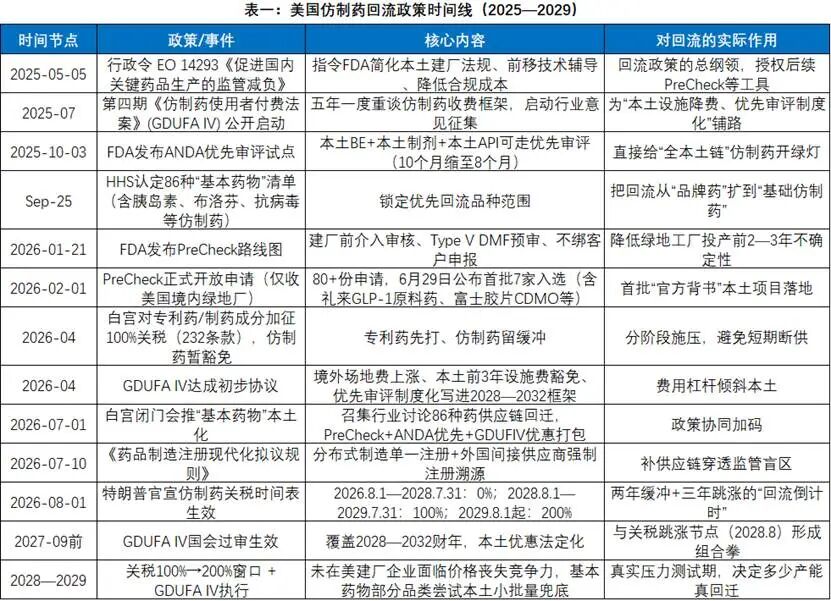
The U.S. call for reshoring didn't start in 2026. The FDA itself previously released data showing that more than half of the medicines circulating in the U.S. are produced overseas, with domestic API manufacturers accounting for only 9% of the global total, compared to 22% in China and 44% in India.
In October 2025, the FDA launched a priority review pilot program for generic drug applications, granting priority status only to products combining domestic bioequivalence testing, domestic formulation production, and domestic API manufacturing. In February 2026, the PreCheck pilot began accepting applications, with 7 selected companies already announced. On July 10, 2026, the FDA released the proposed rule on manufacturing registration modernization, codifying distributed manufacturing and end-to-end oversight into official guidelines.
Yet America's desired reshoring has clear boundaries.
In terms of targets, priority is given to the 86 essential drugs identified by the Department of Health and Human Services — insulin, ibuprofen, antivirals, certain antibiotics, plus bulk generic drugs procured by the military, the Department of Veterans Affairs, and federal Medicare. Thousands of niche generic drugs are not on the list.
In terms of production links, the U.S. is seizing sovereignty over APIs and local filling of key dosage forms first, while intermediates and fermentation processes are not within the reshoring scope. America's environmental, labor, and energy costs make it impossible to return to full-chain low-cost manufacturing.
In terms of methods, the combination of tariff sticks, priority review for generic drug applications, PreCheck factory-building guidance, and federal procurement preferences is designed to push companies to voluntarily reshore after doing the math on their bottom lines.
03
Three Unsolvable Mathematical Problems
First: The Cost Equation
Generic drugs are price-sensitive products. U.S. end prices are already extremely low, with over 90% of prescriptions being generics that rely on global price benchmarking to keep costs down. Relocating formulation production back to the U.S. would mean labor costs 5 to 8 times higher than China, and environmental compliance costs several times those of India, pushing per-pill costs up 3 to 5 times.
If the 200% tariff is actually implemented, import disruptions combined with sky-high domestic prices will leave the U.S. itself facing common drug shortages and inflation protests. Industry insiders judge that when it takes effect in August 2028, there will almost certainly be exemption lists and extensions — precisely because of this arithmetic contradiction.
Second: The Timeline Equation
API production capacity can't be built like stacking blocks. A compliant API plant from project initiation to FDA audit clearance takes 3 to 5 years, with fermentation-based products like antibiotics and vitamins taking even longer.
China's global API market share was built over two decades through industrial supporting systems: chemical parks, environmental facilities, and the engineer dividend, backed by countless pieces of hard infrastructure. Even if the U.S. breaks ground today, it cannot fill the gaps for insulin, ibuprofen, and penicillin-class drugs before 2029. During the window before new capacity comes online, the U.S. cannot shake off its import dependence on Chinese and Indian APIs.
Third: India Is Stuck in the Middle
Around 40% of the U.S. generic drug market belongs to India, which in turn is highly dependent on Chinese APIs — especially for fermentation products and intermediates. For the U.S. to decouple from China, India must first decouple from China, which is even harder than reshoring production itself.
The outcome is likely that the "Chinese API → Indian formulation → U.S." chain will be rearranged to "Chinese API → Mexican nearshore packaging → U.S." — a restructuring of links, not their elimination.
The U.S. can reshore only a small portion of final formulation filling for essential medicines plus strategic API reserves. It is impossible to absorb China's entire generic drug production capacity. Chinese generic drug companies, meanwhile, may proactively shift U.S.-market-oriented capacity to Mexico, Southeast Asia, or even U.S. soil. Huahai, Jianyou, and Puli already have overseas bases, but this represents corporate globalization re-layout, not America "rescuing" Chinese industry through reshoring.
04
China's Struggling Generic Drug Sector Makes U.S. Reshoring Even Harder
This is a counterintuitive yet critical fulcrum.
While China's generic drug industry has thin margins, its global cost curve covering APIs, intermediates, and basic chemical supporting systems remains optimal. If the U.S. forcibly decouples, it must first accept two to three years of rising drug prices and shortage risks.
After domestic volume-based procurement clears the market, surviving leading enterprises — Qilu, Kelun, Huahai, Hengrui's generic drug division, and Shiyao — holding integrated cost advantages, will shift their U.S. strategy from exporting finished products to selling APIs plus building overseas factories to evade tariffs, embedding Chinese manufacturing capabilities into America's new supply chain.
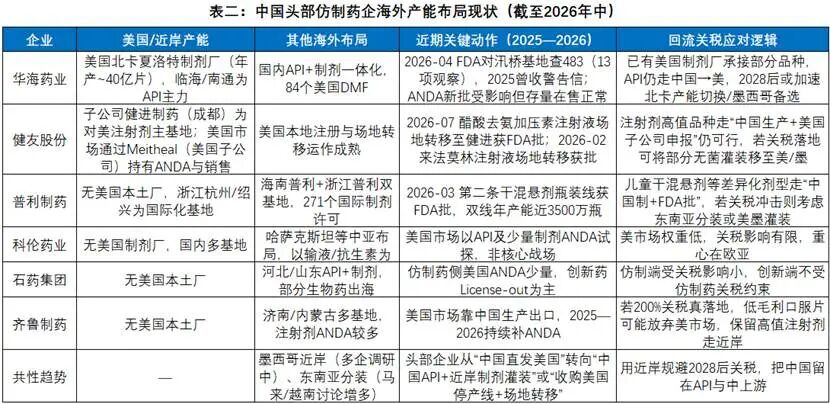
In other words, Chinese generic drug makers' profit statements are indeed on their knees, but their capabilities are not. Their engineering teams, cGMP systems, FDA audit experience, and large-scale continuous manufacturing capabilities are all still intact.
What America's reshoring plan lacks precisely is this pool of talent and systems. Cultivating them domestically would take a decade, while poaching Chinese resources is constrained by geopolitics. Thus a paradoxical scenario emerges: Washington pushes for reshoring, while WuXi and Huahai build factories in the U.S. or Mexico to access PreCheck subsidies, localizing Chinese management capabilities for export.
05
The Most Likely Real-World Scenario Over the Next Three Years
2026–2028 Buffer Period. The U.S. extends zero tariffs, China's formulation exports to the U.S. maintain slight growth, but API exports continue to face pressure. Leading Chinese pharma firms accelerate nearshore layout in Mexico and Southeast Asia to evade post-2028 tariffs.
2028–2029 Critical Point. If the 200% tariff is actually implemented (low probability but not zero), the U.S. market will stratify. Essential drugs like insulin and ibuprofen will be backed by small-batch, high-cost domestic production lines supported by government subsidies; complex generics will still rely on India plus Chinese nearshore transshipment. China's domestic volume-based procurement enters a value governance phase, with first-to-file generics and complex formulations such as extended-release and special injections becoming the main profit pools.
In the long run, the global generic drug supply chain will evolve from a China-centered upstream API model to a multi-centered structure covering China, India, Mexico, and the U.S. mainland. China's market share will decline but never drop to zero, as it consolidates upstream around APIs, specialty intermediates, and complex formulation technologies, while low-end oral tablet production continues to be phased out.
In short: What's on its knees is the old model, not the industry. China's old generic drug business model — profiting from volume-based procurement arbitrage and export price competition — is on its knees. What the U.S. wants to reshore is the political narrative of pharmaceutical sovereignty. The two are not even on the same plane.
The biggest flaw in America's reshoring script is that it demands cheap drugs, domestic production, and decoupling from Chinese APIs — three goals that cannot be achieved simultaneously. The next chapter for China's generic drug industry will definitely not be having its capacity siphoned off by the U.S. Instead, it will package manufacturing capabilities as compliant factories, nearshore production lines, and specialty APIs, continuing to embed itself in the global chain. Domestically, it will restore profit margins through first-to-file generics, complex formulations, and integrated generic-innovative R&D in autoimmunity and oncology.
The old bull market may be gone, but the factories remain. What's on its knees is just valuations and old profit models — what will stand up is an entirely new industrial framework.
This article is from the WeChat public account "YiYao", author Yan Song, published with authorization from 36Kr.