Zara "deadly pants" controversy, Bai Chenming's major safety assessment
Recently, a pair of wide-leg trousers from Zara has sparked widespread attention both domestically and internationally.
According to a report by China.com, a Zara wide-leg trouser model designed with a flowing, lightweight aesthetic has caused multiple incidents of consumers tripping and suffering injuries overseas, due to its exceptionally wide leg openings and thin, lightweight fabric.
Fashion experts point out that the loose leg design creates a "wind-catching wrapping effect", causing the trouser hems to bunch forward while walking and tangle around the ankles, leading the wearer to lose balance and fall — this is the root cause of the hidden safety hazard.
As of now, Zara has not released an official brand statement, nor initiated a recall procedure for the same product, and similar items are still available for sale on domestic online stores.
Notably, on July 21, the customer service team of Zara's flagship store responded to the latest interview from The Beijing News, stating that the relevant issues have been reported, and a dedicated specialist is currently verifying and handling the case, with updates to be provided as soon as results are available.
A safety discussion sparked by a fashion item has gradually evolved into a collective scrutiny of the "fast fashion" industry.
Official Media Stance: Aesthetic Preferences Must Not Trump Safety
When the incident first began to gain traction, Zara's online store customer service attempted to shift blame to consumers with explanations such as "no falls will occur if the size fits properly" and "improper wearing by consumers".
However, as official media outlets joined in to share professional opinions, the nature of the issue became increasingly clear, and the core controversy returned to the safety of Zara's product design.
The safety defect stems from the cut and structure of the garment, not individual consumer issues. In a previous interview with The Beijing News, fashion experts noted that Zara's wide-leg trousers have safety flaws caused by their structural cut — a typical physical design issue. When taking long strides, the trousers are prone to "catching wind and wrapping around the feet", leading to falls, which has no inherent connection to whether the product size is appropriate. The explanation from Zara's online customer service is untenable.
After official media intervened, positive guidance was provided for related discussions. On domestic social media platforms, previous conversations about wide-leg trousers mostly focused on styling tips and personal style expression, and the relaxed, elegant vibe of floor-grazing wide-leg trousers was also celebrated by fashion publications like *Vogue*.
After several official media outlets addressed the issue, public opinion surrounding floor-grazing wide-leg trousers shifted entirely to product safety itself. *China Youth Daily* explicitly stated in its report: "Many consumers are calling for fast fashion brands not to pursue aesthetics alone, but to also consider safety when designing clothing."
At the sales end, the brand has not yet fulfilled its due obligations. As of now, the same wide-leg trouser model on Zara's official online store remains on normal sale, with no safety warnings marked on product shelves or detail pages, and no public notice for inspection of relevant batches.
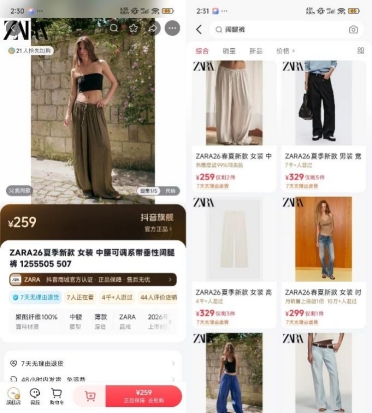
Screenshot source: Zara Douyin Flagship Store
According to Article 19 of China's *Consumer Rights and Interests Protection Law*, operators of defective products shall take measures such as stopping sales, issuing warnings, and conducting recalls. However, Zara's "silent sales" status has further increased the risk of harm to consumer rights.
Gaps exist in industry standards, with a lack of supervision over garment cut safety. For adult clothing, China's current *National Basic Safety Technical Code for Textile Products* (GB 18401) mainly sets requirements for material safety aspects such as formaldehyde content, color fastness, and pH value, but no relevant safety assessments have been conducted on the structural cut of garments or risks in wearing scenarios.
This serves as a reminder for the entire apparel industry: safety assessments for garment cuts and the formulation of corresponding safety standards must be put on the agenda without delay.
The Premiumization Paradox: Disconnect Between Rising Price Premiums and Quality Control
Looking beyond the single product issue to examine Zara's overall strategic planning, another deep-seated contradiction comes to light.
In recent years, Zara's brand positioning has been trending upward, but the details of some basic products have not been upgraded accordingly, giving rise to a clear value paradox.
Product prices continue to rise, but details have not been properly refined. Over the past few years, Zara has been pushing forward a premiumization strategy to shake off its "cheap fast fashion" brand label, with continuous price increases across the globe as the most direct manifestation.
Statistics from French consulting firm Lectra show that over the past five years, Zara's average selling price in the European market has increased by 22%, and by 70% in the U.S. market. The domestic Chinese market has also seen similar price hikes.
Consumers are paying more for Zara products, yet their basic personal safety cannot be guaranteed — which runs counter to the premiumization path Zara aims to follow.
Huge investments in offline store upgrades cannot cover up design flaws. Since last year, Zara has successively upgraded and built immersive flagship stores in core domestic commercial districts including Nanjing Road in Shanghai and Xinjiekou in Nanjing, hoping to create a high-end consumption atmosphere.
No matter how luxurious the store setting is, value ultimately has to be reflected in the products. If a customer who buys the floor-grazing wide-leg trousers falls while trying them on, will she step into a Zara store again? The sophisticated store decor will then create a stark psychological contrast.
Zara's proud "small-batch, fast-response" supply chain model may be the root of the problem. As a leader in the fast fashion industry, Zara uses its "small-batch, fast-response" agile supply chain to compress the 6-9 month new product development cycle of the traditional apparel industry to as short as 15 days, launching more than 12,000 different items every year.
The extreme pursuit of efficiency may have led Zara to compress or even skip the cut safety testing process for its floor-grazing wide-leg trousers to meet tight timelines. Therefore, the safety risk of this product is not an accidental mistake by an individual designer, but a high-probability event caused by the operational model.
Misaligned value priorities have led to insufficient attention to the essence of products. Most ordinary consumers believe that the core value of a pair of trousers lies in comfort, aesthetics, and safety, while brand premium is not their primary demand. However, all of Zara's efforts are focused on boosting brand premium, with no attention paid to the essential functions of products — which is essentially a deviation from core values.
The Test for Bai Chenming: Redefining "Precision Fashion"
This globally spreading safety controversy has pushed Bai Chenming, President of Zara Greater China, into the public spotlight.
Currently, Zara is facing its most severe brand test since entering the Chinese market. The "Precision Fashion" theory previously proposed by Bai Chenming needs to be redefined amid this ongoing turmoil.
Slow crisis public relations response and lack of localized responsibility awareness. Bai Chenming has stated on multiple public occasions that Zara must keep pace with Chinese consumers and build a service system that better fits local needs. However, in this "dangerous trousers" incident, the performance of Zara China clearly fell short of public expectations.
With discussions having raged on for days, Zara has neither released an official statement through its formal channels nor conducted safety inspections on the same-style products sold domestically. This ostrich-style crisis management not only fails to demonstrate responsibility to local consumers, but also stands in stark contrast to Bai's previous public statements.
"Precision Fashion" cannot only chase trends, but must also uphold the bottom line of safety. In previous public interviews, Bai Chenming noted that Zara positions itself as a "Precision Fashion Company", with its core strength lying in accurately capturing fashion trends and precisely matching consumer demands.
However, this wide-leg trousers incident shows that "Precision Fashion" that only chases trend popularity is far from sufficient. Bai Chenming's definition of "Precision Fashion" should also include a precise understanding of consumers' safety demands. If a hit pair of trousers puts the wearer at risk of falls and fractures, it means the brand has not thoroughly understood "user needs".
Localization should not be limited to marketing, but must be rooted in real life scenarios. In recent years, Zara has been implementing a localization strategy in China, launching co-branded products with Chinese designers and adopting marketing channels that better resonate with domestic consumers. But to truly achieve localization, efforts cannot stop at superficial marketing levels.
For example, in European and American regions, a high proportion of consumers travel by private car, while domestic Chinese consumers rely more on public facilities such as subway trains and escalators. As a result, the safety hazard of this Zara trouser model is significantly higher in China than overseas. A truly effective localization strategy must go deep into the underlying product design, making targeted optimizations for Chinese people's daily life scenarios.
Crisis can also be an opportunity for brand upgrading, to reshape a responsible image. From another perspective, this crisis is also a chance for Zara to demonstrate its sense of responsibility.
If Bai Chenming takes this incident as a turning point and proactively launches comprehensive rectification in the Chinese market, he will not only resolve the current public controversy, but also truly deliver on his localization commitments, turning a negative event into an opportunity to consolidate brand trust.
The Path to Breakthrough: Shifting from "Traffic-Focused Aesthetics" Back to "People-Oriented Values"
The dilemma Zara faces is not an isolated case, but reflects common problems across the entire fast fashion industry. As the logic of worshipping speed and chasing traffic-driven aesthetics loses its validity, the industry must return to its roots and build a values system centered on people.
Promote the improvement of industry safety standards, to ensure fashion innovation follows clear rules. To address the gaps in safety standards exposed by this incident, industry associations and regulatory authorities need to work together. For oversize, easily tangled designs such as floor-grazing garments, cut safety design must be incorporated into compliance reviews, and mandatory safety testing must be implemented.
Establish a feedback mechanism for defective products, and reject perfunctory customer service practices. Brands must not treat consumer safety complaints as isolated individual disputes, but should build a regular product feedback and investigation mechanism. The old approach of using scripted customer service lines to respond to consumers cannot deliver any real results.
Balance product aesthetics and practicality, using technology to uphold the safety bottom line. Fashion and safety are not inherently contradictory, and technological innovation can find a balance between the two. For example, for floor-grazing wide-leg trousers, invisible weight strips can be added to the inner side of the hems to reduce wind-induced swinging while walking.
Reshape value priorities, and return to the industry's original people-oriented aspiration. The fast fashion industry has experienced rapid expansion in recent years, but many enterprises have forgotten their original mission: to serve consumers. A fashion piece may be an artistic expression on the T-stage, but in the consumer market it is a commodity, which must prioritize safety and practicality above all else.
After all, aesthetics can be diverse and design can be innovative, but the bottom line of safety must never be breached. As for how Zara's wide-leg trousers incident will develop next, we can all wait and see. This article is from the WeChat official account "Liu Feng Channel", author: Liu Feng Channel, published with authorization from 36Kr.