Q2 earnings report: Google Cloud surged 82%, Tesla's profit margin is only 1.4%
Revenue beat expectations, yet cash flow turned negative at the same time. Google and Tesla are paying the real cost of AI, the difference being that the former has already seen cash returns, while the latter is still primarily relying on car sales to fund its future.
After market hours on July 22, Alphabet and Tesla simultaneously released their Q2 2026 earnings reports.
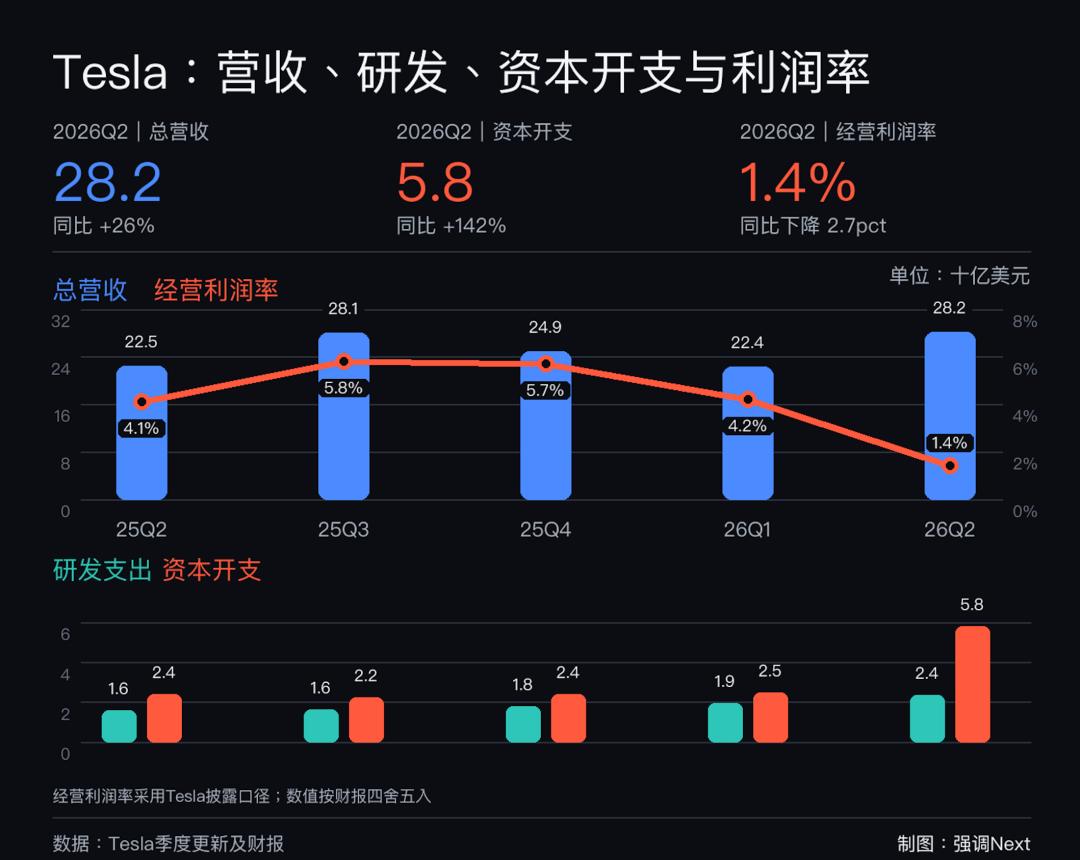
Both companies posted revenue that exceeded market expectations. Alphabet's revenue reached $119.8 billion, up 24% year-over-year. Tesla's revenue hit $28.236 billion, growing 26% year-over-year. However, following the earnings releases, the two companies' share prices fell by approximately 3% and 4.5% respectively in after-hours trading.
Investors are concerned about the same core issue: the AI bill is rapidly ballooning.
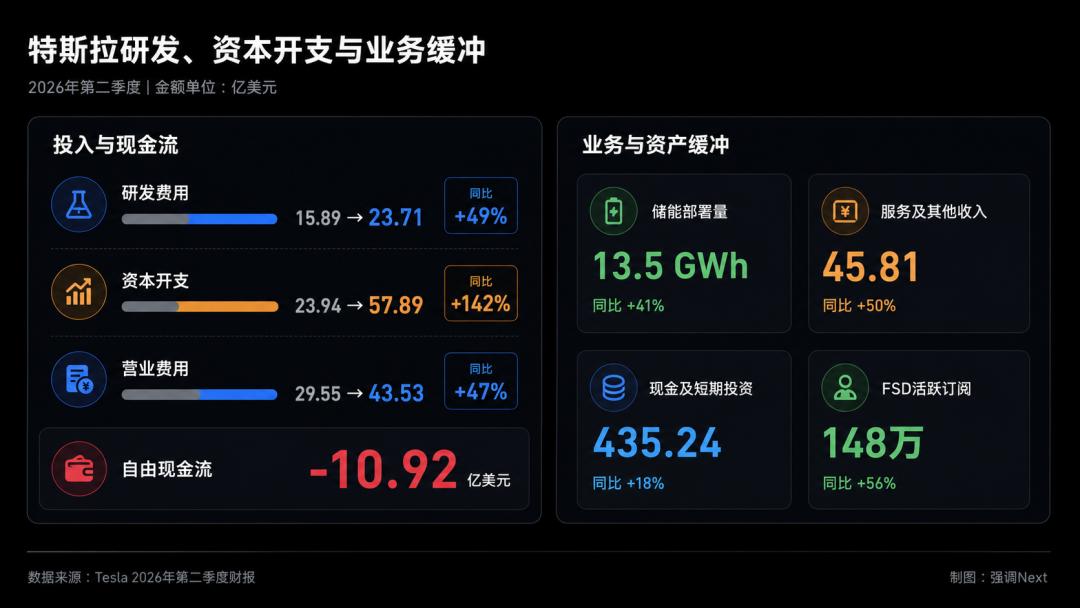
Alphabet's Q2 capital expenditures reached $44.924 billion, exceeding its operating cash flow of $39.069 billion for the quarter, resulting in negative free cash flow of $5.855 billion. This marks the first time in the company's history that it has posted negative quarterly free cash flow. Tesla's capital expenditures hit $5.789 billion, up 142% year-over-year, with negative free cash flow of $1.092 billion — also the first time it has turned negative in over two years.
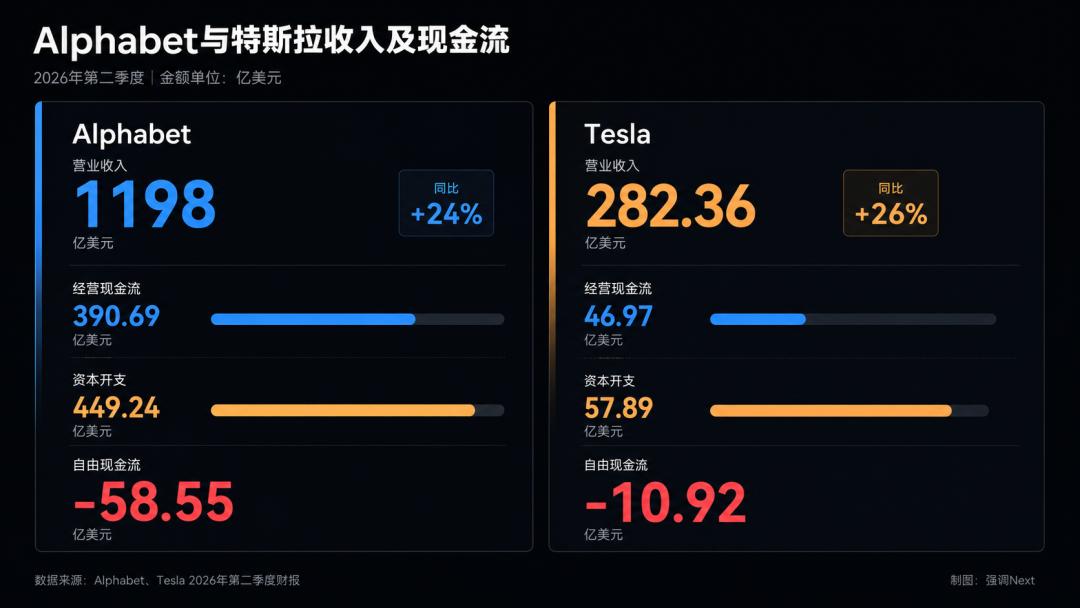
On the surface, both companies are burning cash for AI. The key difference behind the earnings reports is that Google's AI has already generated revenue and profits in its cloud business, while Tesla's Robotaxi and Optimus are still in the stage of heavy investment with minimal returns.
1
The Quality of Their Performance Growth Varies Significantly
Alphabet's most striking figure is its net profit of $112.107 billion, up 298% year-over-year. This does not mean Google's core business suddenly earned an extra $80 billion, however.
In Q2, equity securities held by Alphabet generated a net gain of $99.031 billion, contributing $77.1 billion to net profit after tax, and adding $6.26 to earnings per share. Excluding this impact, earnings per share were approximately $2.85, slightly below Wall Street's expectation of $2.89.
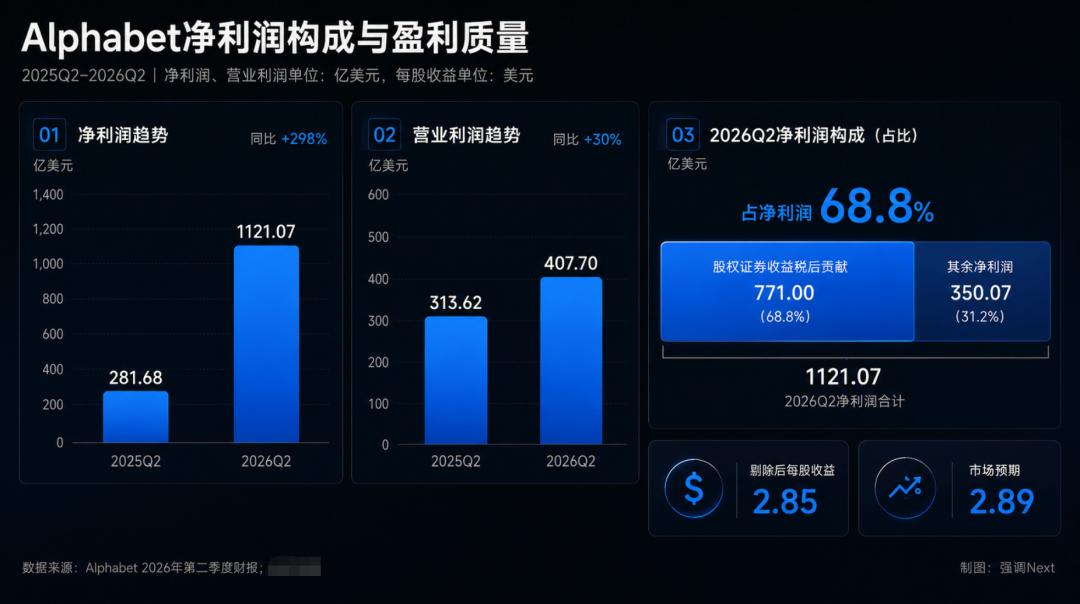
That said, Google's core business remains strong. Operating profit rose 30% year-over-year to $40.77 billion, with operating margin increasing from 32% to 34%. Search and other ad revenue grew 17%, YouTube ad revenue increased 13%, and subscriptions, platforms, and hardware revenue rose 15%. Market concerns that generative AI would siphon off traditional search traffic have not materialized in this quarter's results, at least for now.
Tesla's situation is the opposite. Its growth comes primarily from sales volume, while profits have failed to keep pace.
In Q2, Tesla delivered 480,100 vehicles, up 25% year-over-year, setting a new Q2 delivery record. Automotive revenue grew 23% to $20.516 billion. However, operating profit was only $398 million, down 57% year-over-year, with operating margin falling from 4.1% to 1.4%.
Tesla's average revenue per vehicle dropped from $45,300 in the same period last year to $42,700. Automotive gross margin excluding regulatory credits was only 16.3%, below the market expectation of 18.04%. While more cars were sold, price cuts and rising costs eroded all the profits from the additional sales volume.
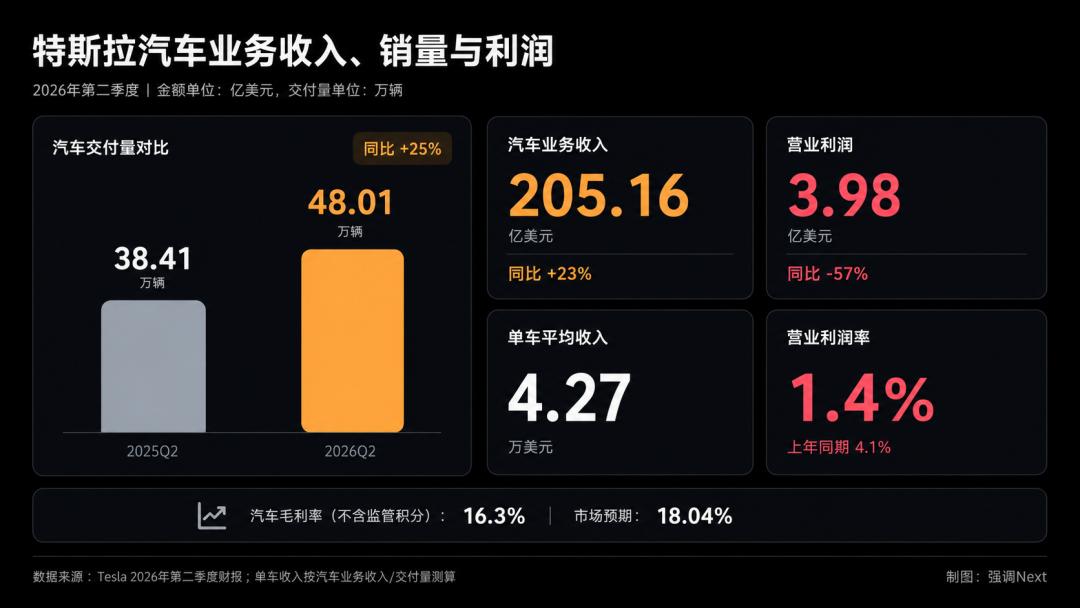
This is the most direct distinction between the two earnings reports: Google's core business is still expanding profits, while Tesla's core business has only expanded revenue.
2
Google's AI Has Already Generated Revenue in Its Cloud Business
Google Cloud delivered the strongest set of metrics in this earnings report.
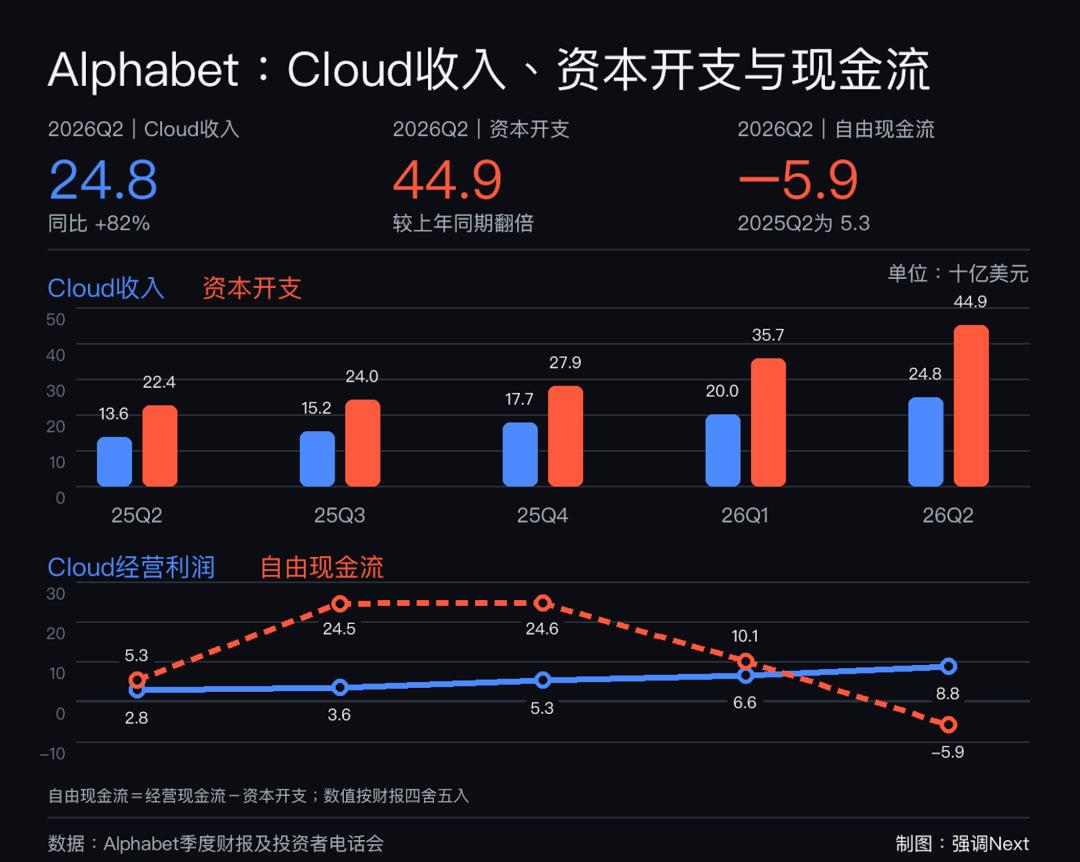
In Q2, Google Cloud revenue grew 82% year-over-year to $24.768 billion, far exceeding the market's 64% growth expectation. Operating profit increased from $2.826 billion to $8.814 billion, up 212%. Operating margin rose from 20.7% to 35.6%. The cloud business now contributes approximately 21% of Alphabet's total revenue and 22% of its operating profit, and is no longer just a secondary growth curve beyond search advertising.
The growth primarily came from enterprise AI solutions, AI infrastructure, and core cloud services. This quarter, Google also for the first time recognized revenue from direct TPU sales. Its in-house developed chips, which previously mainly supported internal operations, are now becoming a commercial offering for external customers.
Consumer-side metrics are equally strong. The Gemini App reached 950 million monthly active users, with the Gemini model processing 22 billion API tokens per minute. Nearly 90% of Fortune 100 companies are already using Gemini Enterprise. User scale does not directly translate to revenue, but the cloud business's growth rate and profitability prove that AI demand is now reflected in Google's financial statements.
The costs are equally clear. Alphabet's Q2 capital expenditures doubled year-over-year to $44.924 billion, and its full-year 2026 capital expenditure guidance was raised by another $15 billion, reaching $195 billion to $205 billion. Management also confirmed that capital expenditures will continue to grow significantly in 2027.
To expand its AI infrastructure, Alphabet issued common stock and mandatory convertible preferred shares in Q2, raising net proceeds of $49.6 billion; it also issued $20.3 billion in unsecured bonds. The company did not conduct any share repurchases during the quarter, compared to $13.238 billion in repurchases in the same period last year.
Google, once one of the most consistent capital returners in the tech industry, is now raising large-scale funds from both the equity and debt markets simultaneously. The cloud business has proven that AI can generate profits. The next test is whether the incremental profits can keep pace with the ever-increasing capital expenditures.
3
Tesla Is Still Funding Its Future with Automotive Profits
Tesla's AI roadmap is longer, and far more expensive.
In Q2, Tesla's R&D expenses grew 49% year-over-year to $2.371 billion, and operating expenses rose 47% to $4.353 billion. The company expects 2026 capital expenditures to exceed $25 billion, nearly triple the 2025 figure. Funds will be allocated to AI training computing power, Robotaxi, Cybercab, Optimus, semiconductor factories, and battery and material production capacity.
Progress on these projects is underway. The Cybercab has entered production, Robotaxi is now available in seven major U.S. cities, FSD active subscriptions grew 56% year-over-year to 1.48 million, and over 55% of new North American vehicles are equipped with FSD subscriptions. The Fremont factory has dismantled the Model S and Model X production lines to retool them for the first-generation Optimus assembly line.
However, this progress has not yet translated into scalable, independently measurable revenue streams. Tesla does not disclose Robotaxi revenue, nor does it break out FSD subscription revenue. The first batch of Optimus robots is primarily used for internal training and data collection, and has not yet entered the external sales phase.
Tesla still relies on its automotive, energy storage, and service businesses to cover these costs. In Q2, energy storage deployments grew 41% year-over-year to 13.5 GWh, services and other revenue rose 50% to $4.581 billion, and gross profit hit a record $648 million. The energy storage and services businesses combined contributed approximately $1.29 billion in gross profit, accounting for 27% of the company's total gross profit.
These two segments have provided a financial buffer, but are not yet sufficient to offset the margin pressure from AI R&D, capacity expansion, and automotive price cuts.
The good news is that Tesla still holds $43.524 billion in cash, cash equivalents, and short-term investments on its balance sheet, with no near-term liquidity pressure. The real challenge lies in the return cycle: capital expenditures are already reflected in the financial statements, but there is no clear timeline for when Robotaxi and Optimus will start contributing to profitability.
4
Google Calculates Returns, Tesla Awaits Revenue
Both Google and Tesla are transforming into AI-focused companies, but they are at very different stages of that journey.
Google is using profits generated from search advertising to expand its cloud and AI infrastructure, and its incremental computing capacity is already monetized through cloud services, enterprise AI solutions, and TPU sales. Its core challenge is capital efficiency: when full-year capital expenditures exceed $200 billion, can free cash flow and shareholder returns remain sustainable?
Tesla is using cash flow from its automotive business to build out Robotaxi, humanoid robots, and in-house computing capacity. Vehicle deliveries have resumed growth, but gross margins remain under pressure. Its new businesses have made product and operational progress, but have not yet delivered scalable financial returns. The next key milestone is when Robotaxi and Optimus will transition from development projects to profitable commercial operations.
For Alphabet, the most critical metrics going forward will not be how many new users Gemini adds, but whether cloud revenue, cloud profits, and free cash flow can continue to keep pace with capital expenditures. Tesla can no longer rely solely on Robotaxi city launches and Optimus production line progress to support its valuation — the market needs to see FSD subscription revenue, paid Robotaxi mileage, and external robot sales.
In this wave of heavy AI investment, Google is already calculating its return on capital, while Tesla is still waiting for its first large-scale revenue stream.
This article is from the WeChat public account "Emphasis Next" (ID: leo89203898), author Yi Xiu, editor Xiao Bai, published with authorization from 36Kr.