Tesla conference call: Elon Musk said that the company is undergoing "the fastest industrial-scale expansion in the United States since World War II" and has obtained the "super quota" of memory chips from Micron.
Facing record Q2 delivery figures and surging capital expenditures, Elon Musk painted a grand empire built on Robotaxi, humanoid robots, and massive AI computing power to Wall Street, attempting to reshape the market's imagination with an extreme expansion pace.
According to Wall Street CN, after U.S. market hours on the 22nd Eastern Time, Tesla released its Q2 financial report, posting revenue of $28.24 billion, over 7% higher than analyst expectations, marking the first time in three years that its year-over-year revenue growth rate exceeded 20%.
However, the adjusted earnings per share in Q2 dropped 18% year-over-year to $0.33, over 35% lower than analyst expectations, and the gross margin in the quarter was 16.8%, below the expected 19.4%.
Facing declining gross margins in both the automotive and energy storage businesses, as well as negative free cash flow, Tesla's management showed no signs of contraction during the earnings call.
Tesla CEO Elon Musk stated that Tesla is undergoing the fastest industrial-scale expansion in the United States since World War II, reiterating that capital expenditures are expected to exceed $250 billion this year and will continue to grow over the next two to three years. Musk emphasized:
This year is an extremely huge year for capital expenditures, but I am confident that all the projects we invest in will generate incredible returns. This could be the best return on capital expenditures we have ever seen.
Chief Financial Officer Vaibhav Taneja added that Tesla is in a "large-scale investment cycle" and the company is seeking to establish a debt financing line of up to $300 billion to accelerate the aforementioned investments.
In addition, Musk thanked Micron during the call for providing Tesla with memory chip quotas, including quotas for the next few years, especially amid the current tight supply in the memory market. He said Micron's memory chip quotas for Tesla are very substantial and on reasonable terms.
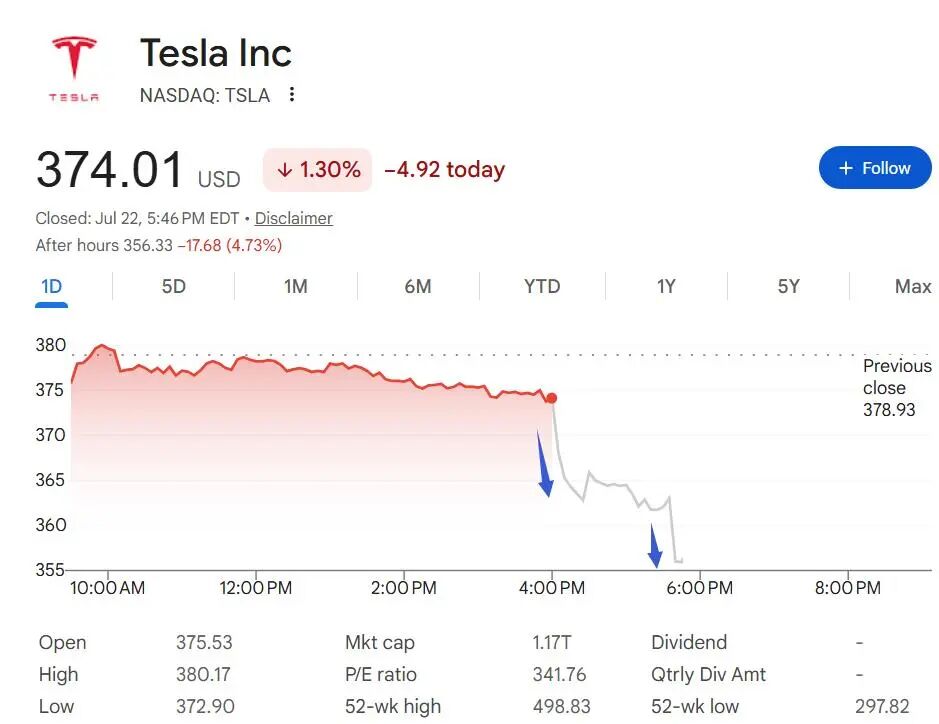
After the financial report was released, Tesla's stock price, which closed down more than 1%, saw its decline widen further, at one point falling more than 3% after hours. Analysts believe the stock price drop does not mean the market is denying Tesla's growth; instead, beyond the strong revenue and delivery figures, investors are more concerned about price pressures in the automotive business, future investment expenditures, the pace of gross margin recovery, and persistently negative free cash flow.
During the earnings call, the stock price decline widened to more than 4%.
01
Unprecedented Capital Expenditure Cycle, Borrowing $300 Billion to Support Expansion
Free cash flow turned negative this quarter because capital expenditures more than doubled quarter-over-quarter.
Chief Financial Officer Vaibhav Taneja stated that the company expects capital expenditures to increase further in the second half of 2026, with full-year capital expenditures exceeding $250 billion.
To support this expansion, the company is "opportunistically" arranging debt financing with a target borrowing limit of up to $300 billion. These funds will be used to expand the Robotaxi fleet, expand the Optimus production line, build a semiconductor wafer fab, install solar panel manufacturing capacity, and develop AI computing infrastructure, among other directions.
Musk stated that the company's principle for capital expenditures is to "spend money as quickly as possible without being overly wasteful," defining the balance between efficiency and speed as a better decision path than simply pursuing capital efficiency.
Vaibhav Taneja added that Tesla acts as the general contractor in almost all of its construction projects to ensure progress speed. Musk compared the current industrial expansion scale to the fastest one in the United States since World War II.
02
Robotaxi Accelerates Expansion, 380,000 Miles of "Zero Accidents," Rejects Third-Party Ride-Hailing Platforms
The highly anticipated Robotaxi business presented clear safety data during this earnings call.
Ashok Elluswamy, Vice President of AI Software at Tesla, revealed that unsupervised Robotaxi is currently operating in six cities across two states. Elluswamy stated:
We have driven more than 380,000 miles in unsupervised Robotaxi with zero noteworthy accidents.
This data is regarded by Tesla as a huge endorsement for the pure vision solution. Regarding future expansion, Musk set an extremely high safety tone:
If we even harm one person, it will make global headlines, and regulators will immediately restrict our activities. So we don't want to hurt anyone—we'd better not even run over a pet.
In response to investors' questions about whether Tesla will cooperate with third-party ride-hailing platforms like Uber, Musk gave a negative answer, explicitly stating that it will maintain absolute vertical integration:
Our profitability is very strong, our products are in no danger of not selling, and we can fully integrate the entire upstream and downstream industrial chain naturally. The only thing restricting growth right now is the 99.999999% strict standard we set for product reliability.
He also stated that the deployment speed of Cybercab is constrained by the accumulation of exclusive driving data for the vehicles; it will require sufficient mileage accumulated by modified Cybercab units equipped with steering wheels and pedals before large-scale deployment on public roads can be realized.
03
Optimus Faces Huge Mass Production Challenges, Supply Chain Built Almost From Scratch
Musk gave a rare detailed explanation of the mass production difficulties of Optimus during the meeting, explicitly warning investors not to underestimate this challenge.
He stated that Optimus will be the most difficult product Tesla has ever mass-produced, because almost all of the robot's components are newly designed, no ready-made supply chain exists, and all of them must be built from scratch or produced in-house.
Musk stated that Optimus mass production will follow an S-curve, but due to the high novelty of the components, the initial ramp-up phase will be "quite long and gradual."
The company is building the Optimus production line at the Fremont factory (the former Model S/X production line).
For the next-generation Optimus 4, the company aims to achieve an order-of-magnitude higher production volume than Optimus 3 and pursue a higher degree of vertical integration, including internalizing the production of a large number of printed circuit boards.
Supply Chain Vice President Karn Budhiraj added that Samsung's soon-to-be-operational wafer fab will be largely dedicated to supporting future projects such as Optimus, and the company is also seeking strategic suppliers for robot-specific components such as metal injection molded parts and flexible printed circuits.
When mentioning the supply chain, in the face of the memory chip shortage and rising prices caused by the ongoing expansion of AI systems, Musk specifically referred to Micron Technology. He said:
They have to make very difficult decisions about memory allocation, and we are really grateful that Micron has made space for Tesla over the next few years, giving us an extremely substantial quota on very reasonable terms even amid today's extremely crazy memory prices.
04
TerraFab and In-House Chip Development: Layout from AI4 to AI6
To support the training and generalization capabilities of robots, Musk is extremely optimistic about the future of Tesla's self-developed chips:
The upgraded AI 4 chip will be mass-produced around the middle of next year; AI 5 is progressing very smoothly and will initially be used for Optimus; and as for the design of Tesla's AI 6 chip, I believe it will be the best edge computing chip in the world.
Regarding the semiconductor wafer fab project TeraFab, Musk refused to disclose its site selection during the earnings call on the grounds that it "deserves a full day of spotlight on its own," but confirmed that equipment orders have been placed for the development wafer fab located in Austin.
This plant will integrate photomask production, logic, storage, packaging, and chip testing under one roof to enable fast iterative chip design verification.
He stated that TeraFab is a necessary condition for the scaling of Optimus, "otherwise we will not have enough AI chips."
05
"Cannot Discuss" Merger Matters with SpaceX, But the Two Companies Are Deepening Synergy
Facing analysts' follow-up questions about the possibility of a merger between Tesla and SpaceX, Musk stated that the two companies are cooperating more and more deeply, but any merger-related matters "must go through proper procedures," and he referred the topic to the legal team.
Brandon Ehrhart, the company's General Counsel, stated that earlier this year the two sides further deepened their cooperative relationship through investments and framework agreements to advance projects such as TerraFab and Digital Optimus.
Musk then disclosed several specific cooperation progress points:
Grok AI has been integrated into Tesla's in-vehicle systems and is helping to power Digital Optimus;
Starlink will be integrated into Cybercab and gradually rolled out to all Tesla models entering Starlink-covered markets to address cellular signal dead zones in some regions.
He pointed out that even in Silicon Valley, cellular signals on some roads are quite unstable and cannot meet the always-on connectivity requirements of Robotaxi. He also proposed that in the future, the Starlink terminal on Cybercab could act as a mobile ground relay node to provide Wi-Fi connectivity for surrounding devices.
This article is from the WeChat official account "Wall Street CN Max", authors: Bao Yilong and Li Dan, published with authorization from 36Kr.