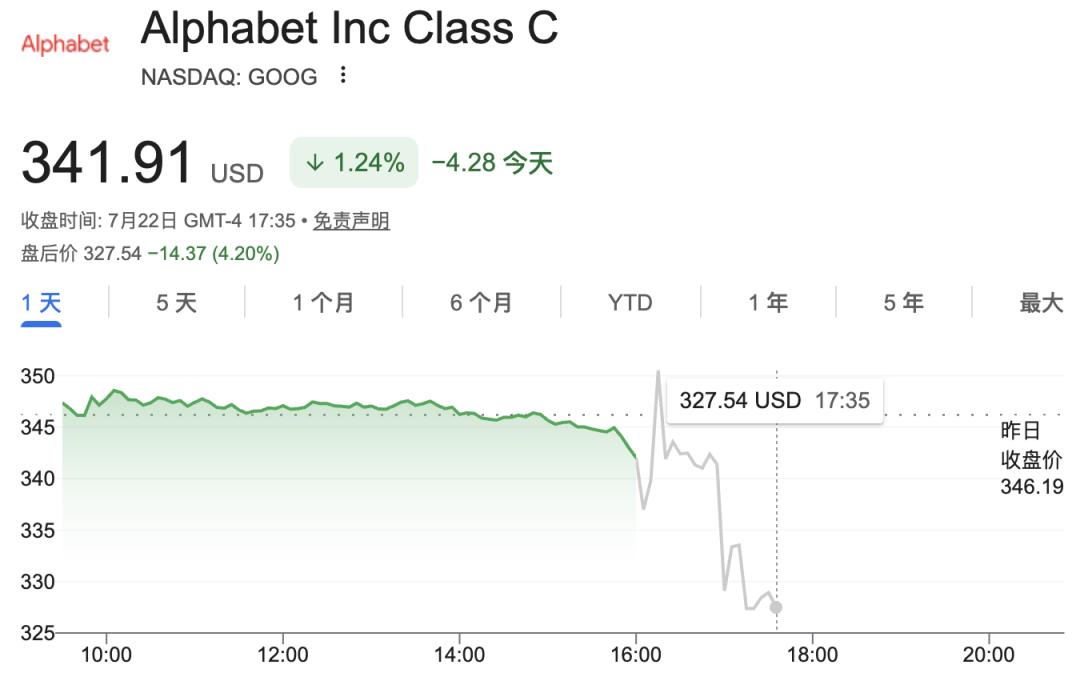
Google posted negative free cash flow for the first time, raised its full-year capital expenditure outlook to a maximum of $205 billion, and its share price fell more than 4% in after-hours trading.
After U.S. markets closed on July 22, Google's latest earnings report revealed that the company generated total revenues of $119.8 billion in Q2, marking a 24% year-over-year increase; operating profit reached $40.8 billion, up 30% year-over-year. Additionally, driven by a surge in equity gains from its investment portfolio (including Anthropic and SpaceX, among others), the company's net income saw a staggering four-fold increase.
Beneath the rosy revenue figures, the market and investors have fixed their attention on two core focuses: first, how much tangible business growth AI has actually brought to Google, and second, how much capital this seemingly bottomless "AI arms race" will ultimately consume.
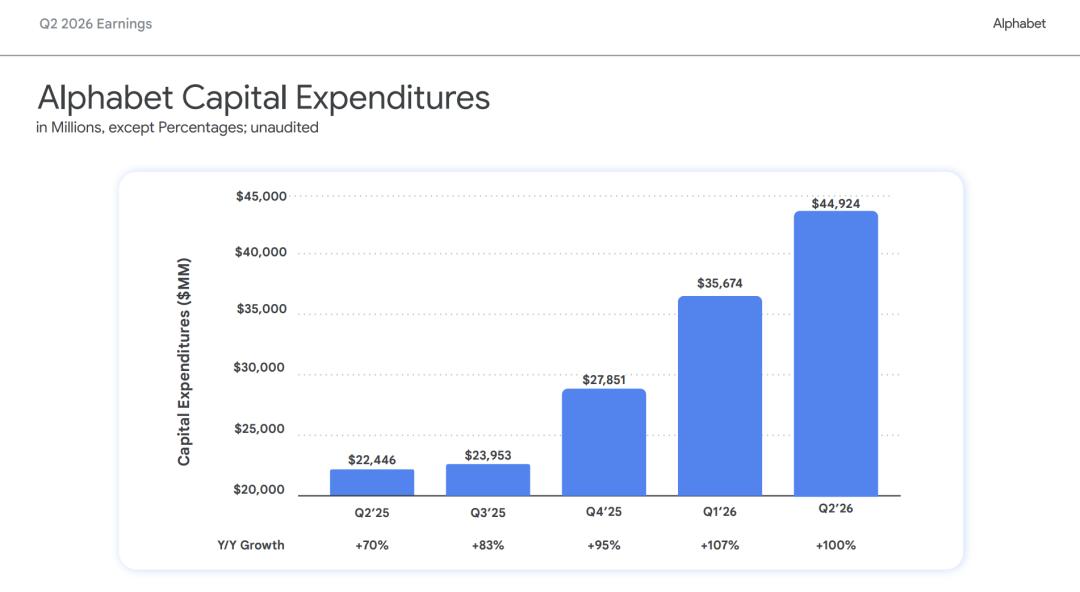
Google's capital expenditures in Q2 hit $44.9 billion, with the vast majority allocated to AI technology infrastructure. The company also raised its full-year 2026 capital expenditure guidance from the previous $180-190 billion range to $195-205 billion. As a result, the company's free cash flow for the quarter turned negative at $5.9 billion, a stark contrast to Google's track record of strong free cash flow in the same period last year and for many years prior.
Following the earnings release, CEO Sundar Pichai, Chief Business Officer Philipp Schindler, and CFO Anat Ashkenazi attended Google's Q2 earnings call. During the call, Pichai stated: "Our AI investments are redefining what is possible across our entire business."
Facing this rare shift to negative cash flow, CFO Ashkenazi projected that AI infrastructure spending will continue to put pressure on the income statement and cash flow. When pressed by a Morgan Stanley analyst about the return on invested capital (ROIC) for GenAI, Pichai shared his core assessment:
"I think we are at a very, very early stage of a structural transformation spanning multiple fields... Much like the cloud itself, only a small fraction of enterprise workloads have migrated to the cloud. Now consider what proportion of workloads are truly AI-native and AI-empowered — it feels very, very early still. If anything, over the past year we have become even more optimistic about the opportunities ahead."
After the earnings release, Google's stock price fluctuated slightly. Following the earnings call, as the market grew concerned about whether massive capital expenditures would deliver corresponding returns, Google's share price plunged 4.2%.
01
Free Cash Flow Turns Negative for the First Time, Capital Expenditure Guidance Raised Again
Alphabet's capital expenditures in Q2 reached $44.924 billion, far exceeding the $22.446 billion recorded in the same period last year, directly resulting in a negative free cash flow of $5.855 billion (approximately $5.9 billion) for the quarter — marking the first time Google has posted negative quarterly free cash flow in the decades since its public listing.
Free cash flow is a metric that measures the cash a company can use to repay debt or return value to shareholders after covering operating costs and capital expenditures, and has long been a core benchmark for Wall Street to assess the financial health of technology firms.
During the earnings call, CFO Anat Ashkenazi announced that full-year 2026 capital expenditure guidance has been raised to $195-205 billion, up from the previous $180-190 billion expectation and surpassing analysts' prior forecast of around $186 billion. This marks Google's second upward revision to its capital expenditure guidance this year — the first came in April, when the company raised its upper spending limit to $190 billion.
Ashkenazi stated: "We expect free cash flow to remain under pressure, driven by our investments in technical infrastructure that position us to capture AI opportunities and continue delivering substantial returns over time."
But following the announcement, the stock price immediately dropped.
Investors are concerned that Google is rapidly transforming from an asset-light enterprise to a capital-intensive company. To support massive AI infrastructure spending, Alphabet has recently raised nearly $100 billion in debt, and completed its first stock offering in more than 20 years as a public company in June, raising approximately $85 billion in net proceeds — a stark reversal from its multi-year strategy of consistent share repurchases.
Thomas Monteiro, Senior Analyst at Investing.com, commented directly: "This further increase in capital expenditure is not favorable for Alphabet. Combined with the rising interest rate environment and persistent supply-demand tensions in AI infrastructure, the logic of 'self-sustaining growth through operating cash flow' is beginning to falter."
However, Dec Mullarkey, Managing Director at asset management firm SLC Management, holds a relatively optimistic view: "The market wants to see hyperscale cloud vendors compete fiercely for AI leadership, but not at the cost of eroding profitability. So far, Alphabet has maintained this balance."
Ashkenazi added that the company will use a combination of operating cash flow, debt, and equity financing to support its spending, explicitly stating that it will not issue additional new shares beyond what has already been announced, while emphasizing its commitment to maintaining a robust balance sheet.
02
Google Cloud Emerges as the Biggest Growth Engine
By business segment, Google Cloud continues to be Alphabet's fastest-growing division.
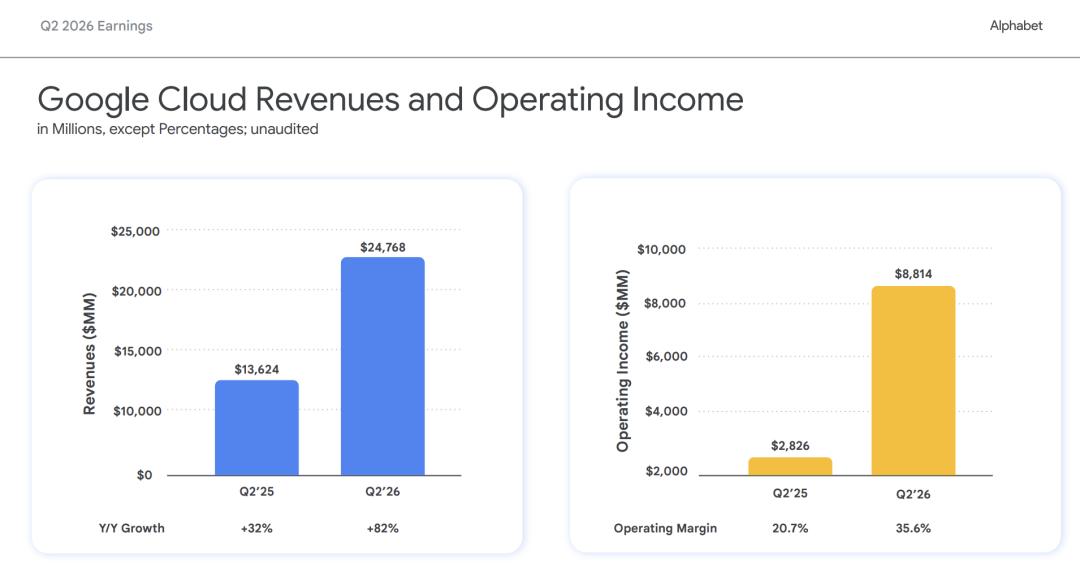
In Q2, Google Cloud's revenue reached $24.768 billion, up 82% year-over-year and accelerating further from prior periods. The company attributed this growth primarily to sustained strong demand for Google Cloud Platform (GCP) enterprise AI solutions, enterprise AI infrastructure, and core cloud services.
At the same time, Google Cloud's operating profit hit $8.814 billion, a substantial increase from the $2.826 billion recorded in the same period last year, reflecting a marked improvement in profitability.
The cloud business's backlog (the value of signed contracts not yet recognized as revenue) expanded to $5.14 trillion, up from roughly $4.6 trillion in the previous quarter and surpassing the $5 trillion threshold for the first time. The company noted that more than half of this backlog is expected to be recognized as revenue over the next 24 months, with a customer base spanning "a broad and diverse mix of clients."
Monteiro stated that the cloud business's outperformance clearly demonstrates at a minimum that the company's AI investments are "translating into high-growth, profitable revenue, with related contracts being realized immediately as capacity comes online."
While Google Cloud still lags behind Amazon AWS and Microsoft Azure, it has become one of Alphabet's fastest-growing businesses, fueled by strong demand for AI infrastructure from AI startups and enterprise customers.
In contrast, the traditional advertising business has maintained steady growth:
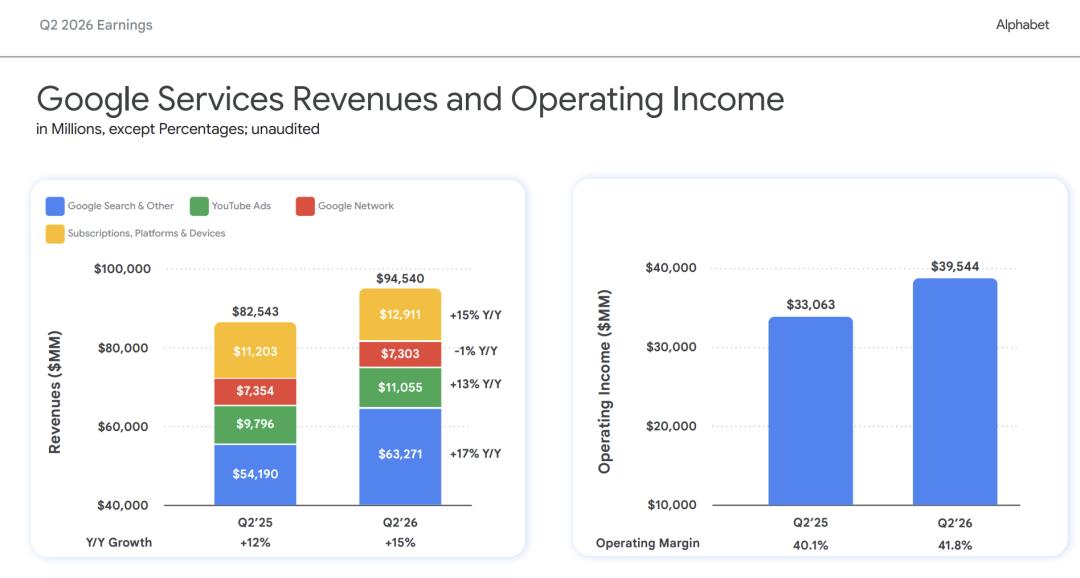
Google Search and other businesses generated $63.271 billion in revenue, up 17% year-over-year;
YouTube ad revenue reached $11.055 billion, a 13% year-over-year increase; in terms of YouTube's monthly unique users, more than 1.7 billion unique viewers watched related content on the platform during the 2026 World Cup, further driving traffic growth;
Google's subscriptions, platforms, and devices business posted revenue of $12.911 billion, up 15% year-over-year.
Overall, Google Services' total revenue hit $94.54 billion, representing a 15% year-over-year increase.
03
CEO: AI Investments Are Reshaping the Entire Google, Focusing on Gemini 4
Alphabet CEO Sundar Pichai stated that the company's AI investments are redefining its entire business. He told investors: "It feels like we are at the very early stage of a long-term structural transformation across multiple fields... Over the past year, we have grown increasingly optimistic about the opportunities ahead."
He revealed that nearly 90% of Fortune 100 companies are already using Gemini Enterprise; the Gemini models process 22 billion API tokens per minute, and the Gemini App has reached 950 million monthly active users. Nate Elliott, Principal Analyst at eMarketer, noted: "Gemini is just one step away from becoming Google's third consumer-facing AI product with a billion users (alongside AI Overviews and AI Mode)."
On the model roadmap, Pichai is shifting focus to the next-generation flagship model Gemini 4, describing it as a "larger-scale next-generation frontier model" that the company is prioritizing for training with dedicated computing resources, and indicating that the pace of Google's model releases will accelerate. The earlier delayed launch of Gemini 3.5 Pro had raised external concerns about Google's competitiveness in areas such as AI programming, where Anthropic and OpenAI have established clear advantages among developers.
At the same time, AI features continue to drive growth in Google Search query volume, demand for the company's cybersecurity products remains strong, and the newly launched Gemini 3.5 Flash Cyber has delivered outstanding performance in terms of cost efficiency. Furthermore, during the 2026 World Cup, more than 1.7 billion unique users watched related videos on YouTube, further boosting platform traffic.
Pichai said the company's "differentiated full-stack AI strategy" is consistently delivering measurable business value to consumers, enterprise clients, and partners.
04
Continuing to Ramp Up AI Infrastructure Investments
To meet the growing demand for AI computing power, Alphabet further strengthened its financing activities in Q2.
In June, the company completed offerings of Class A shares, Class C shares, and mandatory convertible preferred shares, raising $49.6 billion in net proceeds; it also issued $20.3 billion in senior unsecured bonds; additionally, it established an ATM share issuance plan with a maximum size of $40 billion, which had not been activated as of the end of Q2. These measures have brought Alphabet's total newly raised capital close to $100 billion in recent periods.
Due to the substantial increase in capital expenditures, free cash flow for the quarter turned negative at $5.855 billion, but free cash flow over the past 12 months still reached $53.273 billion. Meanwhile, the combined 2026 capital expenditures of the four major hyperscale cloud vendors (Google, Meta, Microsoft, and Amazon) are projected to exceed $725 billion, driving the entire technology industry's free cash flow down to a ten-year low.
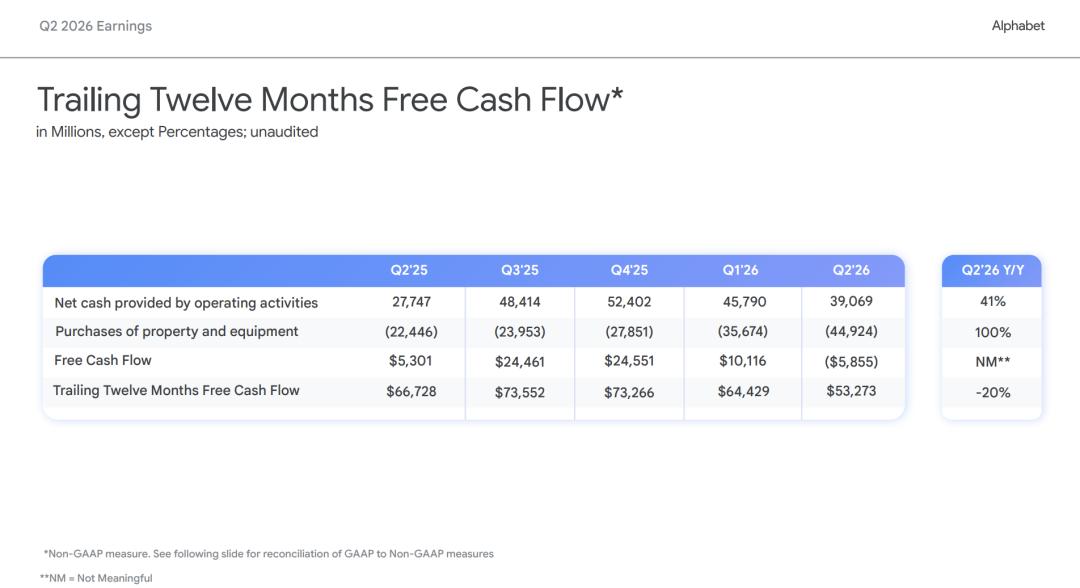
Overall, this earnings report presents a distinct "dual-sided" picture: the explosive growth of the cloud business and the backlog exceeding $5 trillion confirm that AI investments are beginning to deliver commercial returns; however, the first negative free cash flow and the second upward revision of capital expenditure guidance this year have left the market highly vigilant about the sustainability of this AI arms race.
Whether Google can continue to walk the tightrope between competing for AI leadership and maintaining financial health will be the core focus for investors in the coming quarters.
This article is from the WeChat public account "Wall Street CN", authored by YANG Chen and LONG Yue, and published with authorization from 36Kr.