Turn on this little blue light, and "I find myself at the very bottom of the road user pecking order".
"As soon as the blue light turns on, anyone can cut in." This is a widely circulated phrase in car owner groups this year.
It was originally meant to alert surrounding vehicles that "I'm running autonomous driving," but it unexpectedly turned the vehicle into the most noticeable target on the road. Nearby cars will accelerate to block your lane, and the vehicle ahead will deliberately tap the brakes to test you. How could a light that represents future technology become a signal for targeted harassment?
As night falls, the viaduct during evening rush hour is as congested as ever. The river of cars ruled by red taillights creeps slowly forward, everything feels like it's been repeated thousands of times, monotonous enough to make people drowsy.
But now, if you pay a little attention, you will notice that scattered spots of blue are continuously blending into this sea of red.
More and more new cars are quietly lit with a faint eerie blue glow near the edges of their rearview mirrors, at the front of the vehicle, or around the taillight clusters. For people familiar with new energy vehicles, this light has a rather hardcore name — the Automated Driving System Marker Lamp, also known as the ADS lamp, though the general public still prefers to call it the "Little Blue Light."
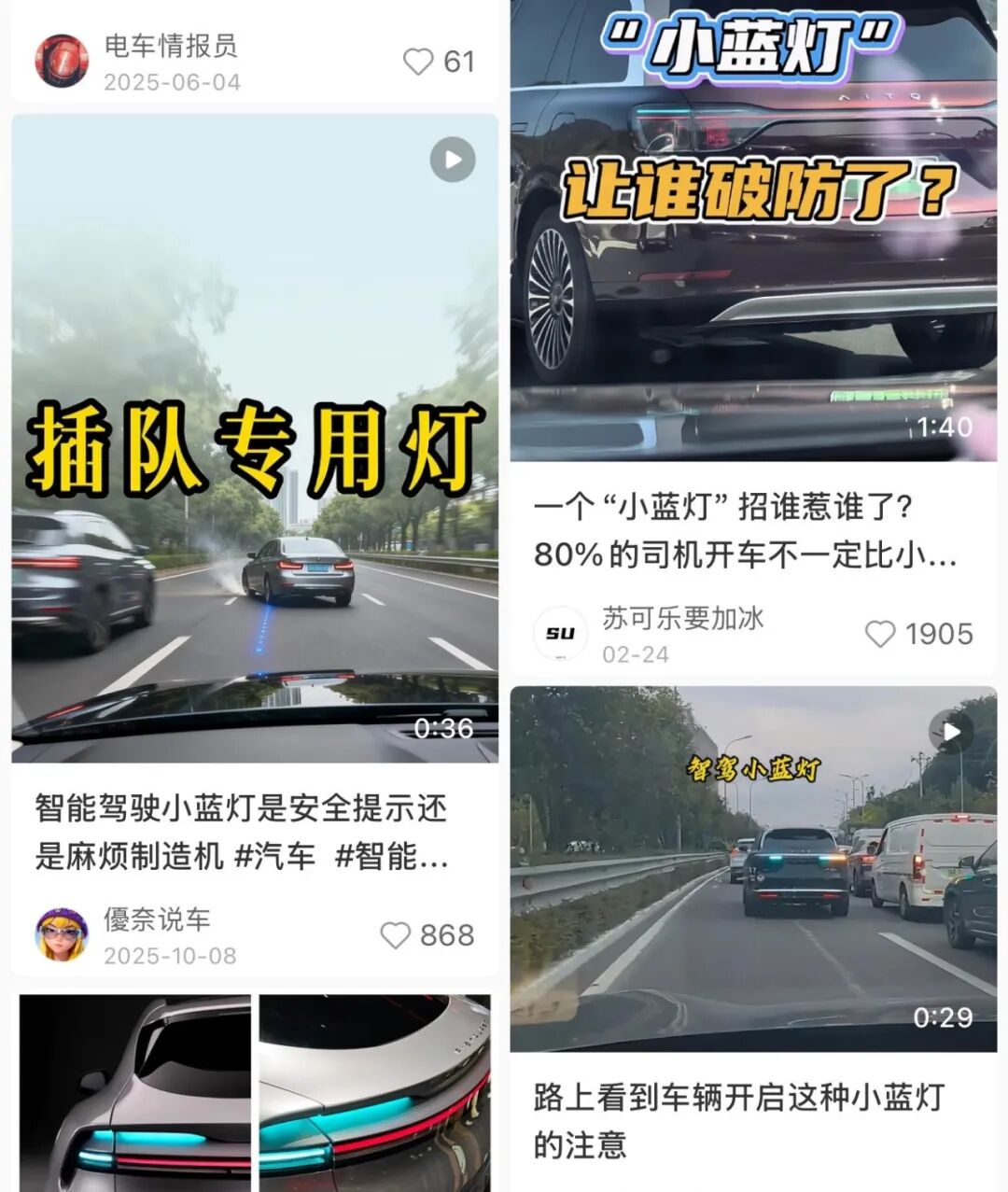
The Little Blue Light, also known as the "lane-cutting indicator", AKA the blinding taillight killer in city traffic at night. (Photo/Social media screenshot)
In August 2022, the Little Blue Light made its debut on Chinese roads as an easter egg feature on some top-trim vehicle models. In just a few years, amid the almost cutthroat competition in China's new energy vehicle industry, it has evolved from an "optional extra" to a "standard feature" for almost every brand that wants to secure a spot at the autonomous driving table.
In the grand narratives of automakers' PPTs, this light is a symbol of a tacit understanding reached between the automotive cyber era and human society: I'm watching the road, and you should watch me too.
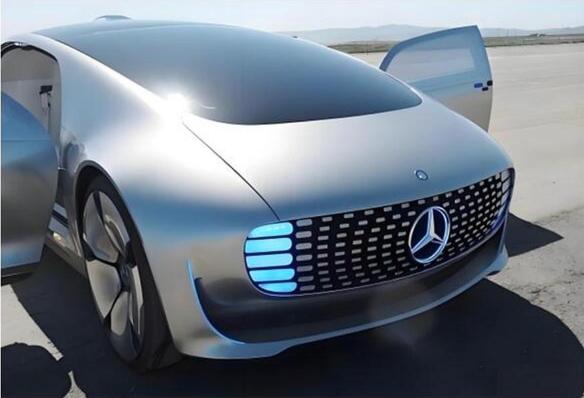
The concept can be traced back to Mercedes-Benz's F015 concept car in 2015, which already featured the idea of fully autonomous driving. When the vehicle activates autonomous driving, its LED lights emit a blue glow. (Photo/Brand official website)
However, when this futuristic beam of light truly shines intensively on China's complex road ecosystem, the story takes an unexpected and absurd turn.
01
The Little Blue Light Era: Ended before it even began?
The number of Little Blue Lights on the road is visibly increasing at a noticeable pace.
In the red ocean where "automakers compete on range after range, on screens after screens, on architecture after architecture, and finally on autonomous driving", urban NOA (Navigation on Autopilot) has become the ultimate battlefield for major carmakers to demonstrate their technological prowess. But autonomous driving is precisely a "sensory-less" technology — the car owner can sit inside resting their eyes, while people outside the vehicle have no way of knowing what's happening.
The Little Blue Light thus became the perfect "walking billboard" for automakers. After all, the more and larger the glowing lights are on the street, the more intuitively they can demonstrate the market share of their own autonomous driving systems. During the vacuum period without mandatory national unified standards, various automakers pushed the Little Blue Light to new extremes, making the light strips longer and longer, just to be conspicuous enough in the dark.
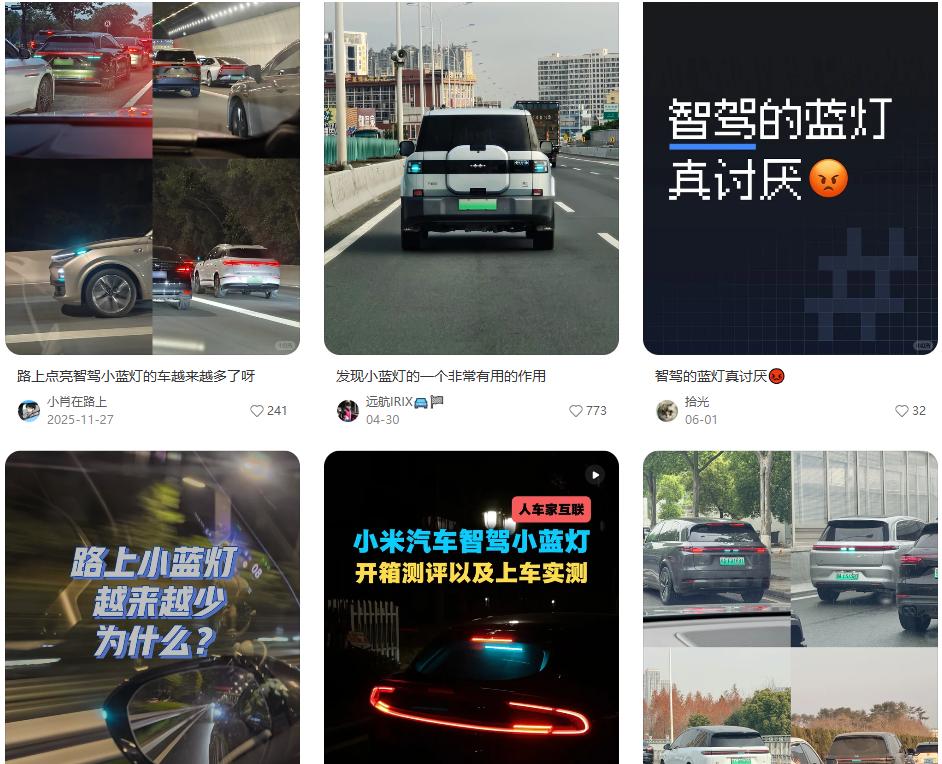
There are more and more Little Blue Lights on the road, and discussions about them are also growing. (Photo/Social media screenshot)
The increasing number of Little Blue Lights on the road is no illusion. In 2022, Li Auto first added an external autonomous driving indicator light on its L9 model, followed successively by Xpeng, NIO, BYD, AITO, and Xiaomi. The "2025 Urban NOA Automotive Assisted Driving Research Report" released by the China Association of Automobile Manufacturers shows that from January to November 2025, the cumulative sales of passenger vehicles equipped with urban NOA functions in China reached 3.129 million units, with a penetration rate of 15.1% in the total insured passenger vehicle volume, an increase of 5.6 percentage points compared to the full year of 2024.
But while the installation rate is soaring all the way, these Little Blue Lights, which were developed at huge expense and regarded as "highlight moments" by automakers, are being manually turned off by car owners.
Because "as soon as the blue light turns on, anyone can cut in."
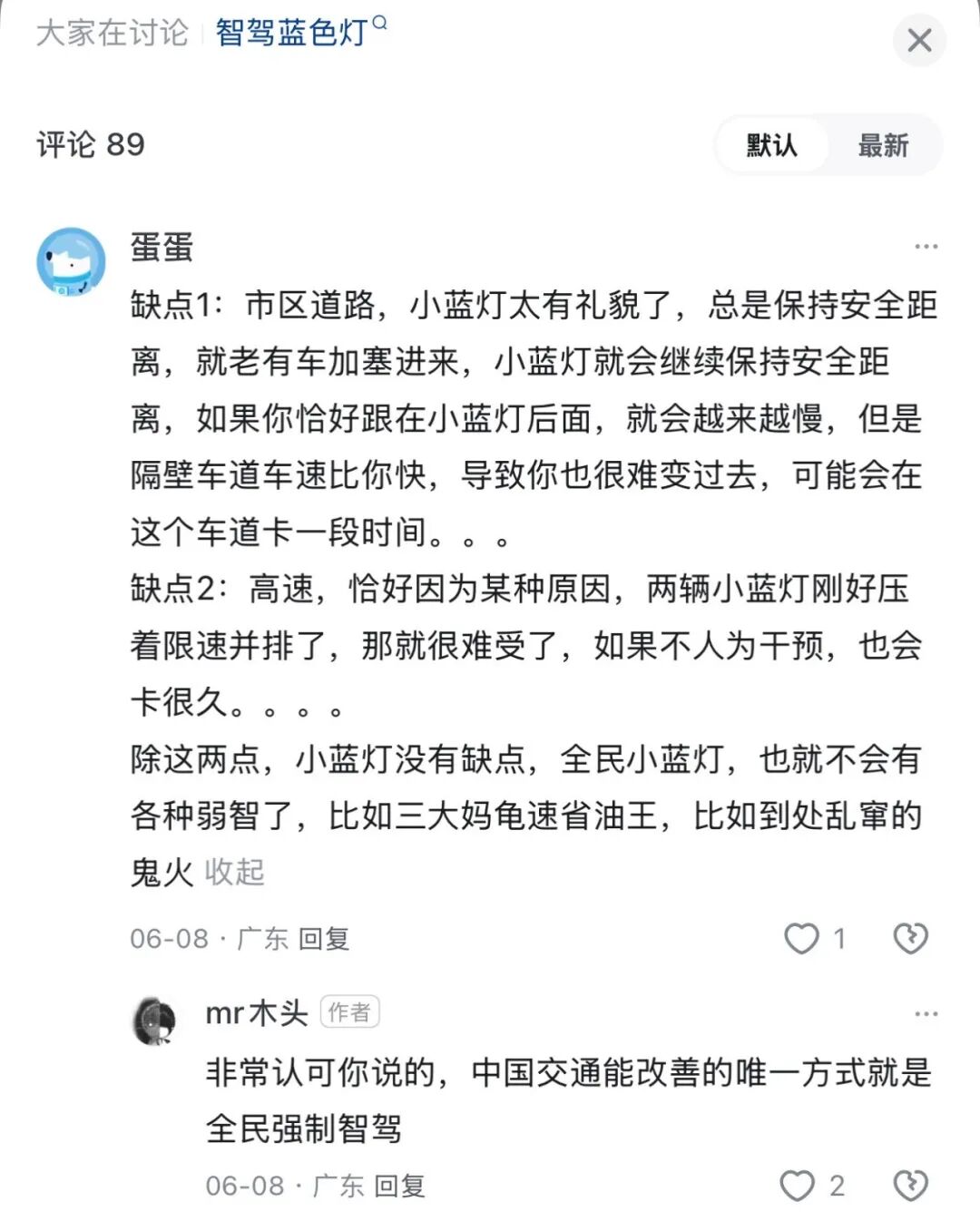
Being overly courteous is also a drawback of the Little Blue Light. (Photo/Social media screenshot)
Walk into any car owner group, and you will hear similar complaints. "I can use autonomous driving every day, but I dare not turn on the Little Blue Light even once."
This is a very specific and trivial kind of psychological pressure, accumulated over time and ubiquitous everywhere.
When you turn on this light during morning and evening rush hours, every move you make will be infinitely magnified. Many drivers, upon seeing the Little Blue Light, can't help but mutter to themselves, instinctively speculating: "This person is probably playing on their phone, right?" or "Are they dozing off?" This moral scrutiny of being spied on and labeled makes many car owners in the driver's seat extremely uneasy.
However, what truly forces car owners to turn off the light is the almost ubiquitous malicious lane-blocking behavior.
Once the Little Blue Light is turned on, the vehicle's living space on the road will be drastically compressed. For example, at a conventional lane-changing merging intersection where everyone was previously taking turns to pass in an orderly manner, as soon as the adjacent car sees the blue light, it will immediately accelerate to block the position tightly; when following the vehicle ahead, the leading car often deliberately taps the brakes to "test the autonomous driving system" even if there is no need for emergency braking at all. Not to mention those vehicles that change lanes without turning on their signals, cutting into the safety distance at an almost perpendicular angle.
All these lane-blocking behaviors are no longer about hurrying to get somewhere, but more like a malicious form of "hunting" for fun.
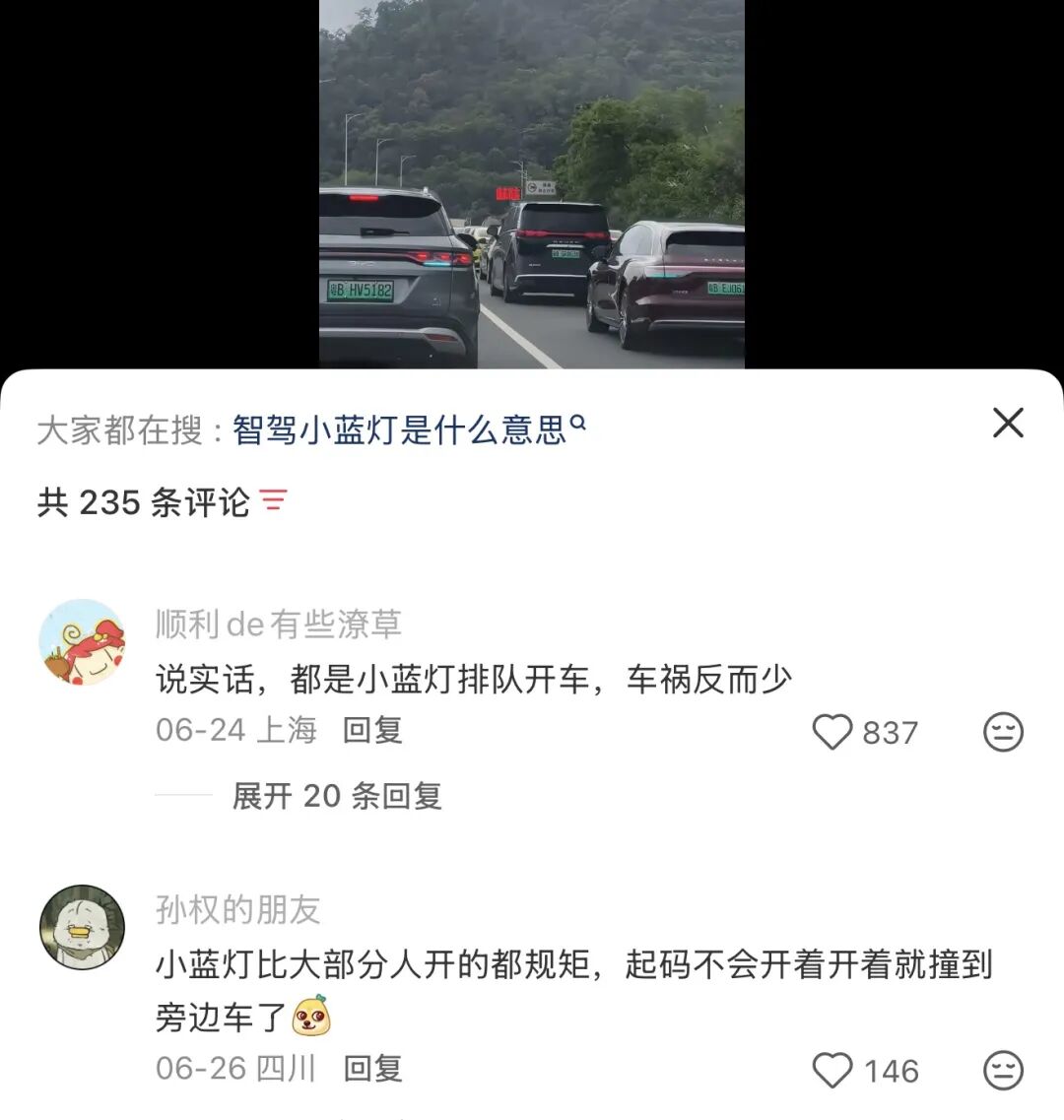
Autonomous driving systems are more "rule-abiding" than human drivers. (Photo/Social media screenshot)
The road is a miniature society intertwined with the law of the jungle and human worldly wisdom. The lane-changing games between Chinese drivers are often built on the "micro-expression" of the vehicle's front end: by slightly edging the front of the car inward, you can tell whether the other driver intends to slow down.
But more frustrating than malicious lane-blocking is the persistent sense of burden hanging over your mind. When driving with the Little Blue Light on, you can't help but wonder if others will think this car is easy to bully and deliberately cut in front of you. This faint, lingering psychological pressure, when accumulated, is even more tiring than traffic congestion itself.
When autonomous driving car owners find that turning on this light not only fails to earn respect, but instead brings multiplied driving risks and more frequent lane-cutting incidents, they can only choose to turn off the Little Blue Light to seek peace and quiet, and avoid being a "target".
This awkward Little Blue Light, born from the cutthroat competition among automakers, is dying out due to car owners' instinct for survival.
02
Road rage lane blockers, bullies who pick the weak
The Little Blue Light, originally a symbol of "high-level autonomous driving", is now rapidly sliding to the bottom of the contempt chain. Not because the technology is not good enough, but because different people see completely different things in it.
But what is truly dangerous and worth pondering is the most aggressive mindset among them — what exactly are those drivers who become overly aggressive the moment they see the Little Blue Light thinking?
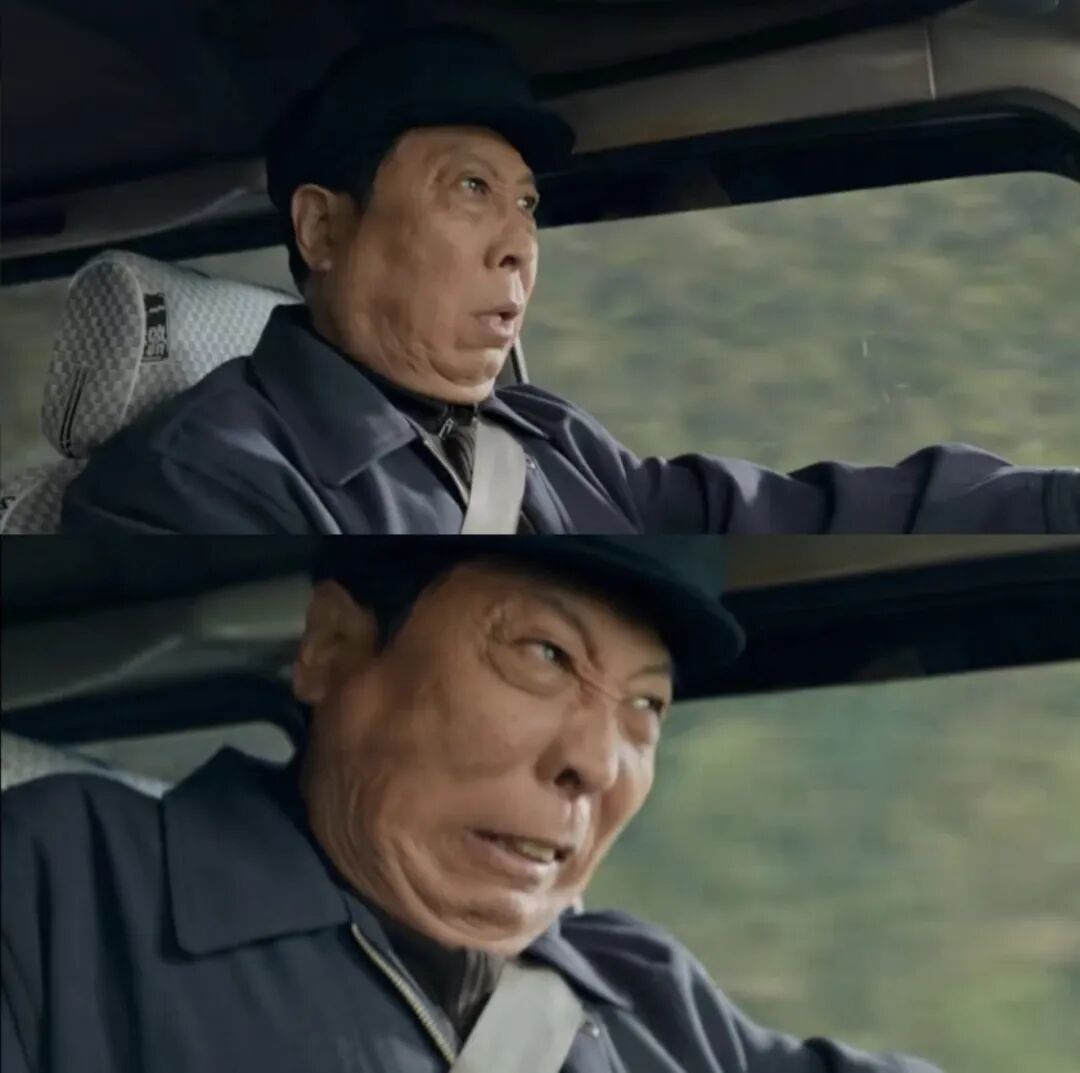
In the eyes of veteran drivers, why should they yield to such an honest "car-mounted computer"? (Photo/<i>The Knockout</i>)
A vehicle that can honestly maintain a safe distance and steadily follow the car ahead should have been the "perfect road companion" that all drivers dream of. But once this sense of compliance is demonstrated by a machine, it is no longer appreciated — instead, the vehicle becomes a target.
To put it plainly, autonomous driving systems only make safety judgments. They are just computers without road rage: if you squeeze in, they yield; if you block them, they brake. They have no temper, let alone retaliate afterwards.
This is completely different from the game between human drivers. As a normal person, if you have a conflict with another driver, you will always hold back before lashing out, thinking "won't he suddenly crash into me?", and then try your best to control your temper and stick to your bottom line.
But when facing the Little Blue Light, this layer of moral concern disappears completely.
Thus, on roads filled with resentment and anxiety, the Little Blue Light unexpectedly becomes the only existence that can be "bullied with confidence" — which is precisely an unforeseen side effect that no one anticipated during its initial design.
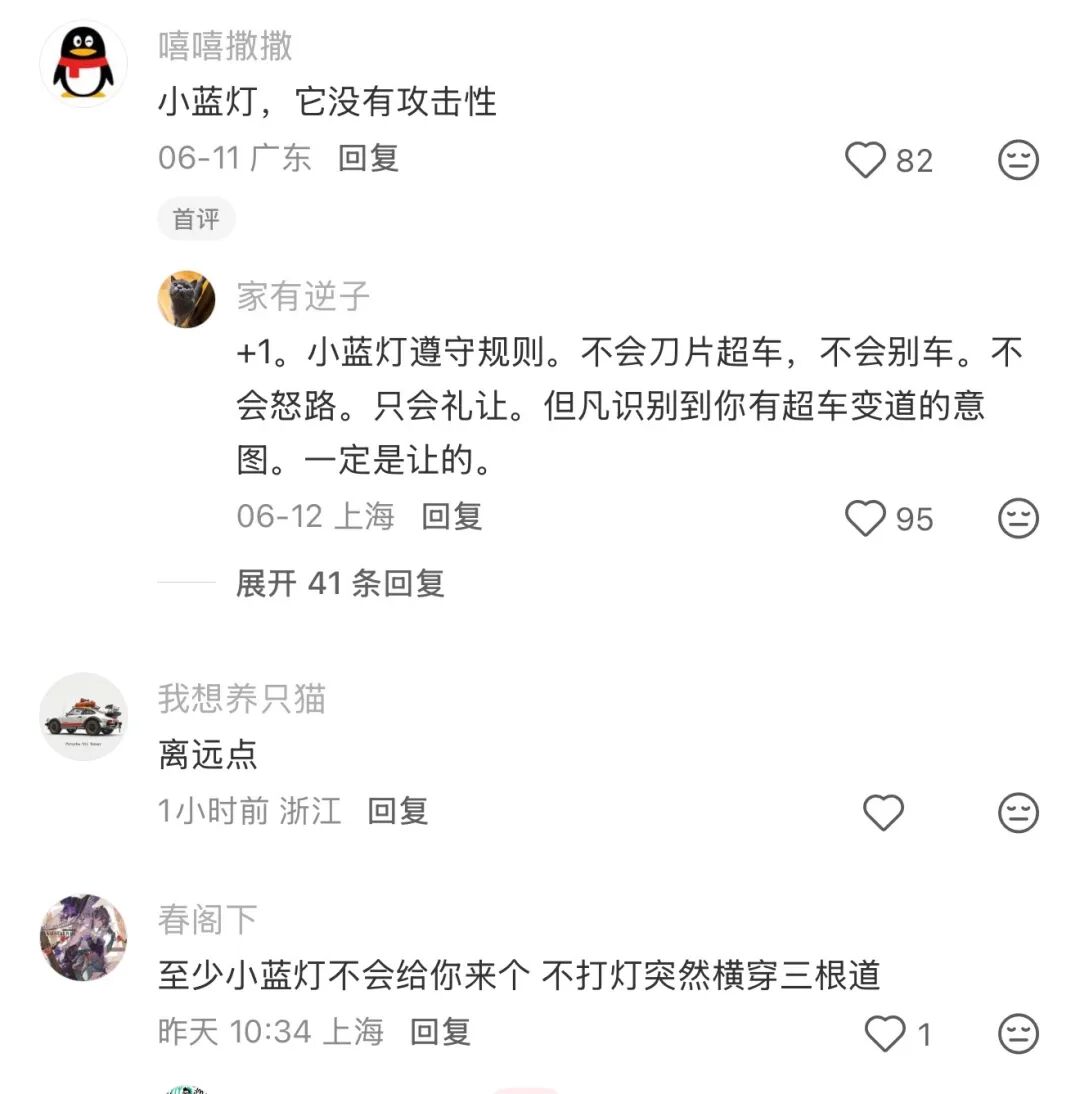
Three different reactions to the Little Blue Light are all very common. (Photo/Social media screenshot)
There has always been only one universal consensus on traffic light colors: red means stop, green means go, yellow means wait. But what about blue? Some people think "it's more reassuring to follow behind", some feel "this is a soft target to bully", while others instinctively "stay away quickly, it might malfunction at any time". One single color with three different interpretations is almost unthinkable in a traffic signal system that requires certainty.
The Little Blue Light tried to use a brand new visual language to reconstruct the rules of human-machine coexistence, but it underestimated the complexity of human nature. When humans face the "machines" they created themselves, they always seem to harbor an indescribable subtle malice.
For example, some time ago, at a hotel in Jiangsu province, a hardworking food delivery robot was kicked over to the ground for no reason by a drunk man; on the internet, videos of people deliberately blocking unmanned delivery vehicles and teasing them until their systems crash always get a lot of views for fun.
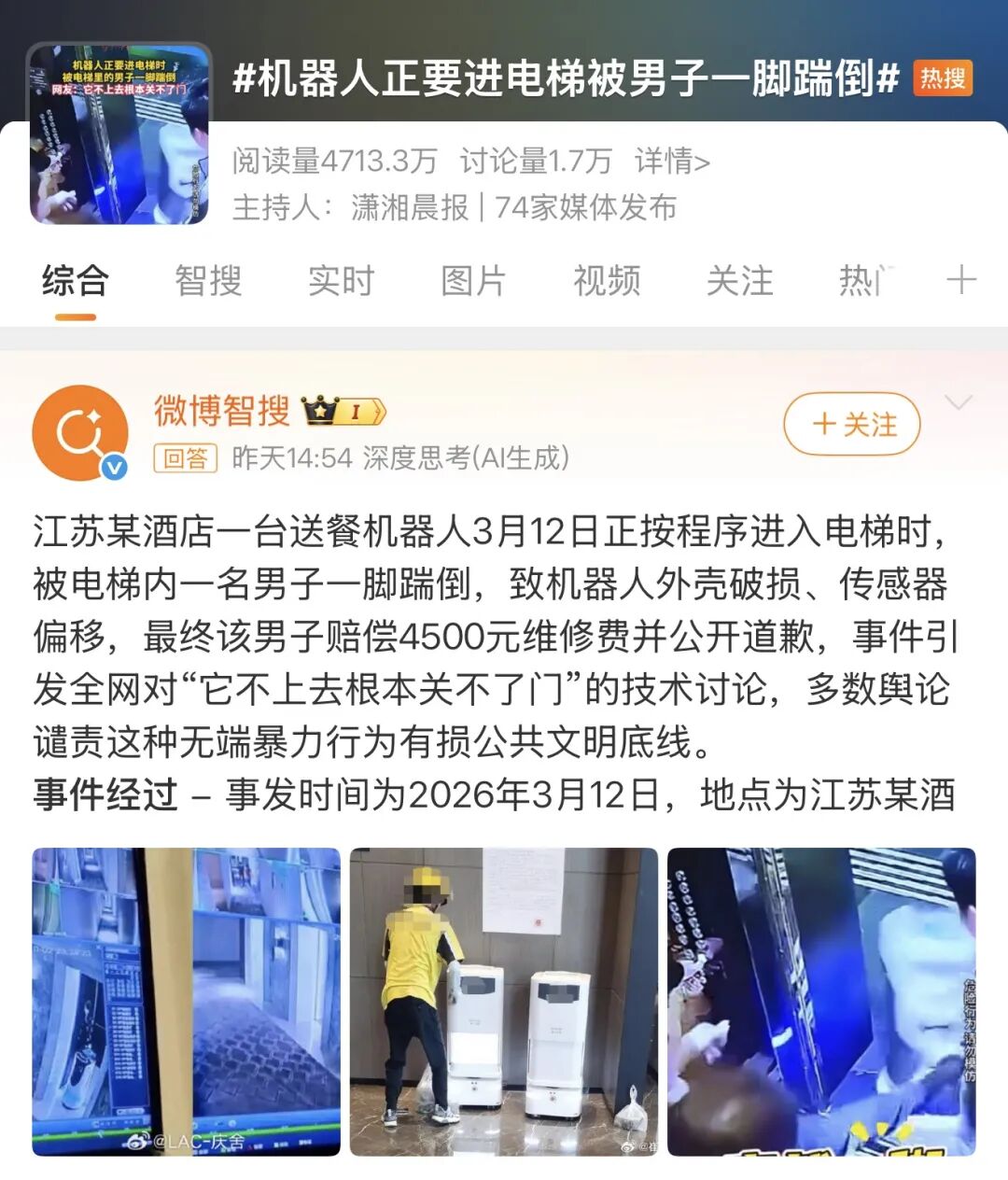
This is the most concrete manifestation of bullying the weak and fearing the strong in human nature. (Photo/Social media screenshot)
Netizens' comments are harsh but accurate: "Having lived a meek life for decades, they finally get to feel superior in front of a robot." Robots and autonomous driving vehicles are facing the exact same situation. But this kind of malice, inside the relatively enclosed car cabin wrapped in a steel shell, is often amplified exponentially.
William Szlemko, a psychologist at Colorado State University, pointed out in his classic "In-Vehicle Territorial Defense Theory" that drivers are extremely likely to regard their cars as an extension of their personal territory. Once something goes slightly wrong on the road, it will trigger strong aggressiveness and a desire for control.
On the one hand, they think the act of "handing over your life to a computer" is extremely unreliable; on the other hand, when they discover that this expensive technological product is actually a "learner driver" that abides by rules and does not fight for road rights in real scenarios, a sense of superiority born from the desire for control arises spontaneously.

Sometimes a person doesn't even need a reason to dislike others or certain things. (Photo/<i>Empresses in the Palace</i>)
Playing these probing games with autonomous driving vehicles on the road is never just about competing for a few extra seconds of travel time.
At the end of the day, those drivers who excitedly swerve to block the lane the moment they see a blue light on the road — wouldn't they block other cars normally? Of course they would. They have thousands of excuses for lane-blocking: the other car is driving too slowly, the other car model is too shabby,