$5.8 billion spent in 90 days, placing heavy bets on AI and chip factories, Tesla: "We hold unprecedented optimism for the future"
On July 22 local U.S. time, Tesla released its Q2 2026 financial report, covering the period ending June 30.
Total revenue for Tesla's second quarter reached $28.24 billion, marking a 26% year-over-year increase and surpassing the average analyst consensus of $25.71 billion surveyed by the London Stock Exchange Group (LSEG).
However, net income attributable to common shareholders fell to $1.114 billion, representing a 5% decline compared to the $1.172 billion recorded in the same period last year. Adjusted earnings per share came in at $0.33, significantly below the average analyst estimate of $0.51 per share from the LSEG survey.
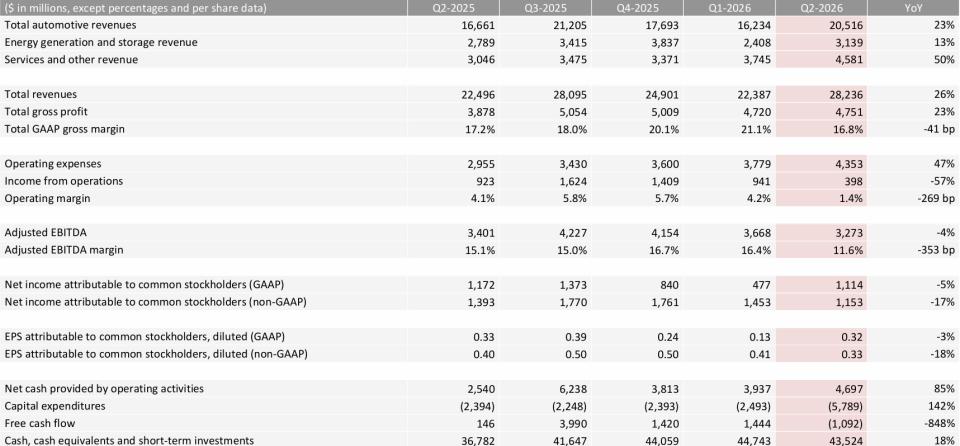
Tesla Q2 2026 Financial Performance
This is a contradictory earnings report. On one hand, Tesla achieved record-high revenue and record vehicle deliveries; on the other hand, net profit declined, free cash flow turned negative, and earnings per share fell far short of Wall Street expectations.
Notably, Tesla is currently in an unprecedented investment spree. Capital expenditures in Q2 hit $5.789 billion, surging 142% year-over-year, leading the company to post a negative free cash flow of $1.1 billion — the first time in over two years.
Behind the pressure on profits and cash flow lies Tesla's full commitment to "physical world AI" including AI, self-driving taxis, and humanoid robots.
Despite short-term fluctuations in financial metrics, Tesla stated in its earnings release: "We are more optimistic about the future than ever before."
Following the earnings announcement, Tesla's stock price dropped by more than 3% in after-hours trading.
01 A Costly Growth Report Card
Tesla's Q2 revenue surged 26%, driven by a strong rebound in vehicle deliveries and breakthroughs in its service business.
However, the revenue growth did not translate into a synchronized improvement in overall profits. Net income attributable to common shareholders stood at $1.114 billion, down 5% year-over-year. On a non-GAAP basis, net income attributable to common shareholders was $1.153 billion, representing a 17% year-over-year decline.
The overall gross margin fell from 17.2% in the same period last year to 16.8%, a 41-basis-point contraction. The operating margin decline was even more pronounced, plummeting from 4.1% a year ago to 1.4%, a decrease of 2.7 percentage points.
The shrinking profit margin stems partially from aggressive pricing strategies and incentive programs. To boost sales volumes, Tesla launched lower-priced versions of the Model Y and Model 3, alongside discounted auto loans.
Meanwhile, global regulatory credit revenue dropped sharply from $439 million in the same period last year and $380 million in the previous quarter to $146 million, further weighing on profitability.
What draws even more market attention is the reversal in cash flow.
With capital expenditures surging 142% year-over-year to $5.789 billion — far exceeding the $4.697 billion in cash flow generated from operating activities (which grew 85% year-over-year) — Tesla's free cash flow turned negative in Q2 at -$1.092 billion, ending a streak of positive free cash flow over four consecutive quarters.
As of the end of Q2, Tesla's total cash and investments stood at $43.524 billion, a $1.2 billion decrease quarter-over-quarter. Tesla explained that this reflects the company being in "the largest and most exciting investment period," allocating substantial funds to lay the foundation for long-term value creation.
Analysts at Morgan Stanley noted in their latest research report that as capital expenditures double and free cash flow turns negative, investors are increasingly focused on whether Tesla's spending is effectively fortifying its moat in physical world AI.
02 Model Y Global Sales Boom, Production Capacity Shifts Discreetly
Despite fluctuations in financial data, Tesla's core automotive business showed strong recovery momentum in Q2. Total automotive revenue for the quarter reached $20.516 billion, up 23% year-over-year and exceeding the general analyst consensus of $18.68 billion.
In Q2, Tesla produced a total of 451,758 vehicles, up 10% year-over-year. Among these, Model 3 and Model Y production reached 442,936 units, a 12% year-over-year increase; production of other vehicle models totaled 8,822 units, down 34% year-over-year.
Compared to production volumes, deliveries are the core driving force behind the revenue surge.
During Q2, Tesla's total vehicle deliveries reached 480,126 units, up 25% year-over-year — far exceeding Wall Street's expectation of 397,466 units. The Model 3 and Model Y remained the absolute mainstay, with combined deliveries of 467,762 units, marking a 25% year-over-year increase. Deliveries of other models stood at 12,364 units, up 19% year-over-year.
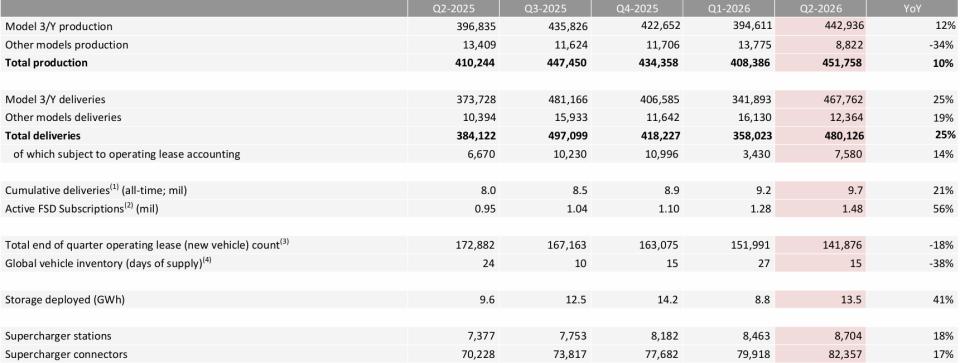
Tesla Q2 2026 Automotive Production and Delivery Data
From a regional market perspective, this performance was supported by record deliveries in multiple new markets, including Asia-Pacific countries such as South Korea, Australia, Japan, and Thailand, as well as several European markets like Portugal and Lithuania.
The European market performed particularly strongly, with registrations rising nearly 108% in May, effectively offsetting an approximate 20% sales decline in the U.S. market caused by the expiration of federal electric vehicle tax credits.
Analysts generally agree that high oil prices, the full production ramp-up of the new Model Y, and the relative cooling of CEO Elon Musk's controversial public profile collectively contributed to this sales rebound.
In terms of production capacity planning, Tesla's strategy reveals a shift in direction.
The planned annual production capacity for vehicles across global factories is not undergoing aggressive expansion, but rather focuses on optimizing and retrofitting existing facilities. For example, the annual production capacity for Model 3/Y at the California Gigafactory remains above 550,000 units, while the Shanghai factory exceeds 950,000 units.
The most critical change is that Tesla has officially retired the Model S and Model X production lines at the Fremont Gigafactory. The vacated space will be used to begin construction on the first-generation production line for the Optimus humanoid robot, with mass production expected to start "soon."
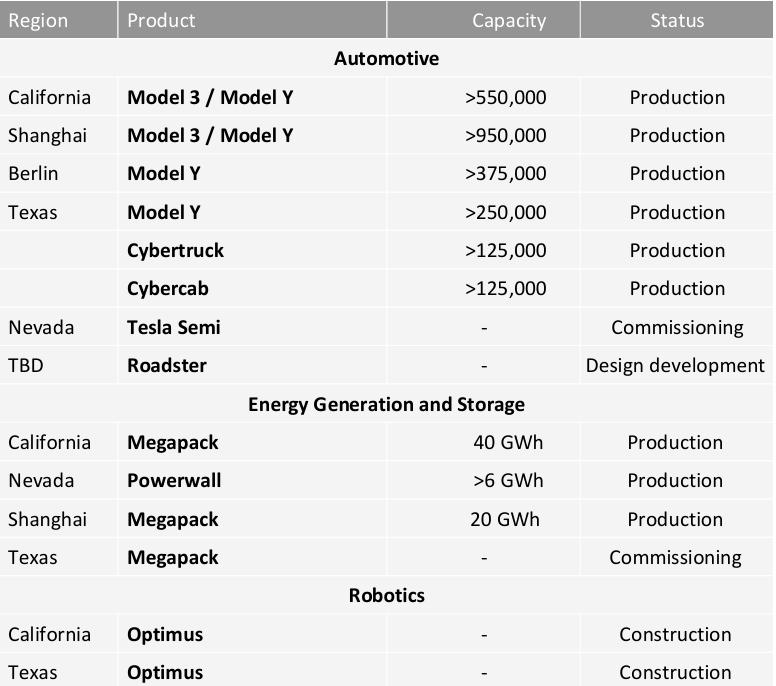
Tesla Q2 2026 Production and Capacity Expansion by Product Line
Meanwhile, capacity construction for two future-defining products — the Tesla Semi and Cybercab — is also steadily advancing.
Among these, the Cybercab, designed specifically for the Robotaxi network, has begun production at the Texas Gigafactory with a designed annual capacity exceeding 125,000 units, and is currently in the "commissioning" phase. The Tesla Semi remains on track to start production at the new Nevada factory this year.
Battery pack production capacity is the main bottleneck limiting recent vehicle output increases. Tesla stated that it has made ramp-up progress on 4680 cells, cathode materials, and lithium refining in Texas, as well as battery pack production capacity at the Berlin factory.
Although the automotive business is recovering, analysts at Barclays have pointed out that automotive revenue is increasingly less influential on Tesla's valuation, and the market's key focus for the stock lies in its future hyper-growth plans in the AI sector.
Bank of America analysts also stated that the focus of the earnings report will remain on the deployment progress of Robotaxi. They believe the core automotive business remains healthy, and Tesla is gaining electric vehicle market share globally.
However, analysts are divided on whether the Q2 sales rebound represents sustainable demand. Some views hold that the third quarter will face the challenge of a high base from the same period last year, and maintaining growth momentum will not be easy.
03 Energy Storage Business Rebounds Strongly
While the automotive business faces competitive and pricing pressures, Tesla's energy generation and storage business has become a critical performance stabilizer.
In Q2, revenue from the generation and storage business reached $3.139 billion, up 13% year-over-year. Energy storage deployments hit 13.5 GWh, marking a 41% year-over-year increase and over 50% quarter-over-quarter growth, achieving the second-highest quarterly deployment volume on record and setting a new 12-month deployment record.
Tesla achieved record energy storage deployments across the Europe, Middle East, and Africa (EMEA) region.
Capacity expansion underpins this growth. The annual production capacity at the California Megapack factory is 40 GWh, while the Shanghai Megafactory has an annual capacity of 20 GWh and is continuing to ramp up production.
More notably, the new Megafactory in Texas is nearing completion, with plans to begin production of the next-generation products Megapack 3 and Megablock this year — laying the groundwork for higher-margin growth in the future.
In the residential sector, the Powerwall 3P (three-phase version) has launched in Germany. It integrates a native three-phase inverter, designed to deliver cost savings and energy security to a broader global market.
04 Optimus Production Line Breaks Ground, FSD Subscriptions Surge
The largest section of the earnings report is dedicated to Tesla's vision for "physical world AI" in the future, and this business segment is rapidly moving from blueprints to production line construction.
Tesla has taken a substantial step forward with its humanoid robot Optimus. Following the retirement of the Model S/X production lines at the Fremont factory, installation of the first-generation Optimus production line has started, with production expected to begin later this year.
Tesla stated that the first batch of Optimus units produced will enter the "Optimus Academy" for training data collection and further feature development, and will not be sold to external customers immediately. This indicates that Tesla will follow the core logic of AI development — iterating models through real-world operation.
In the autonomous driving sector, progress coexists with controversy. The penetration rate of FSD (supervised version) continued to grow in Q2, with the number of active subscribers reaching 1.48 million, up 56% year-over-year. Tesla even achieved a record FSD attachment rate in the North American market, with over 55% of newly delivered vehicles including FSD subscriptions.
On the software side, Tesla began rolling out the FSD v14 lite version to AI3 hardware customers in the U.S. and South Korea starting in July. This version extracts driving behaviors from the AI4 model, adds new destination options and speed modes, and enhances the ability to handle complex scenarios.
The expansion of Robotaxi services is another focal point.
Tesla launched its self-driving taxi services in three cities in Florida — Miami, Orlando, and Tampa — in July, bringing the total number of U.S. metropolitan areas covered to seven. At the same time, the company expanded its unsupervised operating zones in Austin.
However, compared to competitor Waymo, Tesla is still in a catch-up position in the self-driving taxi field.
According to public data, Tesla has 69 authorized autonomous vehicles operating in Texas, while Waymo has 628 vehicles in the state. In California, Tesla has not yet obtained a license to provide fully driverless paid services, and its operations in the San Francisco Bay Area still deploy safety supervisors. By contrast, Waymo already offers driverless taxi services in 11 U.S. cities.
The Cybercab, designed exclusively for shared mobility, has entered the engineering validation and early experience phase. In Q2, the production-version Cybercab began engineering test drives on public roads, and in July started offering ride experiences to employees at the Texas Gigafactory campus — a key milestone before its deployment to the Robotaxi fleet.
05 $5.8 Billion Invested in AI Infrastructure and Chips
One of the most closely watched financial metrics in Q2 is undoubtedly the $5.8 billion in capital expenditures. This massive sum of funding is being deployed into a multi-year infrastructure plan designed to achieve "astonishing abundance."
Spending $5.8 billion in 90 days is equivalent to approximately $64.32 million per day. At current exchange rates, that translates to roughly 4.6 billion RMB per day.
Musk has raised Tesla's full-year capital expenditure forecast for this year to over $25 billion, nearly three times the $8.5 billion spent last year. This massive investment will not be used to expand automotive production lines, but rather directed toward infrastructure such as AI computing power, battery materials, and semiconductor manufacturing.
Tesla stated that before constructing new factories, it will prioritize fully utilizing and optimizing existing production capacity. These current investments are precisely aimed at building the hardware foundation that can support AI, software, and autonomous driving fleet-driven profits.
Computing power is the fuel for AI. In the first half of this year, Tesla's on-site computing power (measured in megawatts) in Texas more than doubled. The supercomputer cluster named Cortex 2 already boasts over 115 megawatts of computing power, dedicated to supporting the development of vehicle and humanoid robot software, with plans for further expansion in the remainder of this year.
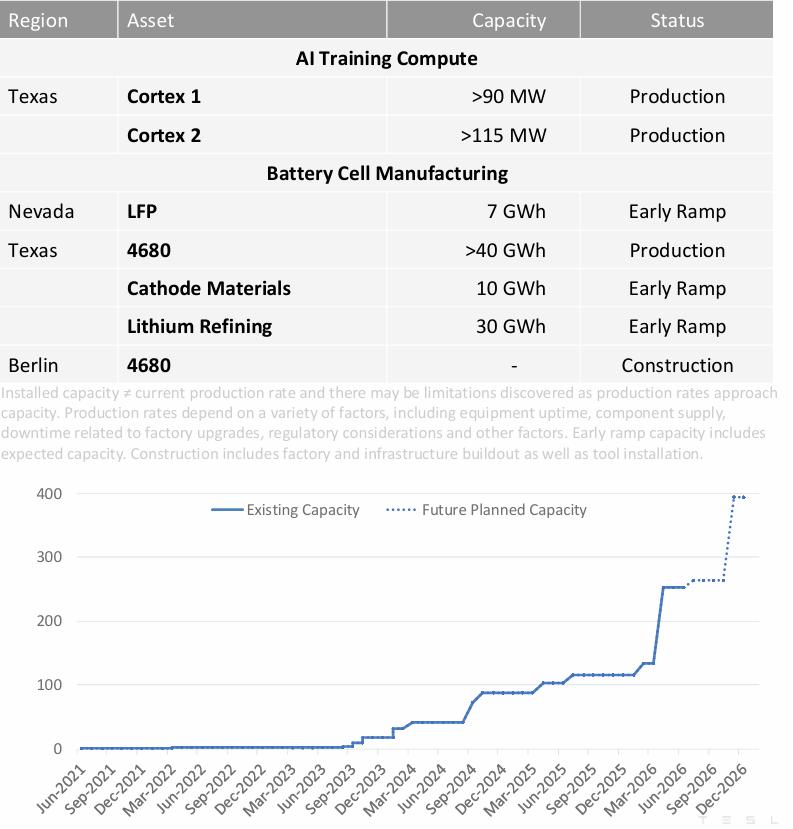
Tesla Q2 2026 Computing Power Cluster Expansion
Tesla's footprint also extends into the semiconductor manufacturing sector. The Terafab chip factory project, launched jointly with SpaceX, is progressing. Tesla has made headway on semiconductor factory construction and equipment procurement in Austin. Tesla believes that although the project is still in its early stages, establishing its own chip manufacturing capabilities is critical to ensuring the long-term reliable supply of key logic and memory chips.
The earnings report also disclosed progress on other supporting infrastructure. The Supercharger network continues to expand, with a net increase of over 2,400 Superchargers in Q2, bringing the global network to a 17% year-over-year growth and a total of 82,357 units. To enhance user experience, Tesla has reduced waiting times by improving trip planning, predicting charger availability, and integrating dynamic queuing features in its app.
These infrastructure investments, alongside AI computing power and chip manufacturing, are accelerating the depletion of Tesla's cash reserves. A subtle contradiction is emerging: Tesla is not spending money nearly fast enough.
Tesla projects full-year capital expenditures of $25 billion, with actual spending of $8.3 billion in the first half of the year — including only $2.5 billion in Q1. This means nearly $17 billion in spending will be required in the second half of the year to fulfill its commitments.
Facing external doubts about the rationality of this massive spending, Tesla emphasized that it will maintain a strong balance sheet and sufficient cash flow to support its product roadmap and long-term expansion. However, as free cash flow shifts from positive to negative, the market's patience and confidence in this huge investment will become the key to determining the future direction of Tesla's valuation.
Special translation by Jin Lu also contributed to