Just now, the world's three top AIs have all secured perfect scores in the IMO, outperforming 99% of human competitors.
In July, Shanghai is engulfed in sweltering heat.
The 67th International Mathematical Olympiad officially concluded, with Team China claiming the championship with a total score of 232 points. Three young contestants secured a perfect full score of 42 points.

Before the applause at the venue had fully faded, another outstanding performance quietly emerged on GitHub.
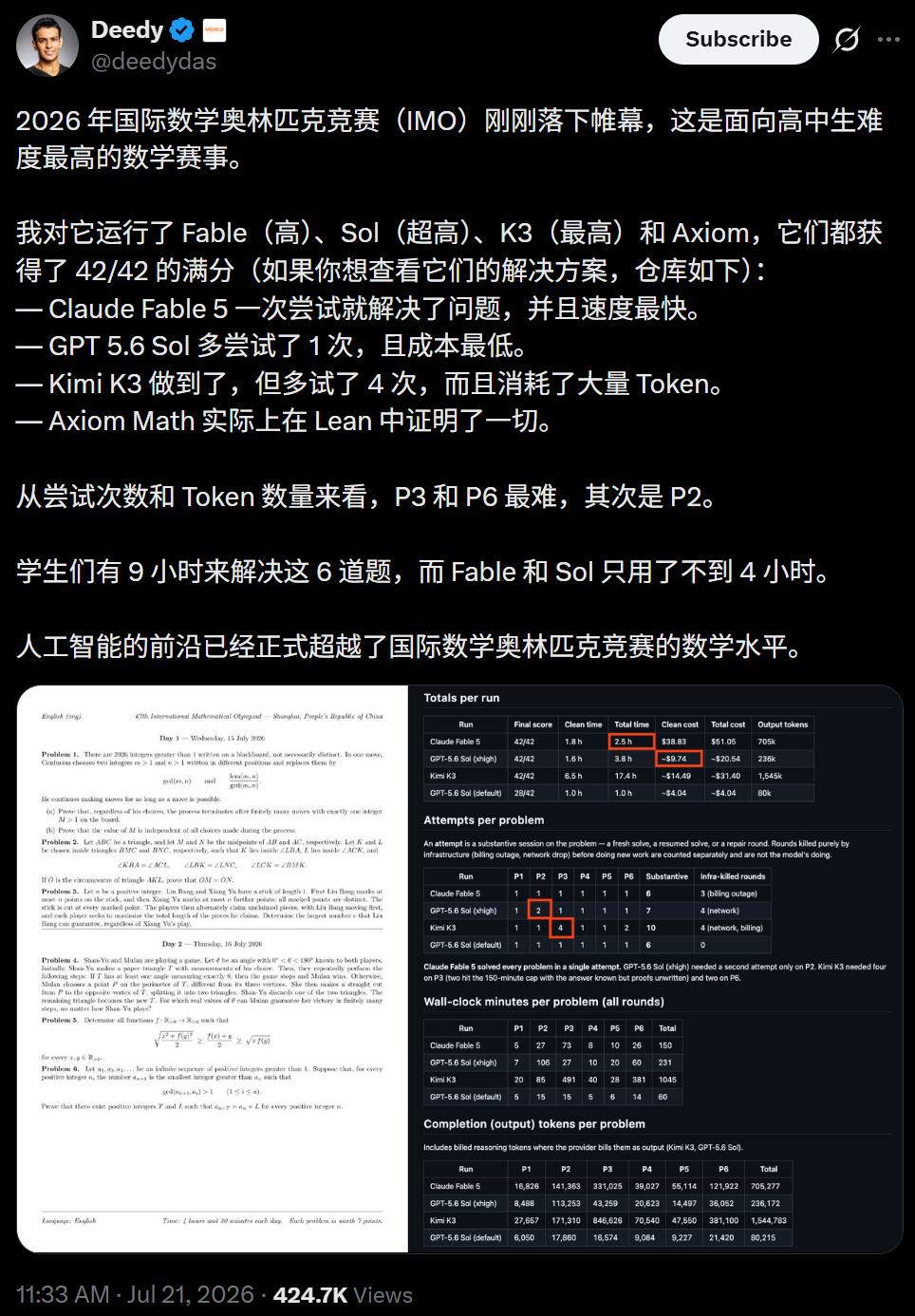
Former Google engineer Deedy Das launched an all-encompassing AI benchmark: 7 cutting-edge large models independently tackled all 6 problems of the full IMO 2026 contest on their own.
Claude Fable 5 achieved a perfect 42-point full score. It took only 2.5 hours and cost just 51 USD.
The xhigh version of GPT-5.6 Sol also obtained a perfect full score. It finished in 3.8 hours, with an extremely low cost of merely 20 USD.
Kimi K3 followed closely behind and also secured a perfect full score. It completed the task after a 17.4-hour grueling session, spending 31 USD.
Adding AxiomProver, which submitted its solutions independently, a total of four different models all reached the top with perfect full scores.
For reference, across all IMO competitions over the past seven years, 4347 human contestants took part, and only 30 of them managed to get a perfect full score — accounting for a mere 0.69% of all participants.

Overwhelmingly Dominant Performance Gap
Judging from the results, there is not only a huge 14-point gap between the perfect 42 points and the 28 points of the fourth-place finisher, but the three full-score models also achieved their top results in completely distinct ways.
Claude Fable 5 performed cleanly and efficiently. It completed the task through 9 rounds of dialogue, with 6 rounds of valid outputs. The longest single run lasted 73 minutes (for Problem 3), and the total number of output tokens reached 700,000.
GPT-5.6 Sol encountered a few setbacks during the process. It spent 106 minutes on Problem 2 running 4 rounds, and was interrupted twice by network failures mid-task. However, its computing power control was remarkably impressive — the total number of output tokens was only 230,000, making it the most cost-effective among the three full-score models.
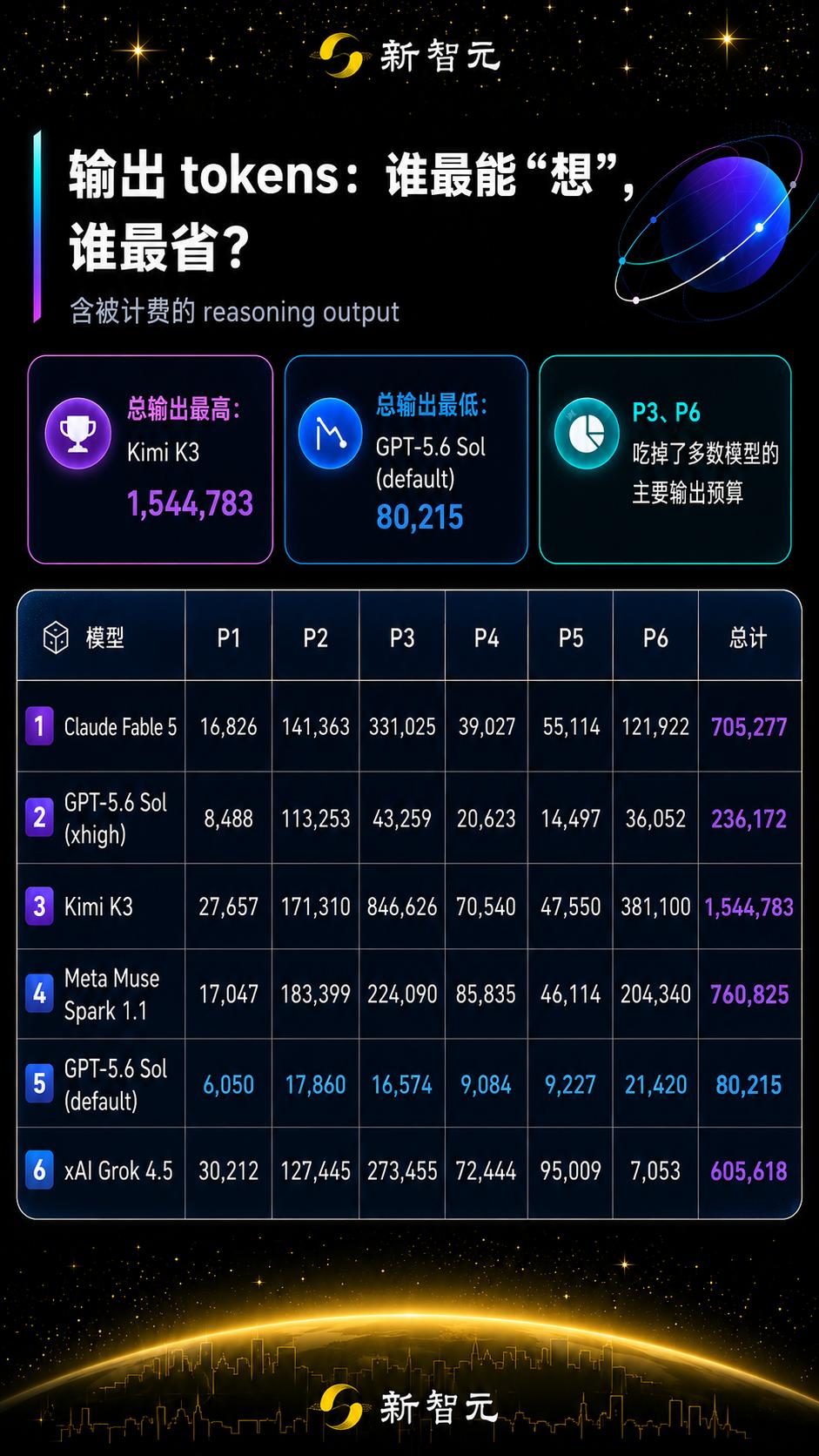
Kimi K3 acted like an indefatigable behemoth. As a MoE model with 2.8 trillion parameters, it generated a total of 1.54 million tokens, 6.5 times the output of Sol. For Problem 3 alone, it launched 6 attempts and fought for 491 minutes.





Head-to-Head Clash of Mathematical Intuition
Problem 1 was the easiest opening problem in the entire contest. All the models solved it in just a few minutes, and almost no human contestant made a mistake on it.
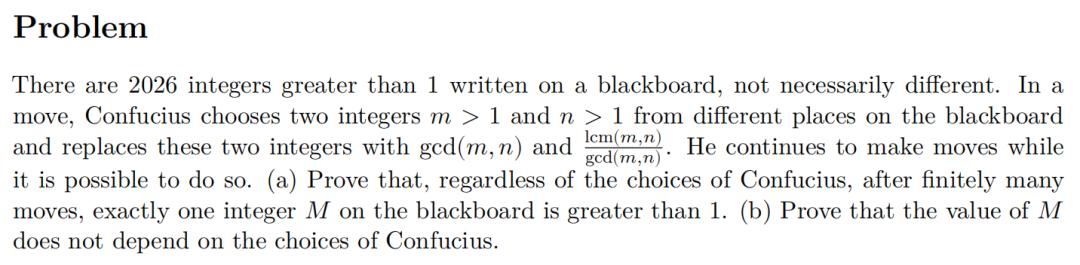
The general idea of the problem is: There are 2026 positive integers greater than 1 written on a blackboard. In each step, select two numbers m and n, erase them, and replace them with gcd(m,n) and lcm(m,n)/gcd(m,n). Repeat this operation until no further moves can be made. Prove that: (a) The process must terminate, and exactly one number M greater than 1 remains in the end; (b) The value of M does not depend on the order of operations.
To help understand this problem, we first conduct a miniaturized experiment.
There are only 12 and 12 on the blackboard. 12 = 2² × 3, 18 = 2 × 3². The first step: gcd(12,18) = 6, lcm(12,18)/6 = 6, the numbers on the blackboard become [6, 6]. The second step: gcd(6,6) = 6, lcm(6,6)/6 = 1, the numbers on the blackboard become [6, 1]. Now there is only one number greater than 1 left, and the game terminates. M = 6.
No matter how you rearrange the order of operations, M will always be 6. Why is that?
The answer lies in the prime factors.
For each prime number p, take the greatest common divisor of the number of times p divides all the numbers, then multiply these prime power values together — this value remains completely unchanged from the first step to the last step of the entire process.
Claude Fable 5: Directly created a custom counter that is guaranteed to decrease with each step.
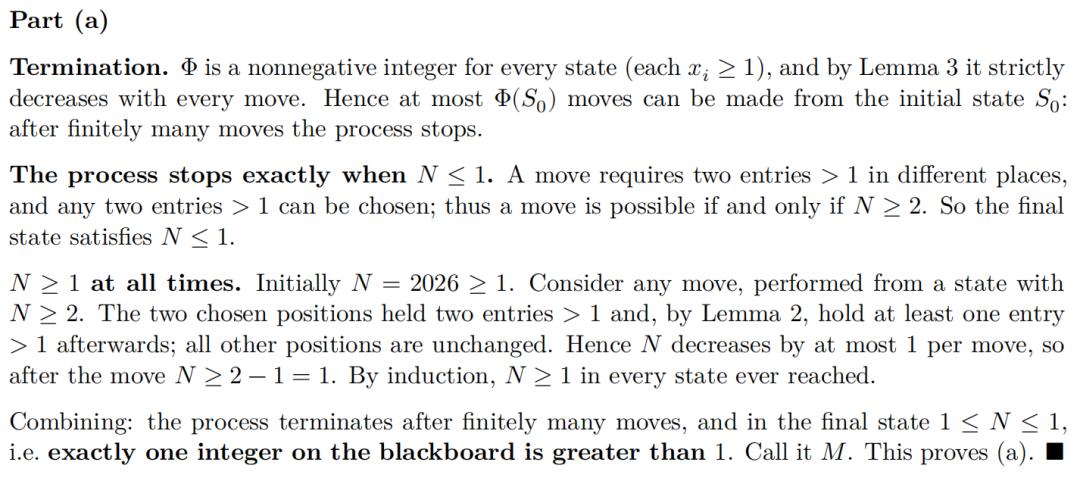
For this problem, Fable 5 defines a quantity Φ = T + N. T is the total number of prime factors of all numbers on the blackboard (counted with multiplicity), and N is the number of numbers greater than 1. For example, for the numbers [12, 18] on the blackboard, 12 has 3 prime factors (2, 2, 3), 18 has 3 prime factors (2, 3, 3), so T = 6, N = 2, and Φ = 8.
Then it proves that: after each operation, Φ decreases by at least 1. This falls into two cases — if gcd(m,n) > 1, the total number of prime factors T will decrease; if gcd(m,n) = 1, T stays the same but the number of values greater than 1 decreases by 1, so N decreases by 1. Since Φ is a positive integer and reduces by at least 1 each step, the process must terminate after a finite number of steps. It used a single counter to solve this part of the problem in a concise, decisive manner.
GPT-5.6 Sol: Tracked the product of all numbers and used lexicographic order for dimensionality reduction.
Sol focused on two quantities: P = the product of all the numbers, K = the number of numbers greater than 1. In each operation, if gcd(m,n) = d > 1, the product of the two new numbers is mn/d, which is smaller than the original product, so the global product P strictly decreases. If d = 1, P remains unchanged, but K decreases by 1.
The ordered pair (P, K) strictly decreases under lexicographic order: either P gets smaller, or P stays the same while K gets smaller. A lexicographic sequence of positive integers cannot decrease infinitely. Therefore, the process must terminate.
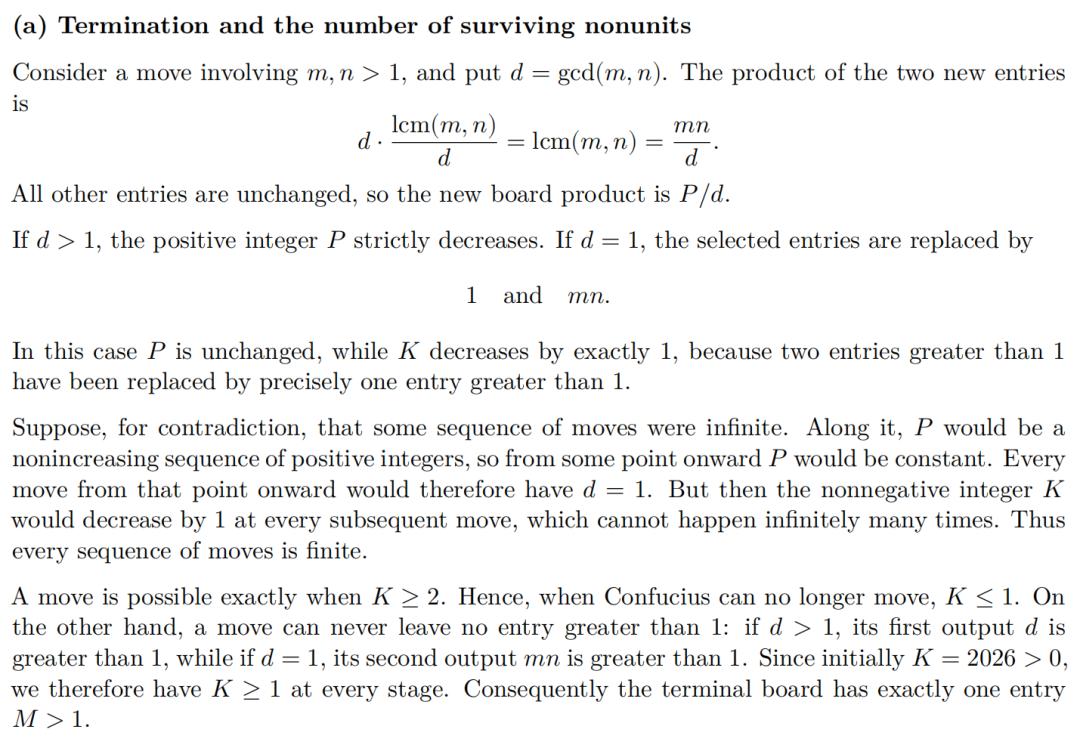
Two completely different approaches successfully solved part (a) of the same problem.
When it came to part (b), the three models converged on the same solution: all of them proved that for each prime number p, the greatest common divisor of the number of times p divides all numbers on the blackboard remains invariant during all operations. The final formula they derived is also exactly identical —

Let's verify this with our earlier example: numbers 12 and 18. For p=2, v₂(12) = 2, v₂(18) = 1, gcd = 1, contributing 2¹. For p=3, v₃(12) = 1, v₃(18) = 2, gcd = 1, contributing 3¹. M = 2 × 3 = 6, which matches our manual calculation perfectly without any discrepancy.
The Cheapest Unfinished Submission in the Entire Contest
Problem 6, a number theory question, was the final challenging problem on Day 2. It required proving that a recursive sequence eventually exhibits periodic behavior.
In the 2025 IMO held last year, only 6 human contestants in the entire world managed to solve Problem 6.
Claude Fable 5: 26 minutes, 2 rounds, full score. GPT-5.6 Sol: 60 minutes, 2 rounds, full score. Kimi K3: 381 minutes, 4 rounds, full score.
Grok 4.5 only produced 7053 tokens for Problem 6, ranking last among all models. The submitted file clearly displayed a line of text: Full proof: (Not yet complete.)
Costing only 0.18 USD, this was the cheapest unfinished submission in the entire contest.
Grok had more flaws than just this. During the entire test, it repeatedly fell into a strange hallucination: it confidently claimed that "the proof has been written to the file", but in reality, it never even touched the writing tool in the backend.
This is not a problem with its mathematical reasoning ability, but a problem with its agent execution capability. The model knew that it was supposed to write to the file, and claimed it had done so, but never actually performed the tool call at the operational level.
Three Leaps in Three Years
The Terrifying Evolution of Silicon-Based Intelligence
In 2024, DeepMind's AlphaProof for the first time reached the silver medal threshold at the IMO difficulty level.
In 2025, both OpenAI and DeepMind made breakthroughs simultaneously. OpenAI's undisclosed model solved 5 problems and obtained a 35-point gold medal, while Gemini Deep Think reached the same performance level.
In 2026, three general-purpose large models directly achieved perfect full scores. This time, these models not only did not receive any special mathematical training, but they are also accessible to all users. One of them is even open-source.
