With expected pre-loss exceeding 3.4 billion yuan in the first half of the year and GL Ventures reducing its holdings at a substantial loss, LONGi Green Energy is putting all its chips on BC technology in a do-or-die battle.
"The most difficult phase for LONGi has passed." This is the message that Chairman Zhong Baoshen conveyed to the market in the 2025 annual report. However, the newly released performance forecast shows that the company expects a net loss of RMB 3.4 billion to RMB 3.8 billion in the first half of 2026.
Recording losses for 11 consecutive quarters since the fourth quarter of 2023, it indicates that the operational inflection point for this photovoltaic leader has not yet arrived.
Facing a market landscape where TOPCon holds an absolute dominant position, LONGi Green Energy has chosen to fully bet on BC cell technology. In the first quarter of 2026, BC shipments as a proportion of total output rose to 66.1%, with costs now largely on par with TOPCon, marking initial tangible results from its technological breakthroughs.
However, risks such as surging hidden patent challenges, an expanding pool of market participants diluting technological exclusivity, and shrinking premium margins continue to cast uncertainty over the prospects of LONGi Green Energy's technological transformation.
Behind the deep losses, LONGi Green Energy's share price has plummeted over 80% from its peak, and institutional investors are also exiting the market. GL Ventures entered the market at a high valuation in 2020 with an investment of RMB 15.8 billion at RMB 70 per share. After several rounds of share reductions, it exited the top ten shareholders in the first quarter of 2026, concluding this investment with a loss of several billion yuan.
As the cost and large-scale production bottlenecks of BC technology are gradually overcome, while the entire industry remains mired in overcapacity and price competition, GL Ventures, the so-called "friend of time", has chosen to retreat. Can LONGi Green Energy achieve a turnaround from its predicament through this "do-or-die battle"?
1
Imbalance between industry supply and demand,
11 consecutive quarters of losses
As a leading domestic integrated photovoltaic enterprise, LONGi Green Energy's main business covers products such as monocrystalline silicon wafers and solar modules, and provides diversified scenario solutions including distributed photovoltaic power stations, ground-mounted photovoltaic power stations, and building-integrated photovoltaics (BIPV).
However, even the photovoltaic leader cannot escape the performance pain brought by the industry cycle.
On July 14, LONGi Green Energy announced that it expects to realize a net loss attributable to shareholders of listed companies of RMB 3.4 billion to RMB 3.8 billion for the six months of 2026, compared with a net loss of RMB 2.569 billion in the same period last year. This means that the scale of losses for LONGi Green Energy in the first half of this year has further expanded year-on-year. This marks the company's 11th consecutive quarterly loss since the fourth quarter of 2023.
Regarding the reasons for the current period's performance loss, LONGi Green Energy explained that the supply-demand relationship in the photovoltaic industry has not improved significantly, and business operations continue to face pressure. Affected by multiple factors such as insufficient new energy consumption and the high base of rush-to-installation in the same period last year, the newly added domestic photovoltaic installed capacity in the first half of the year saw a sharp phased decline.
During the reporting period, LONGi Green Energy's module sales volume and revenue decreased year-on-year, with low operating rates and gross margins. Combined with the impact of investment losses from joint ventures and exchange losses caused by the appreciation of the RMB, the company recorded operating performance losses.
Referring to the 2025 financial report, the capacity utilization rates of LONGi Green Energy's monocrystalline silicon wafers and monocrystalline modules were 60.62% and 59.67% respectively, indicating that the industry is still in a relatively sluggish state, which has directly affected its 2025 performance.
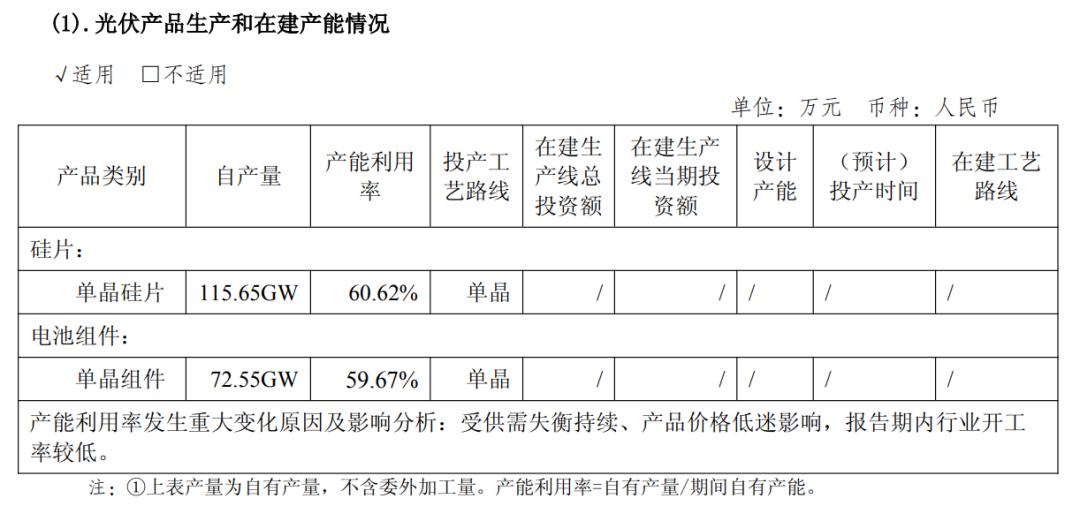
Figure / LONGi Green Energy Announcement
In 2025, LONGi Green Energy achieved revenue of RMB 70.347 billion, a year-on-year decrease of 14.82%; a net profit loss of RMB 6.42 billion. In the first quarter of 2026, the company achieved revenue of RMB 11.192 billion, a year-on-year decrease of 18.03%; a net profit loss of RMB 1.92 billion; in the same period, according to Choice data, the company's gross sales margin was -1.19%.
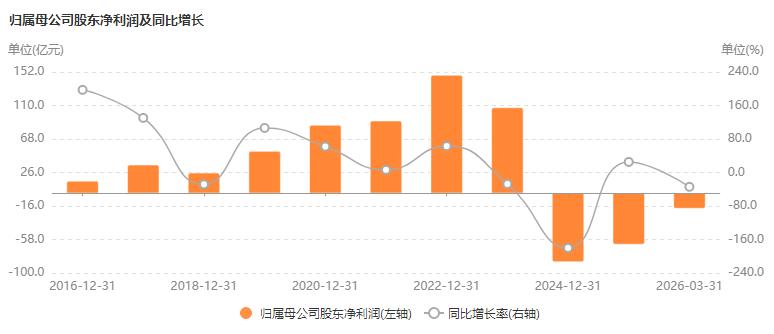
Figure / Eastmoney
From the perspective of segmented businesses, the prices of the company's monocrystalline silicon wafers and module products have fallen sharply, and the revenue and gross margin of the module and cell business have declined significantly. Among them, the module and cell business, which accounts for more than 85% of the company's revenue, had a gross margin of only 0.19% in 2025, 6.08 percentage points lower than that in 2024; while the gross margin of the silicon wafer and silicon rod business was as low as -5.3%, though the loss narrowed compared to 2024.
The company's power station business was affected by the dual impacts of full marketization of new energy power generation, declining feed-in tariffs, and reduced power generation, leading to a year-on-year decrease in the gross margin of this business. The company's other business segments have relatively small revenue scales and little impact on overall revenue.
From the perspective of sales regions, in 2025, the company's sales revenue proportions in Europe, Asia-Pacific, the Americas, and the Middle East and Africa were 15.62%, 12.17%, 13.15%, and 3.81% respectively. With the intensification of overseas trade protection policies, the company faces relatively high operational risks in overseas markets.
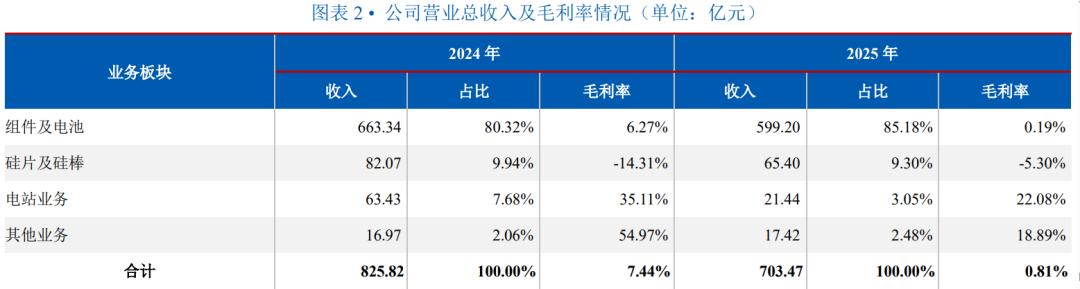
Figure / China United Credit Ratings
In fact, LONGi Green Energy's losses are not an isolated event. The 2026 first-half performance forecast shows that Tongwei Co., Ltd. expects a loss of RMB 4.8 billion to RMB 5.4 billion; TCL Zhonghuan expects a loss of RMB 3 billion to RMB 3.3 billion; GCL Integration expects a loss of RMB 320 million to RMB 450 million.
It is not difficult to see that when the entire industry is mired in overcapacity and a "price war", the profits of all links in the industrial chain are continuously compressed, and the pressure on segmented businesses is directly reflected in the financial statement data of enterprises.
Facing the operational difficulties of the industry, LONGi Green Energy is vigorously promoting the full BC transformation of its photovoltaic business, continuously enriching its product matrix for various scenarios. The proportion of sales in overseas markets and BC product sales has increased significantly, the measures to improve efficiency and reduce costs through BC technology have been continuously implemented, and ACM (Alloy Contact Matrix) cells have achieved large-scale production.
At the same time, the company is accelerating the coordinated layout of photovoltaic and energy storage, launching the "LONGi ONE" full-scenario photovoltaic-storage integrated products covering large power stations to industrial and commercial parks, rapidly building localized capabilities in overseas markets, and enhancing system solution capabilities and competitive advantages.
Regarding issues such as the capacity utilization rates of monocrystalline silicon wafers and monocrystalline modules in the second quarter of this year, the current market share and gross margin of the company's BC products, "BULLET FINANCE" sent a letter to LONGi Green Energy, but no reply was received as of press time.
2
Betting all on BC technology for a do-or-die battle
BC cell, namely Back Contact cell, is a structure where both the positive and negative electrodes of the cell are placed on the back of the cell, with no grid line occlusion on the front, which can maximize the absorption of sunlight, thereby improving the photoelectric conversion efficiency.
BC cell technology is one of the three major routes of N-type technology, and the other two are TOPCon and HJT. Among them, TOPCon, with its low manufacturing threshold, swept PERC to become the mainstream product in the photovoltaic market; BC, due to its complex process, low yield, and uncontrollable costs, has developed slowly.
According to data from TrendForce, global photovoltaic module production reached 669GW in 2025, of which TOPCon module production was 516GW, accounting for approximately 77.1% of the market. Ping An Securities predicts that the BC market share is expected to exceed 10% in 2026.
Against the backdrop of TOPCon's absolute dominance, LONGi has chosen a more challenging differentiated path. LONGi Green Energy began to lay out BC in 2017, and in September 2023, it proposed to vigorously develop photovoltaic BC cells. 2025 was a key year for its comprehensive breakthrough in BC technology, and the yield of BC cell production lines reached 98.5%.
A greater variable lies in cost breakthrough. Chairman Zhong Baoshen stated at the performance briefing in April 2026 that the cost of BC products in March this year has been basically on par with TOPCon, and it is expected to achieve module profitability in the third quarter of this year.
Technological breakthroughs are being translated into market share. In 2025, LONGi's global sales of BC modules reached 22.87GW. In the first quarter of 2026, BC shipments as a proportion of total output jumped from 25% of the previous year to 66.1%, reaching 8.34GW. The company plans to ship about 80GW of modules throughout 2026, of which BC will account for more than 65%.
Jiang Dongyu, the company's vice president, stated that the company will "All in BC" in the future, and the existing TOPCon production lines will be gradually transformed to BC.
However, from "catching up on costs" to "achieving profitability", there are still multiple challenges ahead.
First, patent risks are surging under the surface. Competition in the photovoltaic industry is white-hot, and patents have become a weapon for enterprises to compete for market share, while BC technology involves a complex intellectual property landscape. LONGi Green Energy has built a "technical forest" to strengthen its core competitiveness, and by the end of 2025, it has obtained 510 BC-related patent authorizations, but the patent compliance cost in overseas markets is still a non-negligible variable.
Second, there is a risk that ongoing projects may fail to meet expectations. Since 2025, the company has continuously promoted the construction and upgrading of BC capacity projects. By the end of March 2026, the total remaining investment amount of the company's major ongoing projects was RMB 6.255 billion. Considering the current severe imbalance between supply and demand in the photovoltaic manufacturing industry and the rapid iteration of cell technology, the company's ongoing projects face certain risks that the return on investment may fall short of expectations and the production capacity cannot be effectively released.
Third, industry competition is diluting technological exclusivity. BC technology used to be LONGi's exclusive technological high ground, but with more and more enterprises entering the market, its exclusivity is at risk of being weakened. Whether the influx of followers will repeat the homogenization dilemma of TOPCon still needs continuous observation.
Fourth, BC's premium space is facing compression. Although BC modules currently have a premium of 1 to 2 cents/W compared with TOPCon, with the rapid expansion of competitors' TOPCon capacity and the continuous price war, it is still uncertain whether the premium can be sustained and whether it can cover the transformation costs.
3
Share price continues to decline,
GL Ventures exits the top ten shareholders
According to media reports, an investor stated at the general meeting of shareholders held on May 22 this year that he had invested RMB 15 million in LONGi Green Energy, and now only RMB 9 million remains, while other investments in the same period have doubled 2 to 7 times. He "deeply felt the piercing pain" and questioned whether the company's strategic positioning had made wrong decisions.
In response, Chairman Zhong Baoshen responded that the decline in share prices in the past few years has caused losses to investors, and he understands their feelings. In the past two years, the company has maintained strategic determination and did not blindly expand production with the industry.
The experience of this investor is a microcosm of LONGi Green Energy's long-term depressed share price. In this years-long decline, far more than ordinary retail investors have suffered heavy losses. Even GL Ventures, known as Asia's largest private equity fund, has also suffered a "Waterloo" on LONGi Green Energy.
GL Ventures' investment in LONGi Green Energy began in 2020, the most frenzied year of the photovoltaic industry.
At that time, "carbon neutrality" was the biggest investment theme. As the "photovoltaic Moutai", LONGi Green Energy's share price skyrocketed nearly three times that year, and market sentiment was extremely optimistic.
In December 2020, GL Ventures spent about RMB 15.8 billion, through its subsidiary fund — HHLR Management Co., Ltd.-China Value Fund, to transfer 226 million shares from Li Chun'an, the former second largest shareholder of LONGi Green Energy, accounting for 6% of the company's total share capital. The transaction price was RMB 70 per share, which was about 90% of the market price at that time.
Shortly after the transaction was completed, LONGi Green Energy's share price once rose to RMB 125 per share in February 2021, and GL Ventures' floating profit on paper once reached about RMB 12.4 billion.
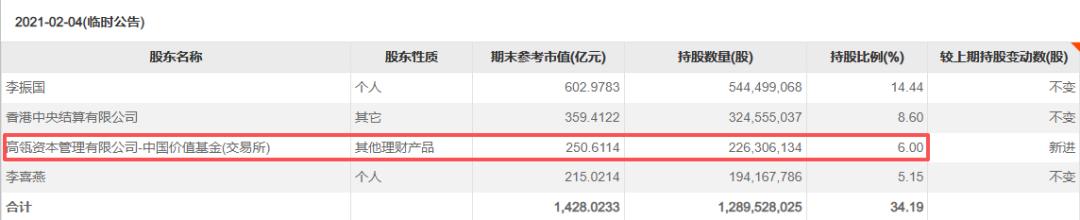
Figure / Eastmoney
However, good times did not last long. As the photovoltaic industry shifted from a state of short supply to a mismatch between supply and demand and overcapacity, the business environment for enterprises deteriorated sharply. LONGi Green Energy's performance also declined significantly from the third quarter of 2023, and it fell into a loss in the fourth quarter.
At the same time, LONGi Green Energy's share price continued to fall from its peak. As of the close on July 22, LONGi Green Energy's share price closed at RMB 12.57, down more than 80%