vivo's Second-Half Challenge: AI Is Yet to Go Mainstream, Product Proliferation Hits Bottlenecks, and Distribution Channels Are Locked in Tug-of-War
With shipments plummeting 11% year-on-year, vivo faces four critical challenges in the second half of the smartphone industry.
"Even the reintroduced entry-level smartphones failed to spark the expected summer student purchasing boom," said Hu Yang, a vivo distributor in a region of Shandong, with palpable anxiety.
This terminal-level anxiety directly points to vivo's current sharp sales decline.
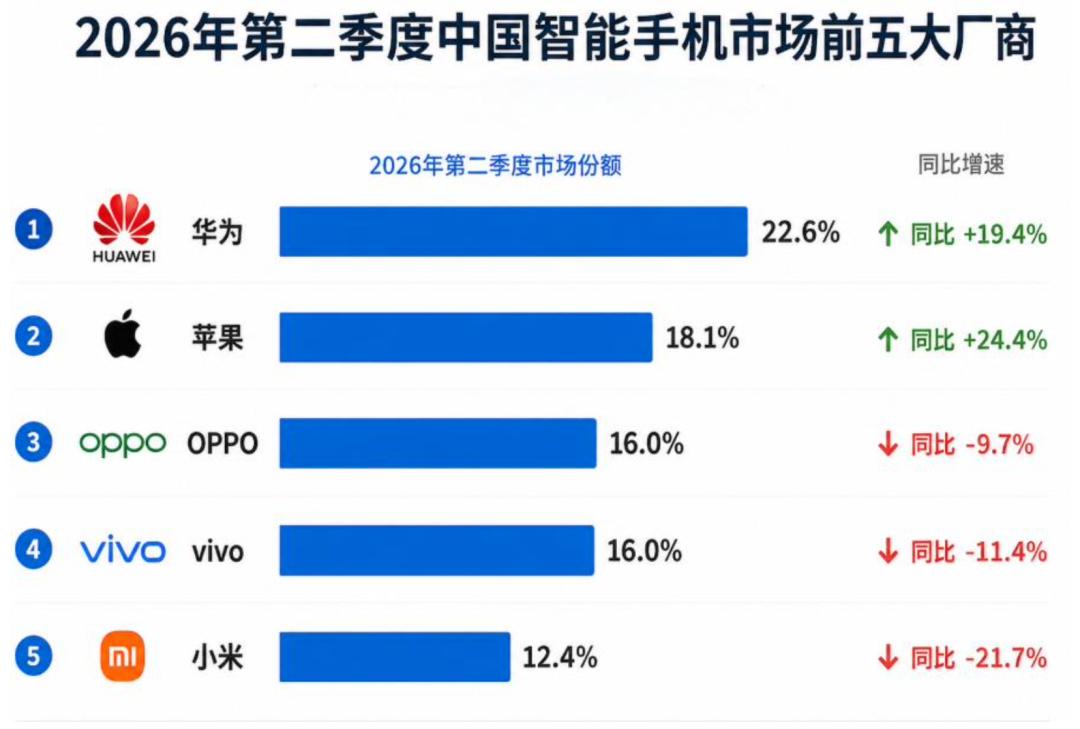
According to IDC data, in Q2 2026, vivo's domestic shipments dropped by 11.4% year-on-year, pushing its market share down to third place in the industry (tied with OPPO); just in Q2 2024, vivo had secured the top spot in domestic market share across multiple rankings from three major research firms: Canalys, Counterpoint, and IDC.
The overall weakening of the smartphone market stems from shared industry-wide factors. Sigmaintell data shows that storage chip prices rose sharply in Q2 2026: 4GB LPDDR4X and 12GB LPDDR5X prices surged 75% and 89% respectively quarter-on-quarter compared to Q1, while the price of 256GB UFS 3.1 flash memory directly doubled sequentially.
As upstream costs skyrocketed, terminal retail prices followed suit. Mid-to-low tier models saw price hikes of hundreds of yuan, while top-tier flagship prices increased by over a thousand yuan. These overall price increases directly fostered consumer wait-and-see sentiment, dragging the entire industry into a downward cycle. A Counterpoint report noted that global smartphone shipments in Q2 2026 fell 11% year-on-year, marking "the lowest Q2 shipment volume since 2013."
Beyond the broader industry headwinds, vivo's own internal issues are impossible to ignore: its heavy reliance on massive offline stores to penetrate lower-tier markets leaves its core user base extremely price-sensitive; coupled with a sprawling, unfocused product portfolio strategy, an AI ecosystem that has underdelivered on expectations, and stalled channel reforms, multiple conflicting internal factors are amplifying operational pressure and accelerating sales declines.
I
Four Structural Contradictions Draining Growth Momentum
Rising storage costs acted as an amplifier for the sales slump, but vivo's unique troubles stem from four years of accumulated structural contradictions spanning products, channels, branding, and performance assessment systems.
First, the overstretched product portfolio strategy amplifies decision fatigue and reduces transaction conversion rates. The classic "jam experiment" demonstrates that a booth displaying 24 jam flavors attracts 60% of passersby to stop, while a booth with only 6 flavors draws 40% of foot traffic — yet their final purchase rates are 3% and 30% respectively. More choices lead to greater decision-making friction: while seemingly drawing more visitors, they actually reduce willingness to complete a purchase.
This is precisely the offline dilemma vivo faces. The brand aims to cover every price segment with a huge lineup of models, but store performance heavily depends on just a handful of breakout bestsellers.
Zhang Feng, a vivo distributor in a region of Henan, revealed that during the February 2025 Spring Festival sales window, a peer's store sold 115 units of the S50 series in a single month, accounting for 40% of total sales; during the June summer period, combined shipments of the S60 and S60 Vitality Edition reached 51 units, making up 47.2% of sales, while all other models moved very few units.
This overreliance on hit products becomes far more problematic during periods of storage price inflation. Zhang explained that many stores received fewer than 10 units of the S50 series per month, causing a large number of potential customers to churn directly due to lack of in-stock units, which undermined overall shipment volumes.
Second, the high-end strategy is misaligned with the core lower-tier consumer base. IDC data shows that in Q2 2026, both Apple and Huawei saw their domestic market shares rise simultaneously, as the entire industry shifted toward the premium segment amid widespread cost pressures. Hu Baishan, vivo's President, has also publicly stated that the brand aims to capture a leading share of the global high-end market by leveraging top-tier product capabilities.
However, vivo's deep overexpansion of channels in lower-tier markets means the proportion of mid-to-high-end users is low, and this group has very limited tolerance for price increases.
Based on Zhang Feng's observations, the mainstream offline purchase budget for vivo phones is concentrated in the 2000-3000 yuan range, while in township markets the budget is only 1000-2000 yuan, making premium models hard to sell: at his store, multiple flagship models including the X300, X200S, and X Fold 5 combined to sell only single-digit units in February; in June, the X300 and X300S together closed 13 deals, accounting for just 12% of the month's total sales.
Furthermore, the premium X-series phones share nearly identical designs with the mid-to-low tier Y and Z series, lacking distinct flagship recognition that would justify a price premium, further reducing users' willingness to pay for high-end models. Take foldable phones as an example: IDC data shows that in Q1 2026, vivo held about 5% of China's foldable phone market share, compared to roughly 60% for Huawei and 21% for Honor.
The core purchasing demographic during the summer sales window is students, who are even more price-sensitive than average consumers. Price adjustments driven by rising storage costs have further intensified their wait-and-see attitude.
Hu Yang revealed that many visiting students explicitly told him, "I'll wait a bit longer — the new models have gotten way too expensive, and my old phone still works fine." Terminal sales have been significantly impacted: a peer's store recorded total monthly sales of only around 100 units in June, down more than 30% year-on-year; some stores sold fewer than 50 units for the entire month, with shipment scales shrinking dramatically.
Third, vicious price competition across channels pushes users' price sensitivity to even higher levels. Public records show that by 2024, the number of vivo offline stores had exceeded 250,000, and the brand continued expanding its retail footprint in 2025.
During market growth phases, a dense channel network is a major advantage for driving product distribution; but in a contracting market, massive stores are forced to compete for a limited pool of customers, leading to increasingly fierce cutthroat price wars that continuously reinforce consumers' habits of comparing prices across sellers and delaying purchases.
Zhang Feng told *Finance Story Club* that vivo stores not only have to compete for customers with Xiaomi, OPPO, and Honor brand stores, but also face price competition from e-commerce platforms and other vivo stores in the same city. For the S50 16GB+512GB model in particular, e-commerce platforms' "10 Billion Subsidy" campaigns offer prices as low as 2699 yuan or 2702 yuan; offline, after applying a 15% national consumer subsidy, transaction prices land in the 2600-2800 yuan range.
To meet rigid monthly performance targets, many stores sell devices at thin margins to drive sales volume and poach nearby customers. The brand is fully aware of this chaotic pricing issue but has been unable to eradicate it. In this long-term price-comparing environment, consumer wait-and-see sentiment has grown increasingly strong, and a large number of potential customers have drifted to competing brands.
Fourth, conflicting priorities between digital performance metrics and store profitability reduce frontline sales motivation. According to Zhang, vivo has set up multiple layers of assessment for offline stores, beyond just phone sales volume, including digital operation tasks such as WeCom response speed, user activity levels, and short video publishing frequency. The original goal was to integrate private and public domain traffic to boost brand exposure and repurchase rates.
At the frontline level, these complicated operational tasks eat into sales consultants' selling time, compressing core processes like hands-on product demonstrations and transaction closing. Self-media operations also add extra costs: a single livestream promotion costs 1000 yuan in paid traffic, while most phones only generate a gross margin of about 100 yuan per unit, requiring at least 10 sales just to break even. However, with customers dropping off at every stage from lead capture to in-store visit to final purchase, the vast majority of livestreams fail to turn a profit, making stores increasingly unmotivated to actively push vivo products.
II
Cold Reception for AI Phones, Ecosystem Products Struggle to Gain Traction
The high price sensitivity brought by lower-tier channel expansion not only drags down premium model sales, but also hinders the implementation of vivo's AI strategy and full-category smart ecosystem.
At present, vivo has built a complete closed-loop AI strategy: with its Blueheart large model as the technical foundation, OriginOS and Blue River OS as interaction carriers, focusing on two core experiences of AI imaging and AI productivity, while simultaneously expanding into a multi-category smart hardware ecosystem.
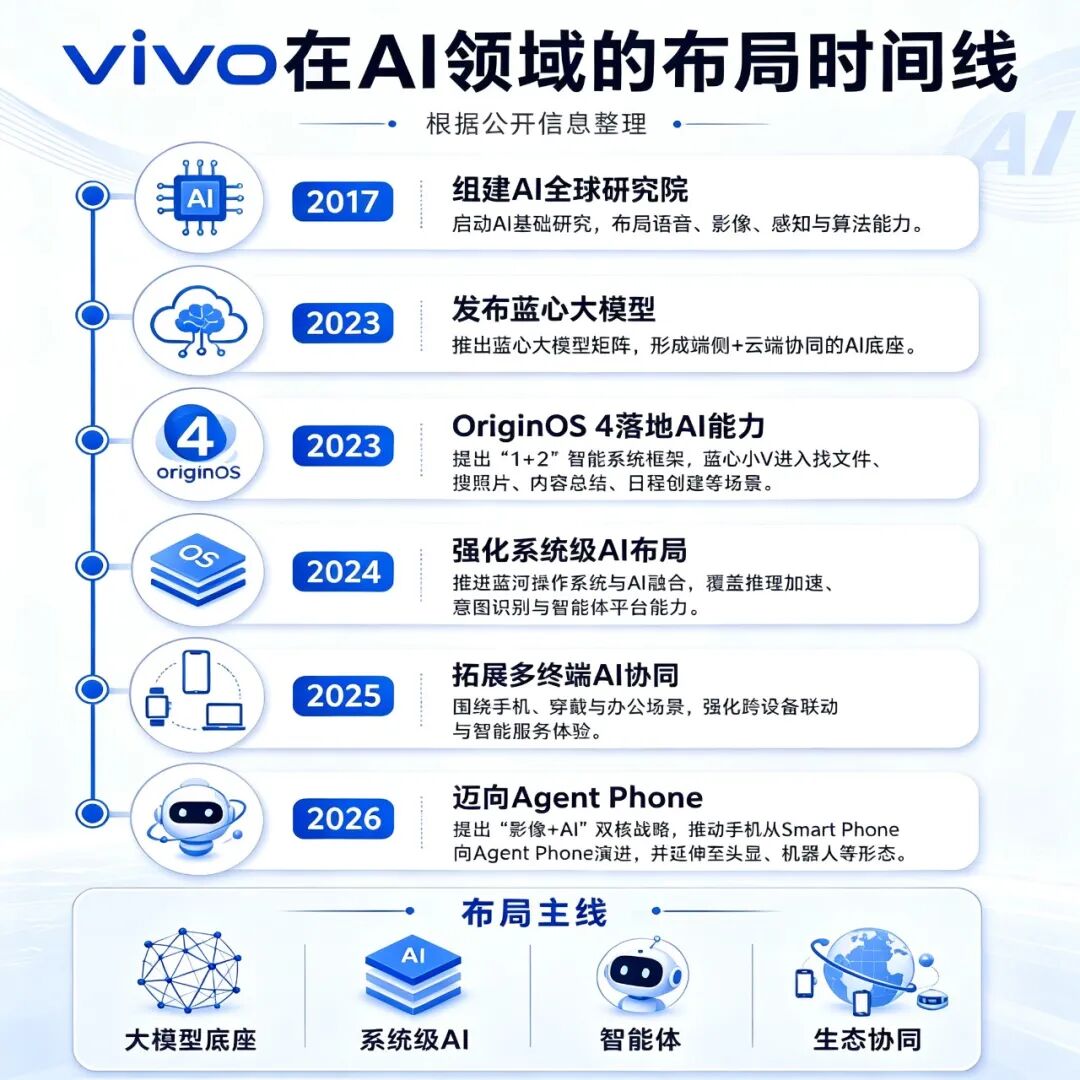
Hu Baishan once outlined the competitive logic for the second phase of AI development: the ability to perceive and understand the physical world will be the decisive competitive edge, and imaging is precisely the core medium through which AI connects to the physical world.
Based on this judgment, vivo has elevated AI + imaging to a core strategic priority, working to cultivate differentiated competitiveness for its premium flagships and driving the brand's transformation from a smartphone manufacturer to a full-scenario ecosystem technology platform.
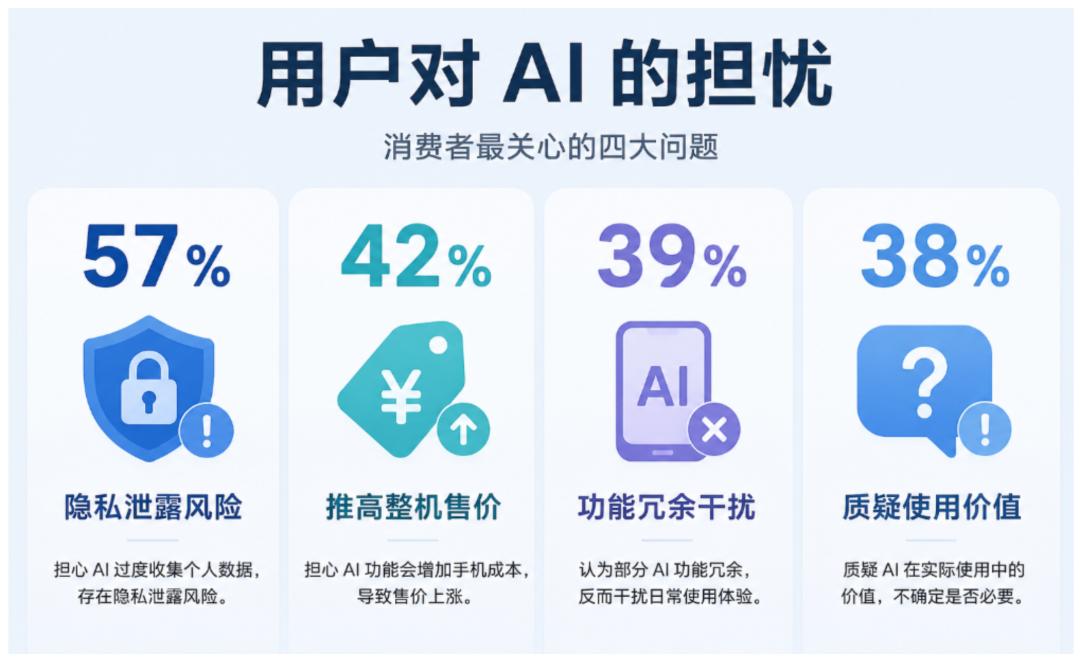
However, this top-level plan is clearly misaligned with mainstream consumer demand in lower-tier markets. After visiting multiple vivo stores in Jieshou, Anhui Province, *Finance Story Club* found that the key selling points promoted by sales consultants are concentrated on practical attributes such as battery life, system smoothness, basic camera performance, price, and storage, with AI features rarely positioned as core highlights.
"Consumers are more willing to pay for basic functions, but refuse to pay extra for value-added features like AI," Hu Yang acknowledged frankly.
Research from 451 Alliance, a division of S&P Global, confirms these purchasing priorities: consumers rank battery life (53%), camera quality (49%), display quality (41%), large storage capacity (37%), and AI features (33%) in descending order of importance.
AI is gradually becoming a standard feature on new phones, but it cannot yet serve as a compelling selling point that justifies a price premium, especially for price-sensitive users.
Terminal sales data directly reflects the lukewarm reception to AI-powered models. Hu Yang shared that during this year's February Spring Festival sales window, a peer's store sold only 4 units of the Y50e AI Edition in a single month, while regular non-AI models sold dozens of units — a stark contrast in performance.
Beyond poor sales of AI phones, vivo's smart hardware ecosystem has also failed to achieve meaningful volume.
Zhang Feng analyzed that on one hand, most of vivo's core users only need a standalone smartphone and have no established habit of using interconnected multi-device setups, so stores that actively push tablets and smartwatches often meet with customer resistance; on the other hand, vivo's smart hardware has low resale value in the secondhand market, and offline recycling channels are scarce, further reducing users' willingness to purchase complementary ecosystem products.
During the June summer sales period, a peer's store sold fewer than 10 combined units of smartwatches and tablets, demonstrating extremely weak volume performance for ecosystem product lines.
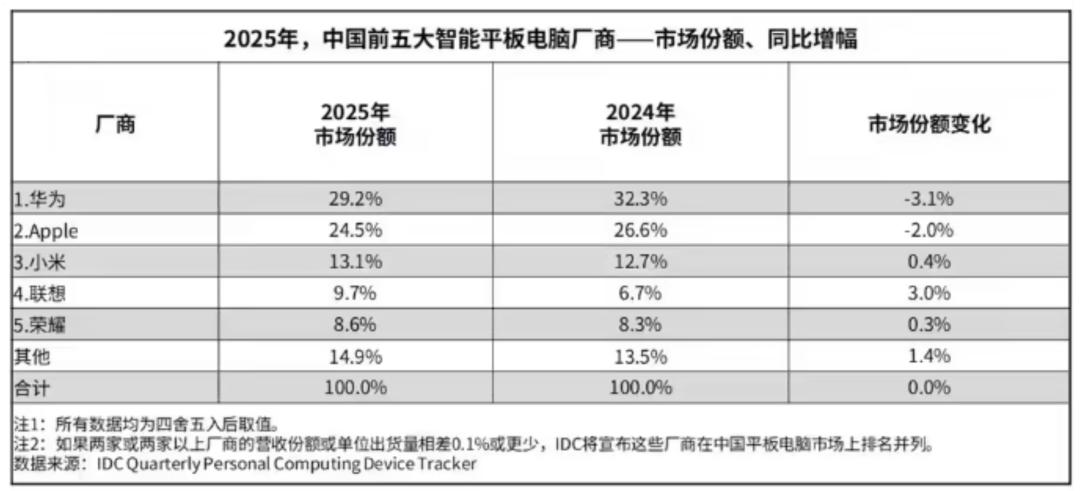
This is not an isolated store issue — industry data also exposes these shortcomings: Canalys statistics show that in the first half of 2025, vivo shipped 700,000 wearable wrist devices in mainland China, capturing a mere 2% market share; IDC data indicates that China's top 5 tablet vendors in 2025 were Huawei, Apple, Xiaomi, Lenovo, and Honor, with vivo consistently failing to break into the leading group.
The dual failure of AI phones and ecosystem products to sell well has created a vicious cycle. While Apple generates extra revenue for its stores through its software and hardware ecosystem, vivo stores' income remains overwhelmingly dependent on smartphone sales. Without a second growth curve to provide a buffer, stores are forced to rely on price cuts to hit performance targets, exacerbating cutthroat competition across channels.
III
Reform at an Impasse: Structural Frictions in the Channel System
In fact, vivo's channel reform has been underway for several years.
As early as 2022, vivo eliminated a large number of "secondary distributor" tiers in southern provinces; in subsequent years, it accelerated the rollout of directly operated stores, for example opening multiple Humanistic Imaging flagship stores in cities including Kunming, Wuhan, and Jinan in 2025.
According to Cao Lei, a vivo distributor in a region of Shanxi, vivo's current distribution channels are roughly divided into three segments:
First, the e-commerce system. The headquarters centrally manages operations, promotion, and marketing across platforms like Tmall and JD.com. OV's core business base lies offline, with online sales accounting for only about 10% of total volume.
Second, the manufacturer-direct system. The brand covers rent and labor costs, and some experience stores are not subject to strict sales targets, with their core focus on brand display and hands-on product experience.
Third, the distributor system. This is the largest segment, and the foundation of vivo's offline sales.
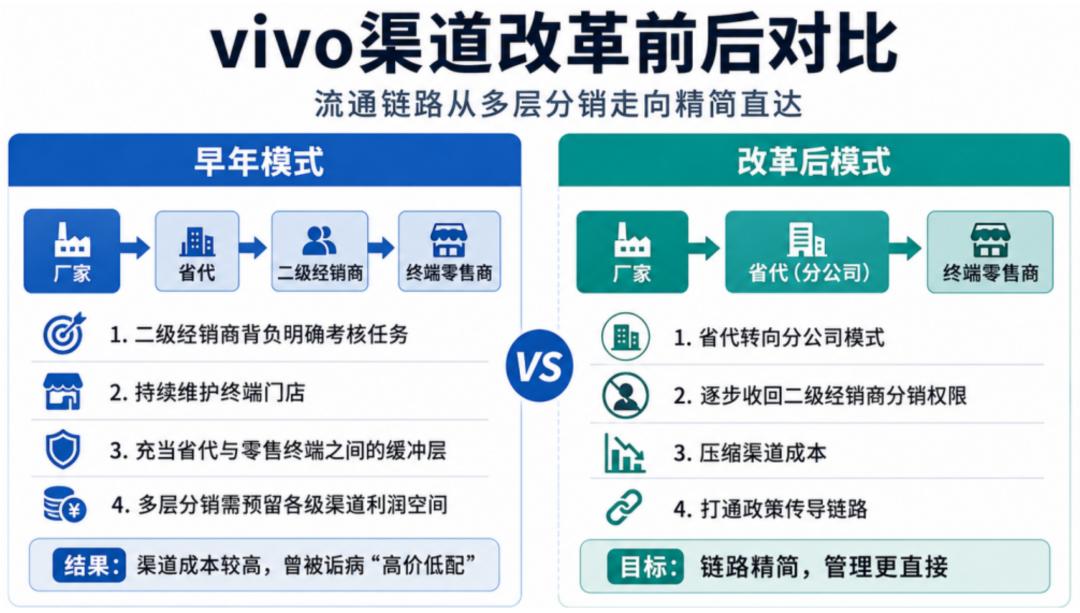
In the early days, the distribution chain followed the path: Manufacturer → Provincial Distributor → Secondary Distributor → Terminal Retailer. Secondary distributors had clear performance assessments and incentives to support terminal stores, acting as a buffer layer between provincial distributors and retailers. However, the multi-tier distribution system required reserving profit margins for every level, leading to longstanding criticism of vivo for offering "high prices for low-specification devices."
To reduce channel costs and ensure policy directives are effectively implemented, vivo has continuously pushed forward reforms: provincial distributors are being transformed into regional branch offices, gradually phasing out secondary distributor authority to streamline the chain into: Manufacturer → Provincial Distributor (Branch Office) → Terminal Retailer.
As reforms are implemented, new contradictions have emerged. On one hand, the provincial distributor system has deep roots and significant bargaining power, meaning there is a non-negotiable red line in channel reform: the core interests of provincial distributors cannot be compromised. This makes it extremely difficult to replicate Apple and Huawei's direct-to-retailer distribution model.
On the other hand, after streamlining the distribution chain, provincial branch offices have limited staff yet are required to manage a huge number of terminal retail outlets directly, leading to a sharp rise in management pressure. Stores are burdened with multiple performance